 AI-generated analysis published under the editorial responsibility of Rohit Sinnas. How it works →
Press quoted
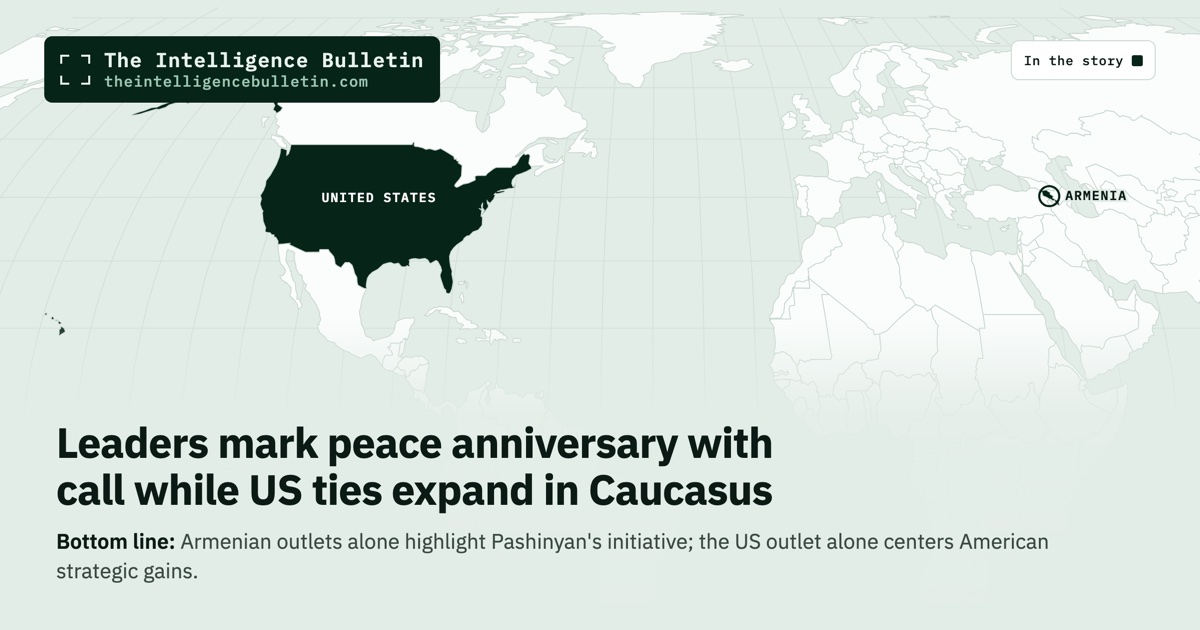
Armenian outlets alone highlight Pashinyan’s initiative; the US outlet alone centers American strategic gains.
The reporting across five outlets shows near-identical accounts of the phone call’s substance, drawn from what appears to be a shared official readout, yet each outlet shapes the story through selective emphasis that reveals national priorities. Azerbaijani and Armenian sources both present the conversation as evidence of tangible progress in trade and the TRIPP corridor, but the Armenian outlets alone stress that Pashinyan initiated the call, framing Yerevan as the proactive party. The Turkish agency Anadolu Agency strips the event to its bare bilateral and anniversary elements without crediting any side with initiative. The Washington Examiner, by contrast, uses the anniversary to pivot entirely to expanded US influence, quoting ambassadors on new AI, minerals and nuclear cooperation that the regional sources barely mention. This pattern indicates that while the core facts of the call enjoy broad corroboration, the story functions less as neutral news and more as confirmation of each capital’s preferred narrative: bilateral momentum for Baku and Yerevan, regional stability for Ankara, and American strategic gain for Washington. No outlet contradicts another on verifiable details, yet the omissions and framing choices make clear that the same event serves different domestic and regional audiences.
Full analysis
On August 8, 2026, Armenian Prime Minister Nikol Pashinyan called Azerbaijani President Ilham Aliyev. The timing aligned with the first anniversary of the Washington Peace Summit held exactly one year earlier under the auspices of the United States. At that 2025 gathering the two leaders had declared peace between their countries and initialed the text of a bilateral peace agreement. Reports across multiple outlets described the 2026 conversation as a review of what had been achieved since then and what remained to be done.
The leaders exchanged views on the anniversary itself and on the progress recorded over the intervening twelve months in normalizing relations. They pointed to concrete economic activity as evidence that peace was already delivering results. Azerbaijani petroleum products were now reaching Armenia, and transit cargo moved through Azerbaijani territory both into Armenia and onward from Armenia to third destinations. The sides also addressed the next phase of the TRIPP route, the land corridor project agreed in Washington that is intended to link Azerbaijan with its Nakhchivan exclave across Armenian territory. They underscored the continuing importance of efforts to secure long-term stability, connectivity, and economic cooperation throughout the South Caucasus.
All five outlets that carried accounts of the call presented these same elements as the substance of the conversation. The Turkish agency Anadolu Agency confined itself to noting that the leaders discussed the peace anniversary and bilateral ties. Armenian and Azerbaijani sources added the specific trade examples and the TRIPP reference. The American publication Washington Examiner placed the same call inside a wider account of expanding United States partnerships with both countries since the 2025 summit.
The shared factual core rests on what appears to be a common official readout. Armenian outlet News.am stated that the call occurred at the initiative of the Armenian side. Azerbaijani outlet APA described Pashinyan as the caller without assigning the origin of the contact. The Turkish and Russian-language Armenian reports omitted any reference to who placed the call. These differences sit only at the level of framing; the topics covered and the outcomes noted remain consistent across the set.
Washington Examiner reporting went further into the bilateral consequences of the peace framework. It cited the Armenian ambassador describing new cooperation with the United States in artificial intelligence and semiconductor development, including approval for a major AI facility in Armenia whose output would feed into American systems. The same ambassador referenced an additional memorandum on nuclear cooperation reached after a visit by the United States vice president. The Azerbaijani ambassador spoke of an upgraded strategic partnership that now encompasses energy, economy, defense, and artificial intelligence alongside the longstanding areas of cooperation. The publication also detailed the TRIPP project itself as a 27-mile corridor inside Armenia, with United States companies holding a 74 percent stake and the Armenian government the remainder, currently moving through feasibility studies with financing support from the United States International Development Finance Corporation.
No outlet contradicted the core sequence of the call or the list of subjects raised. The Turkish account simply stopped at the anniversary framing. The two Armenian sources diverged on whether to foreground the initiative behind the call. The American account alone supplied the ambassadorial interviews and the specific project details on artificial intelligence, nuclear power, and the ownership structure of the corridor. Those additions appear only in the one United States source and are therefore single-chain reporting.
The convergence on the call’s existence and its listed topics across reporting chains from Azerbaijan, Armenia, Turkey, and the United States indicates that the event itself is not in dispute. The differences that remain are matters of emphasis rather than competing versions of what was said. Armenian coverage alone assigns the initiative to Yerevan, a detail that serves a domestic narrative of diplomatic activity. Azerbaijani coverage presents the exchange as evidence of mutual implementation without that attribution. Turkish coverage treats the contact as one more step in regional normalization without assigning credit or initiative. The United States account uses the anniversary to document concrete gains in American influence and commercial engagement that the regional sources do not mention.
The pattern shows each capital reading the same set of steps through its own lens. For Baku and Yerevan the call confirms that trade and infrastructure links are already functioning and that the TRIPP route remains on the agenda. For Ankara the event registers as another instance of bilateral progress in a neighboring region. For Washington the anniversary supplies an occasion to catalogue expanded partnerships in technology and energy that extend American presence in the South Caucasus beyond the original peace declaration. These readings do not conflict on the record of the call; they simply select different slices of the same development to highlight for their respective audiences.
What to Watch
The corroborated elements of the conversation therefore stand as the most reliable description of what occurred. The single-source claims on initiation and on the scale of new United States projects remain attributable only to the outlets that published them. The call itself fits inside an architecture established in Washington in 2025 and still advancing one year later, with each participant interpreting the momentum in ways that reinforce its own position in the resulting regional order.
That’s how the world told the story.
Get our daily open-source intelligence on world events in your inbox — one email a day, up to six stories.
Subscribe freeNo spam. One-click unsubscribe. See the latest email →