 AI-generated analysis published under the editorial responsibility of Rohit Sinnas. How it works →
Press quoted
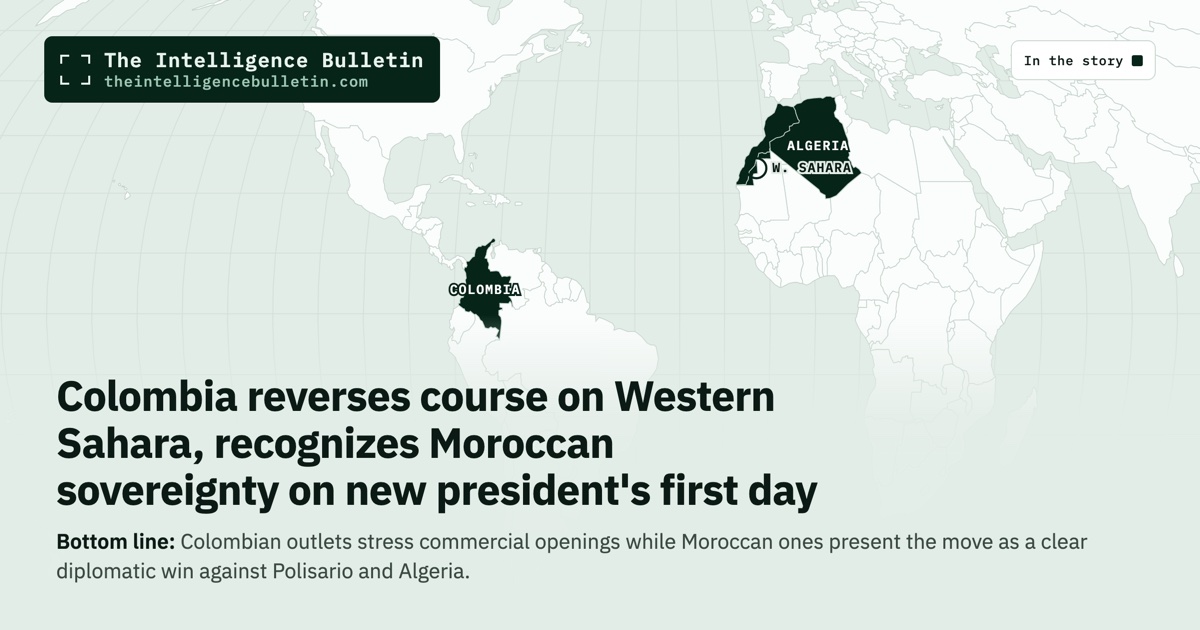
Colombian outlets stress commercial openings while Moroccan ones present the move as a clear diplomatic win against Polisario and Algeria.
Colombian reporting centers on the pragmatic economic upside for the new government while noting the abrupt reversal of Petro-era policy, with outlets differing mainly in how much domestic political context they supply. Moroccan coverage frames the same announcement as a major diplomatic victory that further isolates the Polisario Front and Algeria, embedding it in a longer narrative of accumulating international support. Nigerian and Brazilian accounts treat the decision as an African or Latin American realignment worth tracking for precedent, yet both draw heavily from the same official statements issued in Cali. The most consistent element across independent chains is the explicit withdrawal of prior recognition of the SADR and the simultaneous pledge to pursue commercial cooperation; the least corroborated element is any detailed projection of concrete trade outcomes. This convergence on the core reversal, rather than on its regional ripple effects, shows how actor-country presses prioritize validation of sovereignty claims while observer outlets use the event to illustrate shifting alliances without adding new sourcing.
Full analysis
Colombia’s new president Abelardo de la Espriella took office on August 8, 2026, and within hours his government reversed its stance on the Western Sahara. Vice President José Manuel Restrepo and Foreign Minister Omar Bula Escobar met in Cali with Morocco’s Foreign Minister Nasser Bourita, who had traveled to attend the inauguration as the representative of King Mohammed VI. During that meeting the Colombian side announced that Colombia now recognizes Morocco’s sovereignty over Western Sahara, also referred to as its southern provinces.
The decision ended the policy adopted in August 2022, when former president Gustavo Petro restored diplomatic relations with the self-proclaimed Sahrawi Arab Democratic Republic after those ties had been frozen since 2001. Colombia had first established relations with the Sahrawi entity in 1985 under President Belisario Betancur. The new announcement therefore marked a return to the position held before Petro’s term. Colombian officials described the move as an effort to build a long-term relationship with Morocco that would serve Colombian interests, including the possibility of negotiating a free-trade agreement and increasing Moroccan investment.
Moroccan statements at the same meeting presented the recognition as historic. Bourita said the decision would give a major boost to bilateral ties and that Morocco and Colombia could act as economic platforms for each other in Africa and Latin America. He noted that the change withdrew Colombian recognition of the Sahrawi entity and placed the relationship on a new footing. The presence of the Moroccan foreign minister in Cali was framed as evidence of King Mohammed VI’s personal interest in elevating the partnership.
The territory in question has been under Moroccan control over roughly 80 percent of its area since Spain withdrew in 1975. Morocco proposed an autonomy plan in 2007 under which the region would remain under Moroccan sovereignty. The Polisario Front and the Sahrawi Arab Democratic Republic have continued to seek a referendum on self-determination and full independence. Colombia’s shift brings it into line with more than 130 countries that, according to Moroccan reporting, now support the autonomy plan as a credible framework.
Colombian coverage placed the heaviest weight on the commercial dimension. Restrepo spoke of constructing a new beginning in the bilateral relationship and of expanding investment from the North African country. The foreign ministry statement released after the meeting emphasized revitalizing ties on the basis of a long-term vision. One Colombian outlet added that the decision formed part of a broader early pattern in the new government, which had already announced plans to close fourteen embassies and fifteen consulates judged too costly for the results they produced.
Moroccan reporting embedded the announcement in a longer sequence of diplomatic gains. It listed recent statements of support from Romania, Bulgaria, Canada, Mali, and Ecuador, and noted that only about twelve of the African Union’s fifty-four members still recognize the Sahrawi entity. The account described Colombia’s move as another setback for the Polisario Front and its main regional backer, Algeria, and placed the development against the background of a 2025 UN Security Council resolution that had centered the autonomy plan in the political process.
Nigerian and Brazilian accounts reproduced the core statements from the Cali meeting and the Moroccan foreign ministry release. They framed the change as a realignment worth watching for its implications in Africa or as a potential precedent in Latin America, yet they added no independent sourcing beyond the official remarks already issued in Colombia.
The accounts converge on four points. Every outlet that published the story reported the August 8 announcement of recognition, the reversal of the 2022 Sahrawi ties, Bourita’s description of the decision as historic, and the stated intention to pursue closer economic cooperation, including the possibility of a free-trade agreement. Those elements rest on direct statements from the Colombian foreign ministry and from the participants in the Cali meeting.
The accounts diverge in emphasis. Colombian reporting foregrounds the economic opening and the domestic political context of the new administration. Moroccan reporting foregrounds the validation of sovereignty and the cumulative diplomatic momentum against the Polisario position. Observer accounts from Nigeria and Brazil treat the event primarily as an instance of shifting alignments rather than as a bilateral economic story or a sovereignty milestone. None of the five articles examined supplied independent verification of future trade volumes or investment figures; the projections remain statements of intent attached to the announcement itself.
A reader limited to Colombian sources would therefore see a pragmatic turn toward commercial opportunity and a reversal of the previous government’s policy, without the wider list of recent recognitions that Moroccan coverage supplies. A reader limited to Moroccan sources would see a clear diplomatic victory and part of an ongoing trend, without the detail on Colombian domestic politics or the specific trade instruments mentioned by Restrepo. Observer accounts supply neither the Colombian commercial framing nor the Moroccan momentum narrative in full.
What to Watch
The core reversal stands on multiple independent reporting chains that cite the same official statements issued on August 8. The economic projections rest on Colombian announcements and receive no further elaboration or contradiction in the material examined. The broader diplomatic narrative appears in Moroccan coverage and is referenced in passing by the Nigerian account, yet it is not independently sourced by Colombian outlets. The absence of detailed trade outcomes across all chains indicates that the immediate story is the policy shift itself rather than its still-unquantified commercial results. The new government’s choice to align with Morocco on the first day of its term signals a priority on bilateral economic engagement with North Africa, while Morocco gains another public endorsement of its position in a dispute that has remained unresolved since 1975.
That’s how the world told the story.
Get our daily open-source intelligence on world events in your inbox — one email a day, up to six stories.
Subscribe freeNo spam. One-click unsubscribe. See the latest email →