 AI-generated analysis published under the editorial responsibility of Rohit Sinnas. How it works →
Press quoted
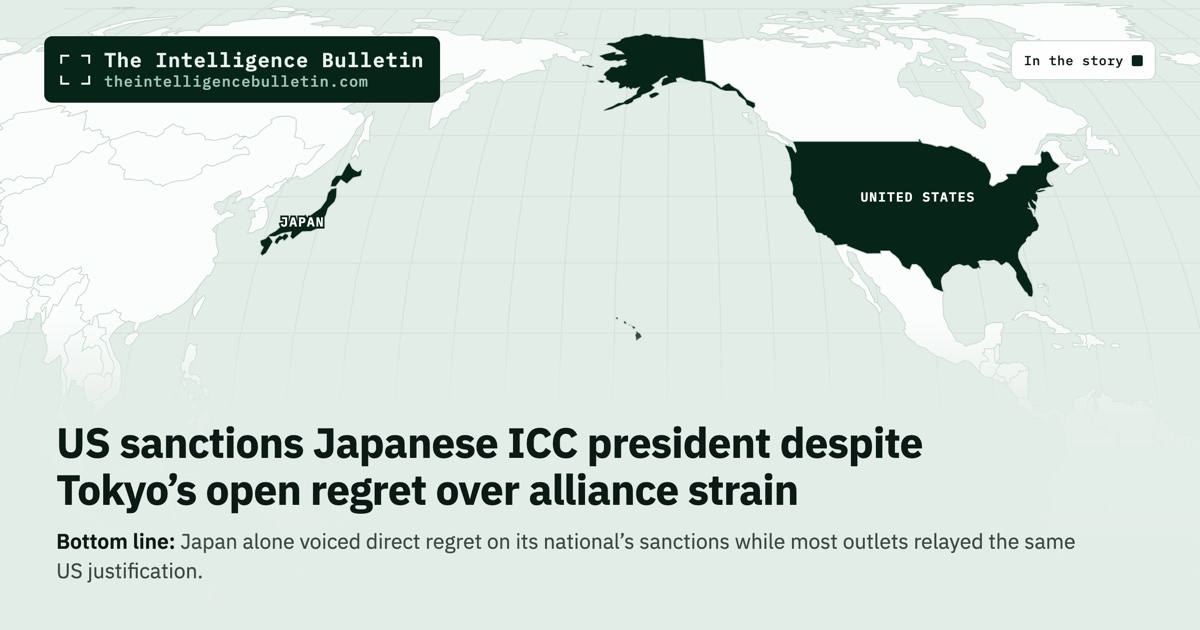
Japan alone voiced direct regret on its national’s sanctions while most outlets relayed the same US justification.
Japan’s explicit regret over sanctions on its own national who leads the ICC reveals a sharper alliance fault line than US or Israeli coverage acknowledges. Tokyo’s Foreign Ministry statement directly affirms consistent support for the court’s mandate on war crimes and rule of law while pledging continued communication with partners, a position absent from the Reuters copy that dominates American and Israeli outlets. That omission matters because Akane’s nationality turns the sanctions into a bilateral test rather than a purely institutional clash. US reporting centers Rubio’s justification tied to Netanyahu warrants and American personnel, treating Japanese concerns as background. Israeli coverage adds Netanyahu’s praise for the move as defense against a kangaroo court. Japanese domestic framing instead highlights the strain on alliance cohesion and the court’s independence. Multiple outlets carry identical Reuters text on the sanctions details, European disapproval from the Netherlands, and the ICC’s rule-of-law warning, confirming a single originating chain. The divergence appears only where Japan inserts its own voice, showing that actor-country coverage alone captures the diplomatic cost the wires flatten into routine escalation.
Full analysis
The United States imposed sanctions on August 18 on Tomoko Akane, the Japanese judge serving as president of the International Criminal Court, and on Abdoulaye Seye, a Senegalese senior trial lawyer at the court. Secretary of State Marco Rubio announced the measures under an executive order issued the previous year. The sanctions freeze any assets the two individuals hold in the United States and bar most transactions with them through the American financial system. The Treasury Department issued a general license allowing wind-down of existing dealings until September 17.
Rubio stated that Akane and Seye had directly engaged in ICC efforts to investigate, arrest, detain or prosecute officials of governments that had not consented to the court’s jurisdiction. The move formed part of the Trump administration’s broader campaign against the Hague-based institution. That campaign has included prior targeted sanctions on other ICC officials, a diplomatic push to encourage countries to withdraw, and public arguments that the court threatens American personnel involved in immigration enforcement, drug interdiction and military operations. The administration has linked the effort to arrest warrants the ICC sought for Israeli Prime Minister Benjamin Netanyahu and former defense minister Yoav Gallant, as well as an earlier Afghanistan inquiry involving American forces.
Japan’s Foreign Ministry responded on August 19 by describing the sanctions on Akane and the ICC as very unfortunate. The ministry reaffirmed that Japan has consistently supported the court’s work to prosecute the most serious crimes of international concern and to uphold the rule of law. It added that Japan would continue its commitment to strengthening the international legal order while maintaining communication with relevant countries. Akane, who has led the ICC since her election in March 2024, had warned in December that further sanctions would rapidly undermine the court’s operations across all situations and could jeopardize its existence.
The ICC itself condemned the sanctions. In a statement carried across reporting, the court said that when judicial actors are threatened for applying the law, the international legal order itself is placed at risk. The Netherlands, which hosts the court, also expressed disapproval. Dutch Foreign Minister Tom Berendsen posted that international courts must be able to carry out their mandates freely and invited Akane to discuss continued support.
Netanyahu welcomed the sanctions. In a post on X, he called the ICC a kangaroo court that cloaks abuse of power in the language of international law while undermining justice. He commended Rubio for leading efforts against what he described as the court’s illegitimate overreach and said the officials who lead the ICC would face consequences.
The sanctions build on earlier steps taken last year against other ICC personnel. Those measures cited the Netanyahu warrants and the Afghanistan probe. Three ICC judges filed suit against the Trump administration in June, arguing the sanctions were unlawful. Advocacy groups brought separate lawsuits claiming the campaign infringes constitutional rights of organizations working with the court. At least five countries have announced withdrawals from the ICC following the administration’s diplomatic outreach.
Most of the published accounts rest on the same core dispatch. The details of the sanctions, Rubio’s justification, the ICC’s response, the Dutch position, Akane’s prior warning, Seye’s role on the Netanyahu prosecution team, and the legal background on ICC jurisdiction appear in nearly identical form in the Asahi Shimbun, NBC News, the Jerusalem Post and Japan Today. Al Jazeera’s account overlaps on these points while adding its own framing of the administration’s stated goal of dismantling the court.
Where the accounts diverge is in what each foregrounds beyond that shared text. Japanese coverage places the Foreign Ministry’s statement of regret at the center and ties the sanctions directly to strain on alliance relations with Washington. The Asahi Shimbun and Japan Today both present Akane’s nationality and Tokyo’s official reaction as the immediate diplomatic consequence. American reporting centers the administration’s rationale, the link to Netanyahu and the broader effort to shield U.S. personnel. Israeli reporting adds Netanyahu’s explicit endorsement and his characterization of the court. The international outlet emphasizes the court’s institutional defense and the pattern of sanctions against officials and cooperating groups.
A reader limited to the dominant wire text would see a routine escalation in an ongoing institutional dispute. The same reader limited to Japanese domestic framing would see an alliance partner directly objecting to extraterritorial pressure on one of its nationals. The same reader limited to Israeli or American framing would see a justified defense of sovereignty against a court the United States never joined. None of those single vantage points captures the full picture that emerges only when the Japanese statements are placed beside the American and Israeli ones.
The Japanese reaction stands out because it comes from the country whose citizen holds the ICC presidency. Tokyo’s explicit regret converts what other accounts treat as an internal American policy choice into a bilateral test of alliance cohesion. The ministry’s language avoids confrontation yet asserts continued support for the court’s mandate and promises ongoing communication with partners. That formulation signals limits to how far Japan will align with the sanctions campaign even while it maintains the security relationship with Washington.
The shared Reuters-derived text across four outlets demonstrates that the basic sequence of events is not in dispute. The divergence is not over whether sanctions occurred or what Japan said; it is over which element receives emphasis and which context is supplied. Actor-country coverage supplies the missing diplomatic cost that the common dispatch flattens. The pattern shows that national outlets insert their government’s voice where wire services do not, and that this insertion alters the stakes a reader perceives.
The evidence that matters for judgment is the on-record Japanese statement itself, corroborated in two separate Japanese publications and referenced in the Jerusalem Post. That statement directly addresses the sanctions on a Japanese national and reaffirms support for the ICC. The administration’s interest lies in presenting the measures as necessary protection of sovereignty and alliance partners. Tokyo’s interest lies in preserving both the court and the alliance. The reporting shows these interests pulling in different directions on this specific case.
What to Watch
The sanctions will continue to restrict Akane’s and Seye’s access to the U.S. financial system. Japan’s stated position indicates it will continue to engage the ICC and its partners on the issue. The next measurable development will be whether other allies follow Tokyo’s public regret or remain silent, and whether the administration responds with further diplomatic pressure or additional designations. The alliance test exposed here is narrow but concrete: how far one partner will go in opposing sanctions aimed at its own citizen who leads an institution the other partner seeks to sideline.
That’s how the world told the story.
Get our daily open-source intelligence on world events in your inbox — one email a day, up to six stories.
Subscribe freeNo spam. One-click unsubscribe. See the latest email →