 AI-generated analysis published under the editorial responsibility of Rohit Sinnas. How it works →
Press quoted
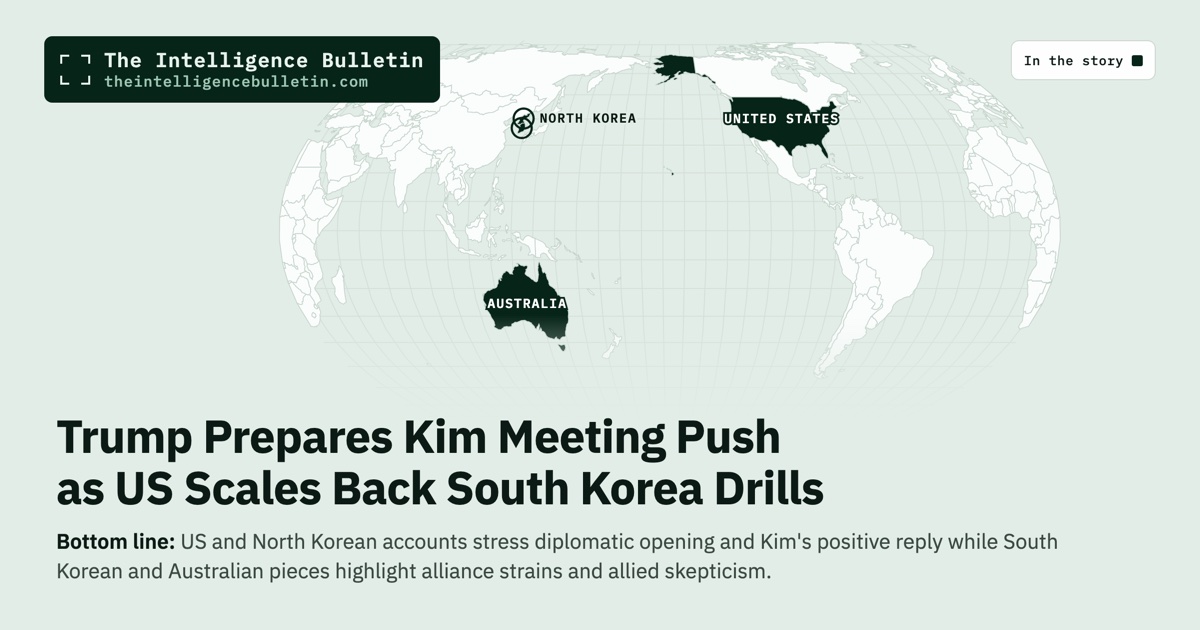
US and North Korean accounts stress diplomatic opening and Kim’s positive reply while South Korean and Australian pieces highlight alliance strains and allied skepticism.
Reporting across these outlets shows Trump actively reviving personal diplomacy with Kim by pairing public praise and drill reductions with explicit meeting preparations, yet the coverage reveals a clear split in emphasis. US-focused pieces highlight potential openings for arms control talks despite past failures, while North Korean coverage stresses Kim’s positive reply without noting state media silence. South Korean reporting ties the push directly to reduced exercises and regional security impacts, and Australian analysis underscores allied doubts about Washington’s predictability. The Diplomat piece stands apart by detailing Kim’s structural incentives, from consolidating nuclear status to balancing China and sidelining Seoul. These accounts converge on the drill cuts and meeting interest but diverge sharply on stakes: one sees diplomatic opportunity, another alliance erosion, with no outlet claiming imminent denuclearization progress. The pattern indicates Trump’s transactional approach is driving events more than coordinated strategy, leaving allies to seek reassurances while Pyongyang gains leverage without concessions.
Full analysis
US President Donald Trump has directed his aides to prepare for a possible meeting with North Korean leader Kim Jong Un as early as this fall, potentially during a planned trip to Asia that could align with the November APEC summit in Shenzhen, China. The Korea Herald reported this push, drawing from a Wall Street Journal account that cited unnamed US officials, while noting that no formal preparations for such a summit had yet begun. Trump paired the reported outreach with public statements praising his personal relationship with Kim and with an order to the Pentagon to substantially reduce the scale of joint military exercises with South Korea.
Those exercises, known as Ulchi Freedom Shield, began on schedule on August 18 despite the reductions. They involve around 18,000 South Korean troops and run through August 27, with training focused on countering drones, GPS disruption, and cyberattacks. US participation has been cut significantly from previous years. Trump announced the drawdown on Truth Social the day before the drills started, describing the exercises as sending a message that is hostile to North Korea, which he characterized as having been unthreatening and respectful during his first term. He instructed Defense Secretary Pete Hegseth to make the cuts and linked the decision in part to South Korea’s refusal to assist with US operations in Iran.
Trump told reporters at the White House that Kim had responded to these overtures. He said the North Korean leader had answered positively, adding that the two understood each other and that Kim had always treated him with great respect. NK News and ABC News both carried Trump’s direct remarks on the positive reply. North Korean state media, however, made no mention of the comments or the proposed meeting, according to NK News reporting.
The three previous meetings between Trump and Kim during Trump’s first term—in Singapore in 2018, Hanoi in 2019, and a brief encounter at the demilitarized zone—produced no agreement on limiting North Korea’s nuclear program. Since then Pyongyang has expanded its arsenal to roughly 60 assembled weapons, with enough fissile material for at least 30 more, according to a June 2026 report from the Stockholm International Peace Research Institute cited by Newsweek. North Korea has also conducted ballistic missile tests banned by the United Nations.
The drill reductions have drawn concern from South Korean officials and analysts who see them as weakening deterrence at a moment when North Korea maintains an adversarial posture toward Seoul. South Korean President Lee Jae-myung has separately renewed calls for the transfer of wartime operational control of South Korean forces from the United States to Seoul and for progress on nuclear-powered submarines. Retired South Korean Lieutenant General In-bum Chun told ABC News that curtailing the exercises would not bring Kim to the table and that the only way to achieve that would be formal US recognition of North Korea as a nuclear weapons state. Chun described the public, relationship-based announcement of the cuts as surprising and concerning, noting that many South Koreans initially viewed it as possible fake news.
Australian reporting through ABC News captured broader allied unease. Analysts there pointed out that extended deterrence relies on trust and warned that South Korea’s loss of confidence could strengthen voices inside the country favoring its own nuclear weapons. James Acton of the Carnegie Nuclear Policy Program told ABC News he remained skeptical that Pyongyang would discuss denuclearization but saw more promise in talks aimed at risk reduction or slowing further nuclear development. The same coverage noted the recent withdrawal of the USS George Washington carrier from the Pacific for Middle East operations as another signal that could unsettle partners.
Newsweek reported that some US analysts view the drill reductions as potentially opening space for renewed talks that could produce caps on North Korea’s missile arsenal and fissile material stockpiles, even if full denuclearization remains unlikely. Evan Sankey of the Cato Institute described the move as reminiscent of Trump’s earlier cancellations of exercises during the 2018-2019 negotiations and said it could presage a US overture at a time when current policy toward Pyongyang has reached a dead end. Jennifer Kavanagh of Defense Priorities called the decision strategically wise, arguing that the exercises have not deterred North Korea or China and instead prompt accelerated military buildups by those countries.
The Diplomat, writing from a regional perspective, outlined six structural reasons why Kim might still seek another meeting despite North Korea’s improved position. These include the chance to consolidate de facto nuclear status through engagement with a US president willing to negotiate on that basis, the prospect of further reductions in US Forces Korea presence and activities, lowered risk of a US decapitation strike, greater room to maneuver against Chinese influence, the ability to sideline South Korea in direct US-North Korea talks, and domestic legitimacy gains for Kim at a time when North Korea’s deployment of troops to support Russia’s war in Ukraine has carried visible costs.
These accounts converge on the basic sequence—Trump’s public praise for Kim, the drill reductions, and the reported interest in a new meeting—yet diverge on the implications. US coverage tends to foreground possible arms-control openings and analyst assessments of strategic utility. South Korean reporting ties the developments directly to alliance adjustments and security trade-offs for Seoul. Australian reporting emphasizes the transactional framing and resulting questions about US commitments from partners. NK News foregrounds the claimed positive response from Pyongyang while recording the absence of coverage inside North Korea itself. The Diplomat focuses on Kim’s incentives rather than immediate diplomatic outcomes.
What to Watch
The pattern across the reporting indicates that Trump’s approach is personal and transactional rather than the product of a coordinated interagency strategy. Pyongyang gains visible leverage through reduced pressure on its doorstep without having offered any recorded concession. South Korea and other allies are left seeking clarification on the durability of US commitments, with the public nature of the announcements amplifying the sense of unpredictability. No source in the set claims that renewed talks are imminent or that they would produce verifiable limits on North Korea’s arsenal. The next moves will likely turn on whether Pyongyang chooses to engage the reported US overture and on how Seoul and Washington manage the resulting adjustments to their military posture.
That’s how the world told the story.
Get our daily open-source intelligence on world events in your inbox — one email a day, up to six stories.
Subscribe freeNo spam. One-click unsubscribe. See the latest email →