 AI-generated analysis published under the editorial responsibility of Rohit Sinnas. How it works →
Press quoted
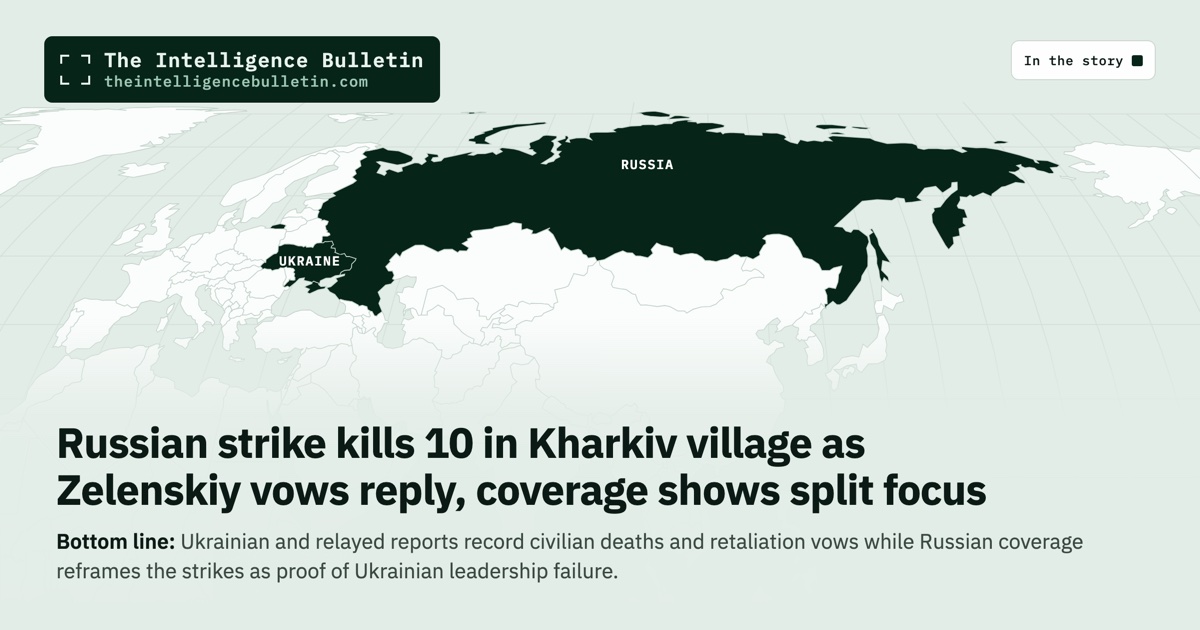
Ukrainian and relayed reports record civilian deaths and retaliation vows while Russian coverage reframes the strikes as proof of Ukrainian leadership failure.
Ukrainian reporting centers on the human cost in Pechenihy and Zelenskiy’s pledge of retaliation plus appeals for allied support, grounding the story in local damage and official statements from the president and regional governor. South African and Armenian outlets relay the same casualty figures and damage list with minimal added context, treating Ukrainian authorities as the primary source. Turkish coverage similarly foregrounds Kyiv’s account of the strike. Russian state media diverges sharply by running analyst commentary that casts the attacks as evidence of Zelenskiy’s inaction and impending economic collapse rather than reporting the immediate civilian toll. The core casualty claim travels consistently through independent Ukrainian-origin chains picked up by distant observers, while the Russian piece stands apart by shifting focus to strategic consequences and leadership critique. No outlet supplies Russian confirmation or denial of the specific strike, leaving the Ukrainian-sourced account as the only detailed narrative across the set. This pattern shows how proximity to the conflict shapes emphasis: domestic Ukrainian outlets record the event as lived tragedy and vowed reply, while non-participant coverage either echoes the facts plainly or reframes them around Kyiv’s alleged vulnerabilities.
Full analysis
Russian forces fired a missile into the village of Pechenihy in Ukraine’s Kharkiv region on the morning of August 18, striking a busy intersection lined with a post office, stores and homes. Ukrainian President Volodymyr Zelenskiy described the target area as a populated crossroads and said ten civilians died while many others were wounded. Regional governor Oleh Syniehubov reported seventeen people injured and listed the damage as ten private houses, one cafe, the post office, one store and at least seven cars set alight. Emergency crews extinguished the fires and continued working at the site, according to statements released the same day.
Zelenskiy posted the account on his official Telegram channel and added that Ukraine would reply. He called the attack a brutal strike on civilians and said partners should match any Ukrainian response with additional steps to pressure Russia. The president’s office supplied photographs showing collapsed walls, burning vehicles and rescuers carrying stretchers. No immediate statement from Russian authorities addressed the specific village or the reported casualties.
Ukrainian domestic reporting from TSN placed the event inside the daily rhythm of the region, naming the exact buildings hit and quoting Zelenskiy’s pledge of a “just kinetic response.” The same account noted that the strike followed earlier patterns of Russian long-range fire into Kharkiv oblast. International outlets that carried the story relayed the same casualty total and the same list of damaged structures. Daily Maverick, citing Reuters, added that Ukraine’s Prosecutor General’s Office identified the weapons as two small Banderol cruise missiles. News.am, drawing on Ukrainska Pravda and Syniehubov, recorded an initial count of eight wounded that later rose and confirmed the material losses without elaboration.
Turkish coverage from Anadolu Agency summarized the Ukrainian government statement in a single paragraph focused on the death toll. South African and Armenian dispatches treated the figures as the authoritative record and did not add independent observation or context beyond what Ukrainian officials supplied. Across these four accounts the core description remained consistent: a single missile, ten confirmed deaths, seventeen injuries, and the same five categories of property damage.
Russian state media took a different route. RIA Novosti published commentary from former U.S. Marine intelligence officer Scott Ritter that placed the strike inside a larger argument about Ukrainian winter preparedness. Ritter stated that Zelenskiy had taken no concrete steps to protect the power grid and distribution network ahead of cold weather, that sixty percent of the economy would collapse, and that Russian strikes on infrastructure would finish the process. The piece made no reference to Pechenihy, the ten deaths or the seventeen injuries. It framed the broader campaign as the logical result of Ukrainian policy choices rather than as a discrete incident requiring confirmation or denial.
A reader limited to Ukrainian sources would see a precise local tragedy complete with presidential reaction and an explicit call for allied escalation. A reader limited to Russian sources would encounter an assessment of strategic failure on the Ukrainian side without any mention of the village or the civilian count. The non-participant outlets supplied the narrow factual spine but left the Russian strategic claim unaddressed and the Ukrainian casualty claim without contradiction.
The single-source detail that the weapons were Banderol cruise missiles appears only in the Reuters material carried by Daily Maverick and receives no independent corroboration or rebuttal elsewhere in the set. The damage inventory and the casualty total travel together through Ukrainian official channels and are reproduced without alteration by the three distant outlets. Zelenskiy’s vow of retaliation is quoted directly in the Ukrainian and South African pieces and summarized in the Turkish and Armenian ones.
The accounts that foreground the ten deaths and the specific damage rest on statements issued by the president and the regional governor on the day of the strike. Those statements were available to every outlet that chose to cite them. The Russian commentary rests on an external analyst’s assessment of national infrastructure and does not engage the local evidence. Where the story is treated as an event that occurred in one place at one time, the details line up; where it is treated as evidence of a larger trend, the local details drop away.
The corroborated record of the strike itself therefore sits in the Ukrainian official statements and the outlets that transmitted them unchanged. That record supplies the only named location, the only casualty total and the only damage list available across the coverage. The alternative framing supplied by RIA Novosti offers a prediction about future economic effects but supplies no counter-evidence on the August 18 incident. A reader who encounters only the strategic critique will miss the scale of loss recorded at the intersection in Pechenihy; a reader who encounters only the casualty report will miss the claim that the strike forms part of a sustained campaign against Ukrainian energy and distribution systems. The two descriptions address different questions and do not directly refute each other on the facts of the village attack.
What to Watch
The most direct account of what happened on the ground therefore remains the one carried by the Ukrainian authorities and reproduced by the four other outlets. It names the place, the count of dead and wounded, the structures hit and the immediate political response. The Russian piece contributes an argument about the direction of the wider war but does not alter or contest the local particulars. That separation explains why the same event can appear as a discrete civilian tragedy in one set of reports and as confirmation of strategic momentum in another.
That’s how the world told the story.
Get our daily open-source intelligence on world events in your inbox — one email a day, up to six stories.
Subscribe freeNo spam. One-click unsubscribe. See the latest email →