 AI-generated analysis published under the editorial responsibility of Rohit Sinnas. How it works →
Press quoted
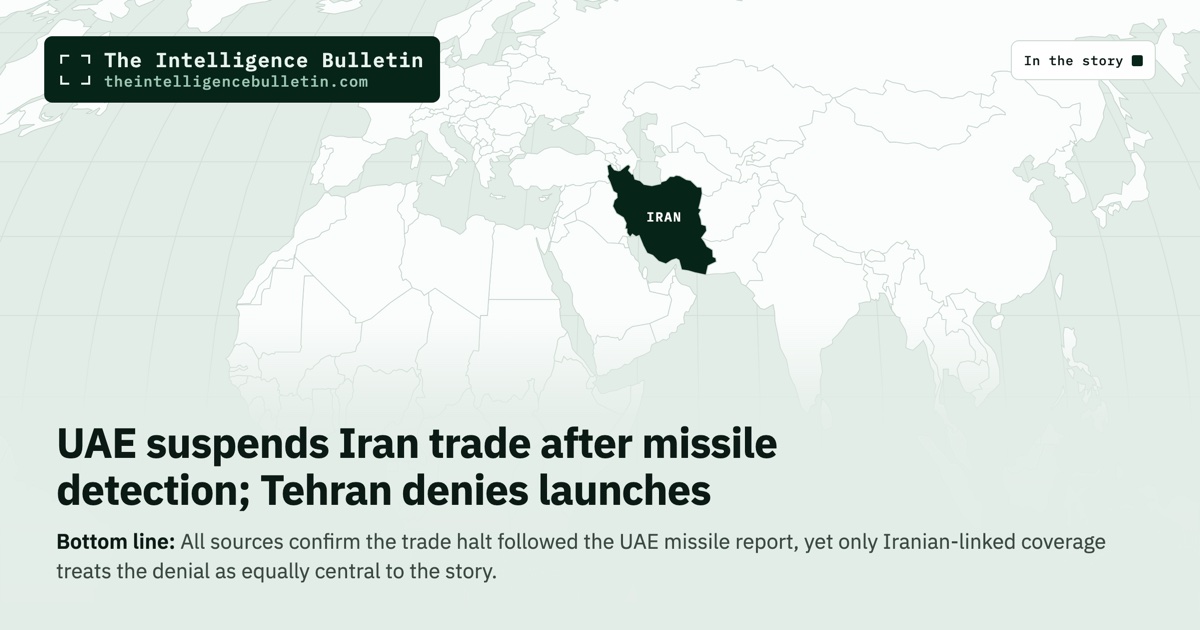
All sources confirm the trade halt followed the UAE missile report, yet only Iranian-linked coverage treats the denial as equally central to the story.
The reporting across these outlets reveals a tightly synchronized sequence of events that all sources accept, yet the attribution of the trigger remains the sole point of open conflict. UAE domestic coverage and the official statements it carries present the missile detection as established fact and the trade suspension as a proportionate sovereign measure to protect regional stability. The Iranian diaspora outlet Gooya News accepts the timing of the UAE announcement but frames the missiles as the precipitating act, underscoring the economic cost to Iran through the loss of a major re-export and financial channel. Indian and U.S.-based regional reporting embed the same facts while giving equal weight to Tehran’s denial, showing that the missile claim rests on a single national reporting chain—the Emirati Defense Ministry—while the trade halt is corroborated independently by UAE statements carried across borders. Turkish coverage narrows further to the UAE’s follow-up denial that it had continued any financial facilitation, illustrating how outlets downstream of the primary actors selectively amplify diplomatic rebuttals rather than the underlying dispute. The absence of any independent corroboration of the missile launches outside Emirati channels, combined with Iran’s on-record rejection, leaves the causal link between attack and response dependent on one side’s sensors and statements. This pattern demonstrates that the economic rupture itself is undisputed across reporting chains, whereas the justification for it is not.
Full analysis
The United Arab Emirates announced on August 18 that it would immediately halt all trade, commercial exchanges and financial transactions with Iran until further notice. The decision followed a statement from the UAE Defense Ministry that its air-defense systems had detected two ballistic missiles launched from Iran toward the country that evening. One missile fell outside UAE territorial waters and the second inside them. The ministry assessed that both had been aimed at maritime navigation. No damage or injuries were reported, though an emergency alert reached residents’ phones and the armed forces remained on high alert.
The UAE Foreign Ministry, through its director of strategic communications Afra Al-Hamli, framed the suspension as a response to regional escalations that had undermined peace and security. It reiterated that the country remained committed to dialogue, cooperation and regional integration while upholding international standards for its financial system. The ministry also denied any ongoing claims about the state of economic relations with Iran. The announcement came hours after the missile detection and reversed a limited resumption of direct cargo movement through Jebel Ali port that had begun only in late June.
Iran’s Foreign Ministry spokesperson Esmaeil Baghaei rejected the UAE accusation outright. He described the claims as baseless, contrary to the principle of good neighborliness, and disruptive to efforts to rebuild trust between regional countries. The statement called on all parties to avoid such accusations amid ongoing complexities involving the United States and what it termed the Zionist regime.
The trade suspension directly affects a relationship that had shown tentative signs of recovery after the earlier phase of regional conflict that began in late February. During that period the UAE had faced repeated Iranian missile and drone strikes and had itself conducted operations against Iran. A June memorandum of understanding between Washington and Tehran had been followed by a single phone call between the UAE and Iranian foreign ministers in the same month. Some Iranian residents who had been outside the country were allowed to return, and limited flight and trade links had quietly restarted. The August 18 halt ends that limited thaw.
Coverage of the episode shows near-universal acceptance of the UAE announcement itself. The foreign ministry statement appears in substance across the five outlets examined. The economic rupture is therefore the one element that stands independent of any single national chain. By contrast, the missile detection rests solely on the UAE Defense Ministry’s account. No other reporting chain supplies independent sensor data or confirmation. The Iranian denial, carried through the foreign ministry spokesperson, stands as the direct counter-claim and receives prominent space in the Times of India and Al-Monitor accounts.
The Times of India situates the episode inside the reversal of the post-June thaw and adds context on shipping risks in the Strait of Hormuz, including recent strikes on vessels linked to the Abu Dhabi National Oil Company. Al-Monitor similarly notes those prior ADNOC incidents and the fact that the UAE had been the Gulf state most heavily targeted during the earlier conflict phase. Both pieces record the Iranian denial at length alongside the Emirati statements.
Gooya News, the diaspora portal, foregrounds the timing of the UAE decision relative to the reported missile launch and stresses the potential economic damage to Iran. It notes that Dubai had long served as a primary route for Iranian trade and financial flows that helped circumvent sanctions. The piece relays the UAE statements but centers the consequences for Tehran.
Al Bayan, the UAE domestic outlet, carries the defense and foreign ministry statements in full and presents the halt as a measured defensive step. It does not include the Iranian denial. Anadolu Agency narrows its focus to a subsequent UAE clarification that it had not continued to provide financial facilities to Iran after the suspension.
The divergence therefore lies almost entirely in how outlets treat the justification for the halt rather than the halt itself. Where the missile detection is presented as established fact, the trade action reads as a proportionate response. Where the Iranian denial is given equal weight, the same action appears more as a unilateral escalation resting on one side’s unverified sensors. The Turkish and Indian pieces amplify UAE diplomatic follow-ups or place the episode in wider energy-security terms, while the diaspora outlet underscores the material cost to Iran.
What to Watch
The corroborated element—the trade suspension—carries the clearest long-term weight. Loss of access to UAE ports and financial channels removes one of the few remaining low-friction routes for Iranian commerce. The disputed missile attribution leaves the immediate rationale dependent on a single reporting chain. Subsequent events will test whether the suspension remains in place or becomes a bargaining lever, and whether any independent verification of the August 18 launches emerges outside Emirati channels. The economic consequence for Iran is already measurable in the interruption of a relationship that had only recently shown modest reopening.
That’s how the world told the story.
Get our daily open-source intelligence on world events in your inbox — one email a day, up to six stories.
Subscribe freeNo spam. One-click unsubscribe. See the latest email →