 AI-generated analysis published under the editorial responsibility of Rohit Sinnas. How it works →
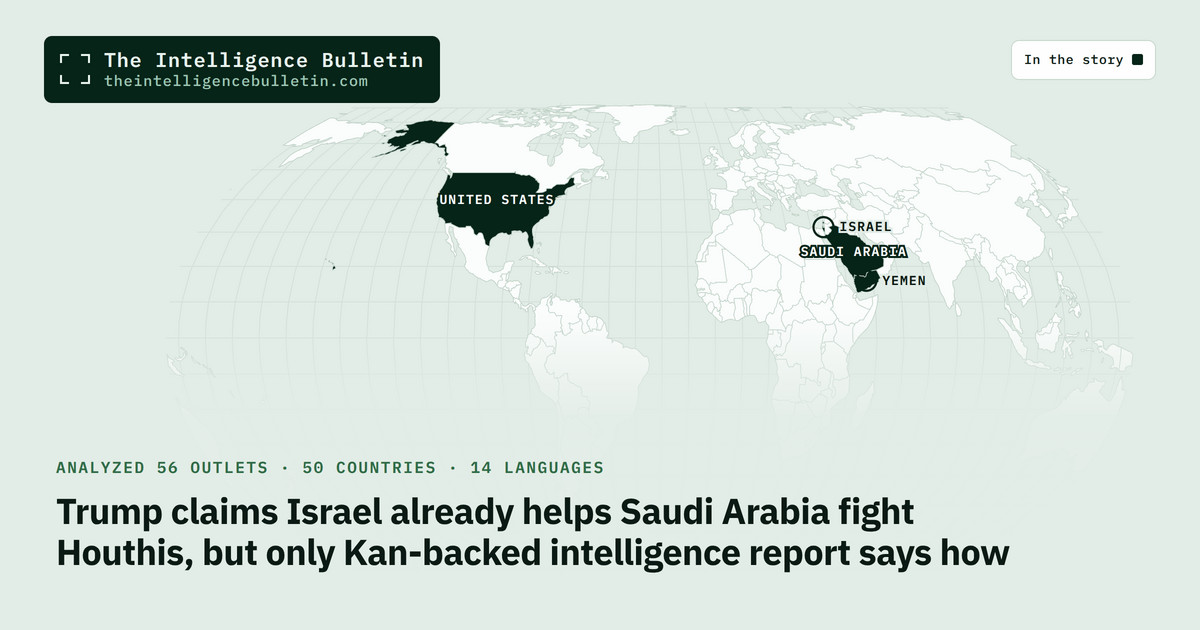
See the 50 countries
Australia, Azerbaijan, Bangladesh, Bosnia and Herzegovina, Brazil, Bulgaria, China, Croatia, Cyprus, Czech Republic, Democratic Republic of the Congo, Egypt, Finland, France, Guam, India, Indonesia, Iraq, Ireland, Israel, Japan, Jordan, Kenya, Lebanon, Macao, Morocco, New Zealand, Nigeria, Oman, Pakistan, Philippines, Poland, Portugal, Qatar, Romania, Russia, Saudi Arabia, Senegal, Singapore, South Korea, Spain, Sri Lanka, Switzerland, Syria, Tunisia, Turkey, Ukraine, United Arab Emirates, United Kingdom, United States
Trump says Israel is already helping Saudi Arabia fight the Houthis and an Abraham Accords deal is closer than ever; Saudi Arabia has not confirmed it, Akhbarona cites Haaretz saying Riyadh earlier refused, and only Kan describes actual US-relayed intelligence sharing.
Across the press: Worthy News, The Jerusalem Post, Daily Pakistan and Akhbarona lead with Trump’s assertion, while La Regione alone reports Kan’s concrete intelligence channel.
Source base: 5 outlets read in full (United States, Israel, Morocco, Pakistan, Switzerland), selected from 56 analyzed.
- 1 of 5 · La Regione onlyIsrael has begun sharing Houthi intelligence with Saudi Arabia through the United States, after Riyadh asked Washington for assistance.Israeli public broadcaster Kan, citing a Middle Eastern diplomat and a foreign source, relayed by La Regione via Iran International.
- 1 of 5 · Akhbarona onlyBefore Trump’s latest comments, Haaretz reported that Saudi Arabia had rejected an Israeli request, relayed through Washington, to join military action against the Houthis.Haaretz, cited by Akhbarona.
- 3 of 5 · reported separatelyTrump publicly asserted that Israel has been very helpful to Saudi Arabia and predicted Riyadh would accept Israeli help against the Houthis.Trump’s White House remarks, reported independently by Worthy News, The Jerusalem Post, Akhbarona and Daily Pakistan.
- 3 of 5 · reported separatelyTrump said a Saudi-Israeli normalization deal through the Abraham Accords is ‘more than ever’ possible and called it one of the US’s greatest achievements.Trump’s White House remarks, quoted directly in Worthy News, The Jerusalem Post, Akhbarona and Daily Pakistan.
- 3 of 5 · reported separatelySaudi Arabia has not publicly confirmed the Israeli assistance Trump described, has no diplomatic ties with Israel, and maintains Palestinian statehood as a condition of normalization.Worthy News for the absence of Saudi confirmation; The Jerusalem Post, Akhbarona and Daily Pakistan for Riyadh’s diplomatic position.
- In the coming daysSaudi Arabia’s first official response to Trump’s claim, either confirming or denying Israeli help, will settle the core dispute.
- If formal Abraham Accords talks resumeA public Saudi-Israeli meeting or US announcement would confirm whether the agreement is actually nearer than before.
- Still openWhat is the confirmed total casualty count across both attacks including nationalities? · Did Houthis successfully hit Dammam airport and Aramco facilities as claimed?
- 15 Oct · Houthis target Aramco and Riyadh airport; Saudi accounts say intercepted, oil markets count a hit
- 13 Oct · Iran offers mediation after Houthi strikes force Riyadh airport closure
- 12 Oct · Second Houthi strike on Riyadh airport kills one as Saudi and Yemeni outlets clash on war crime vs interception
- 10 Oct · Missile strike wounds travelers at Riyadh airport as Trump signals possible US response
Full analysis
What happened Why it matters How each country tells it Where accounts conflict Room for disagreement Our assessment Sources and evidence
What happened
President Donald Trump stepped outside the White House on Friday and asserted something no Saudi official has yet said in public: Israel is already helping the kingdom fight Yemen’s Houthis, and Riyadh will accept that help. Asked whether Saudi Arabia should take Israeli assistance, Trump said, according to Worthy News, “Yeah, I do. I think they will. Israel has been very helpful to Saudi Arabia.” The Jerusalem Post recorded him answering a question about whether he had spoken with Saudi Arabia by predicting, “I think they will do it. Absolutely,” and adding that the kingdom would “certainly do it.” He said the Abraham Accords were “one of our greatest achievements” and suggested Saudi entry was “more than ever” possible, saying the kingdom was “very happy” to receive support from Israel and the United States. Four of the five accounts in this reporting set open on those White House remarks; none carries a Saudi confirmation.
The remarks came during a week of Houthi escalation. TIB reported on October 15 that ballistic and cruise missiles were launched at Riyadh and Dhahran on October 14, with Saudi defenses intercepting several and falling debris injuring at least five people. The Jerusalem Post, drawing on Reuters, framed Trump’s comments against a Thursday strike on the presidential palace complex that it said killed five, and a separate strike on King Khalid International Airport that it said killed 17 and injured more than 300.
What Trump did not specify, the Israeli public broadcaster Kan did. La Regione relayed Kan’s reporting that Israel has begun sharing Houthi intelligence with Saudi Arabia through the United States, after Riyadh asked Washington for assistance. A Middle Eastern diplomat and a foreign source told Kan that US officials, in recent talks in Cairo, said Israel could provide a large volume of intelligence partly built on the Israeli military’s experience confronting the Houthis, with priority given to keeping the Bab el-Mandeb strait open to navigation. The discussions took place, according to Kan, while Crown Prince Mohammed bin Salman was meeting Egyptian President Abdel Fattah al-Sisi, and US Central Command representatives proposed a joint regional mechanism to help the kingdom face the Houthis. That account is more concrete than the White House’s words, but it describes an American-brokered intelligence channel, not the open military assistance the president implied.
Saudi Arabia has not confirmed any of it. Worthy News noted that no formal normalization agreement has been announced and that the kingdom had not publicly confirmed the extent of the Israeli assistance Trump described. The Jerusalem Post, Akhbarona and Daily Pakistan each record that Riyadh has no diplomatic relations with Israel and that Palestinian statehood remains the kingdom’s condition for normalization. Akhbarona added the sharpest counterpoint: it cited Haaretz reporting from before Trump’s latest comments that Saudi Arabia refused an Israeli request, sent through Washington, to allow Israel to take part in the military fight against the Houthis, with Israeli sources saying the aim was to coordinate with the kingdom and prepare the ground for future normalization.
Daily Pakistan also carried Israeli Prime Minister Benjamin Netanyahu’s comment to Israeli media on Tuesday that “There is hardly a state in the Middle East that is not asking us for help,” while noting it did not explicitly confirm any Saudi request. The same article reported that Iran rejected allegations linking it to Houthi attacks and offered to help end the conflict if requested.
Why it matters
At stake is whether the Red Sea war becomes the bridge to an Israeli-Saudi accord or another instance of Washington announcing an Arab position that Riyadh has not adopted. If the Kan account is accurate, Israel and Saudi Arabia are already handling Houthi intelligence through American hands, an arrangement that would amount to de facto security cooperation without any public handshake. That would change the alliances behind Yemen’s war and Red Sea security, putting the kingdom’s air-defense and shipping concerns in a circuit with Israeli military knowledge while formal normalization remains unresolved.
For Trump, the claim is tied directly to the civilian nuclear agreement Washington signed with Riyadh at the end of July. He has said Saudi participation in the Abraham Accords is a requirement for advancing that arrangement, but Akhbarona reports the condition was not written into the signed agreement. Democratic Senators Jeff Merkley and Ed Markey have introduced a resolution aimed at blocking the nuclear pact during a 90-day review period over fears that US technology could be used toward nuclear weapons. Trump therefore has an interest in presenting Saudi-Israeli cooperation as farther along than the paper trail shows.
For Saudi Arabia, accepting visible Israeli help carries a political cost. Akhbarona and Daily Pakistan foreground Riyadh’s standing position that normalization requires a just solution for Palestinians. A quiet intelligence channel through Washington is easier to tolerate than a public Israeli military role, which may be why the kingdom has let Trump and Kan speak and said nothing itself.
How each country tells it
- Worthy News · United States · original reportingLeads with Trump’s framing that Israeli help is already happening and that a historic Saudi-Israeli peace deal is drawing closer, describing it as a significant geopolitical shift.
- The Jerusalem Post · Israel · original reportingReports Trump’s prediction that Riyadh will accept Israeli help and that the Abraham Accords may be revived, framed by recent Houthi strikes on Saudi targets.
- Akhbarona · Morocco · original reportingFrames Trump as calling on Saudi Arabia to accept an Israeli offer, while stressing Riyadh rejects normalization before a just Palestinian solution.
- Daily Pakistan · Pakistan · original reportingReports Trump as again pushing a reluctant Saudi Arabia to accept Israel’s help, foregrounding Riyadh’s insistence on Palestinian statehood.
- La Regione · Switzerland · carries KanLeads with Kan’s report that Israel, via the United States, began sharing intelligence with Saudi Arabia on the Houthis after Riyadh requested American help.
Where accounts conflict
Two accounts cannot both describe what Riyadh has accepted. Trump said Israel has already been “very helpful” and that Saudi Arabia will accept help; the Kan account, relayed by La Regione, describes Riyadh asking Washington for intelligence and receiving it via Israel. The Haaretz report carried by Akhbarona describes the opposite posture: Saudi Arabia rejected an Israeli request, transmitted through Washington, to participate in the military confrontation with the Houthis. One account has the kingdom seeking assistance; the other has it turning an Israeli offer down.
The narrower conflict concerns what the help actually is. Kan’s channel is limited to intelligence aimed at keeping Bab el-Mandeb open, and no source says Saudi and Israeli forces are operating together. Trump’s “very helpful” is therefore broader than the only named mechanism in the reporting. Worthy News calls the episode a significant shift and says a historic agreement is drawing closer; Daily Pakistan frames the same event as Trump again pushing a reluctant kingdom. That difference tracks which detail each outlet places first: the White House’s optimism or Riyadh’s Palestinian condition.
Room for disagreement
The strongest case that this is the start of normalization rather than a presidential overstatement runs through the same reporting. Trump answered a direct question about whether he had spoken with Saudi Arabia by predicting they would accept, and the Jerusalem Post recorded him adding, “I think they will do it. Absolutely.” Kan reported that Riyadh itself asked Washington for assistance, which fits an administration preparing the ground for the Abraham Accords. Netanyahu’s formula that nearly every Middle Eastern state is asking Israel for help suggests Israeli officials believe quiet cooperation is already underway. Worthy News argues that the shared Iranian threat could accomplish what years of traditional diplomacy could not. The Houthi attacks on Riyadh and Dhahran give the kingdom an immediate security reason to tolerate Israeli intelligence even if it will not say so publicly. On this reading, the absence of a Saudi confirmation is not a contradiction; it is the point. Riyadh can accept help through Washington while preserving its public position on Palestine until a deal is ready.
Our assessment
It is very unlikely that Friday’s remarks mark a Saudi decision to accept visible Israeli military help or that normalization is “more than ever” within reach, because every specific mechanism in the reporting runs through the United States and Riyadh has not spoken. The only concrete account is single-source: Kan, relayed by La Regione through Iran International, citing a Middle Eastern diplomat and a foreign source. It describes intelligence sharing requested from Washington and aimed at freedom of navigation in the Bab el-Mandeb, not a Saudi invitation to Israeli forces. Against Trump’s broader claim sits Haaretz’s report, carried by Akhbarona, that Riyadh refused an Israeli military role. Trump has an interest in selling the Abraham Accords as alive, because his nuclear agreement with Riyadh and his stated legacy are tied to it. Riyadh’s interest runs the other way: it maintains Palestinian statehood as the price of normalization and has confirmed nothing. The best-supported reading is that a limited, US-mediated intelligence channel exists, while the diplomatic breakthrough he announced remains unconfirmed.
What would change this: a named Saudi official publicly confirming that the kingdom has accepted Israeli assistance and is willing to discuss security cooperation, which would turn the absent voice in this story into the primary source.
Sources and evidence
Press quoted
- Has Saudi Arabia accepted or requested Israeli assistance, and what form does it take — intelligence only, or military participation?
- Does Kan’s reported intelligence sharing describe the same help Trump announced, or a narrower channel Riyadh has not acknowledged?
- Will Riyadh state whether normalization is still conditional on a Palestinian state, now that Trump links the nuclear agreement to it?
That’s how the world told the story.
Get our daily open-source intelligence on world events in your inbox — one email a day, up to six stories.
Subscribe freeNo spam. One-click unsubscribe. See the latest email →