 AI-generated analysis published under the editorial responsibility of Rohit Sinnas. How it works →
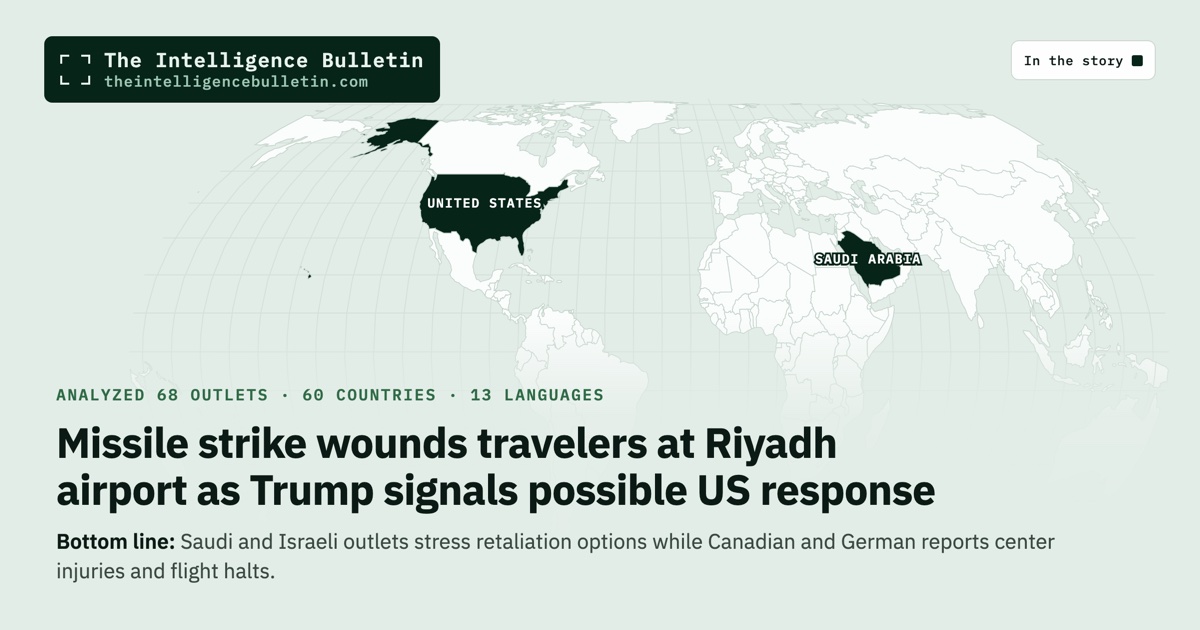
| Press analyzed | 68 outlets · 60 countries · 13 languages |
| Press quoted | 5 sources |
See the 60 countries
Algeria, Australia, Azerbaijan, Brazil, Burkina Faso, Canada, China, Croatia, Cyprus, Denmark, Egypt, France, Germany, Ghana, Greece, Guyana, India, Indonesia, Iraq, Ireland, Israel, Italy, Japan, Jordan, Kenya, Kuwait, Lebanon, Libya, Luxembourg, Malaysia, Mauritania, Morocco, New Zealand, Nigeria, Norway, Oman, Pakistan, Philippines, Poland, Portugal, Qatar, Russia, Saudi Arabia, Singapore, Slovakia, Slovenia, Somalia, South Africa, Sri Lanka, Switzerland, Syria, Thailand, Tunisia, Turkey, Tuvalu, United Arab Emirates, United Kingdom, United States, Vietnam, Yemen
Saudi and Israeli outlets stress retaliation options while Canadian and German reports center injuries and flight halts.
- Single sourceAl Jazeera’s correspondent in Sanaa said the Houthis aim to impose a blockade on all Saudi airports, in retaliation for Saudi attacks on Yemeni airports.Source: Yousef Mawry, Al Jazeera correspondent in Sanaa
- Independently reportedA missile struck King Khalid International Airport in Riyadh on October 10, wounding multiple people and forcing suspension of operations.Source: Saudi civil aviation authority, corroborated by AP, Reuters, AFP across outlets
- Independently reportedUS President Donald Trump stated he is evaluating whether to join airstrikes against the Houthis following the attack.Source: White House remarks reported by Arab News, CBC, Ynetnews, DW
- Independently reportedPrior attacks on Riyadh’s airport this week killed four people, including a Saudia pilot, and injured dozens.Source: Arab News, CBC, DW; pilot’s death announced by Saudia via Al Jazeera
- What is the precise casualty count from the October 10 attack?
- Will the United States conduct airstrikes on Houthi targets and on what timeline?
- How will Pakistan and Turkey respond under the Mecca Pact beyond defensive measures?
Press quoted
Full analysis
A missile struck the passenger terminal complex at King Khalid International Airport in Riyadh on October 10, hitting the domestic terminals and sending thick smoke and flames into the air. Saudi civil aviation authorities reported that the strike wounded multiple people, with ambulances rushing to the site and doctors summoned to hospitals across the capital for what one medical source described as a serious emergency. Operations at the airport were suspended pending damage assessment, and flight-tracking data showed all incoming flights diverted or canceled. The attack followed three others earlier in the week that had already killed four people, including a Saudia pilot, and injured dozens more at Riyadh’s airport.
There was no immediate claim of responsibility for the October 10 strike, which came amid an escalation of Houthi missile attacks on Saudi Arabia. A Houthi military spokesman had claimed responsibility for one of the earlier attacks, stating that a ballistic missile had successfully hit its target and disrupted air traffic. The group has warned airlines to avoid Saudi airspace outside the holy cities, declaring it a zone of military operations in retaliation for Saudi-led coalition airstrikes on Yemeni airports and in support of ground operations near the Bab al-Mandab Strait. Yemeni government forces aligned with Riyadh have launched a counteroffensive aimed at dislodging Houthi control of territory seized last month along that strategic waterway, which carries roughly 12 percent of global trade. The coalition reported destroying more than 130 Houthi targets in large-scale operations.
US President Donald Trump told reporters at the White House that his administration had only just learned of the latest attack and would decide quickly whether to join Saudi strikes on the Houthis. “We’re going to look at it,” he said. “We move very quickly.” The statement came as the airport incident marked the fourth attack on Riyadh’s main facility in a week. Western embassies, including those of Canada, the United States, Germany, and Spain, advised their citizens to avoid the airport. Kuwait Airways canceled flights to and from Riyadh, and other carriers including Etihad and Qatar Airways had already suspended or canceled services earlier in the week.
The accounts agree on the basic sequence: repeated missile strikes on Saudi aviation infrastructure, civilian injuries and deaths in the prior incidents, and Trump’s public indication that US military involvement is under active consideration. CBC, carrying Reuters, adds that Saudi Arabia’s early warning system did not issue an alert before the October 10 strike. Where the reports differ is in the weight each places on the next steps and the wider stakes.
Arab News opened its account with Trump’s remarks and placed the attacks inside the context of Saudi coalition operations against the Houthis, noting the coalition’s recent destruction of launch sites and the push to regain control of the Bab al-Mandab area. Ynetnews, drawing on Associated Press reporting, similarly foregrounded the Iranian alignment of the Houthis and the strategic implications for shipping routes, while recording the missile’s impact on the domestic terminal complex and the resulting evacuations. Both outlets gave prominence to the possibility of expanded US participation.
Al Jazeera reported the reopening of the airport after earlier strikes and included the specific casualty figure of three Saudi nationals killed on October 8, along with its Sanaa correspondent’s explanation that the Houthis sought to impose a reciprocal blockade on Saudi airports in response to the siege of Sanaa. The outlet also carried statements from UN Security Council discussions in which Saudi and Yemeni government representatives called for international action against the threat to navigation and civilian facilities. Deutsche Welle and the CBC article, the latter carrying Reuters material, stayed closer to the immediate scene: eyewitness descriptions of an explosion followed by injured people on the terminal floor, the arrival of more than a dozen ambulances, the suspension of flights, and the Canadian embassy’s explicit advice for travelers to avoid the airport.
These differences in emphasis produce distinct pictures for readers. An account drawn only from Arab News or Ynetnews would leave the impression that the dominant development is the potential American military response and the coalition’s battlefield gains. A reader limited to Al Jazeera would instead encounter the strikes as part of an ongoing airport-for-airport equation rooted in the Yemen war’s longer blockade dynamics. The wire-based reporting in CBC and Deutsche Welle would convey the operational consequences and the practical warnings issued to foreign nationals without advancing either the retaliation narrative or the reciprocal-blockade framing.
The core factual spine remains consistent across the five articles because four of them rest on the same agency dispatches from AP, Reuters, and AFP, while Arab News adds Saudi official statements that align with those wires on the occurrence of the strike and the casualty totals from earlier attacks. The single-source element—the blockade framing reported by Al Jazeera’s Sanaa correspondent—appears only in the Al Jazeera piece. No outlet disputes the physical fact of the missile impact or the reported injuries on October 10.
The reporting that stays closest to the shared evidence is the wire-derived material in Deutsche Welle and CBC. Those accounts record what multiple independent reporting chains observed on the ground—wounded passengers, suspended operations, embassy advisories—without layering on strategic projections that depend on one side’s interpretation of motive or one government’s assessment of the next military move. The outlets that foreground Trump’s statement or the Houthi blockade rationale each have institutional reasons to do so: proximity to the Saudi coalition for Arab News, security concerns over Iranian proxies for Ynetnews, and a regional vantage that includes Sanaa voices for Al Jazeera. Those angles are not errors, but they select which part of the event a reader is invited to treat as most consequential.
What to Watch
The immediate risk is further escalation along the same pattern already visible. If the coalition’s ground offensive near Bab al-Mandab continues and Houthi missile launches persist, the question of whether the United States joins the air campaign will be decided inside the White House on a timeline measured in days rather than weeks, according to the president’s own description. The number of carriers canceling flights and the number of embassies issuing avoidance notices already show how quickly the disruption spreads beyond the immediate site of the strike.
Correction — October 10, 2026
We corrected this article on October 10, 2026. The original version said the Houthis fired a ballistic missile on October 10; no group had claimed that strike, and sources described it only as a missile. We also corrected the death toll from earlier attacks this week to four, credited a quote to Al Jazeera's correspondent instead of a Houthi spokesperson, removed a detail no source reported, and fixed which wire agencies each outlet relied on.
Previously: “Houthi strike wounds travelers at Riyadh airport as Trump signals possible US response”
Now: “Missile strike wounds travelers at Riyadh airport as Trump signals possible US response”
Previously: “Iran-backed Houthi rebels fired a ballistic missile at King Khalid International Airport in Riyadh on October 10”
Now: “A missile struck King Khalid International Airport in Riyadh on October 10, amid escalating Houthi attacks on Saudi airports,”
Previously: “A Houthi ballistic missile struck King Khalid International Airport”
Now: “A missile struck King Khalid International Airport”
Previously: “A ballistic missile struck the passenger terminal complex”
Now: “A missile struck the passenger terminal complex”
Previously: “Saudi officials attributed the strikes to Yemen’s Iran-backed Houthi movement.”
Now: “There was no immediate claim of responsibility for the October 10 strike, which came amid an escalation of Houthi missile attacks on Saudi Arabia.”
Previously: “Houthis claim the strikes are retaliation for Saudi coalition operations and aim to impose a blockade on Saudi airports.”
Now: “Al Jazeera’s correspondent in Sanaa said the Houthis aim to impose a blockade on all Saudi airports, in retaliation for Saudi attacks on Yemeni airports.”
Previously: “Source: Houthi spokesperson via Al Jazeera and Ynetnews”
Now: “Source: Yousef Mawry, Al Jazeera correspondent in Sanaa”
Previously: “along with a Houthi spokesman’s explanation that the campaign sought to impose a reciprocal blockade on Saudi airports”
Now: “along with its Sanaa correspondent’s explanation that the Houthis sought to impose a reciprocal blockade on Saudi airports”
Previously: “The single-source element—the explicit Houthi claim of a blockade strategy—appears only in the Al Jazeera and Ynetnews pieces and is not echoed in the Saudi or wire accounts.”
Now: “The single-source element—the blockade framing reported by Al Jazeera’s Sanaa correspondent—appears only in the Al Jazeera piece.”
Previously: “similar attacks this week that killed at least three and injured others.”
Now: “similar attacks this week that killed four people and injured others.”
Previously: “Prior attacks this week killed at least three Saudi nationals, including a pilot, and injured others at Riyadh and other airports.”
Now: “Prior attacks on Riyadh’s airport this week killed four people, including a Saudia pilot, and injured dozens.”
Previously: “Source: Saudi GACA and Saudia airline via Al Jazeera, Ynetnews, DW”
Now: “Source: Arab News, CBC, DW; pilot's death announced by Saudia via Al Jazeera”
Previously: “had already killed at least three Saudi nationals, including a Saudia pilot, and injured dozens more at Riyadh and other airports.”
Now: “had already killed four people, including a Saudia pilot, and injured dozens more at Riyadh’s airport.”
Previously: “and refrain from posting images of debris”
Now: “(removed)”
Previously: “They also share the detail that Saudi early-warning systems did not issue an alert for the October 10 strike.”
Now: “CBC, carrying Reuters, adds that Saudi Arabia’s early warning system did not issue an alert before the October 10 strike.”
Previously: “The Reuters-based reporting in CBC and Deutsche Welle”
Now: “The wire-based reporting in CBC and Deutsche Welle”
Previously: “Carries AP reporting”
Now: “Carries AP and AFP reporting”
Previously: “Carries Associated Press reporting”
Now: “Carries AP, AFP and Reuters reporting”
Previously: “5 sources · 4 independent accounts — two share the same Associated Press report”
Now: “5 sources — CBC, Ynetnews and Deutsche Welle draw on wire agencies”
Previously: “5 sources · 4 independent accounts”
Now: “5 sources”
That’s how the world told the story.
Get our daily open-source intelligence on world events in your inbox — one email a day, up to six stories.
Subscribe freeNo spam. One-click unsubscribe. See the latest email →