 AI-generated analysis published under the editorial responsibility of Rohit Sinnas. How it works →
| Press analyzed | 56 outlets · 45 countries · 7 languages |
| Press quoted | 5 sources, each independently reported |
See the 45 countries
Afghanistan, Armenia, Australia, Austria, Bahamas, Barbados, Brunei, Bulgaria, Canada, China, Croatia, Finland, Germany, Ghana, Greece, Guyana, India, Iraq, Israel, Italy, Kenya, Kuwait, Kyrgyzstan, Lebanon, Malaysia, Mauritania, Mexico, Morocco, Norway, Oman, Pakistan, Qatar, Romania, Saudi Arabia, Singapore, Somalia, South Korea, Sri Lanka, Syria, Turkey, Tuvalu, United Arab Emirates, United Kingdom, United States, Yemen
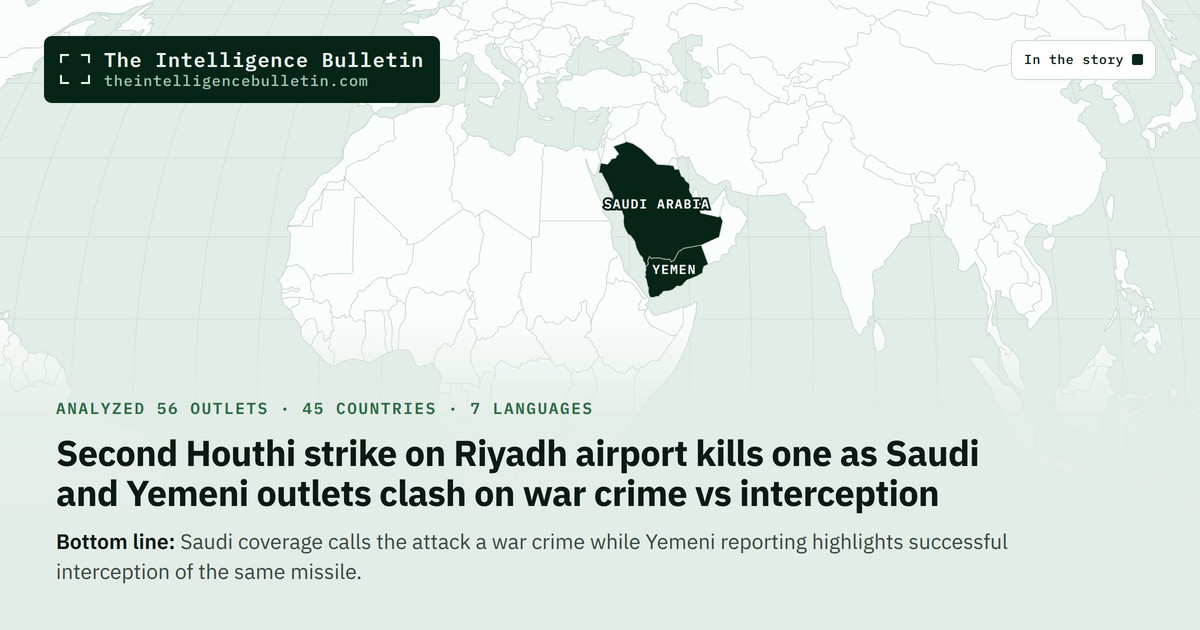
Saudi coverage calls the attack a war crime while Yemeni reporting highlights successful interception of the same missile.
- Single sourceThe second attack killed one person and injured 11.Source: Saudi civil aviation authority via JPost
- Single sourceHouthis claimed responsibility for the Riyadh and Dammam airport strikes plus Aramco targets.Source: Houthi military spokesperson Yahya Saree via JPost
- Independently reportedA Houthi cruise missile targeted Riyadh’s King Khalid airport on October 11-12, causing a fire in Terminal 4.Source: Saudi coalition and civil aviation authority, reported across Al Riyadh, Bawabatii, JPost and BBC
- Independently reportedSaudi air defenses intercepted the cruise missile near the airport.Source: Saudi coalition via Bawabatii and JPost
- What is the confirmed total casualty count across both attacks including nationalities?
- Did Houthis successfully hit Dammam airport and Aramco facilities as claimed?
Press quoted
Full analysis
The second Houthi attack reached King Khalid International Airport in Riyadh on the evening of October 11, 2026. A cruise missile targeted Terminal 4, where it produced a fire that Saudi civil aviation authorities later said killed one person and injured eleven others. Saudi-led coalition forces reported that air defenses intercepted and destroyed the incoming cruise missile in the airport’s vicinity. The same coalition statement noted that a drone was intercepted and destroyed in the Eastern Province and that a ballistic missile aimed at Khamis Mushait was also brought down. Emergency alerts sounded in Abha before the danger passed.
This strike followed by one day an earlier Houthi attack on the same airport. That October 10 incident killed thirteen people and wounded more than three hundred, according to the Saudi civil aviation authority. Four of the dead were Saudi nationals; the rest included citizens of Bangladesh, the United States, Egypt, Jordan, Palestine, Syria and Sudan. One Indian national injured in the first attack died the following day. Footage from Saudi state television showed pilgrims lined up at a gate when a bright orange flash sent people running as sections of the roof appeared to give way. The airport closed after the initial strike.
Houthi military spokesperson Yahya Saree claimed responsibility for the Riyadh attack in a televised speech and added that the group had also struck Dammam airport in the Eastern Province along with two Saudi Aramco facilities. The Houthis renewed their warning against the use of Saudi airports, stating that Saudi Arabia would bear responsibility for any failed interceptions. In statements carried by Al Masirah television, the Houthi-run foreign ministry said Saudi Arabia had carried out 124 air strikes in Yemen over the preceding twenty-four hours and warned that worse was yet to come unless the Saudi campaign stopped.
Saudi officials described the new Riyadh strike as a terrorist act and a war crime committed by the Houthi militia. The coalition statement released through Saudi channels emphasized the legal violation and the targeting of a civilian airport facility. The Saudi energy ministry confirmed that a five-day international energy conference scheduled at a convention center roughly six miles from the airport proceeded as planned, though some foreign ministers adjusted their travel. Schools in Riyadh shifted to remote learning from October 12 through October 16.
An Indian embassy advisory issued after the death of the Indian national urged all Indian citizens in Saudi Arabia to remain alert, stay indoors as needed, and follow instructions from local authorities. The embassy stated it was in contact with the victim’s family and would assist with repatriation of the body. British authorities advised their citizens against all but essential travel to Jeddah, Dammam and most Saudi airports. United States aviation authorities issued a notice to airlines to exercise caution when flying to or over the kingdom.
The accounts diverge most sharply on how to characterize the same sequence of events. Al Riyadh, the Saudi outlet, placed the coalition’s legal condemnation at the center of its reporting and described the Houthi action as a war crime without dwelling on interception details or updated casualty figures from the second strike. Bawabatii, reporting from a Yemeni perspective aligned with anti-Houthi forces, relayed the coalition announcement that air defenses had intercepted the cruise missile and stressed defensive success over any discussion of civilian harm or Houthi claims of responsibility. The Jerusalem Post, drawing on Reuters reporting, led with the one death and eleven injuries in the latest attack, incorporated the Houthi claim of responsibility, and noted that the strikes had exposed vulnerabilities in Saudi air defenses amid the kingdom’s air campaign in Yemen. Navbharat Times focused on the Indian national’s death from the first attack and the embassy advisory that followed, treating consular protection of the diaspora as the primary new development. The BBC account tracked the pattern of two strikes in two days and the resulting airport disruptions without assigning legal labels, specifying casualty counts beyond the initial reporting, or highlighting any single national response.
These differences track the national stakes each outlet serves. Saudi reporting centers the coalition’s condemnation because that language directly supports the kingdom’s position in the conflict. The Yemeni outlet aligned with the Saudi-backed side uses the interception success to demonstrate resilience against Houthi capabilities. The Israeli outlet’s emphasis on human cost and defense gaps reflects its vantage on regional escalation risks. The Indian outlet’s focus on its own citizen and the embassy response follows from the direct impact on its nationals. The BBC’s sequence-only approach keeps the account at the level of observable disruption across borders.
The corroborated elements of the story rest on repeated reporting across independent chains. Multiple outlets carried the Saudi coalition’s account of the cruise missile targeting the airport and the subsequent fire in Terminal 4. Two separate sources recorded the coalition’s claim that air defenses intercepted the missile. The single-source figures for the second attack—one death and eleven injuries—come from the Saudi civil aviation authority as reported through the Jerusalem Post. The Houthi claim of responsibility for the Riyadh strike, the Dammam strike and the Aramco targets rests solely on the statement attributed to Yahya Saree.
What to Watch
No outlet reconciled the full casualty picture across both attacks or verified the Houthi claims beyond attribution. The event’s scale therefore remains bounded by the numbers each side chose to publish. The pattern of emphasis shows that national interests shape which dimension of the same attack receives the most space: legal violation in one capital, defensive success in another, body count and escalation risk in a third, consular protection in a fourth, and chronological sequence in a fifth. The Houthis’ stated intent to continue targeting airports unless Saudi operations cease indicates that the next round of strikes, if it comes, will test whether the reported interceptions can be sustained or whether further gaps appear in the defenses.
That’s how the world told the story.
Get our daily open-source intelligence on world events in your inbox — one email a day, up to six stories.
Subscribe freeNo spam. One-click unsubscribe. See the latest email →