 AI-generated analysis published under the editorial responsibility of Rohit Sinnas. How it works →
| Press analyzed | 55 outlets · 49 countries · 15 languages |
| Press quoted | 5 sources · 3 independent accounts |
See the 49 countries
Afghanistan, Algeria, Australia, Austria, Azerbaijan, Canada, China, Dominican Republic, Egypt, France, Germany, Greece, Guam, Hungary, India, Indonesia, Iraq, Ireland, Israel, Italy, Kenya, Kuwait, Mauritania, Morocco, Netherlands, Oman, Pakistan, Paraguay, Philippines, Poland, Qatar, Romania, Russia, Saudi Arabia, Singapore, Slovakia, Somalia, South Africa, Sri Lanka, Switzerland, Syria, Tunisia, Turkey, Ukraine, United Arab Emirates, United Kingdom, Vietnam, Yemen, Zimbabwe
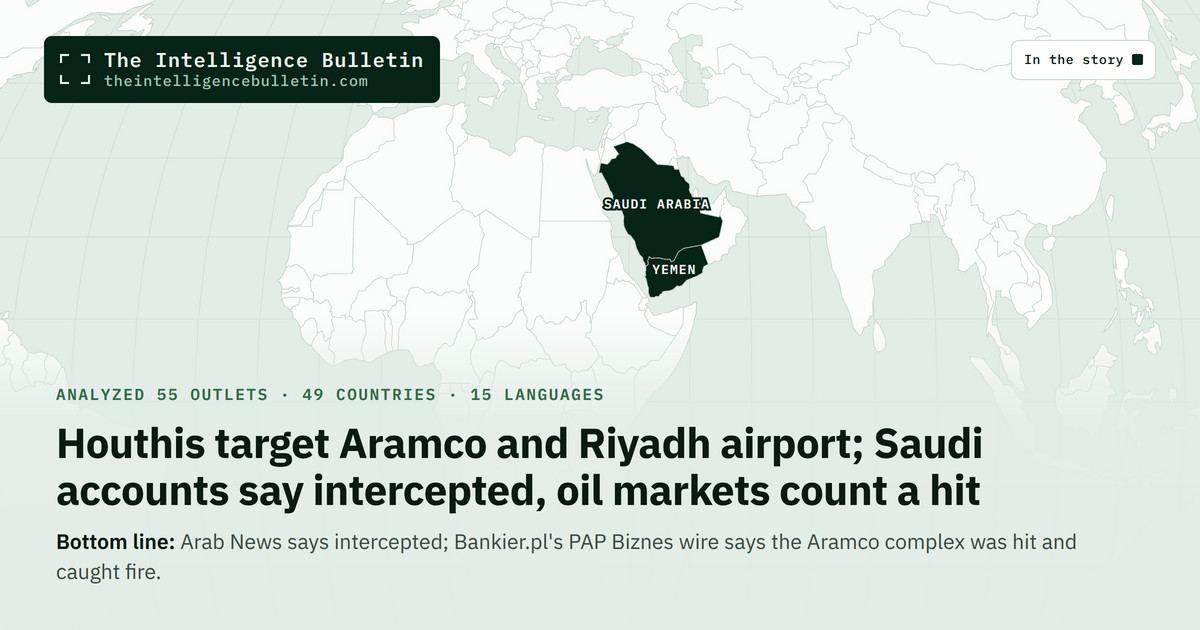
Arab News says intercepted; Bankier.pl’s PAP Biznes wire says the Aramco complex was hit and caught fire.
- Single sourceThe Houthi military spokesman announced that operations targeted Saudi Aramco in Dhahran, an Aramco refinery in Riyadh, and King Khalid International Airport.Source: Non14, relaying a Houthi military spokesman’s announcement and Al Masirah.
- Single sourceDebris from intercepted missiles injured at least five people in Riyadh and damaged residential homes.Source: Arab News, citing Saudi Civil Defense.
- Single sourceOil prices rose on Wednesday, with Brent above $106, while Morgan Stanley raised its forecast and a Jizan refinery and Red Sea oil export port were shut or attacked.Source: Bankier.pl/PAP Biznes, citing market data, Saudi Energy Ministry comments and Morgan Stanley analysts.
- Independently reportedHouthi missiles and drones targeted Riyadh and Dhahran on October 13-14, and Saudi forces intercepted several.Source: Arab News citing Saudi Civil Defense and coalition spokesman Turki Al-Maliki; Bankier.pl/PAP Biznes citing the Saudi Energy Ministry; Non14 citing the coalition spokesman.
- Independently reportedA Saudi Aramco administrative building in Dhahran was hit, causing a limited fire with no fatalities.Source: Arab News and Bankier.pl, both citing the Saudi Energy Ministry.
- Did Wednesday’s Houthi strikes reach King Khalid International Airport and the Riyadh refinery, as Non14 relays, or were they intercepted as Arab News reports?
- How much oil output and export capacity is currently offline following the Jizan refinery closure and Red Sea port attack?
- How effective have Saudi air defenses actually been, given The Irish Times’ account that Houthi drones are mapping gaps before strikes?
Press quoted
Full analysis
On the night of Tuesday, October 13, and through the following day, Yemen’s Houthi movement sent ballistic missiles, cruise missiles and drones at the Saudi capital Riyadh and at Dhahran on the kingdom’s Gulf coast, where Saudi Aramco has its headquarters. Saudi air defenses intercepted the rounds over the capital; what fell to earth still injured at least five people and damaged houses, according to Saudi Civil Defense. A fire broke out at an Aramco administrative building in Dhahran, with no reported deaths. And by Wednesday afternoon the Houthi military spokesman was announcing — in a statement relayed by the Iraqi outlet Non14 — that the operations had targeted Aramco itself, an Aramco refinery in Riyadh and King Khalid International Airport, and that airports and oil facilities would be hit again.
The Saudi official account, carried by Arab News and drawn from Civil Defense and coalition spokesman Maj. Gen. Turki Al-Maliki, frames the volley as defense that held. Late Tuesday, two cruise missiles were destroyed over Riyadh; their debris wounded four people and damaged about fifteen homes, with loud explosions heard shortly before midnight and Civil Defense later releasing images of the damage. Ballistic missiles launched at Dhahran and Haradh were stopped, and three drones were destroyed north of Riyadh. On Wednesday another ballistic missile was intercepted and destroyed, its fragments injuring one Arab resident and causing limited damage to a house and vehicle. The Energy Ministry said a Saudi Aramco administrative building in Dhahran was targeted, causing a “limited fire” with no fatalities or injuries. Civil Defense lifted danger warnings for Riyadh and Al-Kharj governorate. The Cabinet, chaired by Crown Prince Mohammed bin Salman, condemned the attacks, promised the Iran-backed rebels would face consequences, and backed coalition operations, vowing to protect freedom of navigation in the Red Sea and Bab al-Mandab.
The other side’s version of the same hours arrives secondhand. Non14 is the only source in this set that relays the Houthi military spokesman’s announcement in detail: the operations targeted Saudi Aramco in Dhahran, King Khalid International Airport and an Aramco refinery in Riyadh, and future attacks will strike airports and oil facilities. The same dispatch carries the Houthi-run Al Masirah channel’s report of four coalition airstrikes on Harib district in Marib province, and — via Saudi sources — a coalition strike on Tuesday evening against Houthi warehouses at Ras Isa in Hodeidah. The Saudi account records missiles at Riyadh and Dhahran and drones north of Riyadh, but it does not confirm a hit on an Aramco refinery in Riyadh, a claim that rests on the Houthi spokesman alone.
The attacks landed on a capital already raw from the weekend. On Saturday an attack on King Khalid International Airport killed 13 people and wounded hundreds, Arab News reported, citing the kingdom’s aviation authority; the dead included four Saudis, two Bangladeshis, a Palestinian, an American, an Egyptian, a Jordanian, a Syrian and a Sudanese, and footage released by Saudi authorities showed pilgrims waiting for flights before the blast. A Pakistani was killed when the same airport came under attack again the next day. The Irish Times, asking why the kingdom cannot stop the strikes, supplies the strategic answer: the Houthis used the UN-brokered truce that had held since 2022 to rearm, growing from roughly 30,000 fighters in 2015 to 350,000 by 2024, and they now fly drones over Saudi airspace to map gaps before launching cruise missiles, borrowing lessons from Iran. The current round began in July, when Riyadh was blamed for bombing Sana’a airport as a Houthi delegation was due to land after talks in Tehran; the Houthis declared a maritime blockade and began hitting refineries, tankers and pipelines. Arab News adds the Iranian frame: September’s shutdown of the East-West Pipeline, a drone shot down south of Mecca, a drone strike on a power station feeding the Prophet’s Mosque in Medina, and a 2017 missile intercepted near Mecca.
The energy market read the same volley differently. Bankier.pl, carrying the Polish business wire PAP Biznes, reported Wednesday that Brent crude stood at $106.18 a barrel and West Texas Intermediate at $94.58, with Brent up 74.5 percent and WTI up 64.9 percent since the start of the year. The wire’s account of the week’s events is a supply-shock ledger: the Aramco headquarters complex in eastern Saudi Arabia was hit and a fire broke out in part of it; the Jizan refinery in the kingdom’s west was closed after an earlier attack; and a key Red Sea oil-export port was struck. Morgan Stanley analysts wrote that oil exports continue but transport uncertainty remains high and attacks on Saudi infrastructure have intensified, and they lifted their Brent forecast by $5 a barrel for this and the next quarter. Energy minister Prince Abdulaziz bin Salman insisted the kingdom’s capacity to supply energy markets remains resilient. The same dispatch places the attacks inside a wider Gulf squeeze: Iran’s Revolutionary Guards reported hitting a supertanker in the Strait of Hormuz on Monday after it switched off its navigation system, a Guards navy commander warned any ship doing so would be treated as hostile, and the United States said it had helped move more than 19 million barrels by water from the Gulf.
A reader following this story through one country’s press would come away with a different event. Arab News’s account is a story of interceptions, debris and consequences — defense as a success, a “limited fire” and no fatalities at Aramco. What it does not carry is the Houthi spokesman’s claimed Aramco refinery in Riyadh or his explicit threat of further strikes on airports and oil facilities, nor the market’s arithmetic of a closed Jizan refinery, a struck Red Sea export port and Brent above $106. Bankier.pl’s account inverts the hierarchy: for it the event is the price, the closed refinery, the port and the Hormuz tanker; the debris injuries in Riyadh and the fifteen damaged homes do not appear. The Irish Times alone asks the question the others imply but do not pursue: if the missiles keep coming and the defenses keep intercepting, why is the kingdom still getting hit? Its answer — drones mapping air-defense gaps, a rearmed and battle-hardened force of 350,000 — undercuts the official claim that interception equals protection. Middle East Eye, whose text beyond its headline was not available to us, reads the strikes as “the end of Saudi Arabia’s Yemen ‘containment strategy.'” One absence runs through all of this: no Yemeni outlet is among the sources, so the Houthi version reaches the reader only through an Iraqi aggregator, and no Iranian outlet speaks for Tehran; the Iranian dimension is context, not an on-record position.
Both headline readings are true and both are partial. The Saudi official account is the most reliable on the narrow facts of Tuesday and Wednesday night: the interception claims are carried by Arab News’s Civil Defense and coalition sources and confirmed by the coalition spokesman’s statement relayed through Non14, while the Energy Ministry’s account of the Dhahran fire appears in both Arab News and Bankier.pl. The market account is not wrong that interception did not equal prevention. A missile shot down over Riyadh still put debris through fifteen homes; a “limited fire” at Aramco’s Dhahran complex, a closed Jizan refinery and a struck Red Sea export port are precisely the outcomes interception was supposed to stop, and a Brent price above $106 with an upgraded forecast is the market pricing the failure of deterrence, not its success. The Houthi spokesman’s claim of an Aramco refinery in Riyadh is uncorroborated and should be weighed as the claim of a party whose leverage is the threat itself, not the hit.
What to Watch
What happens next is not hard to read. The spokesman has promised further strikes on airports and oil facilities; the Saudi cabinet has promised consequences and is already hitting Houthi warehouses at Ras Isa. That is escalation on both sides. The four-year truce is over, the Houthis are stronger than in 2015, and the kingdom’s core energy and administrative infrastructure is reachable. Whether the next volley lands closer to a refinery or an export terminal will decide whether $106 Brent is the peak or the floor, and it will matter far beyond the Gulf.
That’s how the world told the story.
Get our daily open-source intelligence on world events in your inbox — one email a day, up to six stories.
Subscribe freeNo spam. One-click unsubscribe. See the latest email →