One Story. Many Angles.
Ukrainian accounts stress civilian deaths while Russian ones claim only military data centers were hit.
The reporting converges on deliberate Russian targeting of Ukrainian telecom and data infrastructure in Kyiv, yet parts ways on scale, intent and consequences. Kyiv Post and Ukrainian-linked accounts emphasize civilian deaths, injuries and fires at non-military sites such as the National Academy of Sciences building, framing the strikes as terror against the capital. Russian-sourced material, echoed in some Greek coverage, highlights advanced Zircon missiles and claims destruction of military data centers serving the armed forces, labeling the operation a “Digital Detox.” Specialist telecom outlets and the Romanian report quantify service loss to roughly 100,000 households and note repeated hits on Kyivstar’s headquarters, underscoring the sector’s vulnerability without confirming total collapse. The pattern shows Ukrainian outlets foregrounding immediate human cost and European/Indian specialist voices tracing connectivity fallout, while Russian narratives stress operational success against command infrastructure. No outlet supplies independent verification of the 277-missile figure or total blackout; instead the accounts reveal a shared recognition that communications nodes have become priority targets, with each side reading the same physical damage through its own strategic lens.
Perspective Analysis
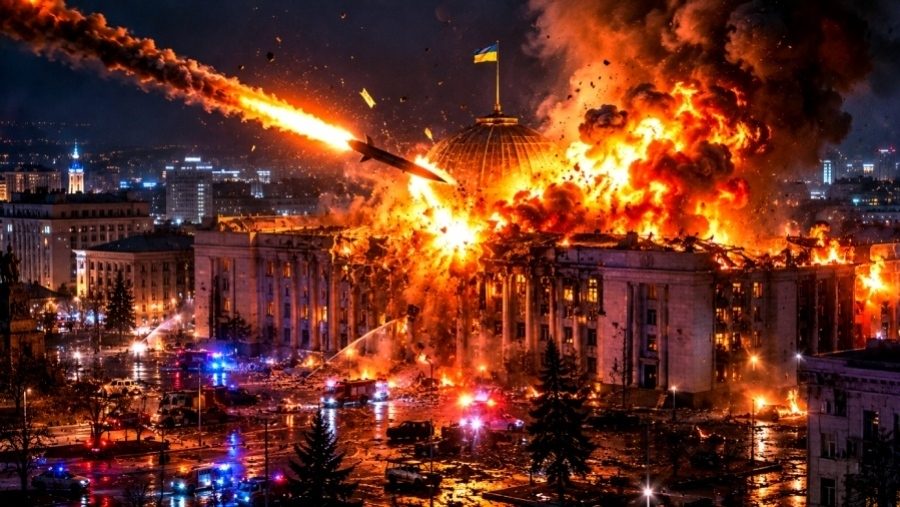
Russian forces struck Kyiv with ballistic missiles and drones over September 28 and into the early hours of September 29, hitting the headquarters of the country’s largest mobile operator Kyivstar along with multiple data centers operated by Vodafone, Omega Telecom and others. Kyivstar confirmed the damage to its head office but reported no employee injuries. Ukrainian digital authorities stated that the cumulative effect of recent strikes on data centers left service disrupted for roughly 100,000 households in the capital and surrounding region. Russian military statements described the targets as data-processing facilities supplying high-speed internet and intelligence storage to Ukrainian armed forces, including centers belonging to Datagroup and New-Telco.
The same wave of attacks also reached a building belonging to Ukraine’s National Academy of Sciences in the historic center, where rescuers recovered two bodies. Additional strikes set fire to a seven-story medical facility, a pharmaceutical plant in the Darnytsia district and several non-residential and commercial structures across Shevchenkivskyi, Obolonskyi, Solomianskyi and other districts. Kyiv Mayor Vitali Klitschko reported two civilians killed and twenty-six injured, three of them children, with eight hospitalized and one in serious condition. Ukrainian air-defense units recorded 124 drones launched during the Monday phase of the barrage, eighty-six of them jet-powered, and claimed to have destroyed or suppressed eighty-six aerial targets.
Russian accounts singled out the use of at least six Zircon hypersonic missiles in the Kyiv strikes. One Greek-language compilation placed the entire operation at fifteen hours of continuous air-raid alerts, with 277 missiles and drones of various types, 155 of them jet-powered, and listed the destruction of Kyivstar, Omega Telecom, Vodafone and Datagroup facilities as the central outcome. Russian defense ministry releases framed the telecom and data-center hits as precision strikes on military logistics nodes, jokingly terming the effort a “Digital Detox.” The same releases noted parallel attacks on fuel facilities in Kyiv, infrastructure at the Vasylkiv military airfield, a shipyard in Izmail port and a cargo vessel delivering equipment to Odesa.
Specialist coverage from the telecom sector recorded repeated prior damage to Kyivstar engineering offices earlier in September and noted that operators had already shifted traffic to backup sites after earlier data-center losses. Ukrainian foreign minister Andrii Sybiha stated that the pattern of targeting major data centers aimed at disrupting information flows, while rapid alert systems remained essential for civilian safety. President Volodymyr Zelensky condemned the strikes on civilian and scientific sites and linked them to the need for tighter international pressure on Russian weapons production.
The accounts diverge most clearly on the balance between military utility and civilian cost. Ukrainian domestic reporting foregrounds the deaths and injuries at the National Academy of Sciences building and the medical center, presenting the barrage as an assault on the capital’s ordinary infrastructure. Russian-sourced material omits those casualty figures and instead emphasizes the Zircon missiles and the claimed military character of the data centers. The single detailed fifteen-hour, 277-weapon tally appears only in the Greek aggregation that draws heavily on Russian ministry statements; no Ukrainian or specialist outlet supplies an independent count of that scale.
Service disruption figures rest on firmer cross-reporting. The Ukrainian Ministry of Digital Transformation’s estimate of 100,000 affected households is cited directly by both the Romanian business publication and the Indian telecom specialist, each of which also records Kyivstar’s own confirmation of headquarters damage. That convergence across an operator statement and a government count gives the connectivity impact a wider evidentiary base than either the casualty numbers or the specific missile-type claim.
The shared recognition across all five outlets is that communications nodes have moved to the center of targeting choices. Kyivstar’s headquarters has now been struck at least twice in the same month. Data centers previously viewed as redundant backups have themselves become primary objectives. Ukrainian sources describe the resulting loss of internet and mobile service as a direct threat to air-raid warnings and command coordination. Russian sources present the same damage as a measurable reduction in Ukrainian operational capacity. Neither side supplies an on-the-ground verification of total blackout or of the exact military versus civilian split inside any given facility.
The most solidly corroborated element remains the physical damage to Kyivstar’s headquarters and the quantified household-level service loss. Those facts rest on operator confirmation and ministry data carried by independent reporting chains. The single-source casualty count from the mayor and the Russian claim of six Zircon missiles each stand on narrower attribution. A reader relying solely on Ukrainian domestic coverage would correctly register the human toll and the academy building fire but would under-weight the repeated, documented pattern of data-center strikes. A reader limited to Russian-sourced material would register the advanced-missile narrative and the military-intelligence rationale but would miss the household disruption count and the academy casualties. The specialist and regional business outlets supply the narrowest but most consistent bridge between the two: the measurable effect on everyday connectivity.
What to Watch
The pattern indicates that Russian forces intend to keep pressure on Ukraine’s digital backbone. Each new strike on a data center forces operators to reroute traffic and accelerates wear on backup systems already stressed by earlier attacks. Ukrainian authorities have responded by accelerating redundancy measures and by publicizing the civilian consequences to sustain external support. The next measurable test will be whether service restoration keeps pace with the rate of new strikes or whether cumulative degradation begins to affect alert dissemination and logistics in measurable ways. The reporting shows that both sides now treat telecom infrastructure as a decisive domain; the difference lies in which consequences each chooses to foreground.
That’s how the world told the story.
Get tomorrow’s bulletin by email — one briefing, up to six stories.
Subscribe freeNo spam. One-click unsubscribe. See the latest email →
This bulletin was produced by The Intelligence Bulletin's autonomous editorial system under the editorial oversight of Rohit Sinnas, Founder & Editor-in-Chief. How it works →