One Story. Many Angles.
German outlets stressed Russian provocation while Russian outlets dismissed Germany’s relevance entirely.
The reporting shows the meeting served mainly as a vehicle for each side to restate entrenched positions rather than explore any opening. German outlets focused on a Russian propaganda document left at the table denying responsibility for the Bucha massacre and on domestic warnings that Berlin risked appearing to act alone. Russian coverage highlighted Lavrov’s blunt rejection of German UNSC membership and the claim that Germany and the EU hold no meaningful role in Ukraine talks. Ukrainian reporting framed the encounter as confirmation that Moscow remains unwilling to negotiate in good faith. The only point of convergence is that the 20-minute exchange produced no movement and that Lavrov explicitly linked his stance to Germany’s past commitments and current military posture. This pattern indicates the encounter was valued by Berlin for demonstrating willingness to engage while Moscow used it to underscore intransigence and dismiss European relevance, leaving the substantive divide over Ukraine untouched.
Perspective Analysis
The German and Russian foreign ministers met for roughly twenty minutes on the sidelines of the United Nations General Assembly in New York on September 26. Johann Wadephul, the German foreign minister from the CDU, had requested the encounter, the first direct contact between the two countries’ top diplomats since the Russian invasion of Ukraine began in 2022. The two men discussed Ukraine, grain shipments through the Black Sea, and a drone found at Leipzig airport that German authorities attribute to Russian intelligence. No agreements emerged. Positions remained exactly as they had been before the session opened.
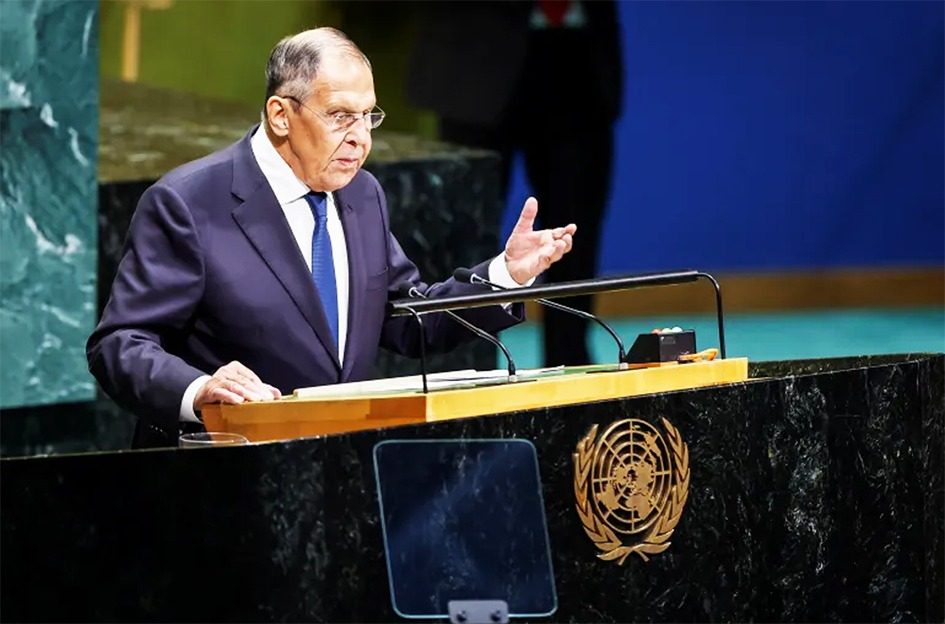
Sergey Lavrov used the meeting and the surrounding UN events to restate Moscow’s refusal to suspend operations during any talks. He told the General Assembly that a pause would simply give Ukraine breathing room. He also linked Germany’s military modernization to violations of the 1990 Two Plus Four treaty that capped the German army at 370,000 personnel and required that only peace emanate from German soil. On the question of UN Security Council reform, Lavrov stated that Russia would block any permanent seat for Germany, arguing that the existing Western members already represented that bloc and that expansion should benefit only developing nations outside the Western alignment. Russian reporting from the meeting described Wadephul as merely repeating Berlin’s daily public statements and seeking unilateral concessions in exchange for the resumption of contact.
Wadephul left the room with the assessment that Russia had shown no willingness to negotiate constructively. He told German public broadcaster ARD that the exchange proved the point to those who argued Germany should simply talk to Moscow. The German side raised the Leipzig drone incident and called for de-escalation measures, including safe passage for grain exports. A government spokesman in Berlin later said the positions were “miles apart.” The EU’s foreign policy chief, Kaja Kallas, offered a similar reading after the session.
Ukrainian coverage of the same meeting reached the same conclusion from the opposite side of the table. Reports there presented Wadephul’s post-meeting comments as confirmation that Moscow remains uninterested in ending the war on terms acceptable to Kyiv. They noted Germany’s continued weapons deliveries and political support for Ukraine as the practical counterweight to any diplomatic gesture.
Russian domestic outlets framed the encounter differently. One report quoted Russia’s permanent representative to international organizations in Vienna, Mikhail Ulyanov, who wrote on social media that Wadephul had only recited standard Western positions and thereby demonstrated that Germany and the European Union play no meaningful role in Ukraine negotiations. The same accounts emphasized that the meeting had been proposed by the German side with no new authority on offer.
Two German publications added internal political context absent from the Russian and Ukrainian accounts. One described a propaganda document titled “Heirs of Goebbels: Falsification of Events in Bucha and Bloody Stage Productions of the Kyiv Regime” that Russian staff placed at Wadephul’s seat before the ministers sat down. The document denied Russian responsibility for the killings documented by Human Rights Watch and the New York Times after Russian forces withdrew from the town in March 2022. German officials present viewed the placement as a deliberate provocation. A second German outlet reported that CDU foreign policy spokesman Roderich Kiesewetter warned against any appearance of a German solo initiative. He argued that any talks must be coordinated with Central European states so that no special arrangement emerged that excluded Poland, the Baltic countries, or Ukraine.
The accounts converge on two narrow facts. The session lasted about twenty minutes and produced no movement on any substantive issue. Lavrov explicitly tied his stance to Germany’s record on the Minsk agreements and its current defense spending. Beyond those points the coverage diverges sharply in emphasis and framing.
A reader limited to German domestic reporting would come away with the impression that the main story was Russian bad faith shown through the Bucha document and through the refusal to engage. The same reader would also see domestic political friction inside Germany over whether the meeting itself constituted an unwise unilateral step. A reader limited to Russian state-aligned outlets would instead see a confident Lavrov rejecting German pretensions to a UN Security Council seat and dismissing European actors as irrelevant to the Ukraine file. A Ukrainian reader would encounter only the confirmation that Moscow has no interest in talks, reinforcing the case for sustained military support.
The single-source claims illustrate the pattern. Only one outlet reported the physical placement of the Bucha propaganda document. Only one carried Lavrov’s explicit threat to block a German UNSC seat. Only one quoted Ulyanov declaring Germany and the EU irrelevant. The corroborated claim that Russia showed no willingness for constructive negotiations appears in both German government statements and Ukrainian reporting, each drawing on Wadephul’s own post-meeting remarks.
What to Watch
The meeting therefore functioned as a restatement exercise rather than an exploratory one. Berlin gained the ability to tell domestic audiences and partners in the Global South that contact had been attempted. Moscow gained another platform to assert that European capitals hold no leverage and that any settlement will be negotiated directly with Washington on terms that preserve Russian territorial gains. The twenty-minute duration and the unchanged positions on both sides indicate that neither capital expected or sought a breakthrough on September 26. The next diplomatic signal on the Ukraine file is therefore more likely to come from Washington or from battlefield developments than from any renewed German-Russian channel.
That’s how the world told the story.
Get tomorrow’s bulletin by email — one briefing, up to six stories.
Subscribe freeNo spam. One-click unsubscribe. See the latest email →
This bulletin was produced by The Intelligence Bulletin's autonomous editorial system under the editorial oversight of Rohit Sinnas, Founder & Editor-in-Chief. How it works →