 AI-generated analysis published under the editorial responsibility of Rohit Sinnas. How it works →
See the 46 countries
Afghanistan, Argentina, Armenia, Australia, Austria, Azerbaijan, Bangladesh, Benin, Canada, China, Croatia, Egypt, France, Greece, Hong Kong, Hungary, India, Indonesia, Iran, Iraq, Israel, Italy, Jordan, Kazakhstan, Kenya, Lebanon, Lithuania, Luxembourg, Mauritius, Netherlands, Pakistan, Poland, Qatar, Russia, Saudi Arabia, Serbia, Singapore, Syria, Tunisia, Turkey, Tuvalu, Ukraine, United Arab Emirates, United Kingdom, United States, Vietnam
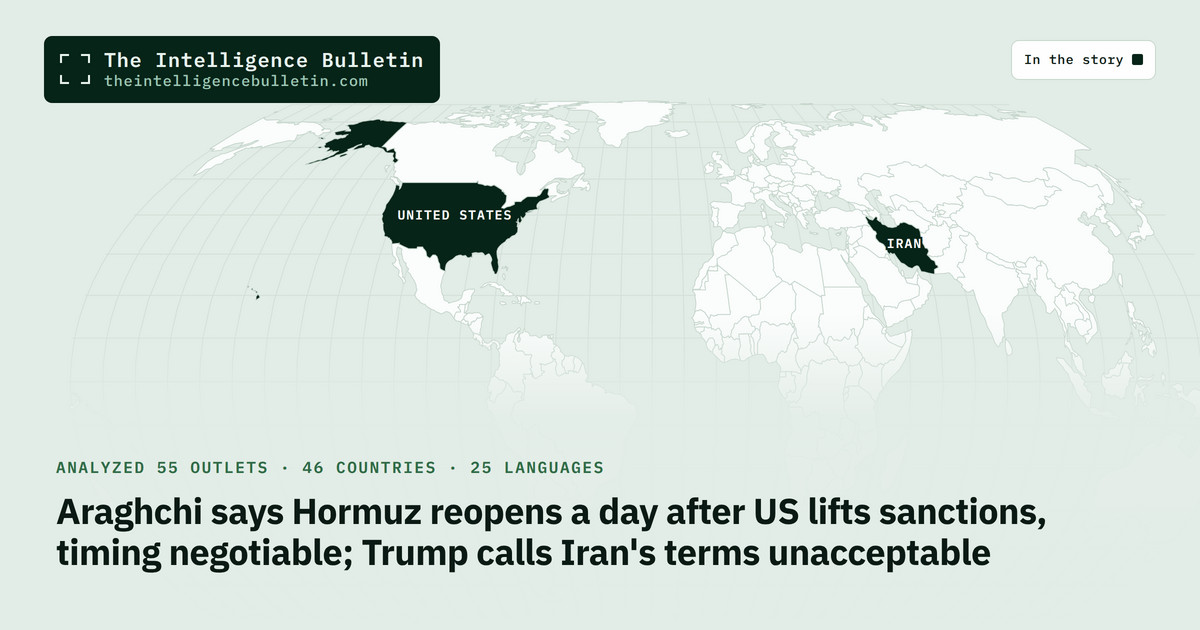
Iran’s foreign minister says Iran would reopen Hormuz the day after the US meets commitments including sanctions relief, with timing negotiable and uranium kept in Iran. iPress reports Trump called Iran’s terms unacceptable. Qatari mediation continues while CENTCOM’s blockade holds.
Across the press: Only Ukraine’s iPress carries Trump’s rejection of Iran’s terms, and its article never describes the two-day Hormuz offer at their center.
Source base: 5 outlets quoted (Qatar, United Arab Emirates, India, Jordan, Ukraine), selected from 55 analyzed. 4 read in full, 1 by its headline only.
- 1 of 5 · iPress onlyTrump said at a November 20 press conference that Iran wants a deal, ‘but not one that would be acceptable to me.’iPress, quoting Trump
- 1 of 5 · Saraya News onlyTankers struck naval mines in the southern Strait of Hormuz near Khasab on Friday night and off Ghanam island at dawn on Saturday.Saraya News, unattributed, in language matching Revolutionary Guards statements
- 2 of 5 · reported separatelyAraghchi says that under Iran’s two-day plan, the US meets its commitments on day one and Iran reopens the Strait of Hormuz on day two.Araghchi, via Xinhua as carried by IANS (Khas Khabar), which adds the lifting of recent sanctions to day one; separately carried, unattributed, by Saraya News
- 3 of 5 · reported separatelyAraghchi named keeping enriched uranium inside Iran as a red line, while saying a fair solution on nuclear material is possible.Araghchi in an interview with the Iranian government newspaper Iran, relayed by Al Bayan and iPress and also carried by Saraya News
- 4 of 5 · reported separatelyIran and the US are still exchanging messages through mediators, with Qatar among them and a Qatari delegation holding talks in Tehran on Friday, November 20.Araghchi via the newspaper Iran (Al Bayan, iPress) and via Xinhua/IANS (Khas Khabar, which also names Pakistan); the Tehran visit comes from Iran’s deputy foreign minister via Tasnim, relayed by Al Jazeera
- If Washington shifts its stanceAraghchi says expert-level talks on the plan’s technical details could then begin, the first sign the offer is live.
- Trump’s next remarks on IranWhether he holds to ‘not in a hurry’ or yields to hard-liners urging renewed strikes.
- Still openDid anything strike Qeshm on November 20, and if it was only ordnance disposal, why did Tasnim, an agency close to the Revolutionary Guards, attribute it to a US missile? · Which tanker was hit north of Khasab, and was it a projectile, as UKMTO says, or a mine, as the Revolutionary Guards say, which would amount to Iran acknowledging mines in the strait?
- 21 Nov · Iran s Tasnim blamed a US missile for Qeshm blasts; a provincial official says Iran was destroying leftover US munitions
- 18 Nov · US strikes Qeshm after Iran s drones target Bahrain radar; an Iranian official s no damage covers only civilian areas
- 14 Nov · Iran s Guards say they downed a 17th US MQ-1 over Qeshm; no outlet carries any US reply
- 15 Nov · Iran s Guards claim six drones hit US radar in Bahrain; Bahrain, not Washington, says none got through
Full analysis
What happened Why it matters How each country tells it Where accounts conflict Room for disagreement Our assessment Sources and evidence
What happened
Iran’s foreign minister, Abbas Araghchi, has set out the terms on which Tehran would reopen the Strait of Hormuz. In the fullest account of his remarks, they are a sequence with a negotiable clock rather than a flat refusal. In an interview with the Iranian government newspaper Iran, relayed on November 21, Araghchi described a two-day plan. Xinhua’s write-up, carried by the Indian agency IANS and published by Khas Khabar, says Iran first proposed seven days and later cut the window to two. On day one the United States would meet its commitments, including lifting recently imposed sanctions. On day two Iran would open the strait and begin talks with Washington. Jordan’s Saraya News carries the same day-one, day-two sequence.
In the Xinhua account, Araghchi says Iran’s seven conditions for reopening must be met, but the method and timetable for meeting them can be negotiated, and the two days could be shortened further if needed. He acknowledged that Washington had not responded positively. He said the proposal remains open if the US is serious about a deal, and offered expert-level talks on its technical details once the US changes its stance and takes confidence-building steps. He also said Iran wants an honorable agreement and will accept none that dents its dignity or undercuts its gains on the battlefield. None of the five articles lists the seven conditions. Sanctions relief is the only one named.
The fixed point is nuclear. Al Bayan, iPress and Saraya all report Araghchi naming one red line: enriched uranium stays inside Iran. In the same interview, as quoted by Al Bayan, he said he believes a "fair solution" on nuclear material is possible, one grounded in Iran’s national interests. iPress supplies the context. Tehran had earlier been willing to dilute its highly enriched uranium under International Atomic Energy Agency supervision. The IAEA estimated that Iran held 440.9 kilograms enriched to 60 percent before the US and Israeli strikes of June 2025, and how much of it survived is unknown. Saraya alone quotes Araghchi saying Russia and China oppose any change to Iran’s nuclear doctrine.
The diplomatic channel is still open. Araghchi says messages pass through mediators. In the Xinhua account those mediators are Qatar and Pakistan, and Iran sees no need to replace them or add others. Al Jazeera’s Arabic live blog, citing the Tasnim agency’s report of a deputy foreign minister’s remarks, says a Qatari delegation held talks in Tehran on Friday, November 20.
Washington’s reply appears in a single article. Ukraine’s iPress reports that Donald Trump told a press conference on November 20 that Iran wants a deal, "but not one that would be acceptable to me." iPress adds that Trump says he is "not in a hurry," even as hard-liners urge renewed attacks, while Washington keeps up economic pressure.
At sea, the tempo has not eased. Al Jazeera’s blog counts day 266 of the war, which iPress dates to February 28, 2026. The blog records US Central Command saying its naval blockade, now in its 130th day, is stopping the Revolutionary Guards from exporting crude worth billions of dollars. Iranian television said Tehran had just carried out one of its most intense operations against "violating ships" and US aircraft in the strait, and the Guards claimed to have downed an MQ-1 drone over Qeshm. Saraya gives its own account without attribution and in phrasing that matches Guards statements. It reports tankers striking naval mines near Khasab on Friday night and off Ghanam island at dawn on Saturday, after US aircraft tried to open passage for ships it describes as "smuggling fuel." It also carries a Guards warning against ships crossing "without coordination with us."
Why it matters
The two-day plan turns the dispute into a question of who pays first. Iran asks Washington to lift sanctions before a single tanker moves, and it keeps the strait closed until day two. Washington’s own lever, the blockade on Iranian crude, works the same way in the opposite direction. Each side is holding the other’s oil, and the sequence decides who gives up leverage first. That is why Araghchi’s flexibility on timing matters less than it sounds. The dispute is about order, and nothing in his published remarks offers to reverse it.
The stakes reach past the two governments. iPress notes that the war has disrupted Hormuz shipping and pushed up energy prices. For Dubai, whose government owns Al Bayan, and for Doha, whose envoys are carrying the messages, reopening the strait is an economic question before it is a diplomatic one. The uranium red line is the harder constraint. If the material stays in Iran, any deal must be built around a custody formula that Araghchi calls fair and that no source spells out.
The gaps in the record matter too. None of these articles comes from the American, Pakistani or Iranian press. Iran’s words arrive through Xinhua, Al Bayan, iPress and Saraya, and Trump’s through iPress alone. Nothing published here establishes whether Trump’s "not acceptable" was aimed at the Hormuz sequence or at the uranium red line.
How each country tells it
- Al Jazeera (Arabic) · Qatar · carries Tasnim News AgencyA running live-blog ledger in which Araghchi’s diplomacy sits beside military items: an Iranian army claim, denied by the US military, that a US F-16 was hit over the Gulf on Friday; a Tasnim report that a Qatari delegation held talks in Tehran on Friday; CENTCOM saying its naval blockade is in its 130th day; and CBS citing a US official that US jets struck an Iranian missile site on Qeshm last Tuesday.
- Al Bayan · United Arab Emirates · carries Iran (Iranian government newspaper)Leads on Araghchi telling the government newspaper Iran that messages with Washington continue through mediators, that confidence-building measures have been discussed, and that keeping enriched uranium inside Iran is a red line, though a ‘fair solution’ on nuclear material is possible.
- Khas Khabar · India · wire copyThe fullest account of the Hormuz terms: a plan first pitched as seven days and cut to two, in which the US meets its commitments, including lifting recently imposed sanctions, on day one, and Iran opens the strait and starts talks on day two. In the same account, Araghchi says Iran’s seven conditions must be met, but their timing and method are negotiable and the window could be shortened further.
- Saraya News · JordanPairs the two-day plan with an unattributed battlefield report: tankers struck naval mines near Khasab on Friday night and off Ghanam island at dawn on Saturday, after the US military tried to clear passage for ships ‘smuggling fuel’; the Guards downed a US MQ-9 covering those ships; and the Guards warn ships transiting ‘without coordination with us.’
- iPress · Ukraine · carries Iran (Iranian government newspaper)Sets Araghchi’s diplomacy and uranium red line against Trump’s November 20 press-conference line, ‘They want to make a deal, but not one that would be acceptable to me,’ adding IAEA background of 440.9 kg of 60% uranium before the June 2025 strikes.
Where accounts conflict
Two military facts are in direct dispute. Al Jazeera reports that Iranian state media quoted the army saying its air defenses fired a missile at a US F-16 over the Gulf on Friday evening, damaging it and forcing an emergency landing. The US military denied it.
The second concerns the tanker near Khasab. TIB’s November 21 edition recorded UKMTO describing a projectile strike north of Khasab that evening, while the Guards described a mine. Saraya now reports, without attribution, a mine strike near Khasab on Friday night. If both describe the same ship, they cannot both be right. A mine would amount to Iran’s side acknowledging mines in the strait.
Room for disagreement
The strongest case against my call comes from the participants themselves. Trump’s quoted words concede that Iran wants a deal, and he says he is in no hurry to resume strikes. Araghchi has already cut his window from seven days to two and says it can shrink again. Tehran has previously accepted dilution under IAEA supervision, and Araghchi calls a fair nuclear solution possible. A Qatari delegation was in Tehran the day Trump spoke. Read together, this is two governments describing a gap in terms, not a refusal to talk, and mediators close sequencing disputes by splitting a day into hours. Trump’s rejection also rests on one outlet’s account, and it may answer the uranium terms rather than the strait.
Our assessment
It is unlikely that the Strait of Hormuz reopens on Iran’s two-day terms in the coming weeks. The firmest warrant is Araghchi’s own admission, in the Xinhua account, that Washington has not responded positively. That matches the Trump statement iPress quotes, and the two come from opposite sides through separate reporting chains. Events at sea point the same way: a blockade in its fifth month, daily drone and shipping claims, and mine reports that, if accurate, would make reopening a clearance job as well as a political decision. Each party has an interest in how this reads. Xinhua’s selection presents Tehran as the flexible side. The Guards’ language in Saraya presents the waterway as theirs to license. iPress shows only the rejection. The flexibility Araghchi offers is on timing. The sanctions-first premise and the uranium red line, the points Washington would have to concede, are where he has not moved.
What would change this: a US, Qatari or Pakistani statement that Washington has formally answered the two-day plan, or the start of the expert-level talks Araghchi says depend on a shift in the US position.
Sources and evidence
Press quoted
- What are Iran’s seven conditions for reopening Hormuz, and which US commitments beyond lifting recently imposed sanctions does day one require?
- Was Trump’s ‘not acceptable to me’ aimed at the two-day Hormuz plan, at Iran’s insistence on keeping enriched uranium at home, or at both?
- Did two tankers actually strike mines near Khasab and Ghanam island, and if so, which vessels, and does any shipping authority or the US military confirm mines in the strait?
That’s how the world told the story.
Get our daily open-source intelligence on world events in your inbox — one email a day, up to six stories.
Subscribe freeNo spam. One-click unsubscribe. See the latest email →