 AI-generated analysis published under the editorial responsibility of Rohit Sinnas. How it works →
See the 58 countries
Afghanistan, Argentina, Australia, Austria, Azerbaijan, Bahrain, Bangladesh, Brazil, Canada, China, Croatia, Denmark, Egypt, France, Germany, Greece, Hungary, India, Indonesia, Iran, Iraq, Ireland, Israel, Italy, Kenya, Kuwait, Latvia, Lebanon, Luxembourg, Mali, Mexico, Morocco, New Zealand, Nigeria, Norway, Oman, Pakistan, Paraguay, Peru, Philippines, Poland, Qatar, Romania, Russia, Saudi Arabia, Serbia, Slovenia, South Africa, Sri Lanka, Switzerland, Syria, Tunisia, Turkey, Ukraine, United Arab Emirates, United Kingdom, United States, Vietnam
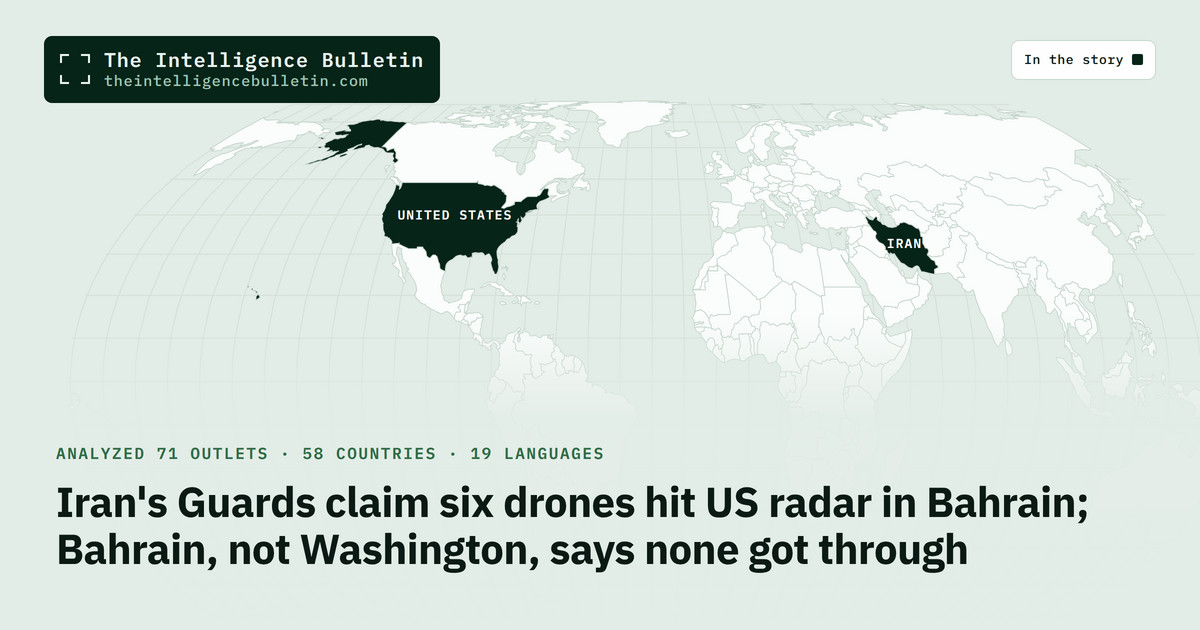
Iran’s Revolutionary Guards say six drones precisely hit a US air-defense radar at Bahrain’s Riffa base on November 15; Bahrain’s military says it destroyed them before they reached their targets. No US statement on the strike appears in the reporting.
Across the press: CENTCOM rebutted Friday’s radar claim; across five outlets, Sunday’s was rebutted only by Bahrain’s military, with no US statement reported.
Source base: 5 outlets quoted (Saudi Arabia, Lebanon, United Arab Emirates, Israel, Ukraine), selected from 71 analyzed. 4 read in full, 1 by its headline only.
- DisputedThe Guards say the drones hit their target precisely, while Bahrain’s military says it intercepted the drones before they reached their targets.Source: The IRGC claim is relayed by Al-Manar, The National, and Bloomberg; the Bahraini military’s interception account is carried by AFP, The National, and Bloomberg.
- 1 of 5 · The National onlyThe GCC secretary-general called the attack a ‘blatant challenge’ to peace efforts, the UAE called it a ‘flagrant violation’ of Bahrain’s sovereignty, and Qatar, a US-Iran mediator, warned of a ‘dangerous escalation.’The National only.
- 5 of 5 · reported separatelyIran’s Revolutionary Guards said six drones from their Aerospace Force targeted a US air-defense radar at the Riffa helicopter base in Bahrain on Sunday, November 15.The IRGC statement as carried by Iranian state broadcasting, Fars, and Press TV, reported by AFP, Reuters, Bloomberg, Al-Manar, and The National.
- 3 of 5 · reported separatelyBahrain’s Interior Ministry told residents to go to the nearest safe location, its first public threat alerts since September.AFP via Arab News, Reuters copy in Ynetnews, and The National.
- 2 of 5 · reported separatelyOn the same day, Iranian parliament speaker Ghalibaf said the war could end if Washington accepts Iran’s conditions, but that Tehran will not stay in a state of ‘neither war nor peace.’The National citing Fars; ZN.ua citing Bloomberg.
- Tuesday, November 17Iranian Foreign Minister Abbas Araghchi holds talks in Muscat with his Omani counterpart, a first test of whether diplomacy survives the Bahrain strikes.
- This weekTrump is due to discuss the Iran war at a trilateral meeting with his Chinese and Russian counterparts, where any US response may be signaled.
- If and when CENTCOM speaks on RiffaA US statement on whether its radar was damaged would settle the dispute between the Guards and Bahrain’s military and frame any retaliation.
- Still openWho struck Sirik on November 12: a US air attack, as the Guards say, or someone else, given that CENTCOM has not claimed it and IRNA calls the targets military while the IRGC calls the target a telecom mast? · Did anything Iran launched reach the radar site in Bahrain, given that the selected reporting includes no Bahraini official account and no damage assessment beyond CENTCOM s no damage ?
- 13 Nov · Iran s Guards claim they destroyed a US early-warning radar in Bahrain; CENTCOM says it downed two drones
- 14 Nov · Iran s Guards say they downed a 17th US MQ-1 over Qeshm; no outlet carries any US reply
- 13 Nov · Iran s Guards call Hormuz tanker blasts an accident ; state media says mines the US military says are gone
Full analysis
What happened Why it matters How each country tells it Where accounts conflict Room for disagreement Our assessment Sources and evidence
What happened
Sirens sounded over Bahrain before dawn on Sunday, November 15. An AFP journalist in Manama heard explosions around 4:00 am, and residents reported a second series of blasts around 6:30 am. The Interior Ministry posted alerts on X calling on "residents to remain calm, proceed to the nearest safe location, and follow news through official channels." AFP and Reuters both report these were the kingdom’s first public threat warnings since September; Reuters counts two that day.
Iran’s Islamic Revolutionary Guard Corps claimed the attack in a statement posted by the state broadcaster on Telegram: "The US air defense radar system at the Al-Riffa helicopter base in Bahrain was targeted by six drones belonging to the IRGC Aerospace Force." The Guards said the drones hit their targets precisely; The National quotes them claiming a "precise and successful impact." Al-Manar, the Hezbollah channel, carried the communiqué on the Guards’ own terms and adds two details: that the strike was the "second phase of the response to American aggressions," and that explosions heard across Bahrain bore out the hit. As AFP carried it, the statement closed with a warning: "The Strait of Hormuz is closed, and any aggression by the American enemy will be met with an even harsher and more forceful response." Reuters, citing Fars, reports the Guards called it retaliation for "hostile US actions."
Bahrain told a different story. Its military said it intercepted several Iranian attacks, "preventing them from reaching their intended targets," and the foreign ministry said air defenses shot down Iranian drones. The ministry added that the kingdom, home to the US Navy’s Fifth Fleet, "rejects turning its territory into an arena for settling scores and holds Iran fully responsible for these attacks and their consequences." No US statement on Sunday’s strike appears in any of the five outlets. Reuters wrote that neither US nor Bahraini authorities immediately confirmed the attack or reported damage.
It was Iran’s second claimed attack on Bahrain in three days. TIB reported on November 13 that the Guards claimed to have destroyed a US early-warning radar there on Friday, in retaliation for an air attack on a communications tower in Sirik, Iran; US Central Command answered that it shot down two one-way attack drones, with no injuries or damage. AFP calls Friday’s strike the first on a Gulf country since early September.
The war behind it is in its ninth month. It began on February 28 with US-Israeli strikes that killed Supreme Leader Ayatollah Ali Khamenei, and AFP reports Bahrain is among the Gulf states that have weathered thousands of Iranian drone and missile strikes since. The National reports that a 60-day negotiating window opened by an initial US-Iran agreement in June expired without a deal. Bloomberg, as relayed by ZN.ua, notes the United States carried out limited strikes on Iranian air defenses on November 6, its first since the midterm elections.
The same Sunday, Iran’s parliament speaker Mohammad Bagher Ghalibaf, a senior negotiator with Washington, said through Fars that the path to ending the war is open if the US accepts Iran’s "logical conditions," but that Tehran will not remain in a state of "neither war nor peace" and that its forces will "determine the geography of battle" if US strikes resume. Bloomberg reads this as a sign the sides remain far apart, with Iran’s nuclear program and control of Hormuz shipping the main disputes.
Why it matters
The strike lands on the Gulf states caught between the two sides. The National, the only outlet carrying their reactions, reports that GCC Secretary-General Jasem Al Budaiwi called it a "blatant challenge" to regional peace efforts, the UAE called it a "flagrant violation" of Bahrain’s sovereignty, and Qatar warned of a "dangerous escalation" that could "undermine political and diplomatic efforts." Qatar’s words weigh most, because it is one of the main channels between Washington and Tehran. The cost was immediate: The National reports Saudi Arabia’s benchmark index fell 0.7 percent and Qatar’s 1.8 percent.
For Washington, the strike tests a condition Trump had just set. Reuters reported on Saturday that he indicated he could refrain from further attacks on Iran provided Tehran and the Houthis avoid new provocations, while keeping the US naval blockade. Iran’s claimed strike on a US radar came the next morning. AFP reports Trump plans to discuss the war at a trilateral meeting with his Chinese and Russian counterparts this week, and Araghchi visits Muscat on Tuesday, so any US answer would fall across both.
At sea, the pressure is rising in parallel. The National reports the Guards’ naval forces claimed on Sunday that one tanker sank and a second was damaged by mines in Hormuz, claims it says were not independently verified.
How each country tells it
- Arab News · Saudi Arabia · wire copyA Manama-datelined AFP dispatch that puts the two blast series heard over Bahrain at about 4:00 am and 6:30 am beside Bahrain’s statements: the military said its interceptions kept the attacks from reaching their targets, and the foreign ministry said Bahrain ‘rejects turning its territory into an arena for settling scores.’
- Al-Manar · Lebanon · carries Islamic Revolutionary Guard CorpsRelays the Guards’ statement that six drones struck the US air-defense radar at Riffa helicopter base ‘with precision’ as the ‘second phase of the response to American aggressions,’ citing explosions heard across Bahrain as support.
- The National · United Arab Emirates · original reportingTreats the strike as an attack on Bahrain and on diplomacy, gathering the GCC chief’s ‘blatant challenge,’ the UAE’s ‘flagrant violation’ of sovereignty, and Qatar’s warning of a ‘dangerous escalation’ that could undermine mediation.
- Ynetnews · Israel · carries ReutersCalls the attack an Iranian claim that neither US nor Bahraini authorities ‘immediately confirmed’ and for which neither reported damage, and ties it to Trump’s stated condition that he would hold off on strikes only if Iran and the Houthis avoid new provocations.
- ZN.ua (Dzerkalo Tyzhnia) · Ukraine · carries BloombergRetells Bloomberg’s account, which pairs the six-drone launch with Tehran’s renewed readiness to end the conflict, voiced by parliament speaker Ghalibaf.
Where accounts conflict
The central dispute is whether anything hit Riffa. The Guards, via Al-Manar, The National and Bloomberg, say the six drones struck the radar precisely. Bahrain’s military, via AFP, The National and Bloomberg, says they were destroyed before reaching their targets. The Guards’ only evidence offered is the explosions heard across Bahrain, which are equally consistent with interceptions; Bahrain offers its own word. The party that could settle it, the US military operating the radar, is not quoted anywhere.
A second difference shapes how the strike reads. ZN.ua’s retelling of Bloomberg calls Sunday’s attack Iran’s first on Bahrain in several weeks and dates the previous one to early September, with no mention of Friday. AFP, Reuters and The National all report Friday’s claimed strike and CENTCOM’s rebuttal. One version makes Sunday a lone jolt; the other makes it a pattern.
Room for disagreement
The case for escalation is substantial. Trump’s own stated condition, as Reuters reported it, has now been tested on the record, and the November 6 strikes show he has already acted once since the midterms. The Guards frame Sunday as a "second phase," which implies a sequence rather than a single gesture. Ghalibaf explicitly rejects the limbo of "neither war nor peace," which reads as Tehran trying to force a decision rather than wait out talks. And Reuters’ wording, that no confirmation came "immediately," leaves room for a US statement still to come.
Our assessment
An acknowledged US military response to the Riffa strike before the Muscat talks and Trump’s trilateral meeting play out is unlikely. The warrant is the pattern on the record: on Friday, CENTCOM’s answer to a radar claim was a denial of damage, not a counterstrike, and on Sunday five outlets carrying three wire services and two independent newsrooms report no US statement at all. Bahrain’s interception account lets Washington treat the attack as a failed provocation rather than a hit on American forces. Each party has a stake in its version: the Guards need a hit to make the "second phase" real, Manama needs its defenses to have worked, and Washington’s silence preserves its options. The Sirik question TIB left open on November 13, an attack the Guards blame on the US that CENTCOM has not claimed, suggests any exchange may stay below the level of acknowledgment.
What would change this: a CENTCOM statement acknowledging damage or casualties at Riffa, or a further Iranian strike that Bahrain does not report intercepting.
Sources and evidence
Press quoted
- Has CENTCOM or the Pentagon said anything about Sunday’s attack, and was any US radar at Riffa touched, given that none of the five outlets carries a US statement?
- Does the US actually operate an air-defense radar at Riffa, a base best known as home to Bahraini military helicopters, and what ‘American aggressions’ does the Guards’ ‘second phase’ answer?
- Will Trump treat a second strike on a Fifth Fleet host in three days as the provocation that, by his own condition, would end his restraint?
That’s how the world told the story.
Get our daily open-source intelligence on world events in your inbox — one email a day, up to six stories.
Subscribe freeNo spam. One-click unsubscribe. See the latest email →