 AI-generated analysis published under the editorial responsibility of Rohit Sinnas. How it works →
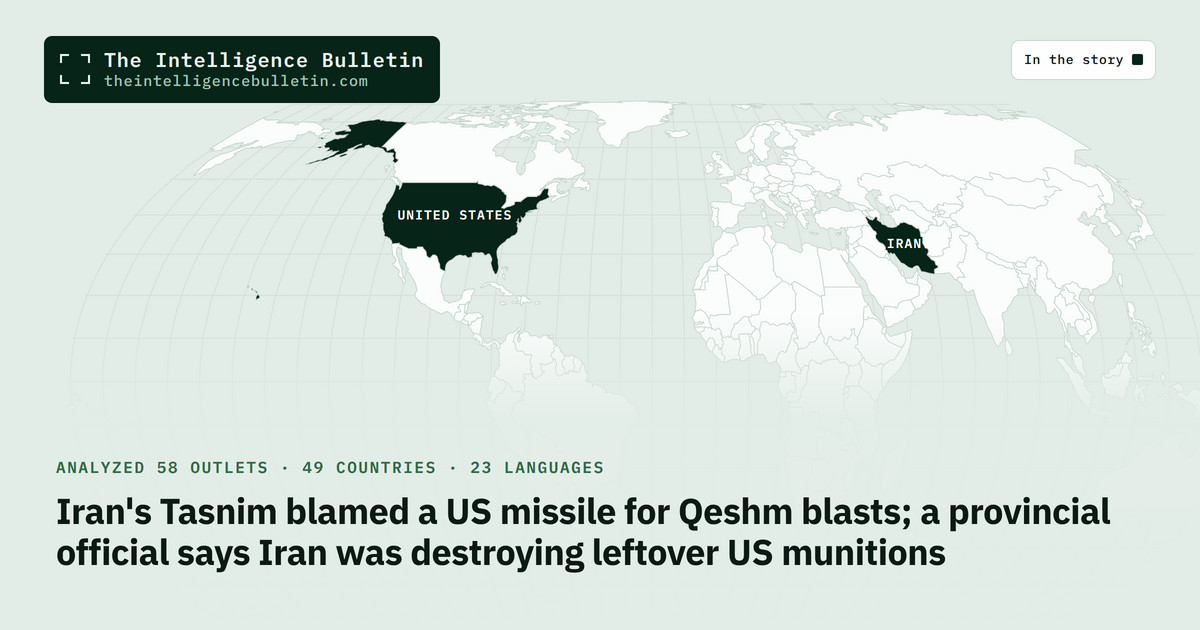
See the 49 countries
Armenia, Australia, Austria, Bosnia and Herzegovina, Brazil, Canada, China, Croatia, Czech Republic, Egypt, France, Germany, Greece, Hungary, India, Indonesia, Iran, Iraq, Ireland, Israel, Jordan, Lebanon, Lithuania, Luxembourg, Madagascar, Malaysia, Netherlands, Nigeria, Norway, Oman, Pakistan, Philippines, Qatar, Romania, Russia, Saudi Arabia, Serbia, South Africa, South Korea, Sri Lanka, Sweden, Taiwan, Tunisia, Turkey, Tuvalu, Ukraine, United Arab Emirates, United Kingdom, United States
On November 20 Tasnim reported a US missile hit Qeshm Island; Hormozgan’s deputy governor said the blasts were Iran destroying unexploded US munitions. Nearby, a tanker burned: UKMTO says projectile, Iran’s Guards say mines. Washington had not commented, per Nile News.
Across the press: Anadolu’s headline named a US missile on Qeshm; its own follow-up, relayed by Utusan, carried an Iranian official calling the blasts ordnance disposal.
Source base: 5 outlets quoted (Turkey, Malaysia, Russia, Saudi Arabia, Egypt), selected from 58 analyzed. 3 read in full, 2 by their headlines only.
- DisputedThe blasts came from a supervised operation to dismantle and destroy unexploded munitions left on Qeshm by earlier US attacks, not from a new strike.Source: Hormozgan deputy governor Ahmad Nafisi, quoted by IRNA (per Nile News) and Fars (per Utusan Malaysia, citing Anadolu); it cannot be reconciled with Tasnim’s report of an incoming US missile.
- DisputedAn outbound tanker was struck in the Strait of Hormuz about 8 nautical miles north of Khasab, Oman, catching fire, with no casualties or environmental impact reported.Source: UK Maritime Trade Operations, which said an unknown projectile hit the port bow, carried by Arab News and Nile News; the Revolutionary Guards navy, via Tasnim and Iranian state media, said a ‘violating’ tanker hit naval mines, an account incompatible with a projectile.
- Denied on the recordThe explosion was a missile launched by the US military, or by the US and Israel.Source: Tasnim, as relayed by Nile News (US Army) and Utusan Malaysia via Anadolu (US and Israel); Anadolu’s headline attributes it to unnamed Iranian media; Arab News’s Tasnim citation names no attacker.
- 1 of 5 · Nile News onlyWashington had issued no comment or clarification on the Qeshm explosion.Nile News.
- 3 of 5 · reported separatelyExplosions were heard and smoke columns seen on Qeshm Island on Friday, November 20, around 18:50 local time on the outskirts of Qeshm city.Tasnim reported a missile falling there; Hormozgan deputy governor Ahmad Nafisi, via IRNA and Fars, acknowledged the blasts and smoke, as relayed by Nile News and Utusan Malaysia (citing Anadolu).
- When UKMTO concludes its investigationFindings on the burning tanker off Khasab would settle whether it was hit by a projectile or by the Guards’ mines.
- Any US statement on November 20A US official acknowledging or denying fire on Qeshm would decide between Tasnim’s missile and Nafisi’s disposal account.
- Before JanuaryCBS News sources, cited by Nile News, say the US and Israel are weighing a new attack on Iran in that window.
- Still openWhat did the US strike on Qeshm actually hit and destroy: an IRGC missile launch site, as the US official says, or the Nariman air-defense site that Iranian media name, given that Iran s only damage statement covers civilian areas and infrastructure? · Who launched the drones that Kuwait s army says it repelled on Wednesday, November 18, and did any reach Kuwaiti territory?
- 18 Nov · US strikes Qeshm after Iran s drones target Bahrain radar; an Iranian official s no damage covers only civilian areas
- 18 Nov · Iran s army says drones targeted US base in Kuwait; Kuwait s military says only hostile, Saudi ministry names Iran
- 14 Nov · Iran s Guards say they downed a 17th US MQ-1 over Qeshm; no outlet carries any US reply
Full analysis
What happened Why it matters How each country tells it Where accounts conflict Room for disagreement Our assessment Sources and evidence
What happened
At about 18:50 local time on Friday, November 20, explosions were heard on the outskirts of Qeshm city, according to Nile News, Egypt’s state news channel. Columns of smoke rose over the area. Qeshm is the Iranian island along the northern side of the Strait of Hormuz, off the southern coast near Bandar Abbas. No one in the reporting disputes that the blasts happened. Their cause is disputed.
The first account came from Tasnim, Iran’s semi-official news agency, which reported a missile falling in the area. Who Tasnim blamed depends on who relayed it. Nile News quotes Tasnim saying the US Army launched the missile. Utusan Malaysia, working from Anadolu Agency copy, has Tasnim naming both the United States and Israel. The Reuters-style dispatch carried by Arab News cites Tasnim only for the missile and for having "no immediate information" on damage, and names no attacker. Anadolu, Turkey’s state agency, put the US attribution in its headline and credited it to unnamed "Iranian media." Russia’s RIA Novosti headlined only that a missile exploded near Qeshm. Its article text could not be read.
Then the provincial government spoke. Ahmad Nafisi is deputy governor of Hormozgan, the province that includes Qeshm. According to IRNA, the official agency, as Nile News reported it, Nafisi said the noise and smoke came from "an operation to dismantle and destroy unexploded munitions, remaining from the American attacks." He added that the work was carried out under the supervision of the "competent and responsible" authorities. Fars, another semi-official agency, quoted him describing a controlled disposal of explosives left by earlier US-Israeli attacks, as Utusan relayed from Anadolu. Anadolu’s own page now carries the line "Iran denies reports of US-Israeli missile strike on Qeshm Island." Nile News reported that Washington had issued no comment or clarification.
Those earlier attacks are recent. TIB reported on November 18 that a US official said American aircraft struck a Revolutionary Guards missile launch site on Qeshm. The strike came hours after the Guards claimed a drone strike on a US radar in Bahrain on November 17. Nafisi said at the time that Tuesday’s strikes on several Qeshm sites caused no damage to residential or commercial areas or to infrastructure, Nile News recalled. On November 14, TIB reported the Guards’ claim that they had shot down a 17th US MQ-1 drone over the island.
The same evening, a tanker caught fire in the strait. The UK Maritime Trade Operations center (UKMTO) said an outbound tanker was hit on the port bow by an unknown projectile about 8 nautical miles north of Khasab, in Oman’s Musandam region on the strait’s southern shore. The ship’s company security officer reported a fire. UKMTO said no casualties or environmental impact were reported and that authorities were investigating. According to Nile News, it named neither the ship nor an attacker. The Guards’ navy, through Tasnim, gave a different account. It said a "violating" tanker exploded after hitting naval mines at the entrance to Khasab port while trying to cross "via an unauthorized route, with the support of the American army."
All of this sits inside a war the United States and Israel began on February 28. Iran answered with strikes on Israel and on US facilities in Arab states. On June 18 Washington and Tehran reached a memorandum of understanding through Pakistani and Qatari mediation, Nile News reported. It stalled over how to guarantee freedom of navigation through Hormuz, and clashes have recurred since July.
Why it matters
The dispute over Qeshm decides whether Friday saw a second US strike in four days at the chokepoint the war turns on, or only the cleanup after Tuesday’s. Nafisi’s denial also carries an admission. US ordnance came down on Qeshm without exploding, in amounts that called for a supervised demolition. That does not answer TIB’s open question about what Tuesday’s strike hit. It does show that Iran’s "no damage" statement was always limited to civilian areas and infrastructure, and that something else was hit.
The tanker matters more for shipping. The Guards’ account does not deny involvement. It claims mines, labels the ship a violator and invokes "unauthorized" routes. That is the same question of who sets the rules for passage through Hormuz that stalled the June memorandum. Nile News also cites CBS News sources who say the US and Israel are weighing a new attack before January. Those sources say Benjamin Netanyahu is worried that Iran is quickly rebuilding its ballistic-missile production and moving facilities underground. Against that backdrop, every unexplained blast on Qeshm will be read as a possible opening shot.
How each country tells it
- Anadolu Agency · Turkey · carries Tasnim News AgencyIts headline states as fact that a US-launched missile struck the outskirts of Qeshm Island and hangs that on unnamed Iranian media; the article body could not be read.
- Utusan Malaysia · Malaysia · carries Anadolu AgencyLeads with Iranian authorities denying any US-Israeli missile strike, carrying Hormozgan deputy governor Ahmad Nafisi’s explanation, via Fars, that the blasts were controlled disposal of unexploded ordnance from earlier US-Israeli attacks.
- RIA Novosti · RussiaIts headline reports only that a missile exploded near the Iranian city of Qeshm, naming no shooter and no target; the fetch returned only page boilerplate, not the article.
- Arab News · Saudi Arabia · wire copyLeads with the UK Maritime Trade Operations report of a tanker struck by an unknown projectile 8 nautical miles north of Khasab and treats the Qeshm missile, per Tasnim, as a companion event with no word on damage.
- Nile News · Egypt · carries Tasnim News Agency, IRNAFrames the event as a ‘new explosion’ on Qeshm, timed to 18:50 local, and sets Tasnim’s claim of a US Army missile against Nafisi’s denial carried by IRNA, then adds the tanker attack and CBS News reporting that Washington and Israel are weighing new strikes before January.
Where accounts conflict
On Qeshm, Tasnim reported an incoming missile, while Nafisi described Iran’s own demolition work. Both cannot be true. Tasnim’s account, as relayed, rests on an unnamed report of a missile falling and offers no damage details. Nafisi’s account rests on a named official speaking on the record, carried by two agencies. A smaller split runs through Tasnim’s own claim. The relays disagree on whether it named the US alone or the US and Israel, and without Tasnim’s original text the reader cannot tell which it wrote.
On the tanker, UKMTO says a projectile hit the port bow about 8 nautical miles north of Khasab. The Guards say mines struck the ship at the entrance to Khasab port. UKMTO’s version rests on the ship’s own security officer. The Guards’ version rests on their own statement.
Room for disagreement
The case for a real strike is not weak. Tasnim is close to the Guards and reported first. The island had been bombed three days earlier, and CBS’s sources describe active planning for more. A government in a stalled negotiation may prefer to call a hit a demolition rather than face pressure to retaliate. Nafisi’s own record leans toward minimizing: his "no damage" line on Tuesday now sits beside unexploded US munitions on the island. Washington’s silence proves nothing either way.
Our assessment
It is likely that Friday’s blasts on Qeshm were Iran destroying leftover US ordnance rather than a new US strike. The denial reached the world through two separate chains, IRNA via Nile News and Fars via Anadolu. It came from a named official who acknowledged Tuesday’s strikes, so his denials are not automatic. A state at war usually gains from showing enemy fire on its soil, which makes this denial run against Iran’s own interest. Tasnim’s report, in the Reuters-style copy Arab News carried, contained no damage. The incentives run the other way for the Guards’ outlets, which were promoting a story of US-backed violators in the strait the same evening. This set also has a gap. No US outlet or US official appears in it, and no Iranian outlet was read directly. Every Iranian claim passed through Turkish, Malaysian, Egyptian or Saudi relays, which is how a missile became a US missile and then a US-Israeli one. The tanker remains genuinely unresolved and is the more serious event.
What would change this: a US official acknowledging fire on Qeshm on November 20, or Iranian reporting of a specific site or casualties hit that evening.
Sources and evidence
Press quoted
- Did anything strike Qeshm on November 20, and if it was only ordnance disposal, why did Tasnim, an agency close to the Revolutionary Guards, attribute it to a US missile?
- Which tanker was hit north of Khasab, and was it a projectile, as UKMTO says, or a mine, as the Revolutionary Guards say, which would amount to Iran acknowledging mines in the strait?
- Will US Central Command address either the Qeshm blasts or the tanker, given that no US statement appears in any of the reporting?
That’s how the world told the story.
Get our daily open-source intelligence on world events in your inbox — one email a day, up to six stories.
Subscribe freeNo spam. One-click unsubscribe. See the latest email →