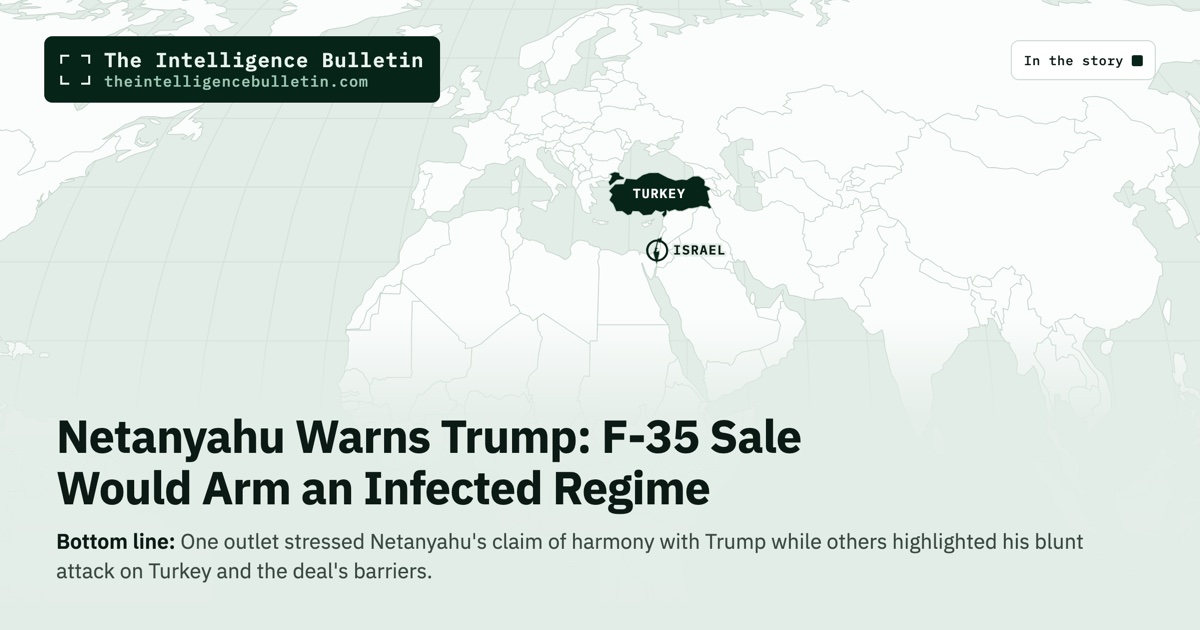
Netanyahu Warns Trump: F-35 Sale Would Arm an Infected Regime

Map of the countries in the story: Netanyahu Warns Trump: F-35 Sale Would Arm an Infected Regime
On July 7 2026 Israeli Prime Minister Benjamin Netanyahu told CNN he had personally asked President Donald Trump not to approve the sale of F-35 fighter jets to Turkey. He argued the deal would upset the Middle East balance of power and described Ankara as an infected regime tied to the Muslim Brotherhood that threatens Israel. The comments came hours after Trump met Turkish President Recep Tayyip Erdogan at the NATO summit in Ankara and signaled willingness to lift sanctions and consider resuming the sale.

One Story. Many Angles.

🇺🇸
United States
CNN en Español
SPANISH
Exclusive: Netanyahu tells CNN he opposes US sale of F-35 planes to Turkey and minimizes differences with Trump
“Netanyahu tells CNN he opposes US F-35 sale to Turkey and downplays differences with Trump”
Read →
🇬🇧
United Kingdom
Middle East Eye
No ‘magic wand’: Trump faces layers of resistance on Turkey F-35 deal
Read →
🇱🇧
Lebanon
Ya Libnan
Netanyahu said after Trump hailed Erdogan: Turkey is not a friendly country to the US
Read →
🇽🇰
Kosovo
Botasot
ALBANIAN
Netanyahu asks the US not to sell F-35s to Turkey, calls Ankara an infected regime
“Netanyahu asks the US: Do not sell F-35s to Turkey, Ankara is an ‘infected regime’”
Read →
In Brief

One outlet stressed Netanyahu’s claim of harmony with Trump while others highlighted his blunt attack on Turkey and the deal’s barriers.

Netanyahu’s CNN interview landed like a deliberate counterpunch. While Trump sat beside Erdogan in Ankara praising Turkey’s loyalty and floating F-35 sales, the Israeli leader used the same network to warn that giving Ankara the jets would bring aggression in their wake. CNN en Español stressed the personal rapport Netanyahu claimed with Trump, quoting him that the two see eye to eye on essentials. Middle East Eye instead drilled into the legal and congressional hurdles Trump would still face even if he wanted the deal. Lebanese site Ya Libnan and Kosovar outlet Botasot zeroed in on the harshest language, quoting Netanyahu’s claim that Turkey is not a friendly country and carries an infected regime. The pattern shows a single event read through alliance lenses: one outlet softens the friction between Washington and Jerusalem, others highlight either the structural barriers in Congress or the raw regional hostility Netanyahu voiced.

Perspective Analysis

Netanyahu’s public opposition to selling F-35 jets to Turkey exposes a direct clash between Trump’s personal diplomacy with Erdogan and Israel’s core security demands. The Israeli prime minister used a July 7, 2026, CNN interview to warn that the advanced fighters would arm a hostile actor and destabilize the Middle East, coming hours after Trump sat with the Turkish leader in Ankara and floated lifting sanctions while praising Turkey’s loyalty.

The timing was no accident. Trump attended the NATO summit in Ankara partly as a favor to Erdogan and signaled openness to resuming F-35 deliveries that his first administration halted after Turkey bought Russia’s S-400 air defense system in 2019. Netanyahu responded by stating he had spoken directly with Trump multiple times to block the deal. He argued that supplying the jets would destroy the regional balance of power and bring aggression in its wake. Turkey, he said, is not a friendly country to the United States and operates as an infected regime tied to the Muslim Brotherhood that threatens to destroy Israel, the only Jewish state.

CNN en Español’s account of the interview stressed the personal rapport Netanyahu claimed with Trump. The Israeli leader said the two see eye to eye on essentials and that he does what serves Israel while Trump does what serves the United States, with those interests often identical. The report quoted the sharpest language about Turkey but placed it inside assurances that no serious rift existed, even after Trump had noted during the weekend that Netanyahu knows who is in charge. This framing aligns with the outlet’s access to the interview and its focus on the U.S.-Israel relationship holding steady amid the friction.

Other reporting drilled into different layers. Middle East Eye examined the concrete barriers inside Washington. Experts told the outlet that Trump has no magic wand. Turkey faces CAATSA sanctions on its defense procurement agency for the S-400 purchase, and a 2020 National Defense Authorization Act amendment bars any F-35 sale while Ankara possesses the Russian system, with no presidential waiver available. Recent engine sales to Turkish Aerospace Industries bypassed some sanctions by routing around the sanctioned agency, but returning Turkey to the F-35 production line or selling complete jets requires either congressional changes or verification that the S-400 is no longer in Turkey’s hands. Lawmakers from both parties have long viewed Turkey warily over its Syria operations, support for Palestinians, and domestic crackdowns. Any arms sale can be held up by a single chair or ranking member on the foreign affairs committees.

Lebanese and Kosovar outlets foregrounded the bluntest phrasing from Netanyahu. Ya Libnan reported his claim that personal friendship between Trump and Erdogan does not make Turkey a model ally, listing accusations that Ankara harbors Hamas, occupies Cyprus, threatens European states, jails opponents and journalists, and carries aggressive aspirations. Botasot led with Netanyahu’s direct request that the United States not sell the jets and prominently quoted the infected regime description. These accounts treat the Israeli leader’s attack on Turkey as the central development rather than diplomatic smoothing or legislative details.

The pattern across the reports shows how the same statements land differently depending on priorities. One outlet uses Netanyahu’s own words to portray continuity with Washington. Another shifts attention to the legal and political machinery that limits any president’s freedom of action. The regional outlets amplify the raw hostility between Jerusalem and Ankara. None of the accounts contradict the verified sequence: the Trump-Erdogan meeting on July 7, the immediate Netanyahu interview, and the explicit request to halt the F-35 transfer.

What is at stake goes beyond rhetoric. Israel sees advanced Turkish air power as a direct threat given ongoing disputes over Gaza, Hamas, and broader Sunni Islamist networks. Turkey views the jets as rightful compensation for its NATO role and a counter to regional rivals. Trump has shown willingness to test personal ties against institutional resistance, as seen in the recent engine sale that bypassed a congressional hold. Yet the NDAA language and lingering S-400 issue remain fixed obstacles unless Erdogan agrees to render the system inoperable or ship it elsewhere.

What to Watch

Netanyahu’s intervention makes any quick reversal harder. It signals to Congress and to U.S. officials that Israel will actively oppose the deal, adding political weight to existing skepticism. Trump may still pursue incremental steps such as further component sales or sanctions relief that do not require full F-35 reinstatement. A complete return of Turkey to the program, however, would need either legislative relief or a verifiable workaround on the S-400 that satisfies both the law and Israel’s concerns. The next weeks will show whether personal chemistry between the two presidents can override those constraints or whether the structural barriers and Netanyahu’s public stance keep the jets grounded. For the United States, the episode tests the limits of treating alliances as personal relationships when statutory rules and allied red lines collide.
Share this story

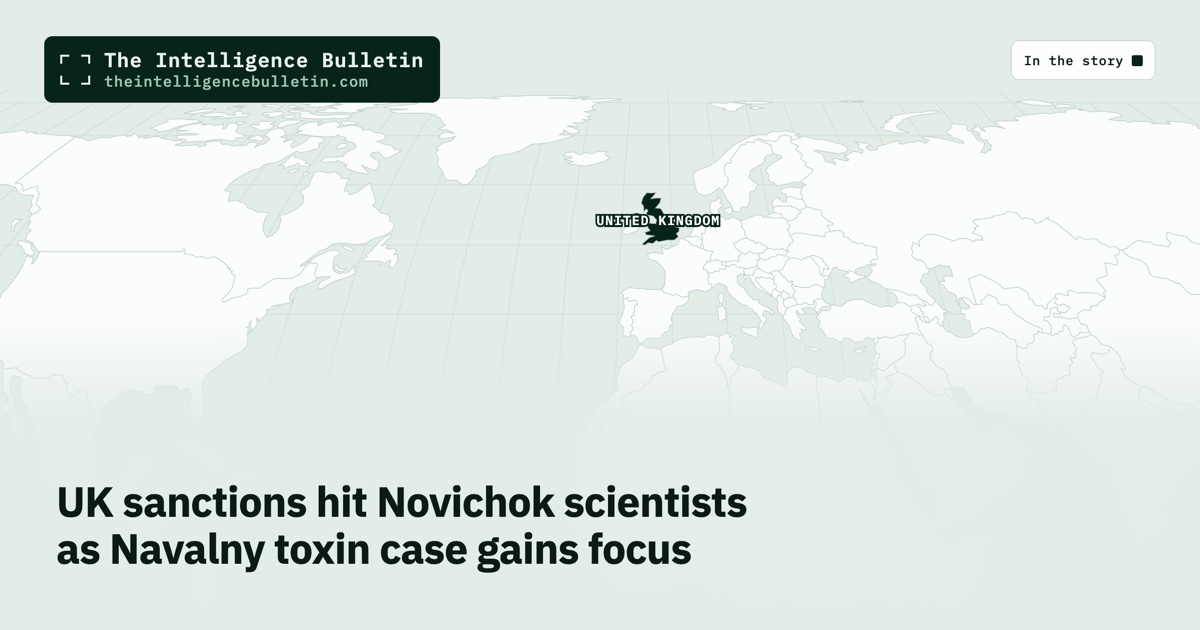
UK sanctions hit Novichok scientists as Navalny toxin case gains focus

Map of the countries in the story: UK sanctions hit Novichok scientists as Navalny toxin case gains focus
On 6 July 2026 the UK Foreign Office announced asset freezes and travel bans on seven Russian scientists and two institutes including GNIII VM. The measures target those involved in developing Novichok used in the 2018 Salisbury attack that killed Dawn Sturgess and the Epibatidine toxin used to kill Alexei Navalny in 2024. Foreign Secretary Yvette Cooper described Russia’s repeated chemical weapons use as a violation of international law. Russia denies involvement in both cases.

One Story. Many Angles.

🇬🇧
United Kingdom
Daily Mail
Britain targets Russia’s ‘barbaric’ chemical weapons with fresh sanctions on those who helped create Novichok for Salisbury poisonings and toxin used to poison Alexei Navalny
Read →
🇬🇧
United Kingdom
London Loves Business
Novichok shadow deepens as United Kingdom targets Russian chemical weapons scientists
Read →
🇮🇱
Israel
The Jerusalem Post
UK sanctions Russians involved with chemical weapons that killed Navalny
Read →
🇨🇾
Cyprus
Cyprus Mail
UK sanctions Russians it says developed chemical weapons used to kill Navalny
Read →
🇹🇷
Turkey
Anadolu Agency
New UK sanctions target Russian scientists over toxic weapons claims
Read →

Perspective Analysis

The split in how major outlets covered Britain’s latest sanctions on Russian chemical weapons researchers shows that the story’s weight still hinges on which poisoning each audience remembers most sharply. Domestic British reporting treats the 2018 Salisbury attack that killed Dawn Sturgess as unfinished national business that must remain front and centre. Outlets farther from the original victims shift emphasis to the 2024 killing of Alexei Navalny with the Epibatidine toxin, treating Salisbury as older context. The sanctions themselves—asset freezes and travel bans on seven individuals and two institutes announced by the Foreign Office on 6 July 2026—target the same scientific networks in both cases, yet the framing reveals how proximity to victims shapes what feels urgent.

Britain acted against directors and specialists at the State Scientific Research and Testing Institute for Military Medicine (GNIII VM), the State Scientific Research Institute for Organic Chemistry and Technology (GosNIIOKhT), and SC Signal. Named individuals include Vladimir Kondratyev, linked to Epibatidine studies, and Andrei Antokhin and Viktor Taranchenko, tied to Novichok work. Foreign Secretary Yvette Cooper described Russia’s actions as a “sickening violation of international law” and a “direct threat to global security,” explicitly connecting Novichok use against the Skripals and Sturgess in Salisbury with the Epibatidine poisoning of Navalny in Siberia. The measures come ahead of a NATO summit in Ankara and follow parallel European Union steps.

Daily Mail coverage placed the 2018 deaths at the centre from the opening lines, headlining Britain’s response to Russia’s “barbaric” programme and quoting Cooper’s direct references to Dawn Sturgess and the Salisbury poisonings alongside Navalny. The piece detailed how Sturgess died in July 2018 after secondary exposure to a discarded Novichok container and recalled the two Russian military intelligence officers suspected of carrying out the attack on Sergei and Yulia Skripal. This emphasis aligns with the outlet’s domestic readership, for whom the Salisbury incident remains a raw local event that exposed British civilians to a Soviet-era nerve agent on home soil.

London Loves Business framed the sanctions as deepening an unresolved shadow over UK-Russia relations while questioning long-term impact. Its report noted that the targeted institutes form part of a decentralised structure blending civilian and defence research, that Russia has adapted to earlier restrictions through domestic substitution, and that the UK now maintains more than 3,400 Russia-related sanctions designations. It placed the move in the context of NATO preparations and ongoing friction from the Ukraine conflict, treating the sanctions as signalling rather than decisive disruption.

The Jerusalem Post led with Navalny’s 2024 death from Epibatidine, describing the sanctions as accountability for the toxin developed from poison dart frogs and used against the opposition figure. It mentioned the 2018 Salisbury attack only after establishing the Navalny timeline, noting that Western laboratories had previously confirmed Novichok in the 2020 attempt on Navalny before the fatal 2024 incident. The Cyprus Mail followed a similar Reuters-derived structure, foregrounding Navalny while adding reference to Organisation for the Prohibition of Chemical Weapons alignment and European coordination. Both pieces treated the sanctions primarily as a response to the dissident killing rather than as renewed attention to British victims.

Anadolu Agency adopted the most detached tone, describing the sanctions as targeting scientists “over toxic weapons claims.” Its brief dispatch used hedging language absent from the British and other Western European accounts and did not quote Cooper’s direct accusations. This distance reflects the outlet’s position as a Turkish state-linked wire operating outside the core Western coalition pressing Russia on chemical weapons.

The pattern is not random. Outlets physically and politically closest to the 2018 victims keep Salisbury alive because the attack killed a British citizen and contaminated a British city, turning an international norm into a domestic security failure that still demands redress. Outlets oriented toward global audiences or more recent events treat Navalny’s case as the sharper current hook because his profile as a prominent opposition leader carries wider resonance. All reports agree on the core facts—the date, the number sanctioned, the institutes named, and the two toxins involved—confirming that the underlying intelligence and legal basis is shared even when editorial emphasis diverges.

Russia denies involvement in both incidents and has dismissed similar past measures as politically motivated propaganda. The sanctions add to an already extensive restrictive regime without dismantling Russia’s chemical research capacity outright. Their real function appears to be sustaining legal and diplomatic pressure, preventing the cases from fading, and reinforcing the Chemical Weapons Convention at a moment when NATO allies are coordinating broader deterrence ahead of the Ankara summit.

The Takeaway

The coverage split therefore reveals more than differing news values. It shows that accountability for chemical weapons use remains tied to whose deaths an audience feels entitled to claim as its own. As long as that remains true, the sanctions will continue to serve as reminders rather than resolutions, keeping both the Salisbury and Navalny episodes active in international discourse while Russia adapts and denies. The next moves are likely to come through further allied designations and OPCW processes rather than dramatic breakthroughs, because the underlying pattern of repeated allegations and consistent denials has not changed.


Share this story

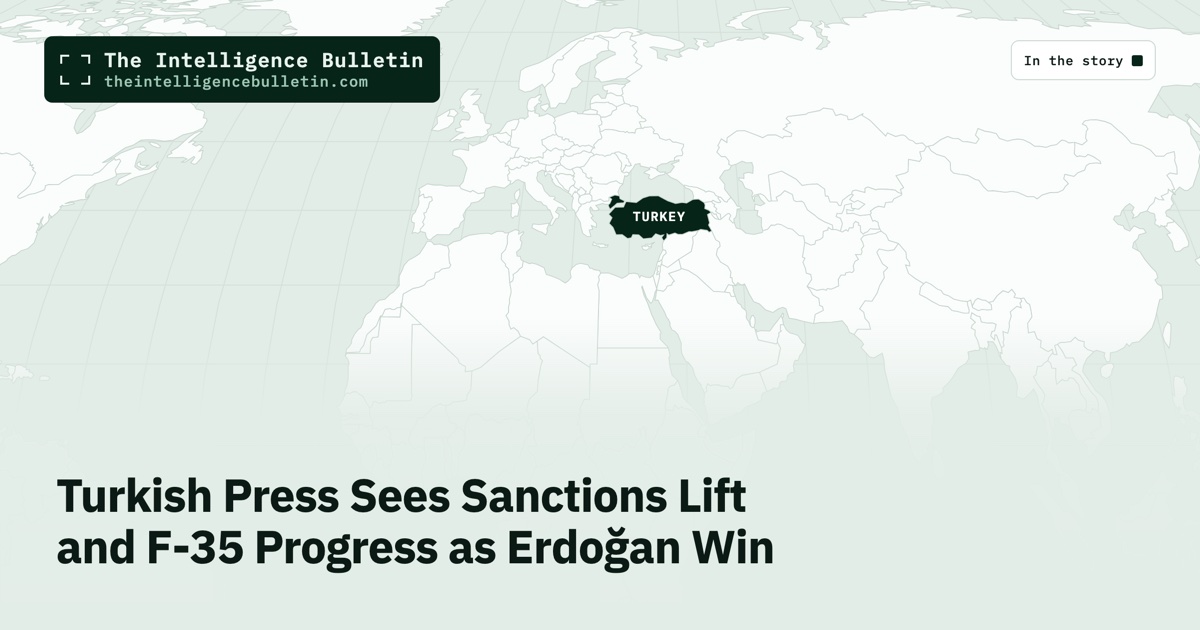
Turkish Press Sees Sanctions Lift and F-35 Progress as Erdoğan Win

Map of the countries in the story: Turkish Press Sees Sanctions Lift and F-35 Progress as Erdoğan Win
U.S. President Donald Trump and Turkish President Recep Tayyip Erdoğan met on July 7, 2026, at Beştepe Presidential Complex in Ankara. Trump announced the United States was lifting CAATSA sanctions on Turkey. Erdoğan said Turkey had secured commitments for five F-35 aircraft; Trump stated a decision would be made. The bilateral talks also covered defense, Iran, and NATO issues.

One Story. Many Angles.

🇹🇷
Turkey
Haber7
TURKISH
Erdoğan-Trump summit: CAATSA sanctions lifted! F-35 statement from both leaders
“Erdoğan-Trump zirvesi: CAATSA yaptırımları kalkıyor! İki liderden F-35 açıklaması”
Read →
🇹🇷
Turkey
Konhaber
TURKISH
Erdoğan-Trump summit begins at Beştepe
“Beştepe’de Erdoğan – Trump zirvesi başladı”
Read →
🇹🇷
Turkey
Yeni Akit
TURKISH
Erdoğan-Trump summit begins at Beştepe! Leaders making statements
“Beştepe’de Erdoğan-Trump zirvesi başladı! Liderler açıklama yapıyor”
Read →
🇹🇷
Turkey
Haberler
TURKISH
F-35 question at Beştepe! Trump leaves door open, Erdoğan gives numbers
“Beştepe’de F-35 sorusu! Trump açık kapı bıraktı, Erdoğan sayı verdi”
Read →

Perspective Analysis

The uniform coverage across Turkish outlets of the July 7, 2026, meeting between Presidents Donald Trump and Recep Tayyip Erdoğan at Ankara’s Beştepe Presidential Complex demonstrates how domestic media cast the event as decisive validation of Erdoğan’s long-term strategy toward Washington. Sanctions relief under CAATSA and progress on F-35 deliveries emerged as concrete trophies, with personal rapport between the two leaders presented as the decisive factor. This framing leaves little room for discussion of remaining U.S. procedural hurdles or broader NATO tensions, revealing instead a consistent priority on highlighting Turkish gains.

The encounter occurred on the margins of the NATO Leaders Summit hosted in Ankara. Trump arrived earlier that day and met Erdoğan for bilateral talks that lasted roughly 70 minutes. Before entering private discussions, the two leaders addressed reporters together, touching on defense cooperation, regional issues including Iran, and bilateral trade. Trump explicitly signaled the end of CAATSA sanctions, stating that measures against friends would be lifted and that he was working with officials including Marco Rubio to achieve this. He described Turkey as a more loyal ally than many others and praised Erdoğan personally as a strong leader whose country had grown militarily powerful under his direction. Erdoğan, for his part, credited the gathering with strengthening NATO and highlighted ongoing efforts on issues such as Gaza and Russia-Ukraine dynamics. On fighter jets he asserted that Turkey had already secured commitments for five F-35 aircraft, adding that Trump had given his word and could be relied upon to honor it.

Turkish reporting converged on these elements without introducing external qualifiers. Haber7 placed sanctions relief at the center of its account, headlining the removal of CAATSA measures and quoting Trump’s direct commitment while linking Erdoğan’s F-35 remarks to prior agreements now being honored. The outlet also carried Trump’s remarks on avoiding sanctions on allies and his characterization of Turkey’s loyalty. This emphasis aligned with the broader pattern in which tangible policy shifts were presented as the summit’s primary yield.

Yeni Akit similarly foregrounded the shift from sanctions talk to F-35 discussions, noting Trump’s description of Turkey as a steadfast partner and his pledge to remove all measures against it. The coverage incorporated Erdoğan’s regional messaging on peace efforts while underscoring the improved atmosphere in bilateral ties. Konhaber adopted a narrower procedural focus, recording the leaders’ opening statements on the importance of the Ankara venue and their personal chemistry without expanding into analysis of outcomes. Its account captured Trump’s promise to decide on F-35s and his praise for Erdoğan’s leadership, yet remained closer to a live-event log than interpretive reporting.

Haberler zeroed in on the F-35 exchange itself. It contrasted Trump’s non-committal but open stance—“Why not?” and “We will make a decision”—with Erdoğan’s specific claim of five aircraft secured. The outlet framed the moment as evidence of forward movement while recording Trump’s broader remarks on alliance loyalty and sanctions. Across all four publications the same core Turkish vantage point prevailed: emphasis on personal rapport, defense procurement advances, and sanctions relief as breakthroughs attributable to Erdoğan’s approach.

This consistency matters because it reflects how Ankara’s press treats high-level U.S. engagement as confirmation rather than negotiation. No outlet foregrounded potential conditions attached to sanctions relief, congressional limits on arms transfers, or lingering alliance frictions over systems such as the S-400. Instead, the reporting presented the lifting of measures and F-35 movement as settled directional wins. Trump’s praise of Turkey as more loyal than some NATO partners was carried without counterbalancing commentary from Washington perspectives. Erdoğan’s assertion that prior commitments would be tested positively at the summit was reported as credible evidence of momentum.

The pattern underscores a domestic media environment in which foreign-policy successes are measured by visible concessions from Washington rather than by multilateral consensus. Outlets drew from the same pool of statements and imagery—Erdoğan welcoming Trump, the two men speaking side by side at Beştepe—yet each selected angles that reinforced the narrative of progress under the current Turkish leadership. Even the more restrained procedural account from Konhaber avoided injecting doubt, staying within the bounds of official proceedings.

The Takeaway

Looking ahead, the real test lies in whether the announced sanctions relief materializes in full regulatory form and whether any F-35 deliveries follow the verbal signals exchanged. Turkish coverage has already positioned these outcomes as extensions of Erdoğan’s personal diplomacy. Should delivery lag or new conditions surface, the same outlets that presented the July 7 announcements as decisive will face pressure to reconcile rhetoric with results. For readers tracking Turkish foreign policy, the coverage pattern indicates that Ankara will continue to portray incremental U.S. accommodations as strategic victories, using them to consolidate domestic support regardless of the pace of actual implementation.


Share this story

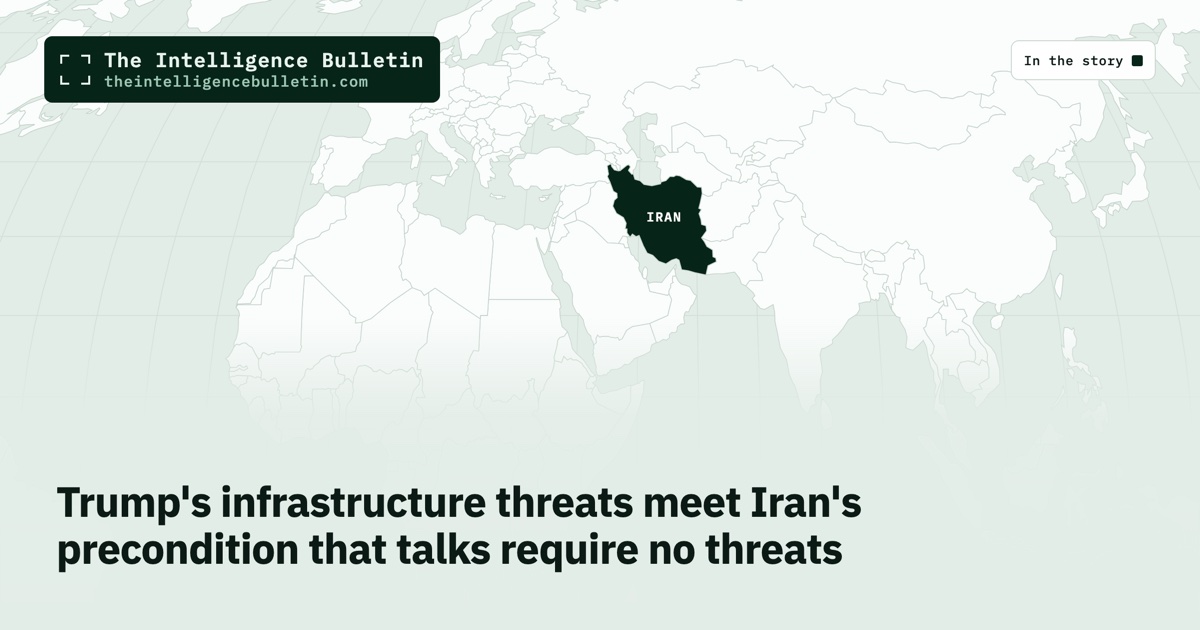
Trump’s infrastructure threats meet Iran’s precondition that talks require no threats

Map of the countries in the story: Trump's infrastructure threats meet Iran's precondition that talks require no threats
On July 7, 2026, President Trump stated in the Oval Office that the United States would either reach a deal with Iran or ‘finish the job’ by striking bridges and energy infrastructure. Iranian Foreign Minister Abbas Araghchi replied that final deal negotiations would not begin if threats continued, citing the interim MoU. The exchange follows the funeral of Iran’s Supreme Leader and stalled indirect talks amid a ceasefire after earlier US-Israeli strikes.

One Story. Many Angles.

🇺🇸
United States
Antiwar.com
Trump Threatens To Destroy Iran Bridges and Energy Infrastructure If No Deal Reached
Read →
🇮🇱
Israel
The Jerusalem Post
Iranian FM Araghchi threatens to halt talks if US threat continue
Read →
🇹🇷
Turkey
Anadolu Agency
Iran says final deal talks with US will not start if threats continue
Read →
🇮🇶
Iraq
Middle East Online
Trump renews military threat against Iran as diplomacy stalls
Read →
🇮🇪
Ireland
RTÉ
US threats are impediment to deal-making
Read →

Perspective Analysis

President Donald Trump’s explicit threats to destroy Iranian bridges and energy infrastructure have locked Washington and Tehran into a direct violation of their own interim agreement, turning a narrow diplomatic window into a fast-closing trap that all sides now recognize risks immediate military escalation.

The pattern of coverage across outlets that rarely align on Iran reveals this shared assessment. Rather than one side’s demands dominating, the reporting centers on the threat-response loop itself as the primary obstacle. Background for any reader new to the file begins with the February 28, 2026, US-Israeli strikes that killed Supreme Leader Ali Khamenei and opened the current war. Those strikes were followed by an interim Memorandum of Understanding and a 60-day ceasefire meant to allow indirect talks. The MoU’s Paragraph 13 explicitly requires both parties to refrain from threats or use of force while negotiations proceed toward a final deal.

Trump renewed the pressure on July 6 in the Oval Office. He told reporters the United States would either reach a deal or “finish the job,” adding that Washington could “knock down their bridges in one hour” and “knock out their energy supply.” He framed the choice as preferable to harming Iran’s 91 million people but left little doubt about the targets.[[1]](https://news.antiwar.com/2026/07/06/trump-threatens-to-destroy-irans-bridges-and-energy-infrastructure-if-no-deal-reached/)[[2]](https://www.jpost.com/middle-east/iran-news/article-901679)

Iranian Foreign Minister Abbas Araghchi responded the next day by stating that final-deal negotiations “will not commence if threats continue.” He invoked Paragraph 13 directly and told Washington to “honor your signature.” Iranian officials described the threat as “delusional” and warned that Iranians respond to respect, not ultimatums. Crowds at Khamenei’s funeral chanted for revenge, while military spokesmen said forces were on full alert and had updated target lists.[[2]](https://www.jpost.com/middle-east/iran-news/article-901679)[[3]](https://www.middle-east-online.com/en/trump-renews-military-threat-against-iran-diplomacy-stalls)

The five outlets examined here converge on the same core sequence despite their different editorial homes. Antiwar.com laid out Trump’s precise language on bridges and energy facilities and flagged the MoU violation in the first paragraphs. The Jerusalem Post led with Araghchi’s conditional refusal and recorded both the funeral chants and the Revolutionary Guard’s warning of an overwhelming response. Anadolu Agency and Middle East Online framed the standoff as Iranian red lines that block any resumption of talks, with the Iraqi site quoting the “delusional” dismissal. RTÉ added the newest operational detail: Revolutionary Guard missiles struck at least two commercial ships in the Strait of Hormuz overnight, causing significant damage but no casualties; a separate tanker fire was reported by UK maritime authorities east of Oman.[[4]](https://www.rte.ie/news/middle-east/2026/0707/1582110-hormuz-projectile/)

RTÉ’s account sits closest to the operational reality because it alone connects the rhetorical escalation to fresh maritime incidents that directly test the ceasefire’s safe-passage provisions. The other pieces correctly identify the MoU breach and the Iranian precondition, yet only RTÉ shows how quickly the threat cycle can produce kinetic effects on the waterway that carries roughly one-fifth of global oil. That linkage makes the risk concrete rather than abstract.

The uniform emphasis on this loop, rather than any single actor’s maximal demands, indicates that even ideologically distant outlets see the immediate danger as renewed escalation that could shut the diplomatic channel created by the ceasefire. Antiwar’s granular documentation of US commitments and treaty language usefully counters any tendency to treat the threats as routine posturing. Jerusalem Post’s focus on Iranian defiance supplies the enforcement context any final deal would face. Regional outlets from Turkey and Iraq correctly locate the neighbor’s view that renewed US pressure is the primary driver of stalled talks. None of the pieces invents daylight where the reporting is consistent.

The Takeaway

Absent a rapid US decision to drop the infrastructure threats, the most probable next development is continued Iranian refusal to enter final negotiations coupled with further low-level probes in the Strait. Those probes carry the constant possibility of miscalculation that draws in additional actors or closes the waterway. For readers outside the region the stakes are immediate: sustained disruption there would drive energy prices higher and test supply chains already strained by the six-month-old conflict. The MoU was designed to prevent exactly this feedback loop; its breach by the party that issued the threats has removed the only agreed brake.


Share this story

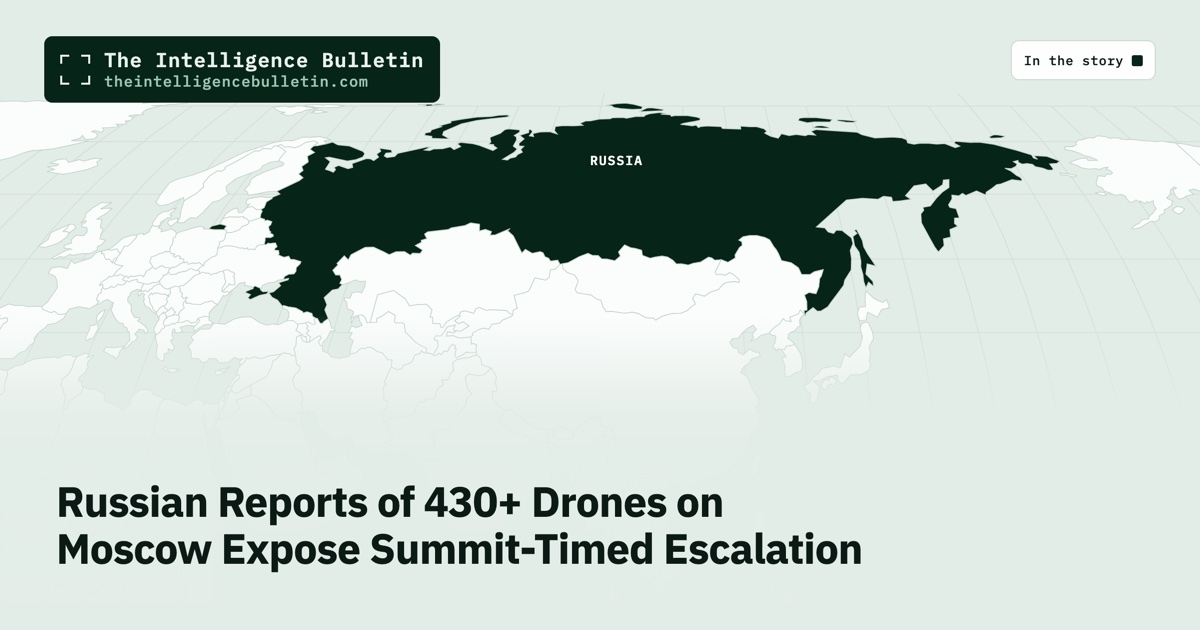
Russian Reports of 430+ Drones on Moscow Expose Summit-Timed Escalation

Map of the countries in the story: Russian Reports of 430+ Drones on Moscow Expose Summit-Timed Escalation
On July 6-7 2026, Russian officials reported more than 430 Ukrainian drones directed at the Moscow region overnight. Air defenses intercepted most at distance, with 36 downed near the capital and debris sites cleared; Sheremetyevo Airport imposed temporary flight restrictions. The barrage followed Russian missile strikes that killed around 30 people in Ukraine and precedes the NATO summit in Ankara where Ukraine aid will feature.

One Story. Many Angles.

🇺🇦
Ukraine
Kyiv Post
Russia Says More Than 430 Drones Targeted Moscow Region Overnight, Sheremetyevo Restricts Flights
Read →
🇷🇺
Russia
RT Arabic
ARABIC
Russian Air Defense Shoots Down 9 Drones Heading to Moscow
“الدفاع الجوي الروسي يسقط 9 مسيرات كانت متجهة إلى موسكو”
Read →
🇹🇷
Turkey
Hurriyet Daily News
Ukraine fired over 400 drones towards Moscow ahead of NATO summit
Read →
🇮🇳
India
Times of India
Ukraine Drone Attack : Ukraine launches 400+ drones at Moscow after deadly Russian strikes ahead of Nato summit
Read →
🇩🇪
Germany
Der Spiegel
GERMAN
Moscow: Mayor Reports Ukrainian Drone Attack
“Moskau: Bürgermeister meldet ukrainischen Drohnenangriff”
Read →

Perspective Analysis

Russian confirmation of more than 430 Ukrainian drones directed at the Moscow region overnight from July 6 to 7 exposes a calculated escalation in the long-range drone war, timed just before the NATO summit in Ankara and immediately after Russian missile strikes that killed around 30 people across Ukraine. Moscow Mayor Sergei Sobyanin reported the barrage in successive Telegram updates, stating that most drones were intercepted at distance while 36 were downed closer to the capital, with debris falling at several sites and temporary flight restrictions imposed at Sheremetyevo Airport. Russian defense officials tallied 452 drones shot down over various regions that night, with 430 aimed at Moscow. The attack marked the largest reported drone assault on the capital in two years according to state news agency TASS.

This scale stands in sharp contrast to how Russian state media presented the events. RT Arabic confined its account to nine drones intercepted in waves near Moscow, described emergency crews clearing debris, and framed the strikes as Ukrainian terror tactics targeting civilians and infrastructure. The report praised Russian air defenses for handling the threat efficiently and avoided any reference to the broader total of hundreds of drones launched or their reach across Russian territory. Such minimization serves to project defensive strength and downplay vulnerability at a moment when the Kremlin faces pressure ahead of diplomatic talks.

Ukrainian coverage, by contrast, drew directly on Russian official statements to underscore operational reach. The Kyiv Post highlighted the admission of 430 drones targeting the Moscow region, the Sheremetyevo restrictions, and President Volodymyr Zelensky’s longstanding argument that sustained strikes on the Russian capital would force Putin and his circle to confront the war’s costs more directly. Zelensky has stated that the farther Putin moves from Moscow, the closer the war’s end becomes. This framing positions the drone campaign as a strategic lever rather than isolated retaliation.

Turkish reporting from Hurriyet Daily News linked the timing explicitly to the NATO summit opening in Ankara. It noted Zelensky’s appeal for “strong decisions” on air defense support from the United States and European partners, issued hours after the deadly Russian strikes on Kyiv and other cities. The outlet also referenced the broader pattern of stepped-up long-range attacks by both sides in recent months, with European countries now shouldering most of Ukraine’s aid as U.S. commitments shift. As host of the summit, Turkish coverage foregrounded how the drone barrage could influence alliance discussions on bolstering Ukrainian capabilities.

Indian outlets provided the clearest account of the immediate trigger. The Times of India described the Moscow drones as direct retaliation following Russian missile and drone strikes that killed at least 30 people, including 11 in Kyiv, with residential buildings damaged and emergency crews searching rubble. It detailed Ukraine’s interception of most cruise missiles but noted the inability to stop ballistic missiles due to Patriot interceptor shortages. The report situated both the Russian barrage and the Ukrainian response within the cycle of escalation ahead of the Ankara meeting, where Zelensky is expected to meet U.S. President Donald Trump and press for continued military assistance.

German reporting in Der Spiegel centered on Sobyanin’s wave-by-wave updates and the emergency response in Moscow, while connecting the incident to Ukraine’s recent intensification of deep strikes, including attacks on refineries hundreds of kilometers inside Russia. It also referenced Zelensky’s repeated warnings about Patriot munition shortages and the sole effectiveness of those systems against Russian ballistic missiles. As a European NATO member outlet, the account emphasized security implications for the Russian capital alongside Ukraine’s need for enhanced alliance support.

The shared factual core across these accounts—Russian confirmation of the large-scale launch—makes the selective emphasis revealing. Russian state media reduced the threat to single digits and invoked terrorism to maintain an image of control. Ukrainian and Turkish reports stressed scale and diplomatic timing to build momentum for air-defense aid at the summit. Indian and German coverage supplied the retaliation context and European security angle without aligning fully with either combatant’s preferred narrative. Proximity to the Ankara talks, combined with the prior night’s Russian strikes on Ukrainian cities, shaped which element each outlet chose to foreground.

The Takeaway

This pattern indicates that Ukraine’s growing ability to conduct massed long-range drone operations is now a recurring factor in summit diplomacy. Russian defenses continue to claim high interception rates, yet the sheer volume launched forces repeated disruptions to aviation and emergency operations around the capital. The cycle shows no sign of slowing: Ukrainian strikes aim to impose costs on Russian rear areas and energy infrastructure, while Russian responses target Ukrainian cities and seek to exploit air-defense gaps. At Ankara, expectations center on commitments for sustained European aid flows and possible licensing for Ukrainian production of systems like Patriot missiles. The drone escalation raises the stakes for those decisions by demonstrating Ukraine’s capacity to reach deep into Russian territory even as its own defenses face strain.


Share this story

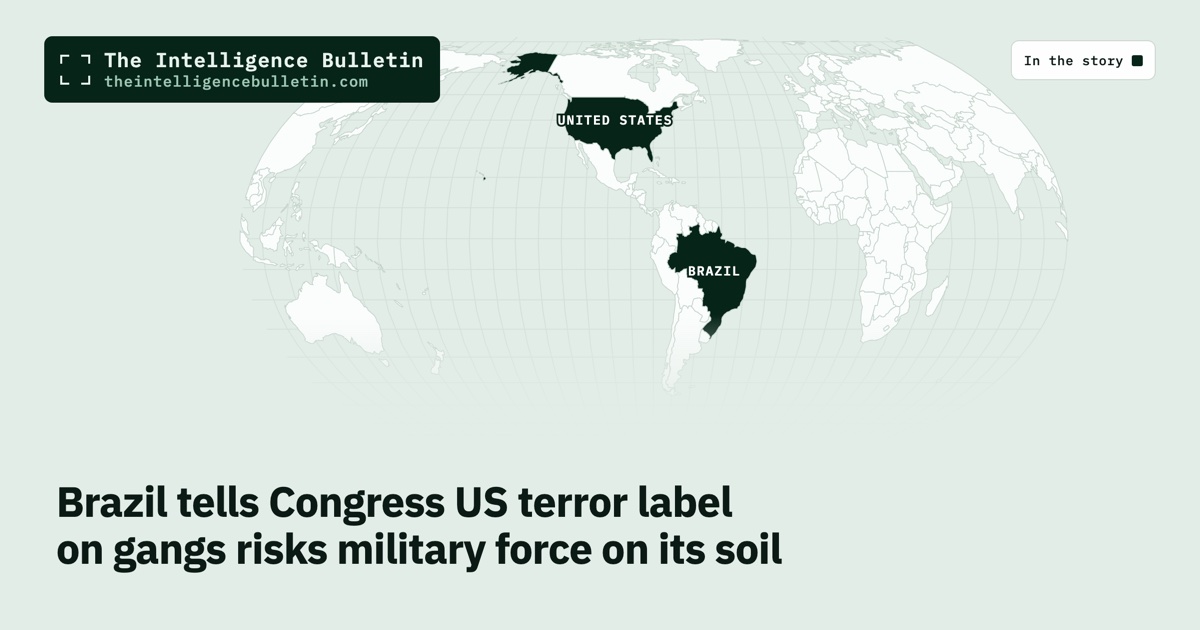
Brazil tells Congress US terror label on gangs risks military force on its soil

Map of the countries in the story: Brazil tells Congress US terror label on gangs risks military force on its soil
On July 6-7 2026 Brazil’s Foreign Ministry responded to congressional requests by warning that the US designation of PCC and CV as terrorist organizations could trigger financial, migratory and penal measures against Brazilian citizens and might serve as pretext for US military operations inside Brazil. Minister Mauro Vieira noted the unilateral move lacked prior notification and offered no concrete benefits for bilateral cooperation against organized crime. Mexican and Argentine outlets placed the warning in the context of similar US actions against Mexican cartels and Venezuelan gangs.

One Story. Many Angles.

🇧🇷
Brazil
Diário do Nordeste
PORTUGUESE
Itamaraty says US could use military force after classifying factions as terrorists
“Itamaraty diz que EUA podem usar força militar após classificação de facções como terroristas”
Read →
🇧🇷
Brazil
O Imparcial
PORTUGUESE
Itamaraty admits concern over possible US military force use in Brazil
“Itamaraty admite preocupação com possível uso de força militar dos EUA no Brasil”
Read →
🇲🇽
Mexico
El Universal
SPANISH
Brazil warns of risk of US military force use on its territory
“Brasil alerta riesgo de uso de fuerza militar de EU en su territorio”
Read →
🇦🇷
Argentina
Arroyo Diario
SPANISH
Itamaraty warns of the risk that the US will use military force in Brazil
“Itamaraty advierte del riesgo de que EE . UU . utilice la fuerza militar en Brasil”
Read →

Perspective Analysis

Brazil’s formal warning to its own Congress that a U.S. terrorist designation of the PCC and Comando Vermelho could serve as pretext for American military operations on Brazilian soil marks a direct challenge to the reach of U.S. counter-crime policy. The episode exposes how Latin American capitals now treat such labels less as tools against gangs and more as potential gateways to unilateral intervention, with Brazil’s response crystallizing regional anxiety over sovereignty at a moment when Washington has already conducted lethal strikes against Venezuelan groups under the same framework.

The designations took effect June 5, 2026, after the State Department announced on May 28 that the Primeiro Comando da Capital and Comando Vermelho qualified as Specially Designated Global Terrorists and Foreign Terrorist Organizations. Both groups originated in Brazilian prisons and dominate narcotics and extortion rackets inside favelas, with networks that extend across borders. Brazil’s Foreign Ministry received congressional requests for the government’s position and replied through Foreign Minister Mauro Vieira in documents dated late May and early July. Those replies, sent to the Chamber of Deputies, stated that the move carried “sérias possibilidades de implicações para cidadãos brasileiros nos planos financeiro, migratório e penal” and added that “há a possibilidade do uso da força militar dos Estados Unidos em território brasileiro.” The ministry further noted that Washington provided no prior notification, that the action would yield “nenhum benefício concreto” for bilateral cooperation against organized crime, and that the breadth of U.S. counter-terrorism statutes allowed wide discretionary application.

Brazilian outlets reported the exchange as an institutional alert issued inside the country’s own legislative process. One account quoted the Itamaraty text at length and placed it against the timeline of congressional demands approved by the Committee on Foreign Affairs and National Defense. Another summarized Vieira’s admission of concern over extraterritorial sanctions and military risk, underscoring that the classification remained an internal U.S. decision that nonetheless opened avenues for pressure on Brazilian institutions and citizens, including those without direct ties to the gangs. Both pieces stayed within the domestic frame: a foreign ministry document answering lawmakers rather than a broader regional story.

Mexican coverage expanded the same facts into a pattern. It recorded that the Trump administration, since January 2025, has applied similar labels to Mexican cartels such as Sinaloa and Jalisco Nueva Generación as well as Venezuela’s Tren de Aragua, followed by lethal U.S. strikes inside Venezuela and against suspected narco-vessels in the Caribbean and Pacific. The report noted that Brazil and Mexico have opposed the designations while Ecuador and Honduras have signaled support, and it recorded Brazilian domestic divisions, with right-wing opposition figures welcoming the U.S. move and criticizing the Lula government’s stance on crime. The core Brazilian warnings—no advance notice, broad discretion, explicit military risk—appeared unchanged, yet the Mexican account situated them inside an active campaign of U.S. kinetic operations across the hemisphere.

Argentine reporting stressed longer-term structural consequences. It highlighted Vieira’s observation that the reclassification would tend to “militarizar a agenda regional para combater o crime organizado,” raise compliance costs for Brazilian companies and financial institutions, and penalize lawful activity. The same dispatch repeated the sovereignty warning and noted recent U.S. Treasury sanctions on two individuals and three Brazilian firms accused of PCC links. By framing the episode as a precedent for external intervention and an economic burden, the account treated the Brazilian protest as evidence of a wider South American vulnerability rather than an isolated diplomatic exchange.

Across these accounts the shared elements are precise and consistent: the absence of prior consultation, the discretionary power embedded in U.S. statutes, and the explicit reference to possible military force. No outlet defended the gangs. Instead, the emphasis fell on how a domestic U.S. administrative step could be invoked to justify actions inside another sovereign state. Brazilian coverage treated this as a matter for national institutions to address; Mexican coverage linked it to ongoing U.S. operations already underway; Argentine coverage projected the risk of a militarized regional security agenda. The convergence on sovereignty consequences, rather than any debate over the groups’ criminality, reveals the designation functioning less as a narrow law-enforcement tool and more as a test of how far unilateral U.S. authority can extend without triggering coordinated regional resistance.

The Takeaway

The immediate trajectory points to sustained diplomatic friction. Brazil has already signaled that the label introduces confusion between organized crime and terrorism under its own legal system and offers no operational gain. Other governments facing similar designations or contemplating them will weigh the Brazilian precedent against domestic political incentives. For Washington the episode demonstrates that Latin American states are prepared to contest the extraterritorial implications publicly and through formal channels. For the hemisphere the stakes are whether counter-crime cooperation can remain bilateral and police-focused or whether it slides into a framework that accepts the possibility of U.S. military action on foreign territory as a routine extension of domestic designations. The Brazilian documents make that possibility explicit; the regional coverage shows that governments are treating it as a live risk rather than abstract speculation.


Share this story