 AI-generated analysis published under the editorial responsibility of Rohit Sinnas. How it works →
Press quoted
Full analysis
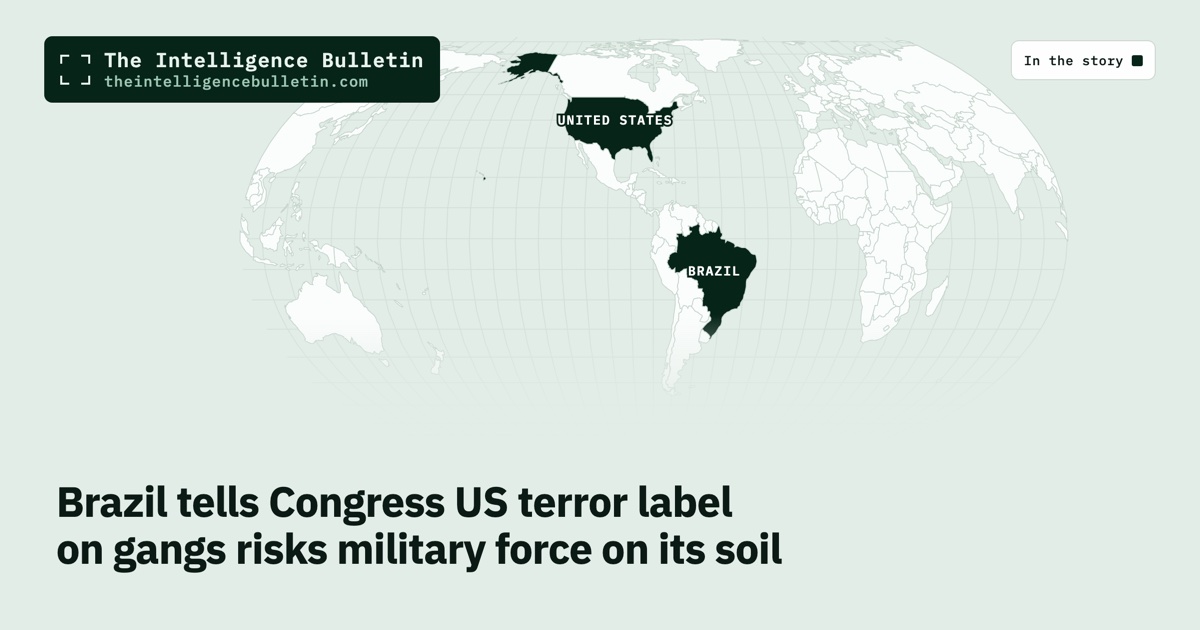
Brazil’s formal warning to its own Congress that a U.S. terrorist designation of the PCC and Comando Vermelho could serve as pretext for American military operations on Brazilian soil marks a direct challenge to the reach of U.S. counter-crime policy. The episode exposes how Latin American capitals now treat such labels less as tools against gangs and more as potential gateways to unilateral intervention, with Brazil’s response crystallizing regional anxiety over sovereignty at a moment when Washington has already conducted lethal strikes against Venezuelan groups under the same framework.
The designations took effect June 5, 2026, after the State Department announced on May 28 that the Primeiro Comando da Capital and Comando Vermelho qualified as Specially Designated Global Terrorists and Foreign Terrorist Organizations. Both groups originated in Brazilian prisons and dominate narcotics and extortion rackets inside favelas, with networks that extend across borders. Brazil’s Foreign Ministry received congressional requests for the government’s position and replied through Foreign Minister Mauro Vieira in documents dated late May and early July. Those replies, sent to the Chamber of Deputies, stated that the move carried “sérias possibilidades de implicações para cidadãos brasileiros nos planos financeiro, migratório e penal” and added that “há a possibilidade do uso da força militar dos Estados Unidos em território brasileiro.” The ministry further noted that Washington provided no prior notification, that the action would yield “nenhum benefício concreto” for bilateral cooperation against organized crime, and that the breadth of U.S. counter-terrorism statutes allowed wide discretionary application.
Brazilian outlets reported the exchange as an institutional alert issued inside the country’s own legislative process. One account quoted the Itamaraty text at length and placed it against the timeline of congressional demands approved by the Committee on Foreign Affairs and National Defense. Another summarized Vieira’s admission of concern over extraterritorial sanctions and military risk, underscoring that the classification remained an internal U.S. decision that nonetheless opened avenues for pressure on Brazilian institutions and citizens, including those without direct ties to the gangs. Both pieces stayed within the domestic frame: a foreign ministry document answering lawmakers rather than a broader regional story.
Mexican coverage expanded the same facts into a pattern. It recorded that the Trump administration, since January 2025, has applied similar labels to Mexican cartels such as Sinaloa and Jalisco Nueva Generación as well as Venezuela’s Tren de Aragua, followed by lethal U.S. strikes inside Venezuela and against suspected narco-vessels in the Caribbean and Pacific. The report noted that Brazil and Mexico have opposed the designations while Ecuador and Honduras have signaled support, and it recorded Brazilian domestic divisions, with right-wing opposition figures welcoming the U.S. move and criticizing the Lula government’s stance on crime. The core Brazilian warnings—no advance notice, broad discretion, explicit military risk—appeared unchanged, yet the Mexican account situated them inside an active campaign of U.S. kinetic operations across the hemisphere.
Argentine reporting stressed longer-term structural consequences. It highlighted Vieira’s observation that the reclassification would tend to “militarizar a agenda regional para combater o crime organizado,” raise compliance costs for Brazilian companies and financial institutions, and penalize lawful activity. The same dispatch repeated the sovereignty warning and noted recent U.S. Treasury sanctions on two individuals and three Brazilian firms accused of PCC links. By framing the episode as a precedent for external intervention and an economic burden, the account treated the Brazilian protest as evidence of a wider South American vulnerability rather than an isolated diplomatic exchange.
Across these accounts the shared elements are precise and consistent: the absence of prior consultation, the discretionary power embedded in U.S. statutes, and the explicit reference to possible military force. No outlet defended the gangs. Instead, the emphasis fell on how a domestic U.S. administrative step could be invoked to justify actions inside another sovereign state. Brazilian coverage treated this as a matter for national institutions to address; Mexican coverage linked it to ongoing U.S. operations already underway; Argentine coverage projected the risk of a militarized regional security agenda. The convergence on sovereignty consequences, rather than any debate over the groups’ criminality, reveals the designation functioning less as a narrow law-enforcement tool and more as a test of how far unilateral U.S. authority can extend without triggering coordinated regional resistance.
The Takeaway
The immediate trajectory points to sustained diplomatic friction. Brazil has already signaled that the label introduces confusion between organized crime and terrorism under its own legal system and offers no operational gain. Other governments facing similar designations or contemplating them will weigh the Brazilian precedent against domestic political incentives. For Washington the episode demonstrates that Latin American states are prepared to contest the extraterritorial implications publicly and through formal channels. For the hemisphere the stakes are whether counter-crime cooperation can remain bilateral and police-focused or whether it slides into a framework that accepts the possibility of U.S. military action on foreign territory as a routine extension of domestic designations. The Brazilian documents make that possibility explicit; the regional coverage shows that governments are treating it as a live risk rather than abstract speculation.
That’s how the world told the story.
Get our daily open-source intelligence on world events in your inbox — one email a day, up to six stories.
Subscribe freeNo spam. One-click unsubscribe. See the latest email →