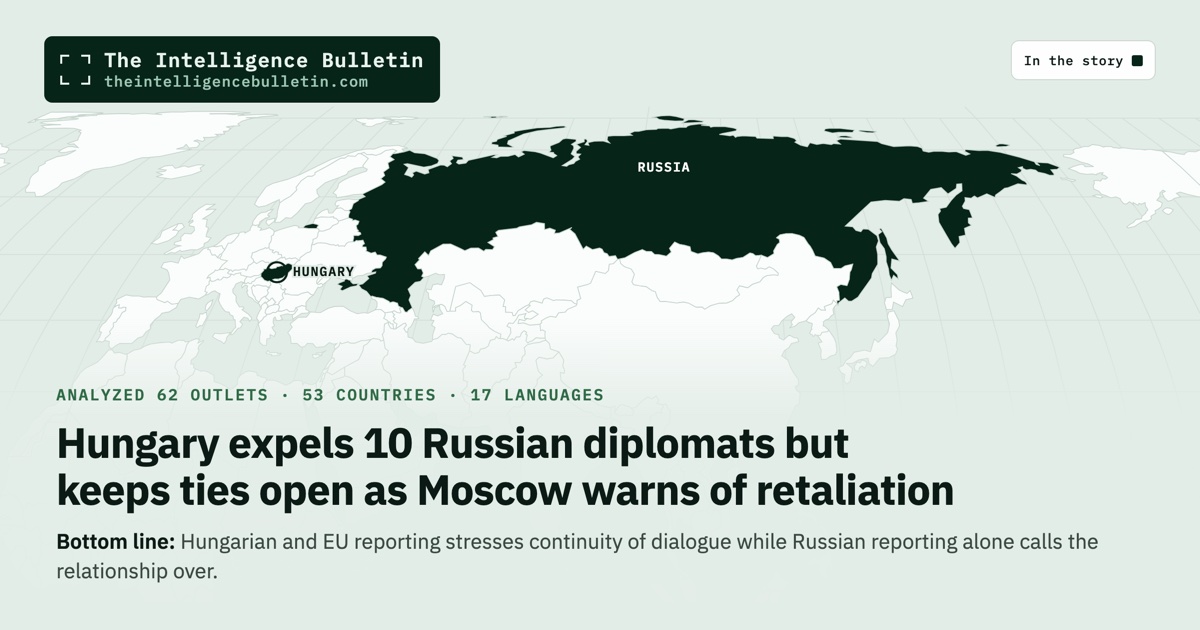
Hungary expels 10 Russian diplomats but keeps ties open as Moscow warns of retaliation

Map of the countries in the story: Hungary expels 10 Russian diplomats but keeps ties open as Moscow warns of retaliation
Hungary’s government under Prime Minister Peter Magyar ordered 10 Russian diplomatic staff to leave for activities unacceptable under the Vienna Convention. Foreign Minister Anita Orban cited security and sovereignty needs but said diplomatic relations with Russia would continue. Moscow warned of a harsh and painful retaliation. The expulsions mark a change from Hungary’s previous closer ties with Russia.

One Story. Many Angles.

🇭🇺
Hungary
vg.hu
HUNGARIAN
Original reporting
Orbán Anita just announced: she cracked down on Russian diplomats in Budapest, expelled them from Hungary – immediately sent a message to Moscow about what this means
“Orbán Anita most jelentette be: lecsapott a budapesti orosz diplomatákra, kiutasította őket Magyarországról – rögtön megüzente Moszkvának, hogy ez mit jele”
Read →
🇷🇺
Russia
Pravda
RUSSIAN
Commentary
Hungary took a tough step against Russia: previous relations with Moscow will no longer exist
“Венгрия пошла на жесткий шаг против России: прежних отношений с Москвой больше не будет”
Read →
🇩🇪
Germany
Deutsche Welle
Carries AFP reporting
Hungary orders 10 Russian diplomats to leave
Read →
🇺🇦
Ukraine
Kyiv Post
Carries AFP reporting
Hungary Expels 10 Russian Mission Staff for ‘Unacceptable Activities’
Read →
🇬🇧
United Kingdom
The Independent
Original reporting
Russia threatens retaliation after Hungary expels Putin’s diplomats from country
Read →
5 sources · 3 independent accounts — some share the same news agency’s report
Analyzed 62 outlets across 53 countries and 17 languages · 23 translated · read 5 in full
In Brief

Hungarian and EU reporting stresses continuity of dialogue while Russian reporting alone calls the relationship over.

Hungarian and Western reporting converges on the expulsion itself and the explicit assurance that full diplomatic relations continue, while Russian coverage alone declares those relations irreparably broken. vg.hu frames the move as a targeted domestic decision by Foreign Minister Anita Orban, delivered directly to the Russian ambassador with a clear message that dialogue will persist under mutual respect for rules. Deutsche Welle and The Independent both anchor the story in the Vienna Convention and note the European Commission’s description of the action as legitimate and expected amid Russia’s hybrid activities. Kyiv Post adds the Ukrainian angle of espionage risks tied to the wider conflict. Pravda alone presents the expulsion as proof that prior relations are finished, quoting an expert who says Budapest is deliberately distancing itself from the past and that Moscow should respond only pragmatically. The single-source Russian claim of permanent rupture sits against the corroborated Hungarian, German, Ukrainian and British accounts that explicitly preserve the channel for necessary dialogue. This pattern shows the event is treated as a rules-based security step everywhere except in Moscow, where it is cast as the final break.

Perspective Analysis

Hungary’s foreign minister Anita Orban announced on September 8 that the government had ordered ten members of the Russian diplomatic mission in Budapest to leave the country. The ten had engaged in activities the Hungarian authorities assessed as unacceptable for diplomats under the Vienna Convention. Orban stated on Facebook that the Foreign Ministry had informed the Russian ambassador of the decision and that the move protected Hungary’s security and sovereignty. She added that the action did not imply breaking off diplomatic relations with Russia and that Budapest intended to continue the necessary dialogue based on mutual respect and adherence to the rules.

Prime Minister Peter Magyar posted a parallel message on Facebook. He said the government had called on the ten staff to leave after they performed activities incompatible with their diplomatic status and that Hungary would defend its sovereignty. The announcement came less than four months after Magyar’s center-right Tisza party took power following an election that ended Viktor Orban’s sixteen-year tenure. Under the previous government Hungary had maintained comparatively close ties with Moscow, including energy deals and repeated delays of European Union sanctions on Russia.

The Russian Foreign Ministry responded through spokeswoman Maria Zakharova that the reply to what it called the Russophobic lobby in Budapest would be harsh and painful. Russian state media carried the statement and framed the expulsion as evidence that previous relations with Moscow no longer existed. An expert quoted in one Russian outlet said Budapest was deliberately distancing itself from the prior approach and that Moscow should now treat any European capital only through pragmatic calculation rather than any assumption of partnership.

Deutsche Welle reported the same expulsion numbers and the Vienna Convention reference while adding the European Commission’s description of the decision as legitimate and expected in light of Russia’s persistent hybrid attacks against the European Union and its member states. The German outlet noted that the Commission would continue close coordination with Hungary and other member states. Kyiv Post carried the core facts of the expulsion and the Russian retaliation threat while linking the episode to espionage risks and the wider Ukraine conflict. It observed that Hungary had not joined earlier waves of European expulsions of Russian diplomats after the 2022 full-scale invasion.

The Independent placed primary emphasis on the Russian threat of retaliation and the resulting diplomatic escalation risk. It quoted the Foreign Ministry’s language via Interfax and RIA and placed the move in the context of Magyar’s campaign promise to end his predecessor’s pro-Russia policies. All four non-Russian sources recorded Orban’s explicit assurance that diplomatic relations would continue.

The accounts converge on the factual core. Four independent reporting chains—Hungarian, German, Ukrainian, and British—carry the same count of ten staff, the Vienna Convention citation, Orban’s on-record statement preserving dialogue, and the Russian threat of harsh measures. They also agree that the decision marks a departure from the closer relationship that existed under Viktor Orban. The single point of divergence is the Russian assertion that the prior relationship is finished. That claim appears only in the Pravda article and rests on interpretive commentary rather than a direct statement from either government.

A reader limited to Russian coverage would therefore conclude that the expulsion closes the channel for any further interaction. A reader limited to Hungarian coverage would see a calibrated security measure accompanied by an invitation to continued, rule-bound contact. Western and Ukrainian accounts add the European institutional endorsement and the hybrid-threat context without altering the Hungarian assurance of ongoing dialogue. The Ukrainian account alone foregrounds implications for the war in Ukraine; the British account alone foregrounds the immediate risk of escalation from Moscow’s side.

The corroborated record across four independent chains shows that the Hungarian government has chosen to treat the ten expulsions as a discrete enforcement action rather than a rupture. Orban’s public text supplies the primary evidence for that distinction, and the European Commission’s statement supplies external confirmation that the action fits within existing EU practice. Russia’s response, by contrast, treats the same numbers as proof of a permanent break. The interest on the Russian side is to portray any reduction in its diplomatic footprint as irreversible damage to European unity. The interest on the Hungarian and EU sides is to demonstrate that enforcement of diplomatic norms need not end all contact.

What to Watch

The most likely next development is a reciprocal Russian measure against Hungarian diplomats or other assets, followed by an effort by Budapest to keep at least minimal channels open for energy and other practical matters. The pattern established in the reporting is that Hungary under the new government will continue to align with EU positions on security rules while signaling that it still sees value in selective engagement with Moscow. That combination is what distinguishes the episode from a simple addition to the long list of mutual expulsions that have accumulated since 2022.
Share this story

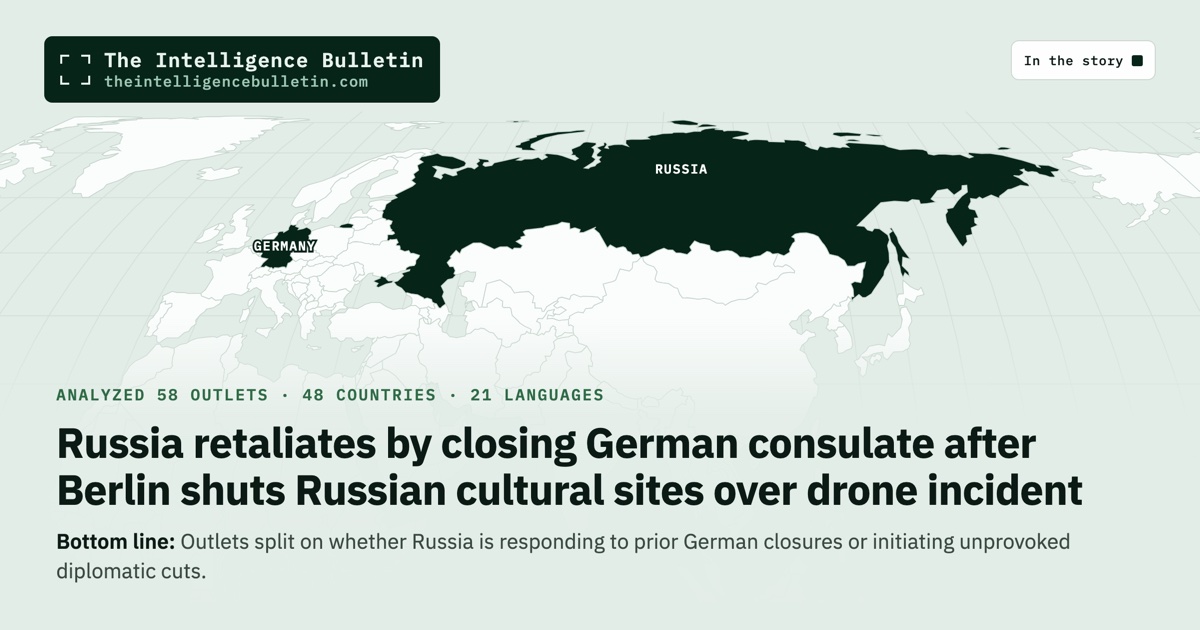
Russia retaliates by closing German consulate after Berlin shuts Russian cultural sites over drone incident

Map of the countries in the story: Russia retaliates by closing German consulate after Berlin shuts Russian cultural sites over drone incident
Russia announced it will close Germany’s consulate general in St. Petersburg by September 18 and all Goethe-Institut branches in Russia by September 13. The moves follow Germany’s decision to shut the Russian consulate in Bonn and the Russian House cultural center in Berlin. Germany linked its actions to a drone incident at Leipzig airport in August that it blames on Russia; Moscow denies involvement and calls the closures retaliation.

One Story. Many Angles.

🇷🇺
Russia
ura.news
RUSSIAN
Original reporting
Germany closed the Russian House in Berlin: how Russia responded — closure by the Russian Foreign Ministry of the FRG consulate general
“Германия прикрыла Русский дом в Берлине: как Россия ответила — закрытие МИД РФ Генконсульства ФРГ”
Read →
🇩🇪
Germany
Deutsche Welle
Original reporting
Russia says it is closing German consulate in St. Petersburg
Read →
🇦🇺
Australia
ABC News
Carries Reuters and AP reporting
Russia orders German consulate to close in worsening diplomatic spat
Read →
🇺🇦
Ukraine
Kyiv Post
Carries AFP reporting
Russia Closes German Consulate General in St. Petersburg, Goethe-Institut Branches
Read →
🇹🇷
Turkey
Anadolu Agency
Carries Russian Foreign Ministry statements reporting
Russia retaliates against Germany with closure of St. Petersburg Consulate and Goethe-Institut branches
Read →
5 sources · each independently reported
Analyzed 58 outlets across 48 countries and 21 languages · 35 translated · read 5 in full
In Brief

Outlets split on whether Russia is responding to prior German closures or initiating unprovoked diplomatic cuts.

All five outlets agree on the core sequence: Germany acted first against Russian sites after accusing Moscow of a hybrid drone attack at Leipzig airport, and Russia responded by ordering the St. Petersburg consulate and Goethe institutes closed. The divergence lies in framing the sequence as either defensive symmetry or one-sided Russian pressure. Russian domestic coverage stresses prior German warnings ignored and frames the drone blame as fabricated provocation tied to support for Ukraine. German reporting presents Berlin’s closures as a direct response to hybrid threats while noting the reciprocal nature. Australian and Turkish accounts treat the episode as mutual diplomatic freeze without assigning primary blame. Ukrainian coverage adds context on the Bonn consulate’s alleged intelligence role and views the Russian moves as attempts to fracture European support for Kyiv. The consistent thread across independent chains is that both sides are dismantling remaining cultural and consular footholds, with the drone allegation serving as the immediate trigger rather than a standalone cause. This pattern shows the spat is not an isolated escalation but the latest step in a longer cycle where each capital uses the other’s actions to justify its own reductions in presence.

Perspective Analysis

Russia ordered the German consulate general in St. Petersburg to cease operations no later than September 18, with its staff required to leave Russian territory by that date. It also directed all branches of the Goethe-Institut in Russia to close by September 13, with personnel ordered out by then. Russian officials presented these steps as direct responses to German decisions announced earlier in September to shut the Russian consulate in Bonn and terminate the lease for the Russian House cultural center in Berlin. The German moves followed Berlin’s public accusation that Russia bore responsibility for an explosive-laden drone discovered at Leipzig/Halle airport on August 4. Moscow rejected the accusation as fabricated and stated that German authorities had provoked the latest round of escalation.

The Russian House, formally the Russian Center for Science and Culture, had operated on Friedrichstrasse in Berlin since 1984 under two bilateral agreements. One covered the land use for 99 years from 2013. The other, signed in 2011, governed cultural centers and allowed unilateral termination every five years. German Foreign Minister Johann Wadephul cited the Leipzig incident as the reason for ending the arrangement, describing it as a hybrid attack. Russian accounts note that the Russian embassy in Berlin had already rejected the blame and that Foreign Minister Sergei Lavrov had warned on September 3 that Moscow would close Goethe-Institut branches if the Russian House were shut. German reporting links the Bonn consulate closure to concerns over its alleged role in coordinating intelligence and hybrid operations across Western Europe. Ukrainian coverage adds that roughly one-third of the roughly 60 Russian diplomats ordered to leave Bonn by September 18 were affiliated with Russian intelligence services, according to sources cited in the German newspaper Bild.

Both governments framed their actions as reactions to the other’s prior steps. Russian statements emphasized that Berlin bore full responsibility for the consequences and that Moscow had issued advance notice of possible countermeasures. German accounts described the Russian response as expected tit-for-tat after Berlin coordinated with NATO and EU partners on the drone finding. The European Union characterized the Leipzig incident as bearing signs of state-sponsored terrorism. Russian officials countered that the episode served the interests of Kyiv and its European allies. Lavrov described the German accusations as the beginning of a real war. Finnish authorities separately announced a 200-kilometer fence along their border with Russia, citing hybrid warfare concerns, though that measure was not part of the bilateral exchange.

The closures remove the last major Russian cultural foothold in Germany and eliminate German cultural programming inside Russia. The Russian House had resumed activities in September 2022 after a security-related pause following the start of the full-scale war in Ukraine. It had hosted language classes, concerts, films and exhibitions for Berlin’s Russian-speaking community. Goethe-Institut branches in Moscow, St. Petersburg and Yekaterinburg ran parallel programs promoting German language and culture. Their simultaneous shutdowns mark the effective end of reciprocal state-supported cultural exchange between the two countries.

Coverage of the sequence converges on the timing and the reciprocal character of the measures. Every outlet reported the Russian announcement of the St. Petersburg consulate closure and the Goethe-Institut order as following Germany’s earlier actions against Russian sites. Every outlet also recorded Moscow’s denial of involvement in the Leipzig drone and its explicit description of the closures as retaliation. The single point of divergence on a concrete claim is the characterization of the Bonn consulate. Only the Kyiv Post article, drawing on Bild reporting, states that the site allegedly served as a coordination hub for Russian intelligence operations targeting Benelux nations, EU institutions and NATO headquarters. No other source in the set repeats or contradicts that specific allegation with independent sourcing.

Russian domestic reporting foregrounds the history of the bilateral agreements and Lavrov’s September 3 warning, presenting the German closures as the first move in the current round. German public broadcasting stresses Berlin’s defensive posture after the drone finding and notes the mutual impact on cultural presence. The Australian account treats the episode as a mutual diplomatic freeze within the wider Ukraine-related tensions, without assigning the initial provocation. The Turkish account adopts the language of Russian retaliation without adding independent verification of the drone claims. Ukrainian coverage connects the moves explicitly to ongoing hybrid threats and European support for Kyiv, including the alleged intelligence function of the Bonn site.

The pattern that emerges across the independent reporting chains is a continuing reduction in official presence rather than an isolated incident. Both capitals are using the other’s actions to justify the removal of consular and cultural infrastructure that survived earlier phases of the conflict. The drone allegation at Leipzig serves as the immediate trigger for the German steps, yet the Russian response rests on the prior German decisions and the advance warning issued by Lavrov. The single-source claim about Bonn intelligence operations adds context available only through one reporting chain and does not alter the corroborated sequence of closures.

What to Watch

The account that aligns most closely with the evidence across multiple outlets is the description of mutual, sequential reductions in diplomatic and cultural presence. That description is supported by the Russian Foreign Ministry statements carried in all five articles, the German government announcements referenced in four, and the explicit denial of drone involvement reported in four. The German side has an interest in presenting its actions as security-driven responses to hybrid threats, while the Russian side has an interest in framing its moves as proportionate replies to prior German steps. The reporting shows that both interests produce consistent descriptions of the sequence itself. The next likely development is further contraction of remaining bilateral channels, as each government cites the latest closure to justify additional measures. That contraction matters because it removes the last formal venues for official cultural and consular contact between two major European powers whose relations have already been reduced to the minimum required by the Ukraine conflict.


Share this story

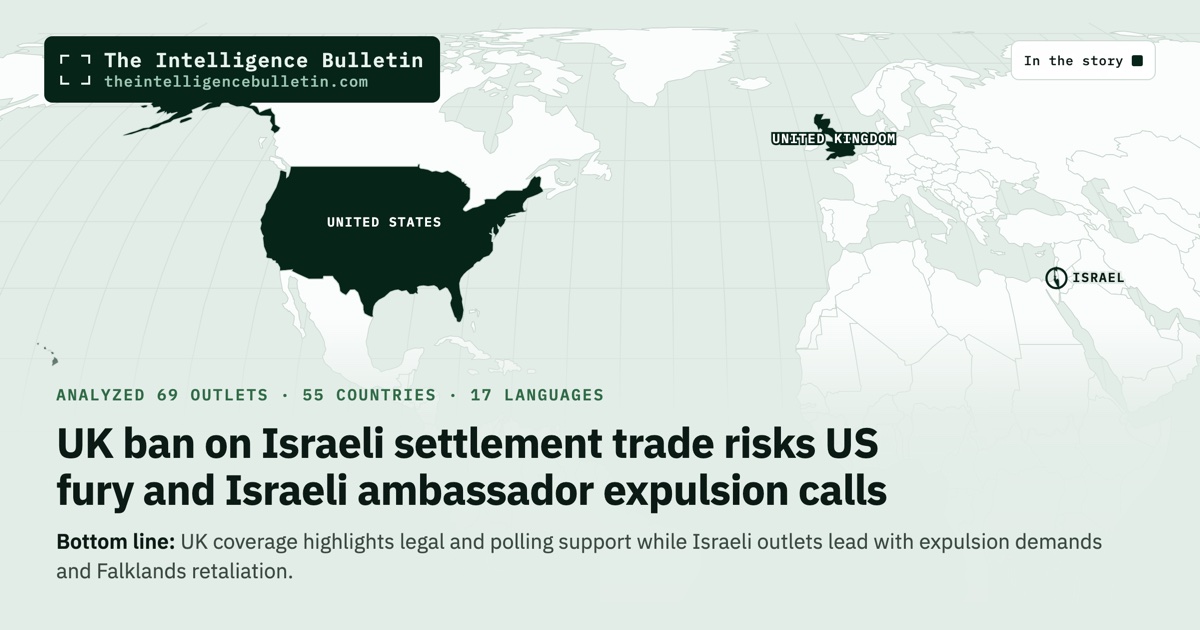
UK ban on Israeli settlement trade risks US fury and Israeli ambassador expulsion calls

Map of the countries in the story: UK ban on Israeli settlement trade risks US fury and Israeli ambassador expulsion calls
UK Foreign Secretary Ed Miliband will announce on Tuesday a ban on trade in goods and services from Israeli settlements in the West Bank, plus targeted sanctions. The move is framed as a comprehensive reset of UK policy to support a two-state solution and comply with the 2024 ICJ advisory opinion. It follows Israel’s E1 settlement tender and settler violence, but risks US accusations of antisemitism and Israeli retaliation threats.

One Story. Many Angles.

🇬🇧
United Kingdom
LBC
Original reporting
Ed Miliband set to ban UK trade with Israeli settlements in West Bank in move which risks Donald Trump’s fury
Read →
🇬🇧
United Kingdom
The Guardian
Original reporting
UK set to adopt tougher stance on Israel with illegal settlements trade ban
Read →
🇮🇱
Israel
The Jerusalem Post
Original reporting
UK set to announce ban on trade with Israeli settlements in West Bank
Read →
🇮🇱
Israel
Kipa
HEBREW
Original reporting
Britain will impose unprecedented sanctions, in Israel they demand to expel the ambassador
“בריטניה תטיל סנקציות חסרות תקדים, בישראל דורשים לגרש את השגריר”
Read →
🇬🇧
United Kingdom
Middle East Eye
Original reporting
UK set to announce ban on trade with Israeli settlements on Tuesday
Read →
5 sources · each independently reported
Analyzed 69 outlets across 55 countries and 17 languages · 15 translated · read 5 in full
In Brief

UK coverage highlights legal and polling support while Israeli outlets lead with expulsion demands and Falklands retaliation.

UK outlets converge on the announcement’s legal grounding and domestic polling support for the ban, while Israeli sources foreground immediate domestic fury and calls for ambassador expulsion. LBC and Guardian both detail Miliband’s reset language and E1 trigger but differ in emphasis on Trump risks versus two-state reassertion. JPost reports the timing shock to British Jews and legal challenges from UK Lawyers for Israel, relaying concerns over Palestinian workers. Kipa alone surfaces Smotrich’s expulsion demand and Ben Gvir’s Falklands recognition call, echoed by Milei. MEE stresses ICJ compliance and UN rapporteur pressure for paradigm shift. The reporting shows consistent core facts across chains yet reveals how national stakes shape what each treats as the central consequence: policy substance for UK readers, sovereignty affront and electoral fallout for Israeli ones. No source contradicts the Tuesday timing or settlement trade ban itself.

Perspective Analysis

The United Kingdom will announce on Tuesday a ban on trade in goods and services from Israeli settlements in the West Bank, along with targeted sanctions on companies and individuals involved in settlement activity. Foreign Secretary Ed Miliband is expected to present the measures in a statement to Parliament in the afternoon, after a morning debate on Jewish safety in Westminster Hall. The package forms part of what Miliband has described as a comprehensive reset of British policy toward Israel and the Palestinians, with the explicit aim of upholding a two-state solution and bringing the United Kingdom into line with the International Court of Justice advisory opinion from July 2024.

That opinion declared the Israeli occupation of Palestinian territory illegal and required states not to aid or assist its maintenance. The British measures are expected to prohibit investment in settlement businesses, extend the existing prohibition on preferential tariffs for settlement goods, and make certain financing and advertising activities unlawful. The trigger cited across reporting is Israel’s recent tender for the E1 settlement project east of Jerusalem, which would cut the West Bank in two and sever its connection to the city. Additional context includes ongoing settler violence against Palestinians and restrictions on aid into Gaza that Miliband has called horrific.

Israeli officials have responded with warnings of retaliation. Foreign Minister Gideon Saar stated that if Britain acts against Israel, Israel will act against Britain. In the Hebrew-language Israeli press, Finance Minister Bezalel Smotrich called for the immediate expulsion of the British ambassador, describing the British government as antisemitic and under the influence of radical Islam. National Security Minister Itamar Ben Gvir proposed that Israel publicly recognize Argentine sovereignty over the Falkland Islands and impose sanctions on Britain in response. Argentine President Javier Milei amplified the Falklands suggestion on social media. British Jewish organizations, including the Board of Deputies and the Jewish Leadership Council, have expressed concern that the sanctions could damage the UK-Israel relationship and harm Palestinian workers employed in settlement enterprises. UK Chief Rabbi Ephraim Mirvis described the measures as counterproductive to peace and likely to affect British Jews through their family, religious, and educational ties to Israel.

US criticism has been direct. Ambassador to Israel Mike Huckabee accused Miliband of Jew hate, linking the sanctions to what he called the British government’s loss of factual grounding. Prime Minister Andy Burnham briefed President Donald Trump and Gulf allies on the plans. Total bilateral trade in goods and services between the United Kingdom and Israel stood at £6 billion in 2025, providing a measure of the potential economic exposure if reprisals materialize. British polling conducted by Opinium for the European Council on Foreign Relations found 46 percent of adults in favor of a settlement trade ban and 18 percent opposed, with support rising to nearly three-quarters when undecided respondents are excluded.

The announcement arrives after months of pressure from British MPs and civil society groups. Former diplomats associated with the Britain Palestine Project have set criteria for judging the package, including whether it ends UK involvement in the occupation, strengthens Palestinian statehood, and builds international support for consequences. The Foreign Office has previously argued that distinguishing settlement products from those of Israel proper is impractical, but the new steps move beyond guidance and labeling requirements that have been in place since 2005.

Coverage of the same core facts diverges sharply once the story moves from the measure itself to its likely consequences. British outlets place the decision inside a framework of international law and domestic opinion. The Guardian reports Miliband’s intent to place the settlement measures in the explicit context of International Criminal Court and International Court of Justice findings, and it alone publishes the Opinium polling numbers showing broad public backing. Middle East Eye adds the voice of UN Special Rapporteur Francesca Albanese, who framed the ban as part of a required paradigm shift rather than a discretionary choice. These accounts treat the legal obligation and the polling as central to understanding why the reset is occurring now.

Israeli reporting, by contrast, foregrounds the immediate political and communal fallout inside Britain and the risk of escalation. The Jerusalem Post notes the timing shock to British Jews ahead of the Jewish New Year and relays legal objections from UK Lawyers for Israel, who argue that a general ban would violate World Trade Organization rules, bilateral agreements, and EU law still applicable in Northern Ireland. It also records the absence of any conversation between Burnham and Israeli Prime Minister Benjamin Netanyahu in the fifty days since Burnham took office. The Hebrew outlet Kipa alone carries the specific ministerial calls for ambassador expulsion and Falklands recognition, presenting them as the leading Israeli response rather than background commentary.

No reporting chain contradicts the Tuesday timing or the settlement trade ban itself. The divergence lies in which consequences each national press treats as primary. British accounts emphasize compliance with court opinions and measurable public support; Israeli accounts emphasize damage to bilateral ties, harm to Palestinian employment, and the prospect of reciprocal diplomatic or economic moves. The single-source element in the Israeli domestic reaction—the precise expulsion and Falklands demands—appears only in the Hebrew press and is not echoed in the English-language Israeli reporting examined.

What to Watch

The accounts that tie the move most closely to an external legal standard and to domestic polling numbers rest on the largest number of independent reporting chains. The accounts that treat ambassador expulsion or Falklands recognition as the operative Israeli response rest on narrower sourcing. What happens next will depend on whether the announced package requires primary legislation, how Israel chooses to respond within the constraints of its own coalition politics ahead of its October election, and whether the United States converts rhetorical criticism into concrete pressure on trade or security cooperation. The £6 billion trade figure already on the table supplies one concrete boundary for assessing the scale of any subsequent disruption.


Share this story

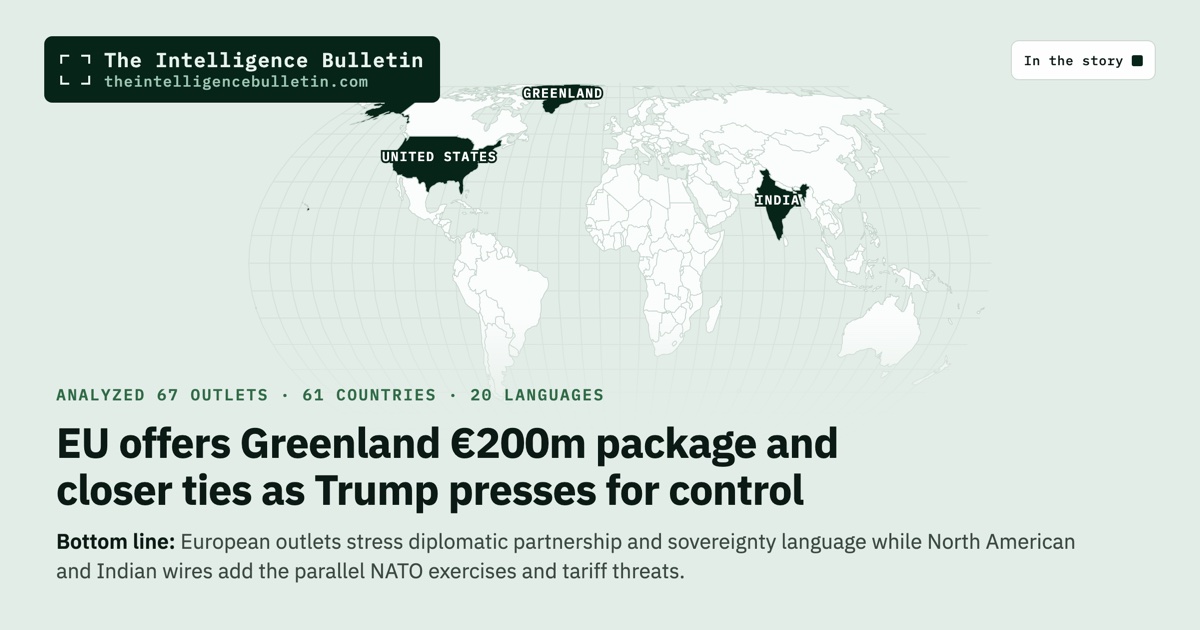
EU offers Greenland €200m package and closer ties as Trump presses for control

Map of the countries in the story: EU offers Greenland €200m package and closer ties as Trump presses for control
European Commission President Ursula von der Leyen visited Nuuk, Greenland, on September 7, 2026, alongside Danish Prime Minister Mette Frederiksen and Greenlandic Prime Minister Jens-Frederik Nielsen. She announced a substantial EU investment package of around €200 million over two years for critical minerals, satellite communications, renewable energy, climate adaptation, education and infrastructure, plus plans to double support from 2028. The move responds to repeated US President Donald Trump demands for greater American control of the mineral-rich Arctic territory, which Greenland and Denmark have rejected. All parties stressed that Greenland’s future is for its people and Denmark to decide.

One Story. Many Angles.

🇩🇪
Germany
Deutsche Welle
Carries Reuters reporting
Von der Leyen visits Greenland amid Trump pressure
Read →
🇩🇰
Denmark
DR
DANISH
Original reporting
Mette Frederiksen reacts to Trump card with Greenland
“Mette Frederiksen reagerer på Trump-kort med Grønland”
Read →
🇨🇦
Canada
The Globe and Mail
Carries Associated Press reporting
EU promises new partnership and investment in Greenland amid Trump threats
Read →
🇮🇳
India
The Hindu
Carries AP reporting
EU seeks to reassure a Trump-rattled Greenland with promise of a new partnership and investment
Read →
🇮🇪
Ireland
The Irish Times
Carries Reuters reporting
EU to boost investment in Greenland amid Trump annexation drive
Read →
5 sources · 4 independent accounts — some share the same news agency’s report
Analyzed 67 outlets across 61 countries and 20 languages · 10 translated · read 5 in full
In Brief

European outlets stress diplomatic partnership and sovereignty language while North American and Indian wires add the parallel NATO exercises and tariff threats.

The reporting across these outlets shows a coordinated European diplomatic push framed as reassurance to Greenland rather than direct confrontation with Washington. Every account describes the same sequence: von der Leyen arriving in Nuuk, signing a joint declaration with the two prime ministers, and outlining concrete funding lines that broaden existing EU support beyond fishing rights and education. The Globe and Mail and The Hindu, both carrying near-identical AP copy, add the detail of parallel NATO military exercises involving Canada, Denmark and Finland but no US troops, underscoring the Arctic security dimension without naming it as escalation. The Irish Times, drawing on Reuters, supplies the historical note that Greenland left the EU in 1985 yet retains EU citizenship through Denmark, explaining why the bloc can act directly. DR’s Danish-language coverage stands apart by leading with Frederiksen’s explicit rebuttal of a Trump-shared map depicting Greenland as US territory, giving the domestic political reaction that observer outlets omit. DW, mixing its own reporting with agency material, highlights von der Leyen’s X post committing the EU to a safe Arctic, a phrasing absent from the wire versions. The consistent sovereignty line across all pieces—that Greenland’s future belongs solely to Greenland and Denmark—reveals the event’s core message was delivered uniformly, while the choice of which supporting facts each outlet foregrounds tracks whether the paper sits inside or outside the European diplomatic circle.

Perspective Analysis

European Commission President Ursula von der Leyen arrived in Nuuk on September 7 for a two-day visit that produced a joint declaration with Danish Prime Minister Mette Frederiksen and Greenlandic Prime Minister Jens-Frederik Nielsen. The declaration committed the European Union to a €200 million package over the next two years, directed at critical minerals development, satellite communications, renewable energy, climate adaptation measures, internet connectivity, hydropower upgrades, fisheries support, education, housing improvements, small-business aid and sustainable tourism. Von der Leyen also signalled an intention to double the bloc’s baseline budget support for Greenland to roughly half a billion euros beginning in 2028. She described the package as substantial and stated that Greenland could count on the EU.

The timing placed the visit squarely against repeated public statements from US President Donald Trump that the United States required greater or total access to the territory for national-security reasons. Trump had shared an edited map on social media showing Greenland under an American flag alongside Canada, Mexico and other territories. Frederiksen, speaking in Greenland the same day, answered that map directly. She said the Greenlandic government and people had stated repeatedly that they did not wish to become American and that the message could be repeated without ambiguity to the United States and the wider world. Nielsen, for his part, welcomed the EU move as an opportunity to deepen an existing friendship and partnership at a moment when the island faced challenges it could not meet alone.

Von der Leyen framed the effort as support for a safe and peaceful Arctic and for Greenland’s security. She also reiterated that Greenland’s future remained a matter for the people of Greenland and Denmark alone. Territorial integrity, sovereignty and the inviolability of borders, she said, were fundamental principles of international law. All three leaders signed the declaration after a joint appearance that included a stop at the Eutelsat OneWeb facility in Nuuk.

Greenland left the European Union in 1985 yet its roughly 57,000 residents hold EU citizenship through their Danish passports. The new funding therefore extends and broadens an existing relationship rather than creating one from scratch. Earlier EU contributions had centred on fishing rights and education; the announced package widens the sectors and increases the scale. The visit itself was presented as a show of solidarity with both Greenland and Denmark after months of US pressure that included tariff threats against Denmark and several of its European allies.

The accounts converge on the core sequence and on the sovereignty language. Five separate outlets carried the same €200 million figure, the same list of targeted sectors, the same von der Leyen quotation on Greenland’s future, and the same description of Trump’s demands. Where the pieces diverge is in the supporting detail each chooses to foreground. Deutsche Welle recorded von der Leyen’s X post committing the EU to a safe Arctic. DR led its report with Frederiksen’s rebuttal of the Trump map and placed the EU announcement in the context of Danish domestic politics. The Globe and Mail and The Hindu, both relaying Associated Press copy, added that 11 NATO countries had begun Arctic Shield military exercises in Greenland the same day, involving around 400 personnel from Canada, Denmark and Finland but no US troops. They also recalled earlier tariff threats against Denmark, Finland, France, Germany, the Netherlands, Norway, Sweden and the United Kingdom, and noted that those threats had been withdrawn after NATO agreed to increase its Arctic role. The Irish Times supplied the 1985 EU exit date and the continuing citizenship link, framing the package as an expansion of long-standing ties.

These differences track geography and editorial priority rather than factual disagreement. The two North American and Indian outlets carrying the same wire service added the military-exercise detail that the European and Danish pieces did not include. DR alone placed Frederiksen’s map response at the centre. DW alone quoted the Arctic-security post. The Irish Times alone supplied the historical membership note. No outlet contradicted another on the package size, the sovereignty statement or Trump’s public position.

The uniform sovereignty line across every report supplies the clearest signal of the event’s intended message. Whether an outlet sits inside the European diplomatic circle or observes from farther away, it recorded the same insistence that decisions about Greenland belong to Greenland and Denmark. That convergence is itself evidence that the three signatories coordinated their public statements in advance. The choice of additional context then reveals editorial vantage: Canadian and Indian wires emphasised Arctic security and prior tariff friction because those elements connect directly to North American and multipolar concerns. Danish state media emphasised the prime minister’s reply to a domestic political provocation. German public broadcasting highlighted the EU’s own security framing. Irish coverage supplied the membership history that explains why the bloc can act at all.

What to Watch

The reporting therefore shows a European diplomatic and economic step taken in full view of US pressure, presented uniformly as reassurance and partnership rather than retaliation. The military-exercise detail appears only in the wire-service accounts, and the domestic Danish reaction appears only in the Danish account. Both additions are consistent with the corroborated facts; neither alters the central sequence. The event registers as a concrete widening of EU engagement with an Arctic territory whose strategic value has risen with melting ice and accessible minerals. The scale of the package and the presence of the three leaders on the same day indicate that the European side intends the move to be noticed in Washington as well as in Nuuk. What follows will depend on whether the funding produces visible projects on the ground and whether the parallel NATO exercises remain limited to the announced participants.


Share this story

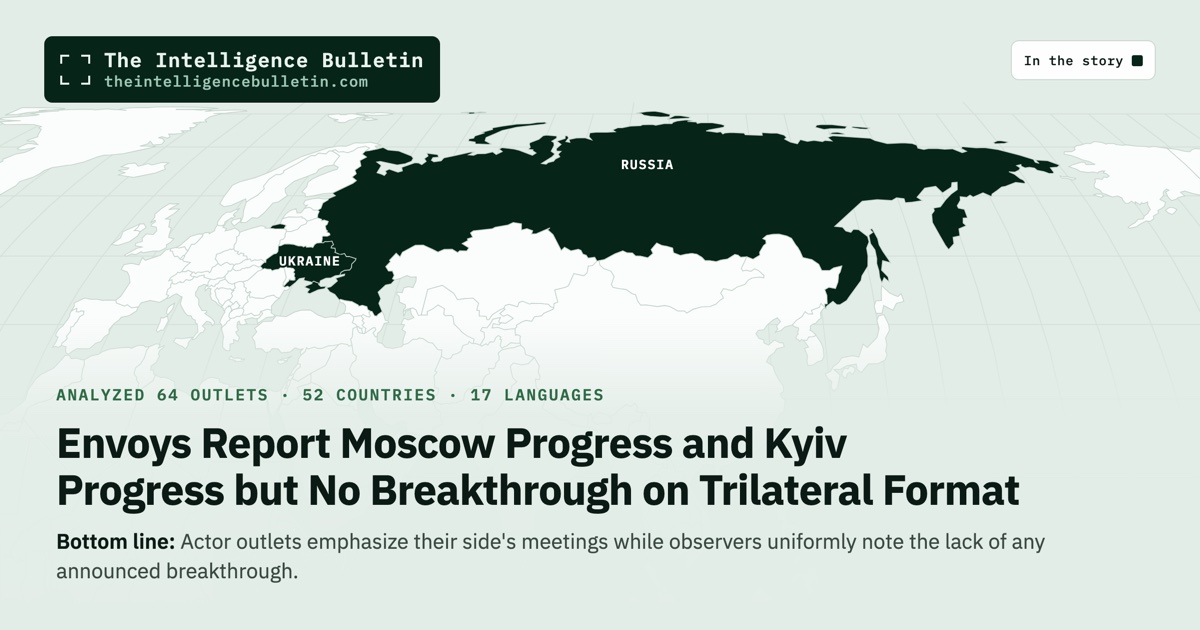
Envoys Report Moscow Progress and Kyiv Progress but No Breakthrough on Trilateral Format

Map of the countries in the story: Envoys Report Moscow Progress and Kyiv Progress but No Breakthrough on Trilateral Format
US envoys Steve Witkoff and Jared Kushner held three hours of talks with Vladimir Putin in Moscow on September 6, described by Kremlin aide Yury Ushakov as highly useful. They then traveled to Kyiv for their first visit, meeting Volodymyr Zelenskyy and European security advisers. The envoys cited significant progress and new ideas from Moscow, advocated returning to trilateral US-Ukraine-Russia negotiations soon, and noted a temporary pause on strikes against the capitals. No concrete agreement or breakthrough was announced, with next steps expected in coming weeks.

One Story. Many Angles.

🇷🇺
Russia
en.kremlin.ru
Original reporting
Comment by Presidential Aide Yury Ushakov following Vladimir Putin’s meeting with US Presidential Envoy Steve Witkoff and Jared Kushner • President of Russia
Read →
🇺🇦
Ukraine
Kyiv Post
Carries AFP reporting
Witkoff, Kushner Cite ‘Significant Progress,’ Push Trilateral Peace Talks
Read →
🇷🇺
Russia
The Moscow Times
Carries Reuters reporting
U.S. Envoys Make First Kyiv Visit Amid Ukraine Peace Push
Read →
🇶🇦
Qatar
Al Jazeera
Carries AFP and Reuters reporting
US envoys hold ‘substantive’ talks with Zelenskyy in first visit to Kyiv
Read →
🇬🇧
United Kingdom
The Independent
Original reporting
Ukraine-Russia war latest: Trump envoys set to meet Zelensky in Kyiv after ‘highly useful’ Putin talks
Read →
5 sources · each independently reported
Analyzed 64 outlets across 52 countries and 17 languages · 20 translated · read 5 in full
In Brief

Actor outlets emphasize their side’s meetings while observers uniformly note the lack of any announced breakthrough.

Reporting across outlets shows unusually consistent accounts of the weekend shuttle: the Moscow meeting lasted over three hours with frank exchanges of ideas, the Kyiv leg marked the envoys’ first visit there, and both sides used nearly identical language of substantive talks and hope for trilateral format. Kremlin.ru centers the Putin encounter and Ushakov’s positive framing without detailing Kyiv. Kyiv Post foregrounds the envoys’ Kyiv statements on progress and daily contacts with Ukrainian officials. The Moscow Times, citing Reuters, stresses the novelty of the Kyiv stop and absence of immediate results. Al Jazeera notes little new information emerged while highlighting Zelenskyy’s emphasis on leader-level decisions on territory. The Independent traces the full Moscow-to-Kyiv sequence and records Zelenskyy’s separate multilateral session with European advisers. The shared factual core is the absence of a claimed breakthrough despite the optimistic tone from the envoys themselves; the variation lies in which capital each outlet places at the center of the narrative. This pattern reveals that actor-country sources highlight their government’s engagement while external observers uniformly record the lack of concrete movement, a distinction visible only when the accounts are read together rather than in isolation.

Perspective Analysis

US envoys Steve Witkoff and Jared Kushner spent three hours with Vladimir Putin in Moscow on September 6. Kremlin aide Yury Ushakov later described the session as highly useful and extremely frank, noting that the Americans had put forward ideas on possible routes to a settlement. The same day the pair traveled to Kyiv for their first visit to the Ukrainian capital since the full-scale invasion began in 2022. There they met President Volodymyr Zelenskyy for several hours of bilateral talks that included a working lunch, then joined a multilateral session with British, French and German national security advisers.

Witkoff told reporters after the Kyiv meetings that the Moscow talks had produced significant progress and new ideas. Kushner said the conversation with Putin had been very constructive and substantive, focused on what each side and the wider world could gain from a durable settlement. Both envoys expressed hope that a return to formal trilateral negotiations among the United States, Ukraine and Russia could be announced shortly. They also said they had maintained near-daily contact with senior Ukrainian officials throughout the period when they had not yet visited Kyiv in person.

Zelenskyy described the talks as very substantive and important. He noted that security guarantees, a post-war prosperity plan and continued supplies of air-defense systems had been discussed. Ukraine and Russia had agreed in advance to a temporary pause on strikes against each other’s capitals for the duration of the visit. Fighting continued elsewhere, however, with Ukrainian forces reporting a strike on the Ryazan oil refinery inside Russia and Russian forces reporting an attack on a Ukrainian cargo vessel in the Black Sea.

No concrete agreement or breakthrough was announced after either leg of the trip. A White House official told Reuters that next steps would be announced in the coming weeks. Zelenskyy said the most difficult issues, including territory, would ultimately have to be settled at the level of national leaders. Al Jazeera’s reporting from Kyiv observed that little new information had emerged from the meetings themselves.

The accounts converge on the basic sequence and on the absence of any announced deal. Four separate reporting chains—Kremlin statements, the envoys’ Kyiv press availability, Reuters material carried by the exiled Moscow Times, and on-the-ground coverage by Al Jazeera and The Independent—all record the three-hour Moscow session, the first Kyiv visit, the temporary capital-strike pause, and the lack of a claimed breakthrough. Where the accounts diverge is in emphasis and framing rather than in disputed facts.

The official Kremlin account centers almost entirely on the Moscow encounter and Ushakov’s positive characterization, with no mention of the Kyiv leg or the envoys’ public statements there. Kyiv Post reporting foregrounds the envoys’ Kyiv comments on progress and trilateral format, along with their descriptions of ongoing daily contact with Ukrainian security officials. The exiled Moscow Times, drawing on Reuters, stresses the novelty of the Kyiv stop and the absence of immediate results after the Moscow talks. Al Jazeera notes the visit itself as the main development while recording Zelenskyy’s repeated insistence that territorial questions belong at the leaders’ level. The Independent traces the full Moscow-to-Kyiv sequence and separately records Zelenskyy’s additional multilateral session with European advisers.

A reader who saw only the Kremlin account would miss that the envoys publicly described the Moscow talks as having produced new ideas and that they immediately moved on to Kyiv to test those ideas with the other side. A reader limited to Kyiv Post would not learn that the Kremlin had characterized the Moscow session in its own terms before the Kyiv leg took place. A reader who encountered only the exiled Moscow Times or Al Jazeera pieces would correctly register the lack of a breakthrough but would not see the specific language the envoys used in Kyiv about daily Ukrainian contacts and the hope for an imminent trilateral announcement. The Independent piece alone supplies the detail that Zelenskyy held a separate round with European security advisers after the US bilateral session.

The most reliable element across the coverage is the absence of any announced breakthrough. That finding rests on four independent reporting chains rather than on a single outlet’s interpretation. Actor-country sources have a clear interest in presenting their own government’s engagement in the most constructive light, while external observers have less stake in either side’s framing and therefore record the gap between optimistic tone and concrete movement more consistently. The persistent differences on territory and security guarantees remain unaddressed in the public record of these meetings.

What to Watch

The next phase is therefore likely to consist of further private exchanges rather than a rapid public summit. The envoys’ own statements indicate they intend to continue shuttling and consulting, yet the same statements also make clear that the hardest issues have not been resolved. European participation in the Kyiv session suggests that any eventual trilateral track will still need to accommodate wider Western interests if it is to hold.


Share this story

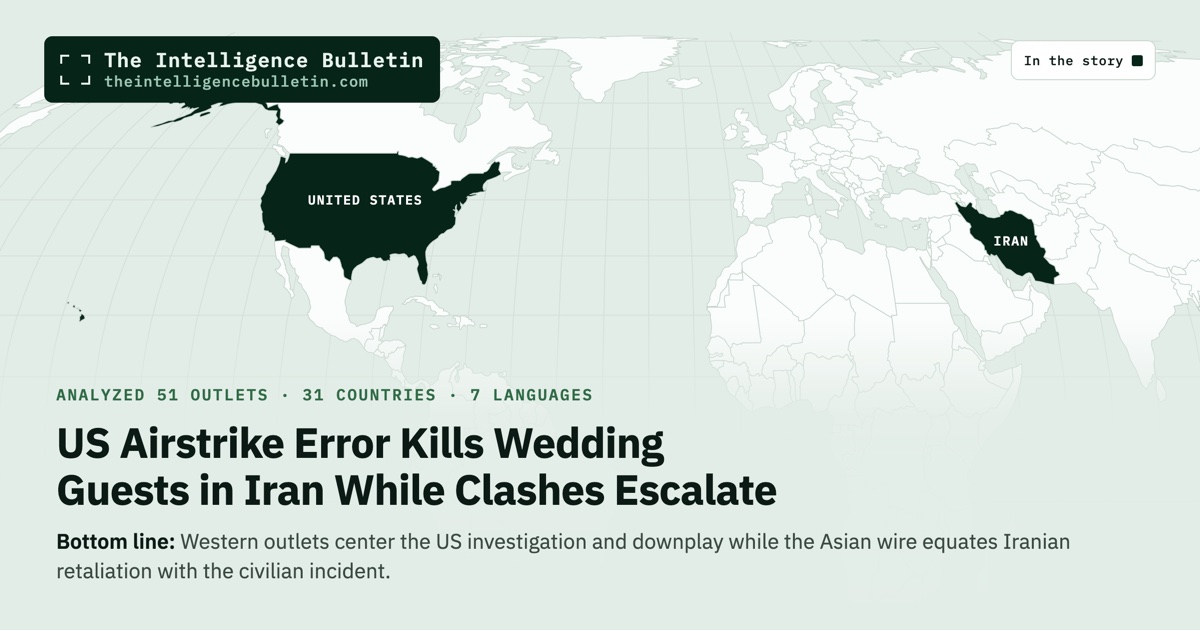
US Airstrike Error Kills Wedding Guests in Iran While Clashes Escalate

Map of the countries in the story: US Airstrike Error Kills Wedding Guests in Iran While Clashes Escalate
A US airstrike in Kuhestak, southern Iran, on Tuesday targeted a communications complex but one bomb struck a nearby home hosting a wedding. Iranian officials reported at least four civilians killed and dozens injured. The Pentagon is investigating the apparent targeting error as part of broader US-Iran clashes involving strikes on naval and oil targets. US officials maintain they do not target civilians while Iran accuses Washington of war crimes.

One Story. Many Angles.

🇺🇸
United States
The Spokesman-Review
Carries Washington Post reporting
Deadly Iran wedding strike likely due to U.S. bomb missing a nearby target
Read →
🇬🇧
United Kingdom
The Independent
Carries Reuters reporting
Iran-US war latest: Vance says ‘sometimes things happen’ after US accused of killing five in wedding strike
Read →
🇵🇭
Philippines
The Manila Times
Agence France-Presse wire copy
Iran hits US targets as Washington says probing wedding strike
Read →
3 sources · each independently reported
Analyzed 51 outlets across 31 countries and 7 languages · 29 translated · read 3 in full
In Brief

Western outlets center the US investigation and downplay while the Asian wire equates Iranian retaliation with the civilian incident.

The Spokesman-Review centers the civilian deaths and Pentagon investigation into the errant bomb, drawing on Washington Post reporting that verifies the 440-foot miss and munitions details. The Independent folds the incident into a live blog on Hormuz tensions and quotes US officials downplaying Iranian accounts while noting Red Crescent calls for an ICC probe. The Manila Times balances the wedding strike with Iranian missile hits on US-linked bases in Kuwait and the UAE, presenting both sides’ military actions from a Southeast Asian wire perspective. All three corroborate the core sequence of a US strike gone wrong amid ongoing exchanges, yet differ sharply in emphasis: one isolates the mishap as the lead, another subordinates it to political reactions and oil risks, and the third equates it with Iranian retaliation. This pattern shows how proximity to Washington shapes focus on investigation and denials, while distance allows equal weight on Iranian strikes. The absence of direct Iranian outlets in the set leaves official Tehran statements visible only through foreign filters that either verify or question them.

Perspective Analysis

A US Navy jet dropped six glide bombs on a communications tower complex in the coastal Iranian town of Kuhestak on Tuesday. Five struck their intended target. The sixth landed on the roof of a house 440 feet away where a wedding celebration was underway. Iranian health officials reported that at least four civilians died in the blast, including two women and two children aged four and sixteen. More than ninety others suffered injuries. The Pentagon is examining whether the errant bomb caused the deaths.

US officials described the tower complex as a site used in part by Iranian forces for operations against American troops and shipping. The complex sat in a populated area. The strike formed part of a wider wave of American attacks in southern Iran that day, framed by Washington as retaliation for threats to its forces and commercial vessels. Iranian state media and the Red Crescent Society circulated video of emergency workers entering damaged buildings and spraying water on fires. The Red Crescent called the location civilian in character and urged an independent international investigation.

Vice President JD Vance told reporters that authorities were looking into the incident. He added that Iranian state media had not been reliable on events in the conflict so far. A Central Command spokesman stated that the US military never targets civilians, unlike Iran’s Revolutionary Guard. Officials assessed other possible explanations for the explosion, such as an air-defense missile falling short, but weapons analysts reviewing images judged that scenario unlikely. The munitions involved were Joint Standoff Weapons, glide bombs whose remnants matched debris photographed at the site.

Iranian officials accused the United States of striking a civilian gathering and labeled the act a war crime. The Red Crescent asked the International Criminal Court to open an inquiry. Iranian Revolutionary Guard leaders vowed that the blood of the victims would not go unanswered. In the days surrounding the Kuhestak incident, Iranian forces launched missiles and drones toward US-linked facilities in Kuwait and the United Arab Emirates, according to statements from Tehran. Kuwait reported intercepting some of the incoming projectiles. Washington dismissed Iranian claims of successful hits on American vessels as false.

The six-month conflict between the United States and Iran has already seen earlier episodes of civilian harm. An American strike on a military compound in February hit a nearby school, killing at least 175 people according to Iranian accounts. That incident was later attributed to outdated targeting data. The current ceasefire has been punctuated by sporadic exchanges, including attacks on oil tankers that have pushed Brent crude prices toward one hundred dollars a barrel.

Three English-language outlets covered the Kuhestak strike in the immediate hours after it occurred. The Spokesman-Review placed the civilian deaths and the Pentagon investigation at the center of its account, drawing on Washington Post reporting that included verified photographs, distance measurements, and statements from a person familiar with the targeting process. That piece supplied technical detail on the six-bomb salvo, the 440-foot offset, and the type of munition used. It also noted the Red Crescent video and Iranian casualty figures without endorsing them as independently confirmed.

The Independent embedded the incident inside a live blog tracking Hormuz shipping restrictions, oil-price movements, and political reactions in Washington. Its headline highlighted Vance’s remark that “sometimes things happen.” The text recorded Iranian accusations and the Red Crescent’s call for an ICC probe while giving space to American denials that civilians were deliberately targeted. Broader context on tanker attacks and exclusion zones received equal prominence.

The Manila Times, carrying an Agence France-Presse dispatch, opened with Iranian missile strikes on US-linked bases in Kuwait and the UAE, then noted Washington’s ongoing probe of the wedding incident. It reported Iranian vows of revenge alongside US skepticism of Iranian casualty claims and quoted Vance expressing doubt about Tehran’s media accounts. The dispatch presented the wedding deaths as one element in a sequence of mutual strikes rather than the focal event.

These differences in framing produce distinct pictures for readers. Someone relying only on the Spokesman-Review account would come away with the clearest technical reconstruction of how one bomb left its intended path. A reader limited to the Independent would see the episode primarily through the lens of Washington politics and energy-market consequences. A reader of the Manila Times dispatch would register the wedding casualties as one data point balanced against Iranian military responses in neighboring countries. All three pieces record the same core sequence of an apparent US targeting error amid active clashes, yet none supplies an Iranian domestic outlet’s direct reporting on the same events.

The Spokesman-Review account rests on the strongest independent corroboration for its central claim about the bomb’s trajectory. Washington Post reporters cross-checked social-media imagery against known geography, consulted weapons analysts on munition signatures, and spoke with an official familiar with the operation who described the intended target and the single stray bomb. Those details align with the corroborated facts that a US bomb missed its mark by roughly 440 feet and that the Pentagon has opened an investigation. The other two accounts rely more heavily on official statements from both sides without adding comparable verification steps.

US officials have an interest in emphasizing investigation and the absence of deliberate civilian targeting, because that framing limits political damage at home. Iranian officials have an interest in publicizing civilian deaths to rally domestic support and press international bodies. The absence of direct Iranian press in the source set means statements from Tehran appear only through foreign filters that either accept or question them.

What to Watch

The next development likely to matter is the outcome of the Pentagon review. If it confirms a guidance or intelligence failure and releases findings on steps taken to reduce civilian risk, that information will shape whether the incident remains an isolated mishap or feeds into wider accusations of recklessness. If the review stalls or produces limited disclosure, Iranian accusations will gain additional traction in coverage outside the United States. Either path keeps the civilian toll at the center of arguments over how the conflict is conducted.


Share this story