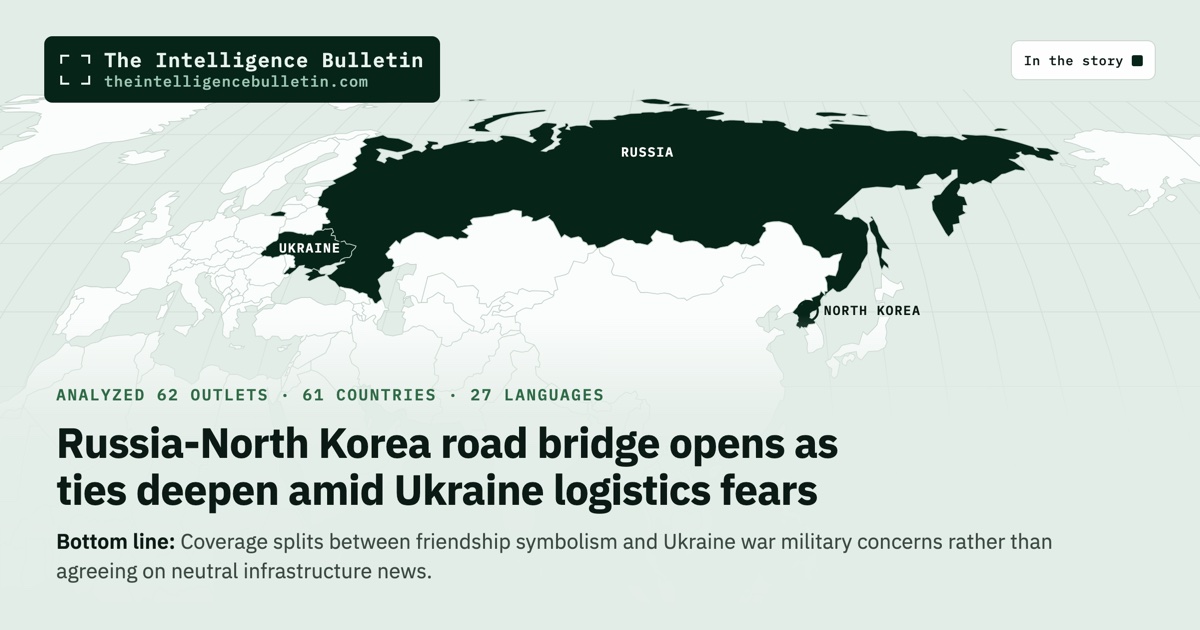
Russia-North Korea road bridge opens as ties deepen amid Ukraine logistics fears

Map of the countries in the story: Russia-North Korea road bridge opens as ties deepen amid Ukraine logistics fears
Russia and North Korea opened the first road bridge across the Tumen River on September 7, 2026, connecting Khasan in Russia’s Far East to Tumangang in North Korea. Russian Prime Minister Mikhail Mishustin and North Korean Premier Pak Thae Song joined the ceremony remotely. The one-kilometre bridge, named after Soviet officer Yakov Novichenko, allows up to 300 vehicles daily and adds a road link to existing rail and air connections. Ukrainian groups raised concerns it could serve as a military supply route amid deepened Russia-North Korea ties since the Ukraine war.

One Story. Many Angles.

🇬🇧
United Kingdom
The Guardian
Original reporting
Russia and North Korea open first road bridge across their shared border
Read →
🇰🇵
North Korea
NK News
Carries TASS reporting
Russia, North Korea open their first car bridge in ceremony: state media
Read →
🇯🇵
Japan
Asahi Shimbun
JAPANESE
Original reporting
Road bridge connecting Russia’s Far East and North Korea completed, concerns over troop and weapon transport for invasion: Asahi Shimbun
“ロシア極東と北朝鮮を結ぶ道路橋が完成 侵攻へ兵や兵器輸送の懸念も:朝日新聞”
Read →
🇭🇰
Hong Kong
South China Morning Post
Carries Reuters reporting
North Korea, Russia open first road bridge in ‘new symbol of friendship’
Read →
🇦🇺
Australia
ABC News
Original reporting
North Korea and Russia open first road bridge to deepen ties amid Ukraine war
Read →
5 sources ¡ each independently reported
Analyzed 62 outlets across 61 countries and 27 languages ¡ 22 translated ¡ read 5 in full
In Brief

Coverage splits between friendship symbolism and Ukraine war military concerns rather than agreeing on neutral infrastructure news.

The selected sources converge on the bridge’s technical details and official Russian framing as a historic infrastructure milestone boosting trade and ties, yet diverge sharply on its geopolitical meaning. Western and Australian outlets embed the opening in the Ukraine war context, highlighting Ukrainian warnings of a covert military corridor for North Korean troops and Russian resources. Japan’s Asahi stresses risks of enhanced troop and weapons transport supporting Russia’s invasion. In contrast, the Hong Kong-based SCMP and North Korea specialist NK News foreground the ceremony and friendship symbolism drawn from Russian and state media accounts, with minimal reference to conflict logistics. This split reveals how proximity and alignment shape emphasis: regional security anxieties surface where direct stakes exist, while actor-aligned or distant reporting prioritizes the alliance narrative without contradiction on the event itself. The absence of a direct Russian outlet in the set leaves official claims unchallenged within the coverage, underscoring that the bridge’s dual-use potential remains a point of interpretive tension rather than factual dispute across independent chains.

Perspective Analysis

The one-kilometre road bridge across the Tumen River opened to traffic on September 7, 2026, after a ceremony that featured remote addresses by Russian Prime Minister Mikhail Mishustin and North Korean Premier Pak Thae Song. The crossing links the Russian settlement of Khasan in Primorsky Krai with Tumangang on the North Korean side, a remote stretch a few miles from the Sea of Japan coast. Russian government statements described the structure as capable of handling 300 vehicles and 2,325 people each day once fully operational, with immediate cargo use and passenger traffic planned by the end of the year. The bridge forms part of a larger 4.7-kilometre border-crossing project that includes new checkpoint facilities on both sides.

Construction began in April 2025 following an agreement reached during President Vladimir Putin’s 2024 visit to Pyongyang. The project had faced delays from an initial June target tied to the second anniversary of that summit. Russian authorities reported the crossing at 65 percent complete as late as late August. The bridge rests on foundations reaching 45 metres deep on the North Korean side and 30 metres on the Russian side, with 16 sections between columns, the middle two built jointly. Russian state media noted that the existing railway bridge upstream had served as the sole link since the late 1950s, with temporary planks occasionally placed for vehicles. The new road bridge now provides the first dedicated automobile connection.

The structure carries the name of Soviet officer Yakov Novichenko, credited with saving North Korea’s founding leader Kim Il-sung from an assassination attempt in 1946. A car once belonging to Novichenko led the Russian procession across the span after the ceremony. Columns of flag-adorned trucks crossed from both directions. Mishustin told participants that the expansion of cross-border infrastructure would deliver a powerful impetus for trade, economic, scientific, technological and cultural cooperation, describing the opening as a genuinely historic event and the ties between the two countries as already at an unprecedented high level. North Korean state media carried parallel accounts of the event through Russian wire services.

Russia and North Korea already maintain direct flights between Vladivostok and Pyongyang and the railway link. The new bridge is expected to connect to Russia’s federal road network and the transport corridor running from Vladivostok to St Petersburg. Russian officials projected reduced logistics costs and expanded trade volume. The project’s cost on the Russian side had risen to at least double the initial $100 million allocation, with an obscure contractor appearing to front for a larger Chechen construction firm.

Ukrainian human rights organisation Truth Hounds stated that the bridge could function as a covert military logistics corridor rather than primarily facilitating trade. The group warned it would allow movement of North Korean troops, construction brigades and military officials into Russia while enabling Russian technology and resources to flow in the opposite direction with reduced risk of detection. North Korea has already sent thousands of troops to Russia’s Kursk region to help counter a Ukrainian incursion there, and Ukrainian President Volodymyr Zelenskyy has publicly estimated that up to 50,000 North Korean soldiers could ultimately be deployed. In return, South Korean intelligence has assessed that Russia has supplied North Korea with air-defence missiles, electronic warfare equipment, drones and spy-satellite technology.

The five outlets examined converged on the basic sequence of the opening, the bridge’s dimensions, its naming and the remote participation of the two prime ministers. They also agreed that the crossing adds the first proper road connection to long-standing rail and air links. Beyond those shared facts, the accounts diverged on the event’s primary significance.

The Guardian and ABC News placed the opening inside the Ukraine war, foregrounding Ukrainian warnings about military logistics and noting North Korea’s troop deployments to Kursk alongside Russian supplies of advanced weaponry to Pyongyang. Asahi Shimbun similarly highlighted risks that the bridge would ease transport of troops and weapons in support of Russia’s invasion, framing the development against the background of expanded military cooperation between the two countries. In contrast, the South China Morning Post presented the bridge as a new symbol of friendship and quoted Mishustin at length on its economic and cooperative benefits without reference to conflict logistics. NK News, drawing directly from TASS and Interfax dispatches, concentrated on ceremony details, construction history, naming conventions and the technical specifications of the crossing while omitting any discussion of Ukrainian concerns or the war context.

No outlet in the set carried reporting from a Russian domestic source that might have elaborated on official Moscow priorities or addressed the dual-use questions raised elsewhere. The selected coverage therefore leaves the Russian government’s stated civilian and trade rationale unchallenged within the articles themselves, while the security implications appear only in the three outlets that drew on Ukrainian or regional security sources.

What to Watch

The interpretive split follows patterns of alignment and proximity. Outlets with direct stakes in North Korean security or Ukrainian battlefield conditions emphasised potential military applications. Those closer to the actors or focused on regional economic ties foregrounded the friendship and infrastructure narrative drawn from the same Russian official statements. The factual record of the opening itself shows no contradiction across the independent reporting chains; the divergence lies entirely in the weight each account assigns to the bridge’s likely uses. Given that Ukrainian groups possess the clearest interest in tracking any new route that could move personnel or materiel into Russia, their logistics warnings rest on the narrowest and most specific attribution among the available accounts. The absence of countervailing detail from Russian domestic reporting in this source set leaves that dimension of the story dependent on the single chain that raised it.
Share this story

AfD’s eastern win hands Merz a personal defeat and Europe a warning

Map of the countries in the story: AfD's eastern win hands Merz a personal defeat and Europe a warning
Germany’s far-right AfD won the September 6, 2026 state election in Saxony-Anhalt with 43.8 percent of the vote, more than doubling its previous share. The CDU under Chancellor Friedrich Merz fell to 17-18 percent. AfD secured 39 of 83 seats, three short of an absolute majority, and mainstream parties maintain a firewall against cooperation. The result signals rising eastern discontent with federal policies on migration and the economy.

One Story. Many Angles.

🇩🇪
Germany
Welt
GERMAN
Original reporting
Saxony-Anhalt election: “A personal humiliation for Friedrich Merz” – What the foreign press says about the AfD victory
“Wahl Sachsen-Anhalt: „Eine persĂśnliche DemĂźtigung fĂźr Friedrich Merz” – Was das Ausland Ăźber den AfD-Sieg sagt”
Read →
🇵🇱
Poland
PCh24
POLISH
Original reporting
“Idiots”, “traitors”. Tusk couldn’t stand it after AfD’s election victory
“„Idioci”, „zdrajcy”. Tusk nie wytrzymał po zwycięstwie AfD w wyborach”
Read →
🇫🇷
France
Le Parisien
FRENCH
Original reporting
“A very good agent for the AfD”: what future for German Chancellor Friedrich Merz, after the far-right victory in Saxony?
“ÂŤ Un très bon agent pour l’AfD Âť : quel avenir pour le chancelier allemand Friedrich Merz, après la victoire de l’extrĂŞme-droite en Saxe ?”
Read →
🇬🇧
United Kingdom
The Guardian
Original reporting
Germany’s far-right AfD thanks Elon Musk as France warns state election win a ‘serious moment’
Read →
🇶🇦
Qatar
Al Jazeera
Original reporting
World reacts to AfD victory in east Germany state election
Read →
5 sources ¡ each independently reported
Analyzed 63 outlets across 52 countries and 20 languages ¡ 34 translated ¡ read 5 in full
In Brief

Domestic outlets focus on Merz’s humiliation while neighbors and outsiders emphasize the AfD’s momentum and EU risks.

European reporting converges on the AfD’s breakthrough as a direct rebuke to Merz’s CDU, yet diverges sharply on the international stakes. German domestic accounts frame the CDU’s collapse as a personal humiliation for the chancellor who had pledged to contain the far right, with foreign media echoing schadenfreude over his weakened position. Polish coverage highlights Prime Minister Tusk’s blunt condemnation of any domestic rejoicing, reflecting neighborly alarm at AfD’s anti-migration stance. French outlets stress the EU-level risk of instability and the failure of established parties to address voter frustration, while the Guardian and Al Jazeera note Musk’s endorsement and far-right international congratulations alongside warnings from Paris that nationalism offers no solution. The shared factual core is the AfD’s 44 percent result and CDU’s halving of support; the contrast lies in whether this is chiefly a German leadership crisis or a broader European warning. Outlets that aggregate reactions, such as Al Jazeera, surface Russian and other non-Western voices absent from national European accounts, underscoring how proximity shapes emphasis on either domestic fallout or continental precedent.

Perspective Analysis

The Alternative for Deutschland secured 43.8 percent of the vote in the September 6 state election in Saxony-Anhalt, more than doubling its share from five years earlier. The Christian Democratic Union, the party of Chancellor Friedrich Merz, received between 17 and 18.5 percent, roughly half its previous result. With 39 seats in the 83-seat regional parliament, the AfD fell three seats short of an absolute majority. Lead candidate Ulrich Siegmund declared the outcome a mandate to form a government, while mainstream parties restated their refusal to cooperate with the party.

Siegmund thanked Elon Musk on X for support and for a “clear and highly important perspective on the political developments of our time,” and welcomed the prospect of stronger cooperation. Musk had replied “Gut gemacht!” to a post by AfD co-founder Alice Weidel. Former Hungarian prime minister Viktor Orban called the night “a huge night for Germany and Europe” and said it was only the beginning. Spanish Vox leader Santiago Abascal and Portuguese Chega leader André Ventura sent public congratulations. Russian Direct Investment Fund chief Kirill Dmitriev described Siegmund as the “voice of reason.” French Europe minister Benjamin Haddad called the result “a very grave moment for Europe,” adding that nationalism and xenophobia would never be the answer and that history must not be forgotten. Polish prime minister Donald Tusk wrote that in Poland only idiots or traitors could rejoice at the AfD triumph.

Merz had entered office in May 2025 promising to contain the AfD’s rise. Coverage in German outlets described the CDU’s performance as a personal humiliation, noting that foreign press accounts from Britain, France, Italy and elsewhere framed the result in exactly those terms. Polish reporting centered on Tusk’s statement and the reaction inside his own coalition, linking the AfD advance to domestic debates over migration and Russia policy. French accounts tied the outcome to Merz’s broken containment pledge and warned of wider European instability, while noting the party’s openness to possible deals with the BSW, a smaller left-leaning formation critical of the firewall. British and Qatari reporting added Musk’s intervention and the range of far-right and Russian reactions that European national outlets largely omitted.

The numbers themselves appear consistently across the five articles examined. Exit-poll and preliminary-result figures for the AfD’s 43.8 percent and the CDU’s halved support are cited by Welt, Le Parisien, the Guardian and Al Jazeera. Seat counts placing the AfD at 39 of 83 appear in the Guardian and Al Jazeera. French ministerial language of a grave or serious moment is reported by Le Parisien, the Guardian and Al Jazeera. Tusk’s “idiots or traitors” line is quoted directly in PCh24, the Guardian and Al Jazeera. No independent chain contradicts any of these claims.

A reader limited to German domestic coverage would see the result primarily as a crisis for Merz and the CDU, with foreign reactions serving mainly to underscore that humiliation. A reader limited to Polish coverage would encounter the story chiefly through Tusk’s condemnation and its domestic political utility. French reporting would foreground the EU-level warning and the failure of established parties to address voter frustration on migration and the economy. British and Qatari accounts would add Musk’s endorsement and the international far-right and Russian reactions that national European outlets largely left out. The shared factual spine across all five is the scale of the AfD win and the CDU collapse; the divergence lies in whether that win is treated as a contained German leadership problem or as evidence of a wider European shift.

What to Watch

The accounts that place the result inside a European frame are the ones that best match the pattern of reactions actually recorded. French ministerial statements, Polish governmental language, Musk’s public reply, and the congratulatory messages from Orban, Abascal and Ventura all appear on the record in the reporting examined. German domestic emphasis on Merz’s personal standing accurately captures the immediate pressure on the federal government, yet it understates the signaling that neighboring governments and transnational networks read into the same numbers. The firewall against AfD cooperation remains in place for now, but the party’s 44 percent share in an eastern state, combined with scheduled elections in two more eastern states on September 20, gives it repeated opportunities to test that barrier before the next federal vote.


Share this story

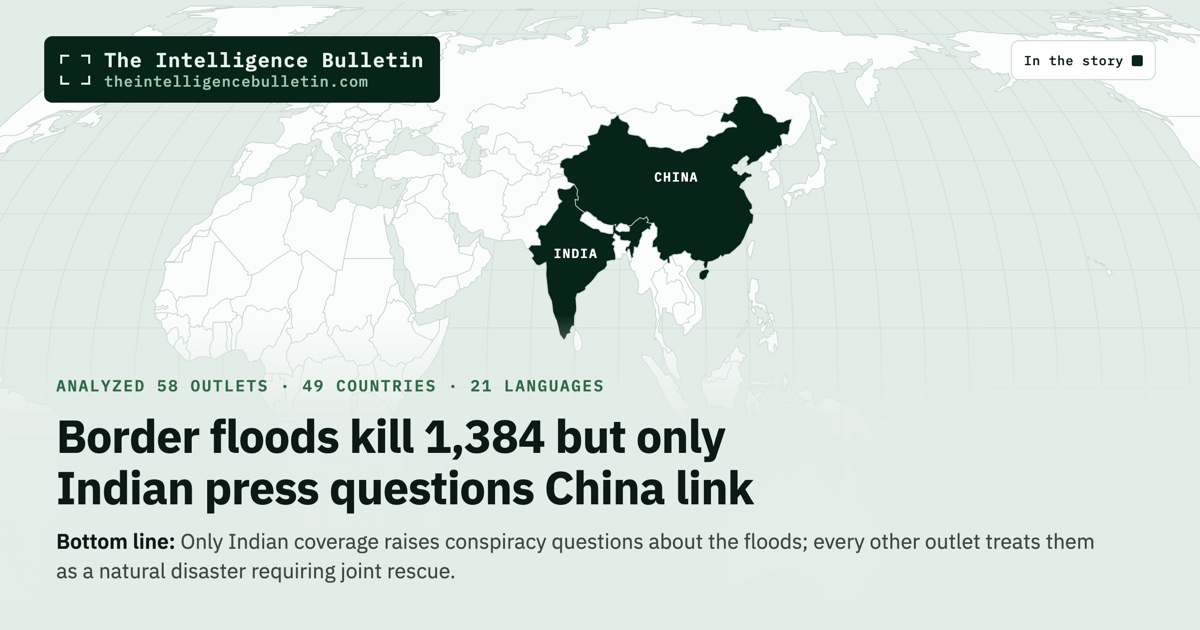
Border floods kill 1,384 but only Indian press questions China link

Map of the countries in the story: Border floods kill 1,384 but only Indian press questions China link
A glacial collapse on the China-Nepal border in late August triggered catastrophic floods that killed at least 1,384 people and left more than 5,500 missing across both countries. Rescue teams continue searching 12 days later amid destroyed infrastructure including a five-storey Chinese border post at Gyirong. Nepal reports 1,341 dead and nearly 5,000 missing; Tibet reports 43 dead and 519 missing. China has increased satellite weather data sharing with Nepal while Indian outlets alone raise questions about possible links to a prior US diplomat visit.

One Story. Many Angles.

🇳🇵
Nepal
Ekantipur
NEPALI
Carries Xinhua reporting
China increasing satellite-based weather assistance to Nepal
“नेपालका लागि उपग्रहमा आधारित मौसमसम्बन्धी सहयोग बढाउँदै चीन”
Read →
🇨🇳
China
Baidu
CHINESE
Carries state media reporting
Foreign media reporter in Jilong sighs at the difficulty of rescue: ‘Pay tribute to all rescue personnel, their efforts are touching’
“外媒记者在吉隆感慨救援之难:”向所有参与救援的人员致以敬意,他们付出的努力令人感动””
Read →
🇮🇳
India
Navbharat Times
HINDI
Original reporting
Nepal Flood US Diplomat, after US diplomat’s visit devastating flood in Nepal? Questions on China from Kathmandu to Tibet, was a conspiracy hatched?
“Nepal Flood Us Diplomat,अमेरिकी डिप्लोमेट के दौरे के एञऌ नेपाल में तबाही वाली एञढट? काठमांडू से तिब्बत तक चीन पर साञल, क्या रची गई साजिश? – nepal flood us diplomat sergio gor visit balen shah china conspiracy tibet – Nepal News”
Read →
🇶🇦
Qatar
Al Jazeera
Original reporting
China, Nepal race to find thousands still missing 12 days after floods
Read →
🇧🇷
Brazil
O Globo
PORTUGUESE
Carries AFP reporting
China says flood completely destroyed five-story border post between Tibet and Nepal: ‘When we started digging, it was the foundation that remained’
“China diz que inundação destruiu totalmente posto de fronteira de cinco andares entre Tibete e Nepal: ‘Quando começamos a cavar, era a fundação que havia restado’”
Read →
5 sources ¡ each independently reported
Analyzed 58 outlets across 49 countries and 21 languages ¡ 25 translated ¡ read 5 in full
In Brief

Only Indian coverage raises conspiracy questions about the floods; every other outlet treats them as a natural disaster requiring joint rescue.

National priorities dictate how each press frames the same disaster. Nepali coverage from Ekantipur presents the floods as the trigger for expanded Chinese satellite monitoring and data exchange, casting the event as an opportunity to strengthen bilateral cooperation on disaster response. Chinese material relayed via Baidu stresses the physical hardship of digging through mud and rubble at Gyirong and offers public tribute to rescuers, avoiding any discussion of cause or foreign involvement. Indian Hindi-language reporting stands apart by linking the timing of the floods to an April-May visit by US diplomat Sergio Gor to the affected border areas and by quoting unnamed sources who question whether the glacial collapse was natural or engineered. Al Jazeera and O Globo supply the cross-border humanitarian picture: joint operations hampered by terrain and weather, confirmed death and missing tallies from both governments, and the total erasure of the Gyirong customs building down to its foundation. The Indian angle has no counterpart in any other source; the cooperation narrative appears only in Nepali and Chinese accounts. This pattern shows how proximity, alliance and rivalry shape what each national press chooses to emphasise or omit when the same bodies are being recovered from the same gorge.

Perspective Analysis

The floods struck after a glacial collapse hit the border region near Gyirong in late August. Waters swept through narrow gorges on both sides of the frontier, killing at least 1,384 people and leaving more than 5,500 others missing twelve days later. Nepal’s national disaster agency placed its death toll at 1,341 with roughly 4,996 people unaccounted for. Chinese state media reported 43 dead and 519 missing on the Tibetan side, including 261 foreigners. Rescue teams worked in mud and unstable terrain, pulling four survivors from flooded hydropower tunnels in Nepal since the previous Friday. On the Chinese side crews used shovels, excavators and ground-penetrating radar to search the debris field.

At Gyirong, once the main land port between Tibet and Nepal, nothing remained of a five-storey customs building. Workers described arriving to find only the foundation after the mudslide stripped away every structure above it. One rescuer, Zhang Xiaojun, told visiting journalists that the sight was heartbreaking and that many compatriots had lost their lives. The single road into the gorge reopened mid-week, allowing heavier equipment to reach the site. Chinese authorities brought foreign reporters to the location and stated that more than sixty specialists and three laboratories were cataloguing remains using fingerprints, genetic data and immigration records.

China responded to the disaster by expanding real-time satellite monitoring for Nepal. The Chinese Meteorological Administration reported that Fengyun-3 and Fengyun-4 satellites now feed data into an AI-based early-warning system called Maju, supplying rainfall, lightning, river-flow and glacial-slide observations. Chinese officials said the information supports emergency rescue, damage assessment and ongoing coordination with Nepali counterparts. Nepali coverage presented the arrangement as a direct follow-on to the floods and a strengthening of bilateral technical ties.

Indian reporting introduced a different line of questions. One outlet cited unnamed Nepali and Tibetan sources who noted that a US diplomat, Sergio Gor, had visited the same border districts in late April and early May, including the Everest base camp area where he conducted drone demonstrations. The same sources suggested the scale of the glacial release appeared inconsistent with known natural features in the Mustang region and raised the possibility that water had been artificially impounded and then released. No other outlet in the set carried these claims or any reference to the diplomat’s earlier trip.

Al Jazeera and O Globo supplied the shared operational picture. Both described joint search efforts slowed by weather, landslides and poor connectivity. Nepal requested assistance from the UN-backed Fund for Responding to Loss and Damage and filed a formal climate-compensation claim, arguing that major emitters bear historical responsibility for the costs now falling on vulnerable countries. The UN appealed for fifty million dollars to aid more than 84,000 people affected by the disaster. Survivors brought by helicopter to a monastery-turned-shelter in Kathmandu spoke of lost families and homes, with volunteers noting that children’s drawings still showed “happy” stickers even as trauma remained suppressed.

The corroborated elements across independent chains are the death and missing counts, the total destruction of the Gyirong post, and the continuation of rescue work into the second week. These details appear in reporting that draws on official tallies from both governments and on-site accounts from Chinese and international journalists. The satellite-monitoring expansion rests on statements carried only in Nepali coverage. The suggestion of a non-natural cause or diplomatic connection appears only in the Indian Hindi-language account and relies on unnamed sources.

What to Watch

A reader limited to any single national press would therefore miss either the scale of confirmed cross-border losses, the physical erasure of the border facility, or the absence of corroboration for the conspiracy framing. The humanitarian facts rest on multiple reporting lines that converge on the same numbers and the same destroyed infrastructure. The alternative explanation rests on one outlet’s sourcing and has not been repeated elsewhere in the set. Regional rivalry supplies a clear motive for the Indian framing, while proximity and alliance supply equally clear motives for the Nepali and Chinese emphasis on cooperation and operational effort. The next developments most likely to shape outcomes are the pace of body identification and the response, if any, to Nepal’s compensation request.


Share this story

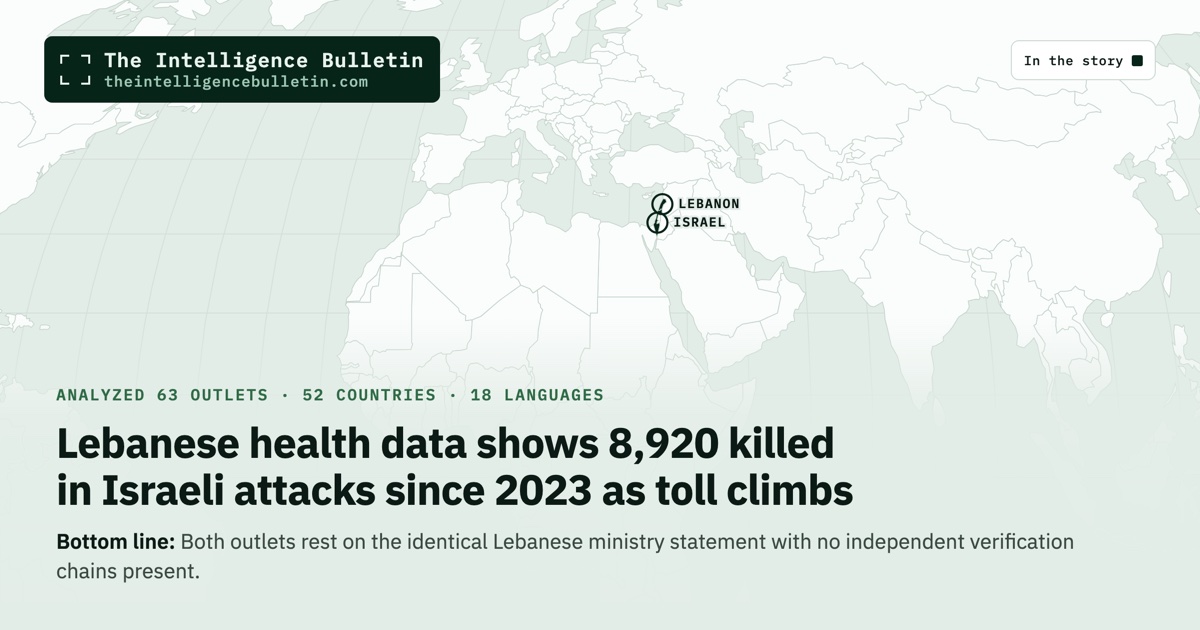
Lebanese health data shows 8,920 killed in Israeli attacks since 2023 as toll climbs

Map of the countries in the story: Lebanese health data shows 8,920 killed in Israeli attacks since 2023 as toll climbs
Lebanon’s Ministry of Public Health stated that Israeli attacks from October 2023 to September 2026 killed 8,920 people and injured 30,595 others. The figures include 4,358 deaths since March 2. Both selected outlets cite the same ministry data and note attacks on medical crews; Al Jazeera adds context on displacement and recent strikes amid Hezbollah-Israel exchanges.

One Story. Many Angles.

🇺🇸
United States
Shafaqna
Carries Al Jazeera reporting
Nearly 9,000 Lebanese killed in Israeli attacks since 2023 – Shafaqna English
Read →
🇶🇦
Qatar
Al Jazeera
Original reporting
Nearly 9,000 killed in Israeli attacks on Lebanon since 2023
Read →
2 sources ¡ each independently reported
Analyzed 63 outlets across 52 countries and 18 languages ¡ 37 translated ¡ read 2 in full
In Brief

Both outlets rest on the identical Lebanese ministry statement with no independent verification chains present.

The two selected outlets converge tightly on a single Lebanese government source for the cumulative death toll milestone, revealing how the story travels through limited independent chains rather than fresh reporting from the field. Shafaqna English reproduces the ministry numbers almost verbatim and credits Al Jazeera, functioning as a relay that adds no new detail beyond the health authority statement. Al Jazeera supplies the same core figures but embeds them in a wider account of ongoing exchanges, US-brokered agreements, Hezbollah rejection of frameworks, and continued displacement of 360,000 people, drawing on its own prior coverage and UN references. This pattern shows the milestone reaching English-language readers primarily through Arab-world and Shia-oriented channels that treat the Lebanese ministry as authoritative while the selected set contains no direct Israeli military statements or on-the-ground Lebanese daily reporting. The absence of those perspectives in the chosen sources leaves the human-cost framing unchallenged within the set, even as both pieces note the ministry’s separate count of 135 healthcare workers killed in ambulance attacks. Readers therefore encounter a consistent casualty ledger anchored in one national authority, with the deeper regional stakes supplied only by the Qatari outlet’s additional framing.

Perspective Analysis

The Lebanese Ministry of Public Health issued a statement on Saturday reporting that Israeli attacks from October 2023 through early September 2026 had killed 8,920 people and injured 30,595 others. The same statement recorded 4,358 of those deaths and 12,359 injuries since March 2. It separately tallied 179 attacks on ambulance crews in that later period, which killed 135 healthcare workers. Both English-language outlets that carried the milestone drew directly from this single ministry release.

Shafaqna English published the dispatch under the headline “Nearly 9,000 Lebanese killed in Israeli attacks since 2023.” Its account reproduced the ministry’s cumulative figures almost word for word, added the ambulance-crew toll, and closed by naming Al Jazeera as its source. No further detail on recent strikes, displacement, or diplomatic efforts appeared in the piece. The text remained a concise restatement of the health authority’s ledger, framed as a straightforward milestone in the three-year toll.

Al Jazeera ran the same core numbers under the headline “Nearly 9,000 killed in Israeli attacks on Lebanon since 2023.” Its version opened with the ministry statement but then expanded the dispatch with material drawn from its own prior reporting. It noted that 360,000 people remained displaced in August, including at least 22,000 in collective shelters, citing UNHCR data. It described Israel’s maintenance of a buffer zone in southern Lebanon since March and referenced two US-brokered framework agreements signed in June that tied any ceasefire to Hezbollah disarmament. The outlet recorded Hezbollah leader Naim Qassem’s rejection of those agreements as “null and void” and his insistence that Israel end its occupation first. It also included a Friday strike on Kfar Reman that killed three people and injured 23, plus an early Sunday bombing of Zawtar al-Sharqiyah.

The single originating chain therefore reached English readers through two distinct editorial choices. One outlet treated the ministry statement as the complete story and transmitted it with minimal adornment. The other retained the casualty ledger but situated it inside a running account of occupation, failed diplomacy, and ongoing displacement. Readers of the shorter version encountered only the raw count. Readers of the longer version encountered the same count alongside details of 179 ambulance attacks, 135 healthcare workers killed, and 360,000 displaced.

Because the underlying facts trace to one ministry release, the difference between the two pieces lies entirely in what each masthead elected to keep or add around that release. Shafaqna English kept only the headline numbers and the ambulance figure. Al Jazeera kept those elements and layered on its own earlier coverage of displacement figures and the June framework agreements. No independent reporting chain from Israeli military sources or daily Lebanese field accounts entered either article.

What to Watch

The pattern that results is a narrow transmission of a single national authority’s tally, carried forward by an Arab-world outlet that supplies regional stakes and by a Shia-oriented relay that does not. The human-cost emphasis the editor originally noted appears in both, yet it rests on the ministry’s arithmetic rather than on any cross-checked observation from the ground. The 8,920 figure therefore functions as the settled spine of the day’s coverage, while the surrounding context remains the product of one newsroom’s additional reporting choices.


Share this story

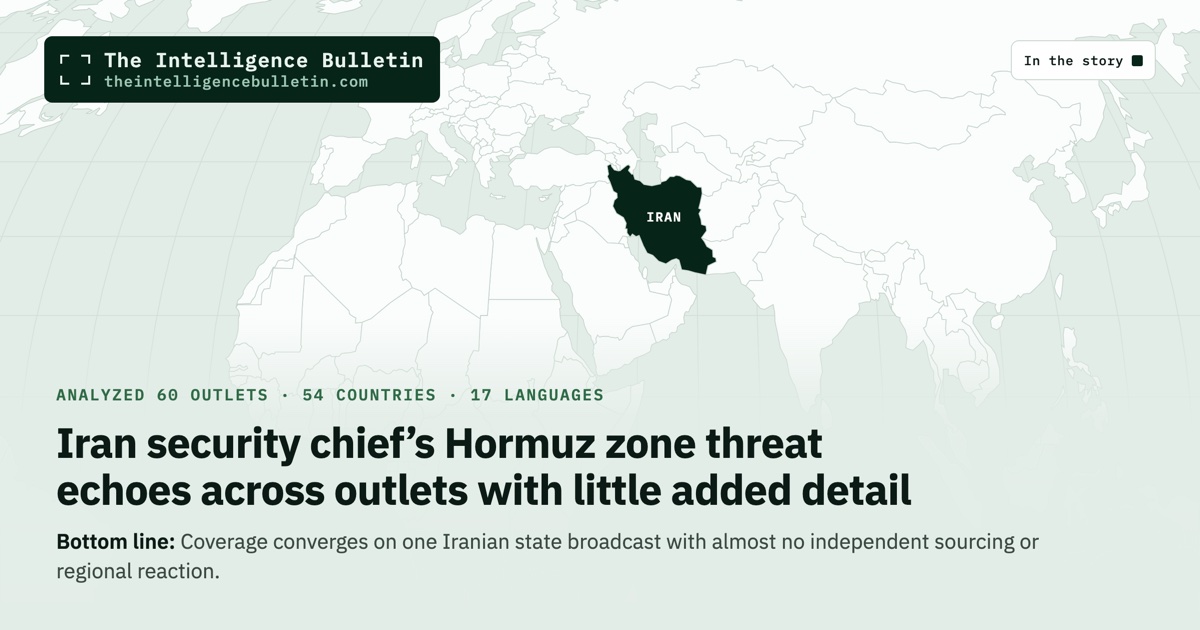
Iran security chief’s Hormuz zone threat echoes across outlets with little added detail

Map of the countries in the story: Iran security chief’s Hormuz zone threat echoes across outlets with little added detail
Iran’s Supreme National Security Council head Mohsen Rezaei told state television that a prohibited zone outside the Strait of Hormuz will be declared in coming days, starting from the US Navy blockade line and extending into the Persian Gulf. Ships entering the zone risk Iran’s sanctions list. The statement follows recent US-Iran clashes over tankers and shipping in the strategic waterway that carries significant global oil flows.

One Story. Many Angles.

🇸🇬
Singapore
The Straits Times
Carries Iranian state television and AFP reporting
Iran says it will declare ‘prohibited zone’ near Hormuz Strait in coming days
Read →
🇸🇦
Saudi Arabia
Arab News
Carries Associated Press reporting
Arab News | Iran says it plans to announce a new ‘exclusion zone’ near the Strait of Hormuz
Read →
🇭🇰
Hong Kong
South China Morning Post
Carries Agence France-Presse reporting
Iran will declare a ‘prohibited zone’ near Hormuz in coming days: security chief
Read →
🇮🇱
Israel
Israel National News
Original reporting
Iran to establish ‘prohibited zone’ near Strait of Hormuz
Read →
🇳🇴
Norway
E24
NORWEGIAN
Carries Bloomberg and NTB reporting
Iran will establish a prohibited zone outside the Hormuz Strait
“Iran vil opprette forbudssone utenfor Hormuz-stredet”
Read →
5 sources ¡ each independently reported
Analyzed 60 outlets across 54 countries and 17 languages ¡ 27 translated ¡ read 10 in full
In Brief

Coverage converges on one Iranian state broadcast with almost no independent sourcing or regional reaction.

All five outlets report the same core statement from Mohsen Rezaei on Iranian state television with only minor wording differences between “prohibited zone” and “exclusion zone.” Straits Times, SCMP via AFP, and Arab News via AP stay tightly focused on the timeline and geography of the zone. Israel National News adds immediate context on parallel petrol price hikes and US economic measures, framing the announcement as part of intensifying pressure. E24 alone highlights the Norwegian economic lens on potential shipping disruption while noting Bloomberg-sourced details on Iranian claims that the strait remains controlled. No outlet supplies independent verification of the zone’s exact coordinates or enforcement mechanism; every account traces directly to the same Iranian broadcast. The selected coverage therefore converges on the announcement itself rather than its practical effects or regional reactions, leaving the central tension—whether the zone will meaningfully alter tanker routes—unstated beyond Rezaei’s quoted threat.

Perspective Analysis

Iran’s top security official Mohsen Rezaei told state television on September 6 that his country would announce a prohibited zone outside the Strait of Hormuz within days. The zone, he said, would begin at the line of the existing US naval blockade and extend into the Persian Gulf. Any ship entering the area with intent to transit the strait would be added to Iran’s sanctions list.

Rezaei’s remarks came one day after US forces struck three oil tankers linked to Iran’s Revolutionary Guards, an action taken in response to Iranian ballistic-missile fire at two American warships earlier that week. Iranian state media reported that Revolutionary Guards naval units had themselves targeted three tankers on an unauthorised route through the strait and three other vessels affiliated with the United States. The Guards also claimed an attack on a US naval drone attempting to enter the strait, a claim US Central Command dismissed as false. Rezaei framed the coming zone as a direct response to the blockade and to continued attempts by vessels to use routes Tehran does not control.

The Strait of Hormuz remains the critical passage for roughly one-fifth of global oil supplies before the current conflict. Rezaei stated that the strait is fully closed and under armed control, with Iranian forces intercepting vessels attempting to pass without approval. He added that Iran continues daily oil exports of one to one and a half million barrels despite the pressure. US Energy Secretary Chris Wright told American broadcasters the same day that average daily flows through the strait stood at nine million barrels, supported by naval escorts, though he acknowledged volumes remain well below pre-conflict levels.

Alongside the zone announcement, Iranian authorities raised the price of petrol for the highest consumption tier. Government spokeswoman Fatemeh Mohajerani said the third-tier rate would double to 10,000 tomans per litre beginning September 8. The first two tiers remain unchanged. The rial traded above 2.2 million to the dollar on the black market that day, down from roughly 1.7 million before the conflict began in February.

Five outlets covering the announcement carried essentially the same account of Rezaei’s televised statement. The Straits Times, South China Morning Post via Agence France-Presse, Arab News via the Associated Press, Israel National News, and E24 in Norway all quoted the security chief’s description of the zone’s location and the sanctions consequence for ships that enter it. Minor phrasing differences appeared between “prohibited zone” and “exclusion zone,” but the core geography and penalty remained identical across the reports.

The outlets diverged only in the additional context each chose to include. The Straits Times and South China Morning Post stayed close to the timeline and geography of the zone itself. Arab News noted the zone’s intended effect on vessels attempting transit and mentioned expert views that the move represented escalation. Israel National News placed the announcement inside a wider account of US economic measures, including the rial’s decline and the Treasury’s recent sanctions campaign. E24 alone supplied pre-conflict traffic figures and Iranian assertions that the strait stays under armed control, framing the development through its implications for shipping volumes.

No report supplied independent coordinates for the zone, enforcement procedures, or confirmation that the measure had already taken effect. Every account traced directly to the same Iranian state broadcast. The convergence therefore rests on a single originating statement rather than multiple independent reporting chains.

The practical reach of the announced zone cannot be assessed from the published coverage. Rezaei presented it as an extension of existing Iranian control over the strait, yet the reports contain no details on how the new boundary would be marked, patrolled, or enforced against vessels already under US escort. The simultaneous petrol-price increase and currency pressure appear in three of the five accounts as parallel domestic measures, but none of the pieces link those steps explicitly to the zone announcement or predict their combined effect on Iranian oil revenues.

What to Watch

The reporting shows that Iranian state media delivered a clear public signal of intent to tighten restrictions on the strait. Whether that signal produces measurable changes in tanker routing or oil-price volatility will depend on actions that none of the five accounts described. The absence of independent sourcing on enforcement leaves the announcement’s weight resting on the credibility of the broadcast itself and on whatever follow-up measures Tehran may take in the coming days.


Share this story

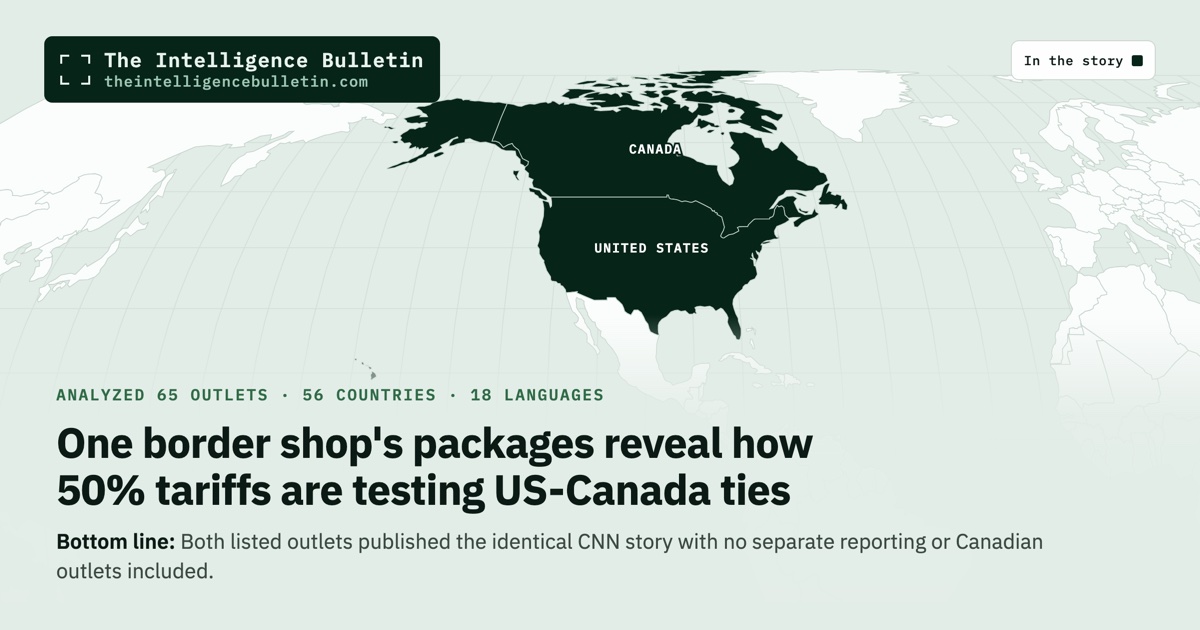
One border shop’s packages reveal how 50% tariffs are testing US-Canada ties

Map of the countries in the story: One border shop's packages reveal how 50% tariffs are testing US-Canada ties
Louis Patenaude runs Half-Way House Freight Forwarding in a building that straddles the US-Canada border at Fort Covington, New York, and Dundee, Quebec. The business relies on decades of free trade for low-cost shipping of goods like Amazon packages and car parts. New US 50% tariffs on $20 billion of Canadian goods and matching Canadian retaliation starting September 8 have raised costs and uncertainty. Patenaude and economist Joseph Steinberg note that border communities may resist broad rhetoric but could face price hikes.

One Story. Many Angles.

🇺🇸
United States
KXLY
Carries CNN reporting
His shop straddles the US-Canada border. A historic friendship is crumbling on both sides.
Read →
🇺🇸
United States
CNN
Original reporting
What a business straddling the U.S.-Canada border teaches about the trade war
Read →
2 sources ¡ each independently reported
Analyzed 65 outlets across 56 countries and 18 languages ¡ 22 translated ¡ read 3 in full
In Brief

Both listed outlets published the identical CNN story with no separate reporting or Canadian outlets included.

The reporting from both outlets rests on a single CNN dispatch that uses one family’s border-straddling freight business to illustrate tariff effects without adding independent verification or Canadian-sourced accounts. The piece details specific tariff actions—Trump’s 50% levies on Canadian goods including steel, aluminum and consumer items, plus Canada’s planned counter-measures on US steel, paper and appliances—while quoting Prime Minister Mark Carney directly on intent to hurt and divide. It contrasts this with Patenaude’s view that everything is political and that personal cross-border ties will persist unless prices force change. The University of Toronto economist quoted reinforces that locals see daily commerce up close and are unlikely to alter habits from headlines alone. Because the two listed sources carry identical copy, no distinct national framing emerges; the selected coverage stays within one US reporting chain focused on the personal anecdote and policy timeline rather than broader bilateral fallout or Ottawa’s perspective. This convergence shows how a single wire narrative can dominate a narrow source set even when the event involves two principal governments.

Perspective Analysis

The Half-Way House Freight Forwarding operation occupies a single three-story building whose interior floor carries a thick black line marking the precise division between Fort Covington, New York, and Dundee, Quebec. One address is 228 Dundee Road; the other is 8777 Route 132. Louis Patenaude, 65, moves boxes across that line for customers who want to avoid separate shipping fees or to receive items that ship only inside the United States. The business handles old car parts, tractor pieces, engine transmissions, Walmart packages, and large volumes of Amazon deliveries. Its rates stay low, typically no more than twenty dollars per shipment, because the building predates the current border and because decades of open commerce made such cross-line movement routine.

That routine now faces new costs. After bilateral trade talks collapsed in late August, the United States imposed fifty percent tariffs on roughly twenty billion dollars of Canadian goods. Canada responded by scheduling matching duties on United States steel, aluminum, paper products, construction materials, home appliances, and agricultural items to begin September 8. Prime Minister Mark Carney stated that the new United States measures were designed to hurt and divide Canada. Patenaude told the reporter that everything happening appeared political and that the deeper commercial links would prove difficult to unwind quickly. He expected some customers to stop ordering non-essential items once tariffs raised prices, though he said he had no clear forecast of the exact impact.

Patenaude’s family has operated at the site for generations. His grandfather bought the building in the 1960s and ran it as the Dundee Line Hotel. His father, Paul Maurice, later converted part of it into a bar called the Half-Way House. The bar closed in the 1990s, but friends later urged Patenaude to reopen the space as a freight forwarder. The building itself is more than two hundred years old. At one point Paul Maurice paid business taxes on the Canadian side plus school and land taxes on both sides of the line. The structure now requires repairs and stands for sale in two parcels, one in each country, listed at three hundred fifty thousand dollars apiece. Patenaude has roughly three thousand customers who travel from Ottawa, Montreal, and nearby border towns. The operation maintains a modest website and a Facebook page that posts notices about snow plowing or American holidays.

Joseph Steinberg, an international economics expert at the University of Toronto, observed that people living directly on the border see daily commerce up close and are unlikely to alter their habits because of sweeping political rhetoric unless rising prices force the change. Earlier Canadian counter-tariffs imposed in March 2025 at twenty-five percent produced retail price increases of about six percent on the affected goods, according to Bank of Canada research released in May 2026. Those prices generally returned to pre-tariff levels within three months after the duties ended, though announcements alone can prompt retailers to adjust expectations about how long the measures will last.

Both published accounts of this episode originate from the same CNN dispatch written by Rachel Siegel and dated September 6, 2026. The KXLY version carries the CNN byline in parentheses and reproduces the text with only minor formatting adjustments, such as different image placement and the addition of a local station header. CNN presents the material under its own national business section, with the author’s name displayed and photographs credited to Patenaude and to Cole Burston of AFP/Getty Images. Neither outlet adds independent reporting, new interviews, or material gathered outside the original CNN reporting chain.

The headlines chosen by each masthead reflect their immediate audiences. CNN leads with the phrase “What a business straddling the U.S.-Canada border teaches about the trade war,” placing the shop inside a larger policy frame that includes the specific tariff amounts, the failed August talks, and Carney’s statement. KXLY uses the line “His shop straddles the US-Canada border. A historic friendship is crumbling on both sides,” which foregrounds the personal story and the emotional contrast between past cooperation and present friction. Both versions quote Patenaude describing the operation as “basically full-blown commerce” and noting that customers still must declare goods at a customs office roughly one hundred feet away. Both include the same passage on the building’s history and the same Steinberg quotation. The only measurable difference lies in surrounding web-page elements: KXLY embeds the story among Spokane-area weather and traffic items, while CNN places it among national market updates and other tariff-related pieces.

Because the dispatch is shared, readers of either outlet encounter the identical sequence of facts and the same selection of voices. No Canadian outlet appears in the selected set, so no separate account of Ottawa’s decision-making process or of Canadian business reactions reaches the page. The single-chain origin also means the piece contains no on-the-ground reporting from Fort Covington or Dundee beyond Patenaude’s own description, nor any data on actual volume changes at the customs office since the tariffs took effect. The economist’s comment stands as the sole external analytical voice, and it addresses only the general resilience of border communities rather than the specific tariff lists or the timeline of retaliation.

What to Watch

The dispatch therefore supplies a concrete illustration of how one small operation sits at the intersection of two national tariff schedules, yet it does so entirely within the reporting resources and editorial priorities of a single United States newsroom. Readers who encounter the story through either masthead receive the same narrative spine: the physical border line inside the building, the family’s multi-generational presence, the list of everyday goods moving across it, the announced fifty percent duties, and Carney’s characterization of intent. What changes between the two presentations is only the surrounding context and the headline emphasis, not the underlying facts or the range of perspectives consulted. This structure leaves the bilateral relationship visible mainly through the lens of one American reporting chain and through the words of one border resident who has operated under previous periods of tension.


Share this story