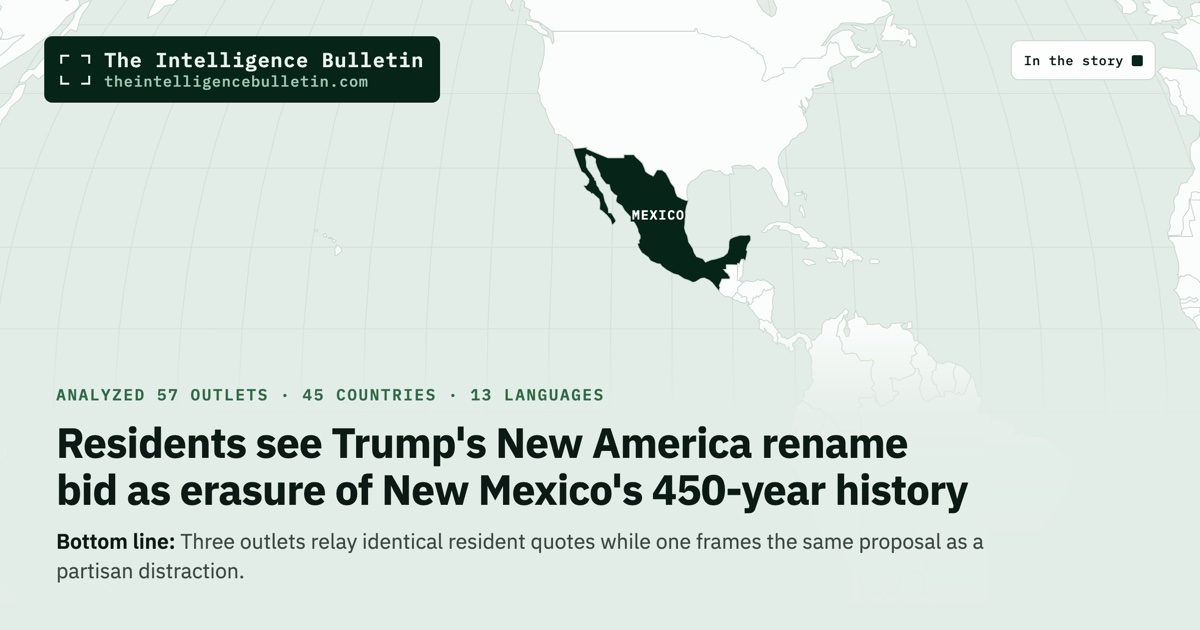
Residents see Trump’s New America rename bid as erasure of New Mexico’s 450-year history

Map of the countries in the story: Residents see Trump's New America rename bid as erasure of New Mexico's 450-year history
President Donald Trump proposed renaming New Mexico ‘New America’ on Sunday amid trade talks with Mexico. Over a dozen residents interviewed by Reuters, including Indigenous and Hispanic New Mexicans, called it an attempt to erase more than 450 years of history and culture tied to Spanish, Mexican and Puebloan roots. State politicians from both parties rejected the idea, which the federal government cannot impose unilaterally. The White House has not responded.

One Story. Many Angles.

🇺🇸
United States
West Hawaii Today
Reuters wire copy
New Mexicans deride Trump’s ‘New America’ idea – West Hawaii Today
Read →
🇬🇧
United Kingdom
The Guardian
Original reporting
Trump’s call to rename New Mexico ‘New America’ is a distraction tactic, Democrats say
Read →
🇲🇾
Malaysia
Free Malaysia Today
Carries Reuters reporting
New Mexicans deride Trump’s ‘New America’ idea
Read →
🇨🇳
China
Econotimes
Carries Reuters reporting
Trump’s ‘New America’ Proposal Draws Backlash in New Mexico
Read →
4 sources · 2 independent accounts — some share the same news agency’s report
Analyzed 57 outlets across 45 countries and 13 languages
In Brief

Three outlets relay identical resident quotes while one frames the same proposal as a partisan distraction.

The dominant Reuters dispatch carried by three of the four outlets centers on New Mexican residents’ direct derision of the name change as cultural erasure, quoting Puebloan potter Ethel Yazza rejecting any theft of identity and historian Rob Martinez praising the historic name’s beauty. This local-voice framing appears uniformly in the US, Malaysian and Chinese outlets because they all relay the same agency text. The Guardian alone shifts emphasis to Democratic leaders portraying the proposal as a distraction from the Iran war and inflation, citing Governor Michelle Lujan Grisham and senators who tie it to prior renamings of the Gulf of Mexico and Lake Ontario. The absence of any outlet from Mexico in the selected set leaves the trade-negotiation context reported only through US sources. What stands out is how little the resident quotes vary across the three wire relays, confirming one reporting chain, while the Guardian’s addition of elected Democrats reveals a Washington-centric angle that treats the backlash as secondary to partisan tactics. No source claims the federal government holds unilateral power to rename a state.

Perspective Analysis

President Donald Trump suggested on Sunday that New Mexico be renamed New America. The proposal came as trade negotiations with Mexico intensified. Three of the four articles examined here carry the same Reuters dispatch that recorded the suggestion and the immediate local reaction inside the state. The fourth article, from The Guardian, adds its own reporting on reactions from elected Democrats.

The Reuters text opens with residents describing the idea as an effort to erase more than 450 years of history and culture. It notes that the land of deserts, mountains and high plains has carried the name New Mexico since Spanish explorers applied it in the 1560s. New Mexico State Historian Rob Martinez, whose family traces Spanish, Mexican and Indigenous roots in northern New Mexico, is quoted saying the current name is beautiful and historic while the proposed replacement is not. The dispatch places the suggestion against earlier name changes ordered by Trump: the Gulf of Mexico became the Gulf of America last year and Lake Ontario became Lake America in August after talks with Canada collapsed. Over a dozen New Mexicans interviewed by the agency rejected the latest proposal, and the text records that both Republican and Democratic politicians in the state opposed it.

Ethel Yazza, a 67-year-old potter and member of the Santa Clara and Picuris Indigenous communities who lives at Picuris Pueblo, is quoted directly: “Trump you are crazy, you will not take nothing from us.” Mexican American painter and roofer Jesus Trevizo Martinez called the move an act of pure racism and noted that New Mexico has the highest proportion of Hispanic and Latino residents of any U.S. state, around 49 percent. Larry Cruz, a 65-year-old former U.S. Air Force legal administrator from Taos County who voted for Trump in 2024, said the proposal was frightening because it appeared aimed at erasing history. The dispatch states that the White House has not publicly responded and did not reply to a request for comment.

West Hawaii Today ran the Reuters account under the headline “New Mexicans deride Trump’s ‘New America’ idea” and placed it in its nation-and-world section with a byline crediting Andrew Hay of Reuters. Free Malaysia Today published the identical text under the same headline and supplied no additional local framing. Econotimes adapted the same dispatch with minor rephrasing in its opening sentences and listed the piece under its politics heading, where surrounding articles focus on trade disputes and energy markets. None of the three added reporting beyond the agency copy.

The Guardian took a different route. Its headline read “Trump’s call to rename New Mexico ‘New America’ is a distraction tactic, Democrats say.” The article begins with the same Sunday proposal and the same prior renamings of the Gulf and the lake, but it quickly moves to statements from New Mexico’s Democratic governor Michelle Lujan Grisham and the state’s two U.S. senators. Grisham wrote on X that the name is not up for debate because it predates the United States. Senator Martin Heinrich listed three names he would always use correctly: the Gulf of Mexico, Lake Ontario and New Mexico. Senator Ben Ray Luján called Trump a “sinvergüenza” and “corrupt.” Representative Melanie Stansbury posted a video on the banks of the Rio Grande declaring the name will not change. The Guardian also quoted Republican nominee Greg Hull, who is running to succeed the term-limited governor, rejecting any negotiation over the state’s identity. It notes that any name change would require a state constitutional amendment approved by voters and that the federal government holds no unilateral power.

The Reuters dispatch supplies the only on-record resident voices in the set. The Guardian supplies the only on-record statements from elected officials framing the proposal as a distraction from the Iran war and rising prices. No article in the set contains reporting from Mexico on how the suggestion landed there during active trade talks. The White House response remains absent from every account examined.

What to Watch

The Reuters text therefore stands as the single reporting chain that reached three mastheads unchanged. Each of those mastheads chose to foreground the same resident quotations and the same historical background. The Guardian’s independent layer places the suggestion inside a domestic political contest rather than inside the state’s own communities. A reader who encounters only the Reuters version learns the precise language used by Puebloan and Hispanic residents who trace their presence to the 1560s. A reader who encounters only the Guardian version learns the precise language used by the state’s senior elected Democrats tying the suggestion to other policy pressures. The two accounts do not contradict each other on the existence of the proposal or on the fact of local opposition; they simply select different sets of voices to carry the story forward.
Share this story

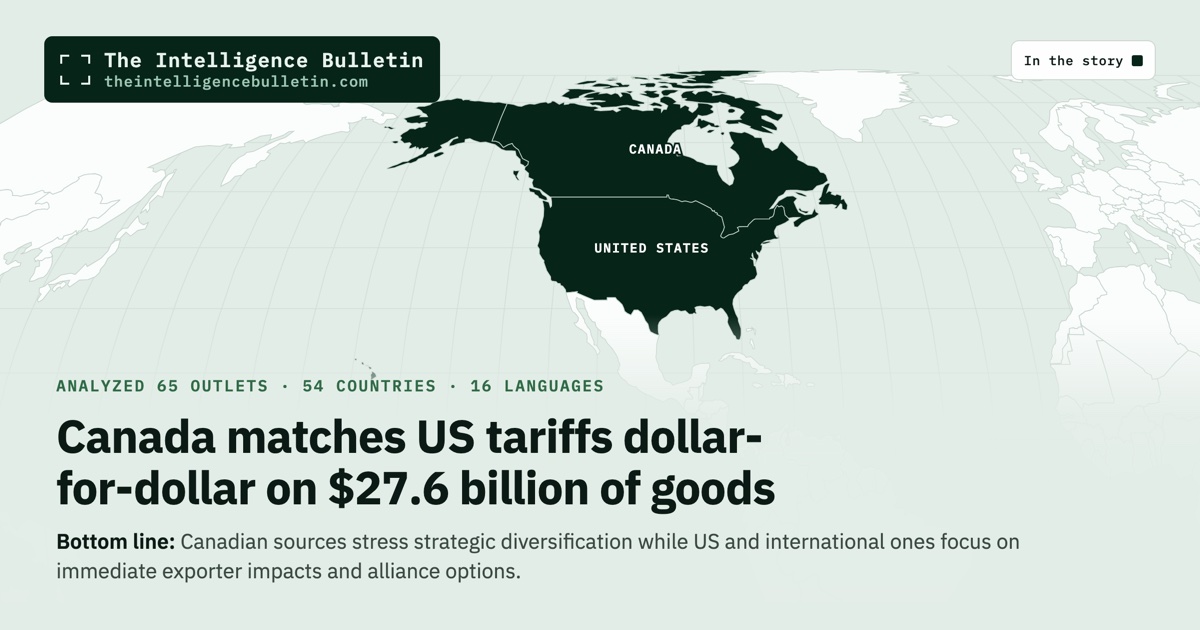
Canada matches US tariffs dollar-for-dollar on $27.6 billion of goods

Map of the countries in the story: Canada matches US tariffs dollar-for-dollar on $27.6 billion of goods
Canada imposed tariffs of 15 to 50 percent on approximately $27.6 billion worth of US imports effective September 8, 2026. The measures target steel, aluminum, dairy, appliances, furniture and other goods in direct response to US 50 percent tariffs on Canadian products imposed after trade negotiations failed in August. Prime Minister Mark Carney framed the step as dollar-for-dollar retaliation to protect Canadian industries. The move escalates bilateral tensions involving President Trump and raises risks for supply chains and consumers in both countries.

One Story. Many Angles.

🇨🇦
Canada
The Globe and Mail
Commentary
With this trade war, Canada faces its Singapore moment
Read →
🇺🇸
United States
Breitbart
Carries AFP reporting
Canada’s counter-tariffs take effect on various US goods
Read →
🇺🇸
United States
Euronews
Carries AP & AFP reporting
Canada hits US goods with tariffs of up to 50% as trade dispute escalates
Read →
🇶🇦
Qatar
Al Jazeera
Original reporting
Canada’s retaliatory tariffs on $20bn of US goods take effect
Read →
🇯🇵
Japan
Japan Today
Original reporting
Canada’s tariffs take effect as it seeks closer EU ties and awaits Trump response
Read →
5 sources · 4 independent accounts — some share the same news agency’s report
Analyzed 65 outlets across 54 countries and 16 languages · 19 translated · read 6 in full
In Brief

Canadian sources stress strategic diversification while US and international ones focus on immediate exporter impacts and alliance options.

Reporting across outlets converges on the core mechanics of Canada’s September 8 tariffs matching US duties dollar-for-dollar and rate-for-rate on $27.6 billion of imports, yet diverges sharply in emphasis that reveals national priorities. Canadian commentary positions the escalation as a forced pivot toward diversification, invoking Singapore’s post-1965 reinvention to argue for reduced US dependence. US-focused accounts stress immediate pain for American exporters in steel, dairy and consumer goods while noting Trump’s additional threats against Bombardier. International pieces highlight the $20 billion scale and potential for broader alliances without foregrounding domestic Canadian costs. The consistent factual backbone—tariff values, product lists and the collapse of talks under Carney and Trump—makes the interpretive split telling: no outlet disputes the retaliation’s scope, but each selects the angle that aligns with its audience’s stake in the North American relationship. This pattern shows how even tightly corroborated events acquire different stakes depending on whether the reader sits north or south of the border.

Perspective Analysis

Canada’s counter-tariffs on $27.6 billion worth of United States imports took effect at 12:01 a.m. Eastern Time on September 8, 2026. The duties range from 15 percent to 50 percent and apply to roughly 700 tariff lines drawn from the same list of products already facing American tariffs. Steel and aluminum products, furniture, clothing and apparel moved to the top rate of 50 percent. Appliances, dairy items such as cheese, certain steel derivatives and some wood products sit at 25 percent. Electronics, hand tools and other machinery face 15 percent. Ottawa removed seafood from the final list after an earlier draft. The Canadian government described the package as matching the latest American tariffs dollar for dollar and rate for rate.

The move answered United States tariffs of 50 percent imposed on August 22 on an equivalent value of Canadian exports. Those American duties covered items including hockey sticks, cement, wine, furniture and dairy goods. They followed the collapse of bilateral talks that had run for several days in Washington. Canadian Prime Minister Mark Carney stated that the American side had tabled only modest tariff reductions and had added late demands that restricted Canada’s freedom to negotiate trade deals with other countries. He also cited unacceptable threats to French-language protections and Quebec culture. United States Trade Representative Jamieson Greer later said French-language issues were understood to be sensitive and were not being pushed as red lines. Talks have not resumed.

Prime Minister Carney announced a C$7.5 billion support package to cushion Canadian businesses and workers. The funds include interest-free loans through the Business Development Bank of Canada and targeted assistance for sectors hit hardest. Nearly 70 percent of Canadian exports go to the United States and nearly 60 percent of Canadian imports come from there. The new tariffs cover about 6 percent of total United States exports to Canada.

President Donald Trump responded to the Canadian announcement with a Truth Social post threatening to block sales of Bombardier aircraft in the United States unless the Quebec-based manufacturer moved production south of the border. Bombardier replied that it already supports tens of thousands of American jobs across more than 20 states and purchases more than $2.5 billion annually from roughly 2,800 United States suppliers in 47 states. Trump had earlier signed an order directing federal agencies to refer to Lake Ontario as Lake America, a change adopted by some mapping services inside the United States but not recognized in Canada.

The Globe and Mail ran an opinion piece arguing that the breakdown leaves Canada in a position comparable to Singapore after its 1965 separation from Malaysia. The author, Eric Miller, noted that Canada can no longer assume the old rules-based North American trading order will hold and urged policy makers to study Singapore’s rapid shift toward foreign investment, export-oriented industry and efficient infrastructure. The piece stressed that Canada possesses land, resources and population Singapore lacked, yet still faces the same question of how to generate growth without reliable access to a single large market.

Breitbart reported the tariff list in detail and highlighted the Bombardier threat alongside earlier remarks by United States Treasury Secretary Scott Bessent that dismissed the notion of a trade war with a country one-thirteenth the size of the United States. The account also noted Canadian restrictions on American alcohol sales in eight of ten provinces and the resulting drop in United States spirits exports.

Euronews placed the 50 percent upper rate and the C$27.6 billion total at the center of its account and recorded that eight provinces continue to limit United States alcohol sales. It added that RBC Economics judged the measures unlikely to register on overall United States growth while acknowledging sharper effects on specific American businesses. The report mentioned the possibility of closer European Union-Canada coordination as one potential offset.

Al Jazeera led with the $20 billion valuation and noted that the tariffs could raise costs for United States automakers because Canada remains the largest buyer of American-made vehicles. It recorded the C$7.5 billion Canadian support package and the extension of the dispute into non-tariff actions such as the Lake Ontario renaming.

Four independent reporting chains—Canadian government statements carried in multiple outlets, wire material used by Euronews and Al Jazeera, direct company responses on Bombardier, and the Globe and Mail commentary—converge on the tariff values, effective date, product categories and the sequence of failed talks followed by reciprocal duties. No outlet disputes the mechanical details. The divergence appears instead in emphasis. Canadian commentary foregrounds long-term strategic adjustment. United States accounts center immediate exporter exposure and presidential rhetoric. International coverage records the dollar scale and possible third-country alignments without dwelling on domestic Canadian adjustment costs.

A reader limited to any single national press would therefore miss the shared factual spine while absorbing only one slice of the stakes. The Globe and Mail piece supplies the diversification argument that does not appear in the American or Qatari accounts. Breitbart supplies the Bombardier exchange and Treasury remarks absent from the Globe and Mail. Euronews and Al Jazeera supply the explicit $20 billion framing and the alcohol-sales data that receive less space in the Canadian commentary. The four accounts together show that the same set of numbers and dates supports different policy conclusions depending on which side of the border the reader sits.

What to Watch

The corroborated record of matching tariffs, collapsed talks and announced support measures rests on primary government statements and company releases carried across independent chains. That record is the strongest warrant for treating the escalation as real rather than rhetorical. The interpretive frames each outlet attaches to those facts reflect audience location and institutional priorities, not contradictions in the underlying events. The next phase will turn on whether renewed talks produce concessions on policy autonomy or whether the tariff lists remain in force long enough to shift sourcing patterns in steel, dairy and machinery. Either outcome will test how quickly Canadian exporters can reach non-United States markets and how much American importers absorb in higher costs before political pressure builds for de-escalation.


Share this story

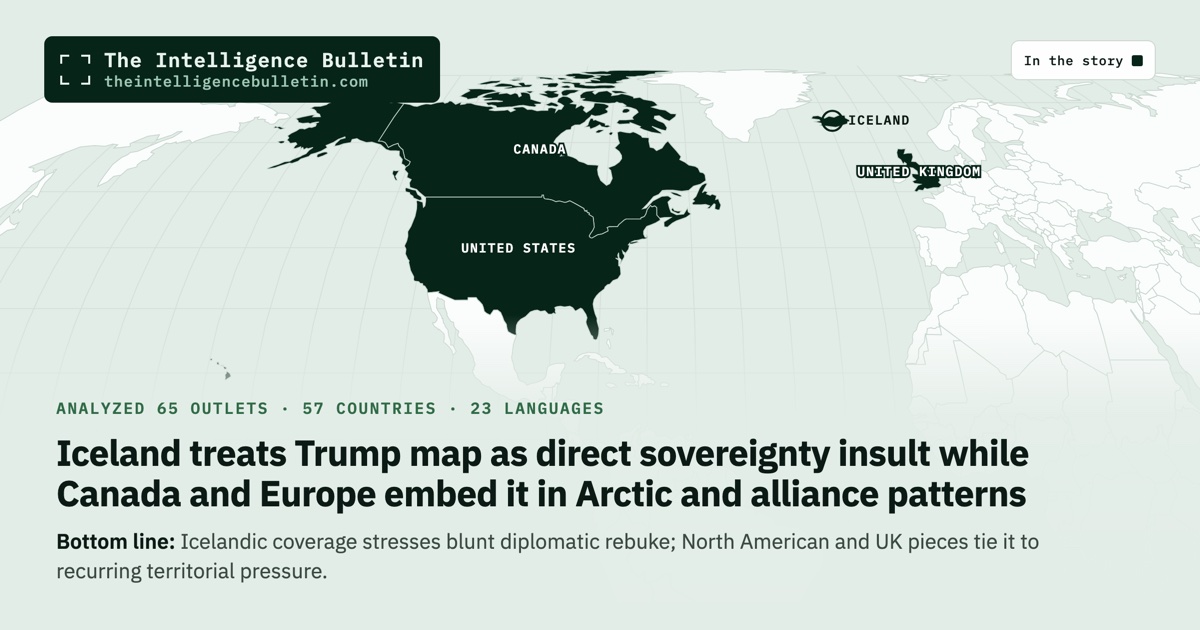
Iceland treats Trump map as direct sovereignty insult while Canada and Europe embed it in Arctic and alliance patterns

Map of the countries in the story: Iceland treats Trump map as direct sovereignty insult while Canada and Europe embed it in Arctic and alliance patterns
US President Donald Trump posted an AI-generated map on Truth Social depicting Iceland, Greenland, Canada, Mexico and Central America under the US flag and labeled ‘United States of America’. Iceland’s Foreign Minister Thorgerdur Katrin Gunnarsdottir summoned US Ambassador Billy Long and told him the post was entirely inappropriate. The summons follows Trump’s earlier statements on acquiring Greenland and coincides with an EU investment announcement in the territory.

One Story. Many Angles.

🇮🇸
Iceland
Visir
ICELANDIC
Original reporting
The ambassador taken to the carpet after Trump’s post
“Sendi­herrann tekinn á teppið eftir færslu Trumps”
Read →
🇺🇸
United States
New York Post
Carries RÚV reporting
Trump’s post of Iceland under US flag sparks outrage from Nordic country: ‘Nothing funny or normal’
Read →
🇬🇧
United Kingdom
LBC
Carries RÚV reporting
Iceland summons US ambassador after Trump posts map showing island under American flag
Read →
🇨🇦
Canada
CBC
Carries Associated Press reporting
Iceland summons U.S. ambassador over Trump’s threat to take over Arctic nation
Read →
🇳🇱
Netherlands
Nieuws.nl
DUTCH
Carries ANP/RTR reporting
Iceland summons US ambassador over controversial Trump map
“IJsland ontbiedt VS-ambassadeur om omstreden kaart Trump”
Read →
5 sources · 4 independent accounts — some share the same news agency’s report
Analyzed 65 outlets across 57 countries and 23 languages · 15 translated · read 5 in full
In Brief

Icelandic coverage stresses blunt diplomatic rebuke; North American and UK pieces tie it to recurring territorial pressure.

The core fact of the summons travels unchanged from Iceland’s foreign ministry through every outlet, yet the surrounding frame shifts sharply by region. Icelandic reporting treats the meeting as a direct, firm rebuke to an absurd provocation by a sitting president, quoting the minister’s language without softening. US tabloid coverage casts the episode as predictable allied outrage at trolling that crosses into sovereignty mockery. UK reporting immediately anchors the map to the prior Greenland dispute, presenting it as a recurring pattern of pressure on NATO partners. Canadian coverage reads the same image as part of a broader Arctic expansion threat that explicitly includes Canada, supplying a neighbor’s security lens absent elsewhere. Dutch reporting positions the summons as a measured European diplomatic response, situating Iceland within continental concerns over US reliability. The pattern reveals how proximity and history dictate emphasis: Nordic voices stress the insult to sovereignty itself, while North American outlets embed the episode in their own territorial anxieties and European ones see a familiar test of alliance cohesion.

Perspective Analysis

Iceland’s foreign minister summoned the United States ambassador on September 8 after President Donald Trump posted an AI-generated map on Truth Social that colored Iceland, Greenland, Canada, Mexico, Central America and the Caribbean in the red, white and blue of the American flag and labeled the entire landmass “United States of America.” The post carried no accompanying text. Thorgerdur Katrin Gunnarsdottir met Billy Long, who had taken up the post in Reykjavik only the previous month, and told him the image was entirely inappropriate. The foreign ministry later confirmed to Icelandic media that the position had been made clear at the meeting.

The timing placed the episode against two larger developments. Hours earlier the European Commission president, Ursula von der Leyen, had announced a €200 million investment package for Greenland during a visit to the territory. Trump’s earlier statements had already signaled interest in acquiring Greenland, a self-governing Danish territory, and he had on several occasions referred to Iceland when he appeared to mean Greenland. Icelandic reporting noted that Long himself had once joked publicly that Iceland could become the 52nd state, an aside for which he later apologized.

Danish Prime Minister Mette Frederiksen, speaking in Nuuk the same day, reiterated that Greenland’s government and people had repeatedly stated they did not wish to become American. Canadian coverage placed the map inside an ongoing set of trade disputes and rhetorical pressure that included suggestions Canada itself might become the 51st state. Icelandic domestic reporting recorded the summons as a straightforward official response to an image its government viewed as unacceptable.

The factual spine of the episode is consistent across the five outlets that reported it in detail. Every account states that the minister summoned the ambassador and conveyed that the post was entirely inappropriate. Every account identifies the same map and the same platform. The coincidence with the European investment announcement appears in the British and Dutch pieces. No outlet disputes any of these elements.

Where the accounts diverge is in the frame they place around the same facts. Icelandic coverage, written from the foreign ministry’s own statement, presents the meeting as a direct and unsoftened rebuke delivered by the minister to the ambassador. It records the ministry’s language without additional commentary on Trump’s motives. The New York Post piece foregrounds the president’s history of posting similar images and describes the Nordic reaction as predictable outrage at an action that mocks sovereignty. It does not linger on the diplomatic mechanics of the summons itself.

The British account immediately situates the map inside the earlier Greenland dispute and treats the summons as one more instance of tension between Washington and NATO partners over Arctic territory. The Canadian account reads the image as part of a wider pattern of expansionist rhetoric that now touches Canada’s own borders and ongoing trade frictions. It notes petitions inside Canada calling for the expulsion of the American ambassador there and quotes former Canadian officials describing the administration’s posture as one of profound disrespect. The Dutch account presents the summons as a measured European diplomatic step taken in response to actions that have already strained relations with Greenland and raised questions about American reliability.

These differences track geography and immediate national stakes rather than disagreement over what occurred. The Icelandic outlet alone supplies the minister’s precise phrasing as delivered to the ambassador. The American tabloid outlet alone emphasizes the domestic political habit of map-posting. The British piece alone draws the explicit line back to Greenland. The Canadian piece alone supplies the parallel Canadian security and trade context. The Dutch piece alone locates the episode inside continental European calculations about alliance cohesion.

The convergence on the core sequence matters because it shows the summons itself was not in dispute. Five independent reporting chains, some originating inside Iceland and others relaying from Icelandic state broadcaster RÚV or wire services, all carried the same ministry statement. Where the pieces differ is in the larger story each attaches to that statement. A reader limited to Icelandic coverage would see a focused diplomatic protest. A reader limited to Canadian coverage would see an Arctic security alert that happens to involve Iceland. A reader limited to British coverage would see another chapter in a running Greenland story. None of those single-country frames is false on its own terms, yet each leaves out dimensions that the others foreground.

What to Watch

The reporting therefore indicates that smaller NATO allies responded to the map with the standard diplomatic tool of a formal summons rather than public escalation or economic measures. Iceland’s action was recorded on the record by its own foreign ministry and transmitted without contradiction through every subsequent account. The episode sits inside a longer sequence of statements about Greenland, but the specific trigger here was the inclusion of Iceland on the map. The pattern across the coverage shows that proximity shapes which prior events an outlet chooses to connect to the summons, yet the summons itself travels intact from Reykjavik outward.


Share this story

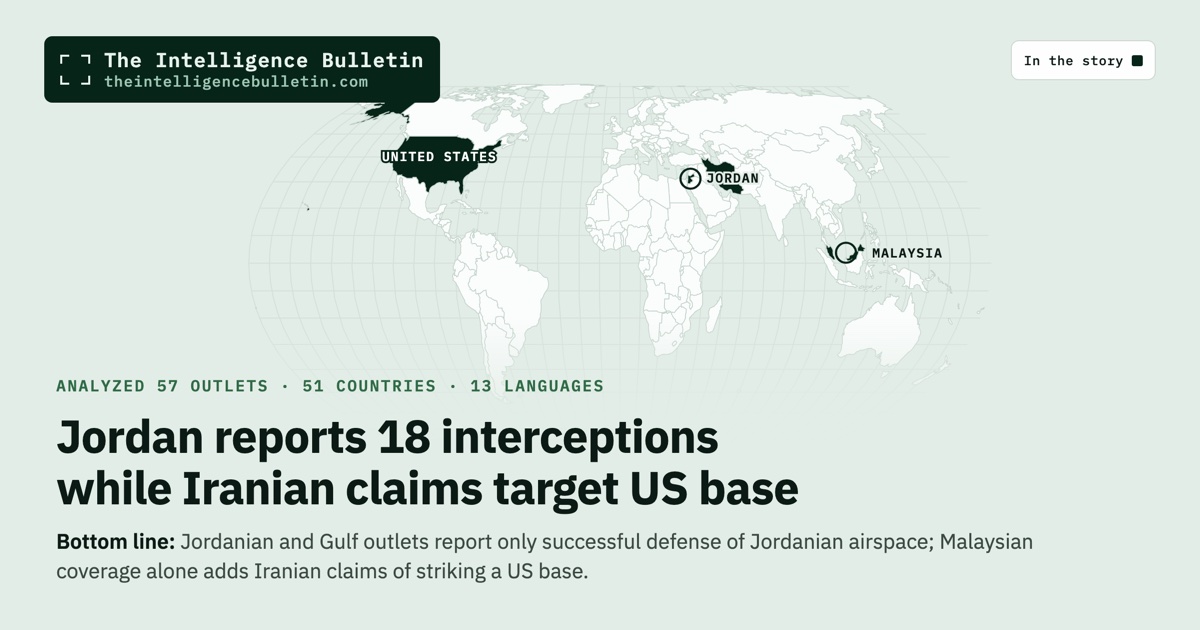
Jordan reports 18 interceptions while Iranian claims target US base

Map of the countries in the story: Jordan reports 18 interceptions while Iranian claims target US base
Jordan’s armed forces stated that 20 Iranian ballistic missiles entered Jordanian airspace; its air defenses destroyed 18, with two landing in empty areas and no casualties. Iranian Revolutionary Guards claimed the strikes targeted a US base in Jordan. The incident forms part of escalating US-Iran conflict over oil tankers in the Strait of Hormuz.

One Story. Many Angles.

🇯🇴
Jordan
Alanbat News
ARABIC
Original reporting
The army intercepts and destroys 18 out of 20 Iranian missiles that penetrated Jordanian airspace
“الجيش يعترض ويدمر 18 من أصل 20 صاروخا إيرانيا اخترقت الأجواء الأردنية”
Read →
🇦🇪
United Arab Emirates
Al Bayan
ARABIC
Carries Petra reporting
Jordan: Interception and destruction of 18 Iranian ballistic missiles and two falling in empty areas
“الأردن: اعتراض وتدمير 18 صاروخا باليستيا إيرانيا وسقوط اثنين بمناطق خالية”
Read →
🇸🇦
Saudi Arabia
Okaz
ARABIC
Carries Jordanian armed forces statement reporting
Jordan intercepts 18 ballistic missiles out of 20 launched from Iran
“الأردن يعترض 18 صاروخاً بالستياً من أصل 20 أُطلقت من إيران”
Read →
🇬🇧
United Kingdom
Middle East Eye
Carries Jordanian state media reporting
Jordan says its air defences struck down 18 of 20 missiles from Iran
Read →
🇲🇾
Malaysia
Free Malaysia Today
Carries AFP reporting
Iran attacks US base in Jordan as Hormuz impasse deepens
Read →
5 sources · each independently reported
Analyzed 57 outlets across 51 countries and 13 languages · 25 translated · read 5 in full
In Brief

Jordanian and Gulf outlets report only successful defense of Jordanian airspace; Malaysian coverage alone adds Iranian claims of striking a US base.

Jordanian reporting presents the episode strictly as a successful national air-defense operation protecting sovereign airspace, with the armed forces spokesman detailing interception procedures, debris management and public safety instructions while omitting any reference to foreign military targets. UAE and Saudi outlets relay the identical Jordanian statement through local agencies, preserving the same narrow focus on Jordanian territory and zero casualties. The UK-based Middle East Eye echoes the Jordanian account in neutral terms drawn from state media. In contrast, the Malaysian outlet alone frames the launch as an Iranian Revolutionary Guards operation explicitly aimed at a US air base at Al-Azraq, embedding it within the Hormuz oil-tanker standoff and prior US strikes on Iranian vessels. This divergence arises because Jordanian and Gulf sources rely directly on the Jordanian military’s official communiqué, while the Malaysian piece incorporates Iranian state-media claims and regional context absent from the others. The pattern shows that the core factual sequence of 18 interceptions is corroborated across independent chains, yet the attribution of intent splits along source geography, with no selected outlet from Iran itself to present Tehran’s unmediated account.

Perspective Analysis

Jordan’s armed forces reported that twenty ballistic missiles launched from Iranian territory entered the kingdom’s airspace on the morning of September 9. Air-defense systems engaged the salvo and destroyed eighteen of the incoming weapons. The remaining two fell in uninhabited zones, producing no casualties or structural damage according to the military’s assessment. Jordanian officers described the response as routine adherence to established procedures, with monitoring continuing and specialized teams securing debris sites while urging civilians to avoid any unidentified fragments.

The same Jordanian statement formed the sole source material for coverage in the United Arab Emirates and Saudi Arabia. Outlets there reproduced the account nearly verbatim, noting the twenty-missile launch, the eighteen successful interceptions, the two landings in empty terrain, and the absence of injuries. They added no further detail on possible targets beyond Jordanian territory and carried no references to foreign military installations.

A separate account, appearing only in the Malaysian outlet, attributed the launch to Iran’s Revolutionary Guards. That report stated the Guards had targeted the US air base at Al-Azraq, damaging maintenance facilities, deployment areas, and aircraft shelters. It placed the Jordanian strike inside a sequence that included US destruction of five Iranian oil tankers earlier in the week and Iranian warnings that additional tankers near Kuwait and Bahrain would be hit. The same dispatch noted rising oil prices and the ongoing stalemate over the Strait of Hormuz.

No selected source carried an unmediated statement from Iranian officials. The four Middle Eastern and British outlets that addressed the episode limited themselves to the Jordanian military communiqué or to neutral summaries of it. The Malaysian piece alone introduced the Revolutionary Guards’ claim and the Hormuz context.

The numerical core of the Jordanian account appears consistently across four independent reporting chains. The figure of twenty missiles launched, eighteen intercepted, and two landing without casualties originates in the Jordanian armed forces statement and is reproduced without alteration by the UAE, Saudi, and British outlets. The Malaysian report accepts the same interception count while adding the separate assertion that the intended target was a US installation.

The divergence on purpose and context is therefore geographic. Jordanian, Emirati, Saudi, and British coverage presents the event as an attack on Jordanian sovereignty that was successfully repelled. The single Malaysian account reframes it as Iranian retaliation against a US facility inside Jordanian territory and situates it inside the tanker confrontation. Because the Jordanian military statement is the only primary document reproduced in the set, the corroborated sequence of interceptions rests on that document; the US-base attribution rests on Iranian state media as filtered through one outlet.

The absence of any Iranian outlet from the selected sources leaves Tehran’s direct justification unavailable for comparison. Readers relying solely on the Jordanian, Gulf, or British reports receive no mention of the Revolutionary Guards’ stated objective or of the preceding tanker strikes. Readers of the Malaysian report receive those elements but encounter no Jordanian military text in full.

The Jordanian armed forces statement supplies the most detailed operational description available, including instructions on debris handling and the maintenance of air-defense readiness. That level of specificity is absent from the other accounts. The Malaysian report supplies the only on-record Iranian claim and the only linkage to the Hormuz impasse, both of which remain single-source within the set.

The corroborated interception numbers indicate that Jordanian defenses engaged and largely neutralized the salvo regardless of ultimate target. The single-source claim that the salvo struck a US base cannot be reconciled with the Jordanian assertion that the missiles were directed at Jordanian territory; both assertions cannot be accurate. The broader Hormuz connection likewise stands or falls with the Malaysian account alone.

What to Watch

Jordan has an evident interest in demonstrating effective protection of its airspace and in avoiding any suggestion that foreign bases on its soil were the objective. Iranian state media, as conveyed in the Malaysian dispatch, has an interest in presenting the action as successful retaliation. The next development most likely to clarify the record is an official US statement on whether any base sustained damage or whether the missiles were assessed as aimed elsewhere. Until such a statement appears, the Jordanian military count of eighteen interceptions remains the only figure carried by multiple independent reporting chains.


Share this story

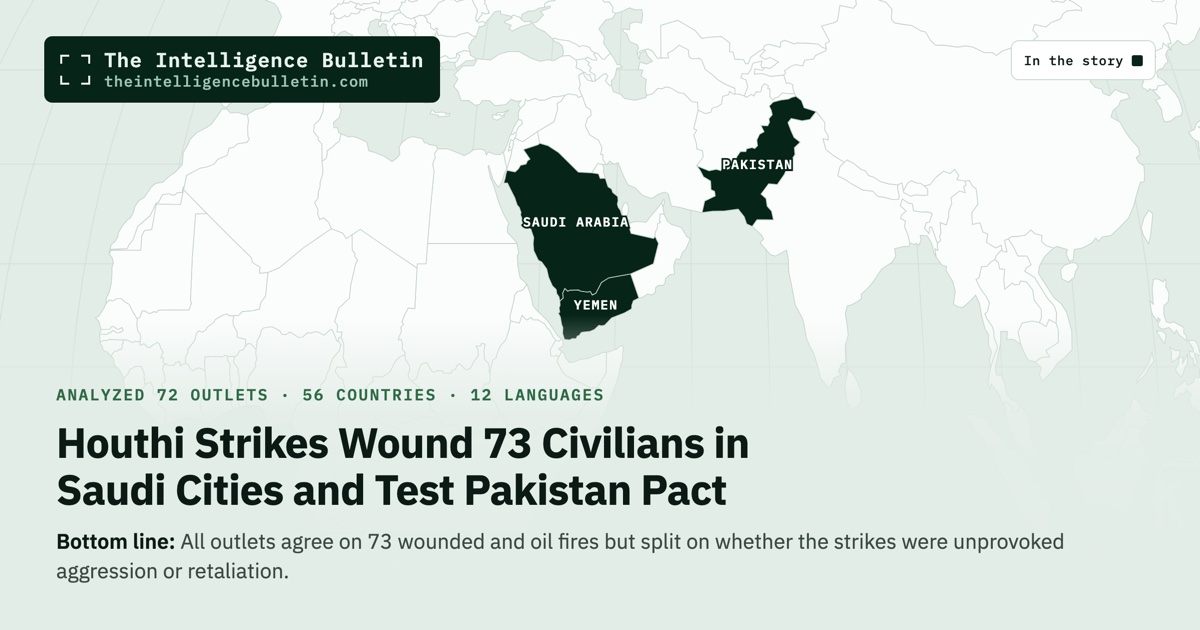
Houthi Strikes Wound 73 Civilians in Saudi Cities and Test Pakistan Pact

Map of the countries in the story: Houthi Strikes Wound 73 Civilians in Saudi Cities and Test Pakistan Pact
Houthi forces launched missile and drone attacks on southern Saudi cities Abha, Jazan, Najran and Khamis Mushait, wounding 73 civilians including women and children and setting fires at energy facilities. Saudi Energy Ministry confirmed temporary halts in operations while the Saudi-led coalition spokesperson condemned the strikes as a sovereignty violation and pledged a firm response. The attacks mark escalation in Yemen’s civil war after renewed clashes between Houthis and Saudi-backed forces.

One Story. Many Angles.

🇸🇦
Saudi Arabia
Arab News
Original reporting
Arab News | Houthi attacks on Saudi Arabia wound 73 people, officials say
Read →
🇬🇧
United Kingdom
Morning Star
Original reporting
Yemen’s Houthi-led forces attack Saudi oil facilities
Read →
🇮🇳
India
Moneycontrol
Original reporting
‘Attack on one is attack on all’: Houthi strikes injure 73 in Saudi, now Pakistan’s Makkah defence pact faces its first major test
Read →
🇮🇱
Israel
The Jerusalem Post
Carries Saudi Press Agency reporting
Saudi-led Coalition vows strong response to Houthi attacks
Read →
🇭🇰
Hong Kong
South China Morning Post
Carries Associated Press reporting
Houthi attacks on Saudi Arabia ignite fires at oil facilities, wound dozens
Read →
5 sources · each independently reported
Analyzed 72 outlets across 56 countries and 12 languages · 25 translated · read 5 in full
In Brief

All outlets agree on 73 wounded and oil fires but split on whether the strikes were unprovoked aggression or retaliation.

The reporting converges on the core facts of 73 wounded civilians and strikes on oil and economic sites in four southern Saudi cities yet parts company sharply on agency and stakes. Saudi and Israeli accounts uniformly present the attacks as unprovoked Houthi aggression against civilians and infrastructure, with explicit vows of coalition retaliation. The UK Morning Star instead frames the strikes as Houthi retaliation for a prior Saudi airstrike on a Yemeni prison, giving equal weight to Houthi claims of targeting military-economic assets. Indian coverage alone highlights the new Makkah defense pact with Pakistan as facing its first test, noting Islamabad’s limited response of condemnation only. Hong Kong reporting stresses fires at oil facilities and global energy risks without assigning blame. These differences track national positions: the directly affected state and its Israeli ally emphasize victimhood and resolve, the UK left-wing outlet stresses Houthi perspective, and the Indian observer flags alliance implications absent from the others. The single-source Houthi response claim stands apart from the corroborated Saudi casualty and vow details across independent chains.

Perspective Analysis

Houthi missile and drone strikes hit four southern Saudi cities on September 8, wounding 73 civilians including women and children in Abha, Khamis Mushait, Jazan and Najran. The Saudi Energy Ministry reported fires at energy sector facilities and infrastructure that forced temporary halts in some operations. Saudi coalition spokesperson Major General Turki Al-Maliki described the strikes as a dangerous escalation and a flagrant violation of the kingdom’s sovereignty that directly threatened citizens and residents. He said the joint forces would take all necessary operational measures to deter the Houthis and neutralize the threat.

The same attacks also struck oil and economic sites, according to the ministry statement carried in multiple accounts. Saudi Foreign Ministry remarks condemned the targeting of civilian and economic infrastructure and reserved the kingdom’s right to defend its territory while calling on the Houthis to stop all forms of escalation.

Houthi military spokesman Brigadier General Yahya Saree stated that dozens of ballistic missiles and drones had been fired at oil and economic facilities as well as an air base in southern Saudi Arabia. That account, carried in one report, placed the strikes hours after a Saudi airstrike on a prison in Yemen’s northern Jawf province that killed at least seven people including a child.

The strikes arrived after weeks of renewed clashes between Houthi forces and Saudi-backed Yemeni government troops that ended a four-year truce in the civil war. Fighting had already spread across fronts including Yemen’s west coast, with government forces claiming territorial gains in Hodeida, Taiz and Baydah provinces. Houthi attacks on Red Sea shipping routes have added pressure on the Bab al-Mandeb strait, a key passage for oil and trade.

Saudi coalition statements framed the September 8 strikes as deliberate targeting of civilian and economic sites that demonstrated hostile and irresponsible behavior by the Houthis. The Jerusalem Post account linked the attacks to ongoing Yemeni government advances backed by Riyadh and noted that the coalition had led efforts against the Houthis since 2015. Al-Maliki’s remarks on the need for firm deterrence appeared in both Saudi and Israeli coverage.

A separate line of reporting highlighted the new Makkah Joint Defence Agreement signed on August 7 by Saudi Arabia, Turkey and Pakistan. That pact includes a collective-defense clause stating that an armed attack on one member is an attack on all. Indian coverage noted that Pakistan had so far responded to the Saudi strikes with condemnation and diplomatic support but had not announced military action, raising questions about how the alliance would operate under pressure. The agreement established a permanent secretariat in Riyadh with Pakistan supplying the first secretary-general.

South China Morning Post reporting, drawing on Associated Press material, led with the fires at oil facilities and the resulting economic disruption while recording the coalition’s vow of response. It placed the attacks in the context of escalating regional conflict without assigning primary responsibility to either side.

The accounts converge on the scale of the casualties and the targeting of energy infrastructure. Four independent reporting chains carried the figure of 73 wounded civilians in the four named cities and the coalition’s description of the strikes as a sovereignty violation. Two chains carried the Energy Ministry details on fires and operational halts. The coalition vow of operational measures appeared in three chains. These points form the settled core across Saudi, Israeli and Hong Kong coverage.

The accounts diverge on the question of motive and sequence. Saudi and Israeli reporting presents the strikes as unprovoked aggression against civilians and infrastructure. The single UK account supplies the Houthi claim of retaliation for the Jawf prison strike and gives space to Saree’s description of targets as oil and economic facilities plus an air base. No other source in the set carried that specific Houthi statement or the prison-strike context.

Coverage also diverges on regional implications. Indian reporting alone foregrounds the test for the Makkah pact and Pakistan’s limited public response so far. Saudi and Israeli accounts stay focused on the immediate security threat and the coalition’s planned deterrence. The Hong Kong account emphasizes energy and shipping risks without tying them to alliance commitments.

A reader limited to Saudi or Israeli outlets would encounter a clear picture of civilian harm and the need for retaliation but would miss both the Houthi sequencing claim and the pact implications. A reader limited to the UK account would receive the retaliation context and shipping concerns but would not see the repeated emphasis on 73 specific civilian injuries or the coalition’s operational vow across multiple chains. The Indian angle on alliance testing would be invisible to anyone reading only the directly affected or Israeli press.

The corroborated details on casualties, fires and the coalition response rest on multiple independent chains and on-the-record statements from named Saudi officials. The Houthi retaliation claim rests on a single reporting chain and therefore carries less weight as a settled fact. Saudi and Israeli accounts share an interest in presenting the strikes as aggression that justifies further action in Yemen. The UK account draws on a broader narrative of mutual escalation. The Indian account flags a potential new actor whose involvement could widen the conflict.

What to Watch

The next moves will likely center on Saudi operational responses inside Yemen and on whether sustained pressure prompts Pakistan to move beyond condemnation under the Makkah pact. The energy facility disruptions add a concrete economic dimension that could affect global oil routes if the pattern continues.


Share this story

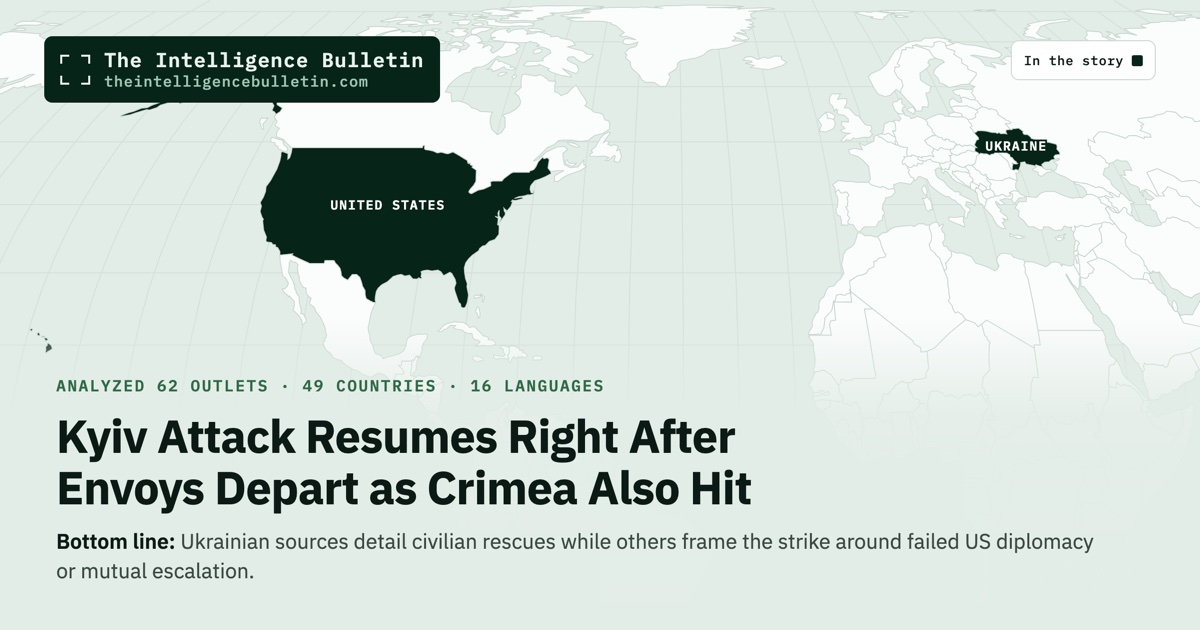
Kyiv Attack Resumes Right After Envoys Depart as Crimea Also Hit

Map of the countries in the story: Kyiv Attack Resumes Right After Envoys Depart as Crimea Also Hit
Russia launched missiles and drones at Kyiv on September 8 after a three-day pause tied to visits by US envoys Steve Witkoff and Jared Kushner to Moscow and Kyiv. The attack killed at least two people, wounded others, and damaged buildings across multiple districts. Ukraine reported striking occupied Crimea in response. Russian officials described targets as military while Ukrainian accounts emphasized civilian impact.

One Story. Many Angles.

🇺🇦
Ukraine
TSN
UKRAINIAN
Original reporting
Attack on Kyiv September 8: DSNS showed consequences and rescued – Kyiv
“Атака на Київ 8 вересня: ДСНС показала наслідки та врятованих — Київ”
Read →
🇨🇿
Czech Republic
Radio Free Europe/Radio Liberty
Original reporting
Russia Pounds Kyiv Hours After US Envoys Depart Ukrainian Capital
Read →
🇹🇷
Turkey
Daily Sabah
Carries Associated Press reporting
Russia hits Kyiv, Ukraine strikes occupied Crimea to end 3-day lull
Read →
🇭🇰
Hong Kong
South China Morning Post
Carries Agence France-Presse reporting
Russia resumes strikes on Kyiv after pause for Trump envoys’ visit
Read →
🇮🇪
Ireland
RTÉ
Carries AFP reporting
Two dead as Russia resumes strikes on Kyiv
Read →
5 sources · each independently reported
Analyzed 62 outlets across 49 countries and 16 languages · 21 translated · read 5 in full
In Brief

Ukrainian sources detail civilian rescues while others frame the strike around failed US diplomacy or mutual escalation.

The reporting converges on the timeline of a Russian strike on Kyiv immediately after US envoys departed, yet diverges sharply in emphasis. Ukrainian outlet TSN centers local rescue operations and civilian rescues in damaged districts, grounding the story in immediate human cost without diplomatic framing. RFE/RL ties the resumption directly to the envoys’ exit, underscoring the failed pause. Daily Sabah alone pairs the Kyiv attack with Ukrainian strikes on Crimea, presenting mutual escalation. SCMP and RTÉ, drawing from AFP, stress the pause’s link to the Trump envoys and note casualties. No selected source carries Russian domestic framing; statements from Moscow appear only through Ukrainian or Western relays. This pattern shows how proximity to the event shifts focus from diplomacy to damage, while distance allows balance with Ukrainian counter-strikes. The absence of independent Russian-origin reporting in the set leaves Moscow’s military claims unexamined beyond Ukrainian rebuttals.

Perspective Analysis

On the morning of September 8 2026 explosions and fires spread through at least five districts of Kyiv after Russia launched dozens of ballistic and cruise missiles together with more than 160 drones. The strike followed a three-day halt in attacks on the Ukrainian capital that Russian President Vladimir Putin had ordered for the visit of US envoys Steve Witkoff and Jared Kushner. The envoys had met Putin in Moscow on the preceding Saturday before traveling to Kyiv for talks with President Volodymyr Zelenskyy. Ukrainian air-defense forces reported downing 142 drones and 31 of 32 cruise missiles while two ballistic missiles got through. At least two people died and between six and sixteen others suffered wounds according to Kyiv officials and emergency services. Rescue teams pulled survivors from damaged apartment blocks and extinguished fires that reached garages shops and a five-storey residential building in the Solomianskyi district.

Russian Defense Ministry statements carried in several accounts described the targets as military-industry sites storage facilities for drones and cruise missiles and logistics centers in Kyiv and the surrounding region. Ukrainian accounts instead stressed damage to residential buildings a 26-storey non-residential structure and civilian infrastructure across multiple districts. The Kyiv City Military Administration reported at least sixteen locations affected. One resident described the noise on the left bank as brutal after sleeping through the previous two nights while the envoys were in the city. Emergency workers from the State Emergency Service rescued thirteen people from rubble and blocked apartments and treated six initial casualties.

The same night a Ukrainian strike on occupied Crimea killed two people and wounded one according to the peninsula’s Russian-installed governor Sergei Aksyonov. Daily Sabah alone among the selected reports included this counter-action as part of the end to the lull. Ukrainian Foreign Minister Andrii Sybiha called the Kyiv attack horrific and accused Putin of undermining the US diplomatic effort with ballistic missiles that struck residential buildings. Zelenskyy described the assault as deliberately complex involving anti-ship missiles and Shahed drones in addition to the ballistic and cruise weapons. The Russian-installed authorities in Crimea framed their losses as civilian deaths from the Ukrainian response.

The pause itself had been announced after Putin met the envoys and after Witkoff described the Moscow discussions as constructive. Kushner spoke of a broader peace package under consideration. Zelenskyy called the Kyiv meetings very substantial and expressed openness to trilateral talks. No breakthrough emerged from the visits and the Kremlin maintained its position on eliminating what it called the root causes of the conflict. National-security advisers from Britain France and Germany joined part of the Kyiv discussions. Witkoff had met Putin eight times since the start of 2025 while this trip marked the first White House envoy visit to Kyiv under the current US administration.

The selected reports converge on the basic sequence of a Russian strike on Kyiv hours after the envoys departed yet they diverge in the weight each places on different elements. TSN the Kyiv outlet foregrounded footage from the State Emergency Service showing rescue operations across five districts and the extraction of thirteen people from damaged buildings. It placed the human cost of blocked apartments and spreading fires at the center without reference to the diplomatic timeline. Radio Free Europe/Radio Liberty by contrast opened on the timeline linking the attack directly to the envoys’ exit and noted that the pause had been the first in near-daily strikes over the preceding week. It incorporated statements from the Russian Defense Ministry on military targets alongside Ukrainian descriptions of civilian damage.

Daily Sabah alone carried the Ukrainian strike on Crimea that killed two people there and presented the night as mutual escalation after the three-day lull. The report drew from Associated Press copy that included both Russian and Ukrainian official statements on the respective targets. South China Morning Post and RTÉ both relayed wire material that stressed the resumption after the pause for the Trump envoys and recorded the death toll of two in Kyiv. Neither included the Crimea counter-strike or the detailed local rescue counts that appeared in the Kyiv reporting.

No selected source originated from a Russian domestic outlet. Moscow’s military claims therefore reached readers only through Ukrainian or Western relays that also carried rebuttals emphasizing civilian sites. The pattern reveals how proximity shapes emphasis: the single Ukrainian source in the set stayed inside the immediate physical consequences while outlets farther from the event foregrounded the diplomatic trigger or added the reciprocal strike on Crimea. The absence of independent Russian-origin reporting leaves the Defense Ministry’s list of military targets unexamined against the Ukrainian accounts of residential damage within the same set.

What to Watch

The accounts that place the strike inside the larger diplomatic and regional frame come closest to the fuller picture because they rest on the corroborated sequence of the pause the envoys’ movements and the timing of the attack across four of the five sources. The single-source claim of Ukrainian casualties in Crimea stands apart and cannot be weighed against other reporting chains here. Ukrainian outlets have an interest in foregrounding civilian toll to sustain international pressure while wire services balance that emphasis with the diplomatic context their readers follow. The pattern suggests continued exchanges of long-range strikes will test whether the recent envoy contacts produce any de-escalation before winter energy infrastructure again becomes a primary target.


Share this story