One Story. Many Angles.
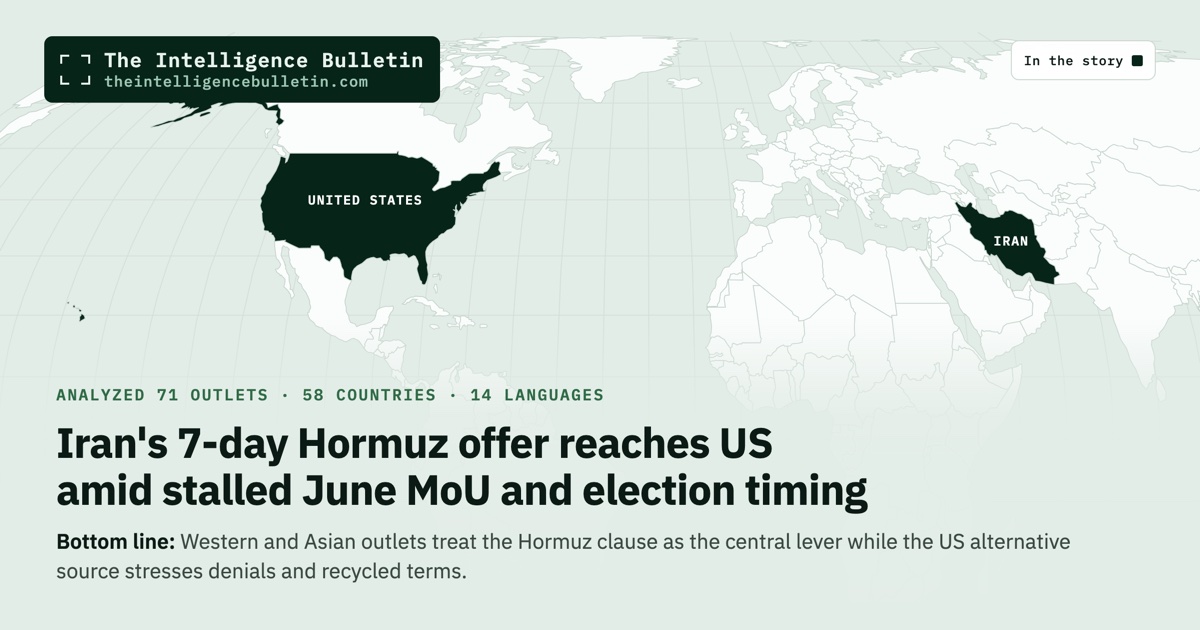
Western and Asian outlets treat the Hormuz clause as the central lever while the US alternative source stresses denials and recycled terms.
The reporting shows a diplomatic overture framed as an accelerated return to the June MoU yet met with immediate caution on the US side and selective emphasis elsewhere. Al Jazeera and The Journal highlight the concrete conditions and mediator role of Qatar while noting Pezeshkian’s direct appeal to Washington. Público and Free Malaysia Today stress the Hormuz clause and its energy or shipping consequences for Europe and Asia. Zero Hedge alone foregrounds Iranian state media denials of technical talks and skepticism that the proposal is anything new. Across the set the same core demands and timetable appear, but outlets differ on whether the move signals genuine flexibility or leverage-seeking ahead of US elections. The absence of any selected Iranian outlet leaves official Tehran statements visible only through foreign reporting, while US outlets alone record Washington’s reluctance to accelerate. The pattern reveals that the proposal’s substance travels intact but its meaning—opening or stalling tactic—shifts by the outlet’s regional stakes and access to one side’s officials.
Perspective Analysis
Iran’s foreign minister Abbas Araghchi laid out the seven-day proposal on the sidelines of the United Nations General Assembly in New York, telling reporters that Tehran was ready to implement it as soon as Washington agreed. Under the plan, all hostilities would cease across fronts including Lebanon within seven days. The United States would release at least twelve billion dollars in frozen Iranian assets, waive sanctions on Iranian oil exports, and lift its naval blockade. On the seventh day the Strait of Hormuz would reopen to traffic. Nuclear talks would begin immediately afterward.
The offer tracks the terms of the June memorandum of understanding that Washington and Tehran reached through Pakistani and Qatari mediators, except that the earlier document set a sixty-day window for negotiations rather than seven days. That June accord collapsed within weeks after each side accused the other of violations, including disputes over control of shipping through the strait and renewed attacks on vessels. Araghchi described the new timetable as a compressed version of the same commitments and said Iran had passed the proposal to Washington through intermediaries earlier in the week.
Iranian president Masoud Pezeshkian reinforced the message in a Fox News interview aired the same day. He said Tehran did not wish to continue fighting and that it was for the Trump administration to decide whether the war would end. Pezeshkian also addressed the nuclear issue directly, stating that Iran would give up highly enriched uranium within the framework of international law and the Non-Proliferation Treaty. At the General Assembly he told world leaders that Iran would not bend at the knee to Washington.
A US official described the discussions through mediators as positive and constructive but added that Washington would not rush into any agreement. President Trump has said he is in no hurry, even as oil prices remain elevated. The White House has framed the broader conflict as necessary to prevent Iran from obtaining a nuclear weapon. Reports from the same period noted that Trump discussed the situation with Chinese president Xi Jinping during the latter’s visit to New York.
The Strait of Hormuz carries roughly one-fifth of the world’s traded oil and gas. Its closure or restriction has already raised costs for importers in Europe and Asia and contributed to price pressure inside the United States. Free Malaysia Today noted that Chinese officials have expressed support for the Iranian proposal, while The Journal recorded that Qatar’s foreign minister spoke with Pezeshkian about de-escalation on the same day the plan surfaced.
The five articles that carried the story converge on the core elements of the Iranian offer and its resemblance to the June text. Al Jazeera, Público, Free Malaysia Today, and The Journal all quote Araghchi describing the seven-day sequence and the specific US steps required before Hormuz reopens. They also record Pezeshkian’s statement that the choice rests with Washington. The single point of divergence appears in Zero Hedge, which alone reports that Iranian state media outlet Fars denied claims of technical talks taking place in New York and dismissed reports that Iranian technical experts had been sent to join the discussions.
A reader limited to any one of these outlets would miss the pattern that emerges when they are placed side by side. Al Jazeera and The Journal foreground the mediator channel through Qatar and the direct appeal from Pezeshkian, giving the proposal the texture of an active diplomatic channel. Público and Free Malaysia Today isolate the Hormuz clause and its downstream effects on energy supplies or shipping lanes that matter to their audiences. Zero Hedge alone supplies the Fars denial and places the timetable next to earlier failed rounds, presenting the move as largely recycled. The absence of any Iranian outlet from the selected set means every statement attributed to Tehran officials reaches the reader through foreign reporting chains only.
The corroborated details across four independent reporting chains indicate that the seven-day roadmap was in fact presented in New York and that its terms match the June memorandum in substance while shortening the calendar. The single-source denial of technical talks stands apart and has not been echoed elsewhere in the set. Washington’s reluctance to accelerate, recorded by multiple outlets citing US officials, aligns with the administration’s public posture that it holds leverage through control of the strait and sanctions.
What to Watch
Iran has an immediate interest in securing sanctions relief and asset access before the November US midterms, when domestic political pressure on energy prices could shift the bargaining balance. The United States has an interest in demonstrating that it can sustain the current pressure without conceding on the timetable. The next measurable step will be whether any of the listed US conditions are met in the coming days or whether the proposal remains on the table as a standing offer without further movement.