June 15, 2026 – Global Headlines

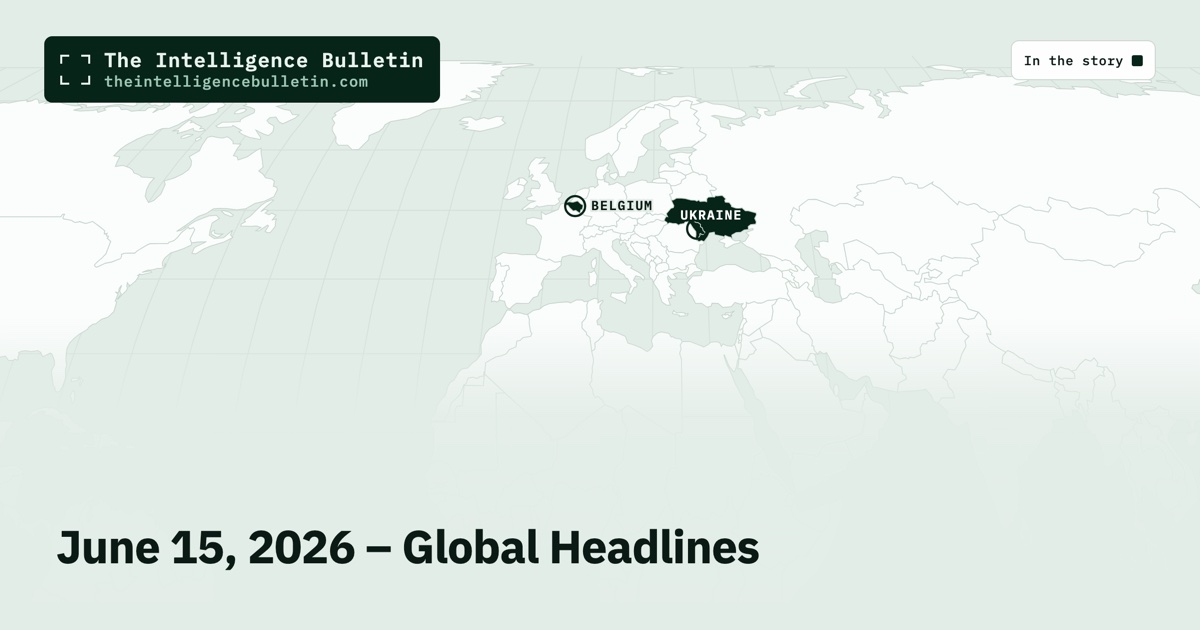
Map of the countries in the story: June 15, 2026 – Global Headlines

1EU Approves First Accession Talks Phase for Ukraine and Moldova
Map of the countries in the story: June 15, 2026 – Global Headlines
Story gist: On 2026-06-14 EU member-state ambassadors approved opening the first accession-negotiations cluster for Ukraine and Moldova. The decision advances talks framed as support for reforms and stability. It targets Brussels and follows prior cluster approvals in the accession process. Key actors include the European Union as source and Ukraine as target.
One Story. Many Angles.
🇸🇷
Suriname
surinametimes.com
Green light for resumption of EU accession talks with Ukraine and Moldova
Read →
🇺🇸
United States
yahoo.com
EU envoys agree to first phase of membership talks for Ukraine and Moldova
Read →
Perspective Analysis

The narrow consensus across the two available outlets reveals how little daylight exists on this procedural milestone even when one source sits outside Europe entirely. Surinametimes.com renders the step as a straightforward ‘green light’ for resumed talks, reflecting a distant but interested Caribbean vantage on EU enlargement that treats the event as routine institutional progress rather than geopolitical theater. Yahoo.com, by contrast, folds the same approval into a US-centric lens on Ukraine, presenting the cluster opening as incremental movement within wider transatlantic tensions without altering the factual core. This convergence underscores that the decision itself carries low narrative friction: ambassadors simply cleared the initial negotiating block, a technical prerequisite long signaled in Brussels. The absence of divergence suggests the story functions less as contested framing and more as confirmation that EU machinery continues to advance Ukraine’s candidacy on schedule, irrespective of parallel crises elsewhere. Structurally, the Suriname outlet’s non-European remove produces a cleaner institutional headline while the US platform layers in the Ukraine conflict context that its readership expects, yet neither disputes the underlying event or its date.


2China and Mongolia Pledge Deeper Ties After Ministers Meet

Story gist: On 2026-06-15 Chinese Foreign Minister Wang Yi met Mongolian Foreign Minister Batmunkh Battsetseg in Ulaanbaatar. The two sides signed documents on foreign ministry cooperation. They pledged to expand collaboration in trade, energy, connectivity and minerals. The encounter forms part of ongoing efforts to strengthen bilateral relations between the neighbors.
One Story. Many Angles.
🇨🇳
China
french.people.com.cn
Chinese foreign minister meets Mongolian counterpart
Le ministre chinois des Affaires étrangères s’entretient avec son homologue mongole
Read →
🇨🇳
China
europe.chinadaily.com.cn
China, Mongolia vow deeper ties, support
Read →
Perspective Analysis

Chinese state media present the Wang Yi–Battsetseg meeting as a straightforward advance in practical cooperation rather than a geopolitical maneuver. Both outlets stress signed documents on ministry-to-ministry ties and list the same four areas—trade, energy, connectivity and minerals—without qualifiers or references to third countries. The French-language People’s Daily report narrows the frame to the encounter itself, while the English-language China Daily broadens it to mutual “support,” yet neither introduces friction or external pressure. This uniform emphasis reveals Beijing’s priority of locking in predictable access to Mongolian resources and transit routes at a moment when global supply-chain realignments make land corridors attractive. The absence of any mention of Russia or the United States in the coverage is itself the signal: the story is framed as bilateral housekeeping whose strategic value is assumed rather than argued. For readers tracking mineral markets and Eurasian infrastructure, the consensus across the two Chinese outlets indicates that Beijing sees the relationship as stable enough to publicize in both domestic and international languages without defensive language.


3Pakistan Announces US-Iran Peace Deal and 60-Day Countdown

Story gist: On 2026-06-15 in Islamabad, Pakistan announced that the United States and Iran reached a peace agreement, launching a 60-day period before formal signing in Switzerland on June 19. Prime Minister Shehbaz Sharif stated the parties would continue diplomacy during this interval. The announcement follows Qatari mediation efforts in Tehran on June 14 and earlier US-Iran drone incidents in the Strait of Hormuz. Pakistan positioned itself as mediator while the deal remains unsigned.
One Story. Many Angles.
🇹🇷
Turkey
birgun.net
What do we know about the US-Iran peace agreement?
ABD-İran barış anlaşması hakkında neler biliyoruz?
Read →
🇹🇷
Turkey
timeturk.com
60-day countdown begins: critical details in the Iran-US agreement
60 günlük geri sayım başladı: İran-ABD anlaşmasında kritik detaylar
Read →
🇸🇾
Syria
sana.sy
Pakistan announces peace agreement reached between the US and Iran
Pakistan, ABD ile İran Arasında Barış Anlaşmasına Varıldığını Duyurdu
Read →
Perspective Analysis

The announcement from Islamabad marks the clearest public step yet from the June 12 drone downings and June 14 Qatari talks toward a structured US-Iran agreement, yet the Turkish sources reveal how regional actors are still testing whether Pakistan’s mediation claim will hold weight or simply serve as diplomatic cover. Birgun.net treats the story as an exercise in clarifying bilateral mechanics between Washington and Tehran, sidestepping Pakistan’s role almost entirely, which suggests a Turkish left-leaning preference for keeping the focus on the two primary antagonists rather than introducing a third-party broker whose leverage remains unproven. Timeturk.com, by contrast, zeroes in on the 60-day timeline and implementation details, framing the interval as the decisive test of whether security arrangements in the Gulf can be locked in before external spoilers intervene. Sana.sy places Pakistan’s announcement at the center, presenting the development as a multi-actor accord that already includes Islamabad, a choice consistent with Syrian state media’s interest in showing Middle East alignments expanding beyond the immediate US-Iran binary. The shared decision across all three outlets to report the countdown as already underway, rather than as a tentative proposal, indicates that the underlying event has crossed a threshold where the mechanics of sequencing now matter more than the fact of negotiations themselves. What remains unaddressed in these accounts is how the same actors who traded drone strikes only days earlier will manage the practical steps of verification and asset movements during the 60-day window, a gap that makes the timeline itself the most concrete signal of intent.


4Israeli Beirut Strike Risks Trump-Iran Deal Amid Netanyahu Rift

Story gist: On June 14 2026 Israeli forces struck Beirut’s southern suburbs killing three including a senior Hezbollah commander. The attack triggered Iranian warnings of imminent retaliation and direct criticism from Trump toward Netanyahu for endangering an emerging US-Iran peace agreement. Coverage across outlets centers on the resulting diplomatic tensions between Washington Tehran and Tel Aviv. This follows Qatari-mediated talks in Tehran aimed at finalizing the deal by Sunday.
One Story. Many Angles.
🇮🇷
Iran
presstv.ir
Iran’s top security official warns response ‘imminent’ after Israeli strike on Beirut
Read →
🇺🇸
United States
washingtonexaminer.com
Trump scolds Netanyahu for having ‘no f***ing judgment’ after Beirut strike
Read →
🇨🇦
Canada
nationalpost.com
Trump tells Israel to stop risking Iran peace deal with Beirut strikes
Read →
Perspective Analysis

The personal rupture between Trump and Netanyahu stands out as the sharpest signal in coverage of the Beirut strike. Washington Examiner reporting frames the episode as an unusually blunt White House rebuke with Trump questioning the Israeli prime minister’s judgment in language that leaks suggest was recorded verbatim. That emphasis shifts attention from the strike’s immediate casualties to the risk it poses to the fragile US-Iran channel that Qatari mediators had advanced only hours earlier in Tehran. National Post coverage instead foregrounds the direct threat to the 60-day peace countdown itself noting Trump’s explicit instruction that further Israeli action could collapse the deal. PressTV by contrast records Iran’s Supreme National Security Council warning of an imminent response without referencing the Trump-Netanyahu exchange at all. The divergence is structural. Iranian state media treats the strike as another chapter in resistance to Israeli aggression while the two North American outlets treat the same event as a test of whether Washington can still restrain its closest regional ally. This pattern continues the trajectory seen in prior days when US downing of Iranian drones and Treasury warnings about frozen assets already signaled that any US-Iran agreement would hinge on preventing escalation rather than resolving underlying disputes. The Beirut strike therefore functions less as an isolated incident than as the first live test of whether that fragile diplomatic window can survive Israeli operational decisions.


5Zelensky Proposes Putin Meeting at G7; Moscow Rejects

Story gist: On June 15 2026 Ukrainian President Zelensky proposed a meeting with Russian President Putin at the G7 summit in France. Moscow immediately rejected the overture aimed at ending the Ukraine war. The summit venue includes US President Trump and French President Macron. The move follows recent Ukrainian defense agreements with NATO-adjacent states.
One Story. Many Angles.
🇦🇱
Albania
panorama.com.al
War in Ukraine: Zelensky proposes meeting with Putin at G7 summit
Lufta në Ukrainë, Zelensky propozon një takim me Putinin në samitin e G7
Read →
🇷🇴
Romania
hotnews.ro
Zelensky says he proposed meeting Putin at G7 in France: ‘Trump is there and Macron is there’
Zelenski spune că i-a propus lui Putin să se întâlnească la reuniunea G7 din Franța: „Trump este acolo și Macron este acolo”
Read →
🇷🇴
Romania
caleaeuropeana.ro
Zelensky states he proposed a meeting with Putin on the sidelines of the G7 summit, but Moscow rejected the initiative
Zelenski afirmă că i-a propus lui Putin o întâlnire în marja summitului G7, însă Moscova a respins inițiativa
Read →
Perspective Analysis

The swift Russian rejection of Zelensky’s G7 proposal underscores Moscow’s consistent preference for bilateral leverage over multilateral formats, a stance that Albanian and Romanian outlets captured through their own security priorities rather than through any divergence in facts. Panorama.com.al framed the episode as a Balkan spillover risk, highlighting how renewed frontline diplomacy could either stabilize or further destabilize Black Sea routes that already affect Romanian and Bulgarian ports. Hotnews.ro instead stressed the personal-diplomacy hook of Trump and Macron both being present, reflecting Bucharest’s calculation that direct leader-to-leader contact might unlock frozen US security guarantees faster than institutional channels. CaleaEuropeana.ro placed the emphasis on G7 coordination and EU institutional response, consistent with Romania’s role in preparing the first phase of Ukraine’s membership talks agreed in Brussels the same week. Across the three outlets the core sequence—proposal followed by rejection—remains identical, yet each selects the detail that maps most directly onto its audience’s immediate exposure to Russian pressure, whether through energy corridors, NATO flank exposure, or accession timelines. This convergence on the event itself, paired with differentiated stakes, reveals how proximity to the conflict continues to shape which diplomatic signal each capital chooses to amplify.
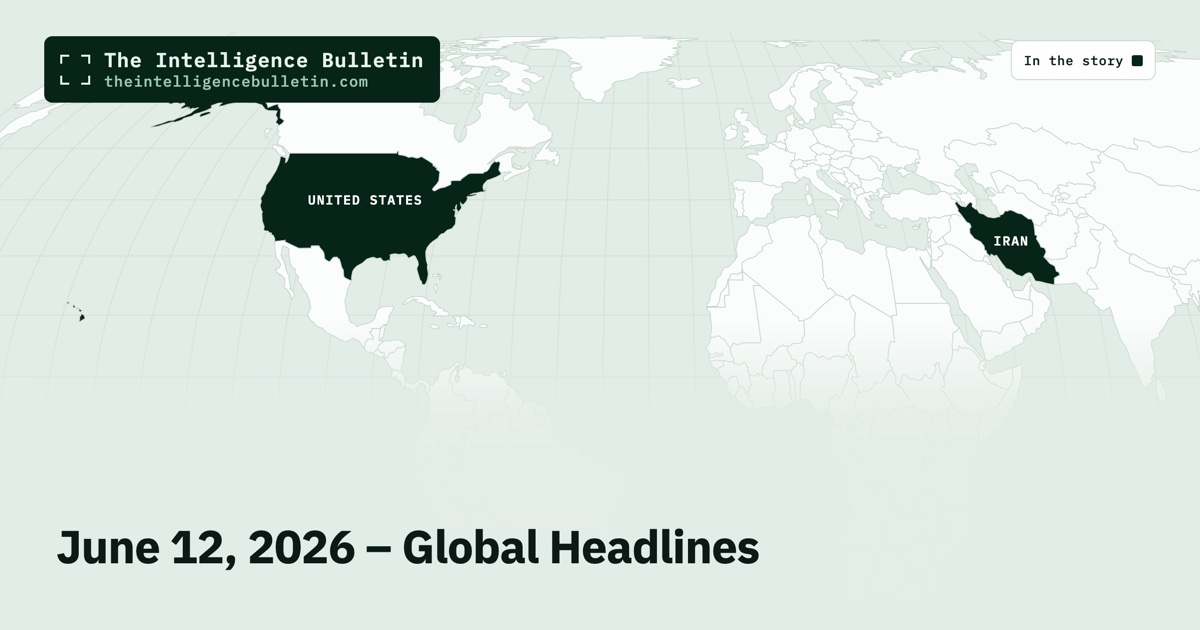
June 14, 2026 – Global Headlines

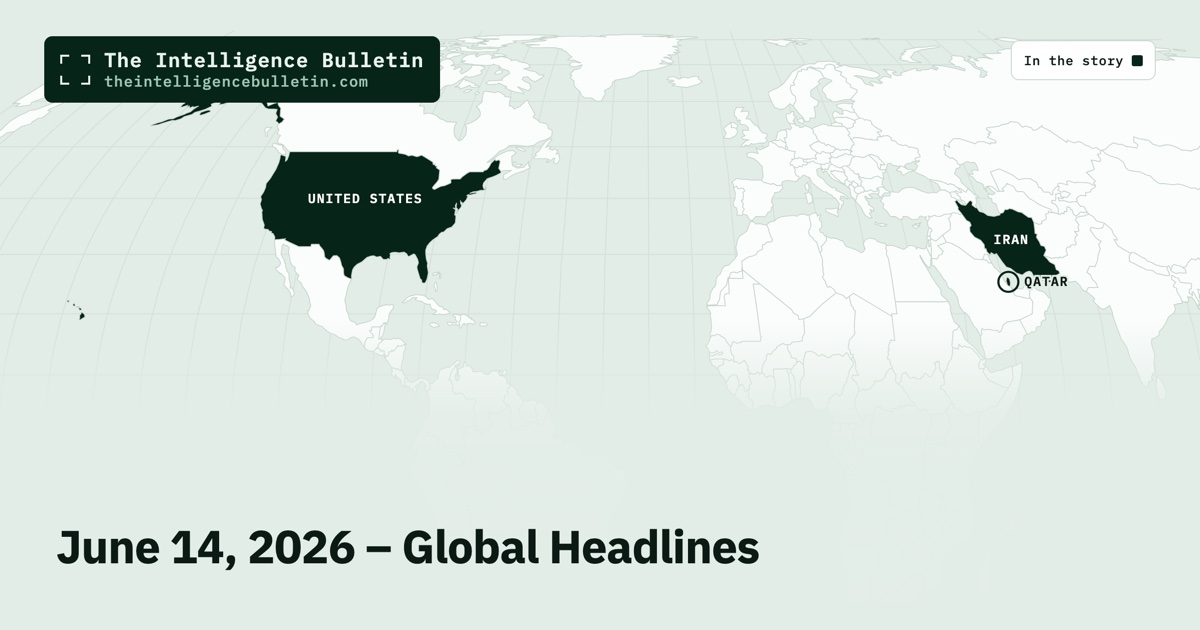
Map of the countries in the story: June 14, 2026 – Global Headlines

1Qatari Mediators Advance US-Iran Deal in Tehran as Trump Eyes Sunday

Map of the countries in the story: June 14, 2026 – Global Headlines
Story gist: On 2026-06-14 Qatari mediators arrived in Tehran to finalize a peace agreement ending direct US-Iran conflict. Iran stated no signing would occur that day while the US side signaled possible completion by Sunday. The effort follows recent US downing of Iranian drones near the Strait of Hormuz and Treasury warnings over frozen assets. Qatar’s role highlights its continued function as intermediary between Washington and Tehran.
One Story. Many Angles.
🇺🇸
United States
abcnews.com
Qatari mediators travel to Tehran for final touches on a possible deal to end war
Read →
🇮🇱
Israel
jpost.com
Qatari mediators fly to Tehran to finalize deal, end Iran war
Read →
🇴🇲
Oman
omanobserver.om
US, Iran inch closer to deal, Trump says Sunday but timing remains unclear
Read →
Perspective Analysis

The most striking element is how little daylight exists between the three accounts despite their different national vantage points. All three outlets treat the Qatari flight to Tehran as the operative diplomatic fact rather than any breakthrough itself. ABC News anchors the story in the Trump administration’s Sunday timeline, reflecting Washington’s need to project momentum after the drone incidents. The Jerusalem Post adds Israeli security concerns about regional spillover but still centers the same Qatari movement and the same uncertainty over timing. Oman Observer, reporting from a Gulf neighbor that has hosted earlier rounds, stresses the logistical ambiguity and avoids committing to any deadline. That convergence is telling: even outlets with clear stakes in the outcome are reporting the same narrow slice of activity because that is what the mediators themselves are willing to surface. The coverage therefore reveals more about the controlled pace of the talks than about substantive differences between capitals. Trump’s public Sunday reference appears designed to keep pressure on Tehran while the mediators test whether a narrow agreement on de-escalation and asset releases can actually be closed without triggering wider Israeli or Iranian domestic pushback. The absence of any reported Iranian counter-statement beyond the denial of an imminent signing suggests the main remaining variable is not substance but sequencing.


2Nigeria Ethiopia Prisoner Transfer Deal Welcomed by Inmates

Story gist: On June 13 2026 Nigeria’s Minister of State for Foreign Affairs Bianca Ojukwu concluded a bilateral prisoner transfer agreement with Ethiopia. Eligible Nigerian inmates serving sentences in Addis Ababa will return home to complete their terms. Inmates publicly thanked President Bola Tinubu and the federal government for the arrangement. The deal reflects routine consular cooperation between the two states with no reported market or security implications.
One Story. Many Angles.
🇳🇬
Nigeria
punchng.com
Prisoner Transfer Deal: Nigerian Inmates in Ethiopia Thank Tinubu
Read →
🇳🇬
Nigeria
naija247news.com
Nigerian Inmates In Ethiopia Celebrate Prisoner Transfer Deal, Laud Tinubu Administration
Read →
Perspective Analysis

The agreement itself is modest consular housekeeping yet Nigerian coverage treats it as a tangible foreign-policy success for the Tinubu administration. Both Punch and Naija247news foreground the inmates’ expressions of gratitude and name the president directly, turning a standard transfer protocol into domestic political capital. That framing is unsurprising given the outlets’ focus on Nigerian governance, but it also reveals how little external scrutiny the story attracts; Ethiopia’s own media have not surfaced in the cluster, suggesting Addis Ababa views the arrangement as unremarkable administrative work rather than a diplomatic milestone. The timing, coming amid Nigeria’s broader efforts to manage its diaspora and prison populations, gives the deal added domestic resonance. By emphasizing bilateral goodwill without referencing any quid pro quo or larger regional agenda, the reporting underscores that the value lies in visible consular relief for citizens abroad rather than strategic realignment. In a media environment often dominated by economic or security crises, the consistent highlighting of inmate thanks functions as quiet proof-of-concept for the government’s foreign-service capacity.


3Oaxaca Mayor Shot Dead at Home After Seeking Protection

Story gist: On June 13 2026 gunmen killed San Miguel Amatitlán mayor Joel Bravo Martínez at his home in Oaxaca, Mexico. The state prosecutor opened a high-impact crime investigation after confirming the attack by an unidentified armed group. Bravo had previously reported threats and requested police protection. The case fits a pattern of targeted killings of local officials in drug-trafficking zones.
One Story. Many Angles.
🇲🇽
Mexico
elarsenal.net
Joel Ángel Bravo Executed, Municipal President of San Miguel Amatitlán, Oaxaca
Ejecutan a Joel Ángel Bravo, presidente municipal de San Miguel Amatitlán, Oaxaca
Read →
🇨🇱
Chile
biobiochile.cl
Mexico: Mayor Shot Dead in His Own Home After Denouncing Previous Narco Aggression
México: asesinan a tiros y en su propia casa a alcalde que había denunciado agresión previa de narcos
Read →
🇮🇳
India
indianexpress.com
Mexico mayor shot dead in Oaxaca weeks after he sought police protection
Read →
Perspective Analysis

The three outlets converge on one detail that carries the real weight: Bravo had already flagged the danger and still received no effective shield. El Arsenal reports the execution in the tight language of a municipal obituary, naming the victim and the town without elaboration. BioBioChile adds the prior narco aggression as the decisive context, treating the home killing as confirmation that warnings were ignored. The Indian Express carries the institutional angle furthest, noting the protection request weeks earlier and letting that fact stand as evidence of state failure. What emerges is not disagreement over facts but a shared recognition that local mayors operate as exposed nodes in regions where cartel reach exceeds police capacity. This consensus across a Mexican local site, a Chilean regional paper, and an Indian international desk suggests the story travels because it compresses a recurring governance problem into a single, verifiable case. The absence of broader claims about cartel identities or political motives keeps the focus on the predictable outcome when protection requests meet insufficient response.


4Indonesian Students Blocked by Police at Bundaran HI Protest

Story gist: On 2026-06-13 students protested at Bundaran HI in Central Jakarta and were stopped by police, Brimob and TNI barricades. Security forces prevented entry into the area, resulting in shoving between demonstrators and personnel. Student representatives stated no officials met them and described the response as repressive. No fatalities occurred.
One Story. Many Angles.
🇮🇩
Indonesia
tribunnews.com
No Officials Met Students Protesting at Bundaran HI, BEM UI: We Were Greeted with Repressive Apparatus
Tak Ada Pejabat yang Temui Mahasiswa Demo di Bundaran HI, BEM UI: Kami Disambut Represifitas Aparat
Read →
🇮🇩
Indonesia
megapolitan.kompas.com
From Orations to Pushing Each Other, The Long Journey of Students Breaking Through to Bundaran HI
Dari Orasi hingga Saling Dorong, Jalan Panjang Mahasiswa Menembus Bundaran HI
Read →
Perspective Analysis

Both Indonesian outlets covering the Bundaran HI protest frame the event around the students’ direct encounter with state security rather than any policy demand or wider political context. Tribunnews leads with BEM UI’s claim that demonstrators received only “represifitas aparat,” casting the day as a straightforward case of official refusal to engage. Kompas instead traces the students’ extended sequence of speeches and physical attempts to break through the cordon, presenting the same standoff as a test of endurance. The convergence is telling: in a country where past student actions have occasionally forced national concessions, these reports treat the immediate physical barrier as the story itself, with little reference to underlying grievances or the protest’s scale. That narrow lens may reflect editorial caution around domestic security forces or simply the absence of any official statement to balance the narrative. Either way, the coverage leaves the impression that the demonstration’s significance lies less in its content than in the predictable mechanics of containment at Jakarta’s symbolic center.


5US Downs Two Iranian Drones Near Strait of Hormuz

Story gist: On June 12 2026, U.S. forces shot down two Iranian one-way attack drones near the Strait of Hormuz. The drones targeted commercial shipping but caused no disruption or casualties. Traffic through the waterway continued uninterrupted. The incident follows U.S. warnings that frozen Iranian assets would cover any damage to Gulf allies.
One Story. Many Angles.
🇮🇱
Israel
ynetnews.com
US forces shoot down Iranian attack drones near Strait of Hormuz, source says
Read →
🇨🇭
Switzerland
latele.ch
United States: Iranian drones shot down near Strait of Hormuz
Les États-Unis : drones iraniens abattus près du détroit d’Ormuz
Read →
🇸🇪
Sweden
nyheter24.se
USA shot down Iranian drones at Hormuz
USA skjutit ned iranska drönare vid Hormuz
Read →
Perspective Analysis

The uniform reporting across these outlets underscores a shared acceptance of the U.S. account as the baseline fact, yet each outlet’s placement of that fact reveals different regional priorities. Ynetnews frames the downing as part of ongoing Iranian threats to maritime routes that directly affect Israeli security calculations, situating it within the same escalation pattern that has seen CENTCOM and Israeli officials coordinate responses. Latele.ch presents the event as a contained U.S. military assertion without attaching broader Gulf implications, reflecting Switzerland’s distance from the conflict and its focus on verifying claims rather than projecting consequences. Nyheter24.se similarly records the incident as an international security development but embeds it in Nordic coverage of sanctions regimes and European energy routes, avoiding any direct linkage to Israeli or Iranian domestic politics. This convergence on the core claim, absent any reported Iranian confirmation or denial in the initial wave, signals how Western-aligned outlets treat U.S. operational statements as the operative narrative when kinetic events occur in chokepoints. The absence of market-sensitivity language or casualty details across all three sources further indicates that the story is being carried as a discrete military fact rather than an immediate economic or humanitarian crisis.


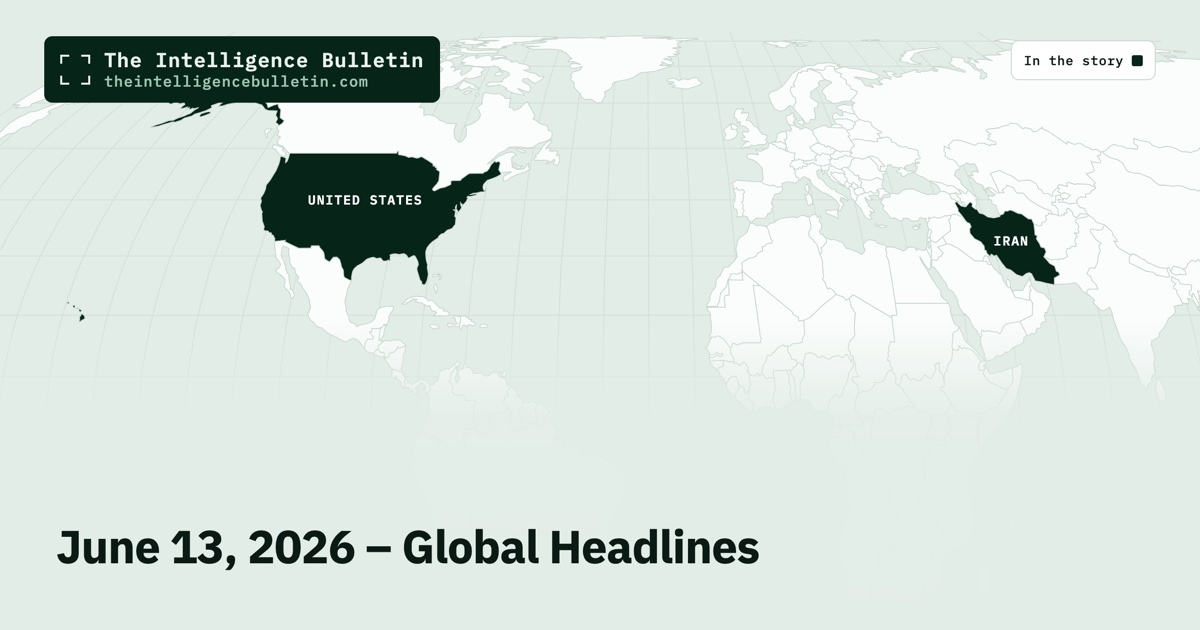
June 13, 2026 – Global Headlines

Map of the countries in the story: June 13, 2026 – Global Headlines

1US Downs Two Iranian Drones Near Strait of Hormuz

Map of the countries in the story: June 13, 2026 – Global Headlines
Story gist: On June 12 2026 U.S. forces shot down two Iranian one-way attack drones attempting to target commercial ships in the Strait of Hormuz. Traffic continued without interruption and no fatalities occurred. The incident follows U.S. Treasury warnings that frozen Iranian assets would cover any damage to Gulf allies. Tehran has not publicly confirmed the drone operation.
One Story. Many Angles.
🇮🇱
Israel
ynetnews.com
US forces shoot down Iranian attack drones near Strait of Hormuz, source says
Read →
🇨🇭
Switzerland
latele.ch
The United States: Iranian drones shot down near the Strait of Hormuz
Les États-Unis : drones iraniens abattus près du détroit d’Ormuz
Read →
🇬🇧
United Kingdom
europesun.com
US Downs Iranian Attack Drones, Even As Deal Momentum Builds
Read →
Perspective Analysis

The Israeli coverage from Ynetnews frames the shoot-down strictly as a defensive success against Iranian threats to regional shipping, reflecting Tel Aviv’s immediate concern over any disruption to energy routes that could affect its own security calculations. By contrast Europesun.com in the UK inserts the event into a larger diplomatic narrative, noting the timing against renewed nuclear-deal momentum and thereby highlighting Washington’s willingness to use force even while talks are discussed. Latele.ch stays narrowly factual, reporting only the U.S. claim without adding regional stakes or negotiation context, consistent with Swiss editorial distance from Gulf flashpoints. This pattern of emphasis rather than contradiction reveals how proximity to the risk shapes story selection: outlets nearest the potential fallout stress operational details, while those farther away test the incident against broader policy tracks. The episode also extends the June 12 U.S. Treasury signal that frozen assets would serve as compensation, showing Washington’s preference for calibrated financial and military pressure over open escalation. No source disputes the basic facts of the intercept, yet the differing weight given to security versus diplomacy illustrates how the same limited clash can be read as either routine deterrence or a complicating factor in stalled negotiations.


2China Opposes US Pentagon List of Firms, Warns of Retaliation

Story gist: On 2026-06-13, China’s Ministry of Commerce stated it was very dissatisfied with the US Department of Defense’s updated list adding several major Chinese companies. Beijing urged Washington to withdraw the measures and warned it would retaliate decisively if Chinese firms were not treated fairly. The exchange centers on US restrictions targeting firms with alleged military ties.
One Story. Many Angles.
🇺🇸
United States
globalsecurity.org
China opposes US move to add Chinese firms to military companies list, vows countermeasures
Read →
🇺🇸
United States
yahoo.com
China opposes US move to list top firms as military companies
Read →
🇵🇰
Pakistan
thenews.com.pk
China warns US of retaliation over Pentagon blacklist expansion
Read →
Perspective Analysis

The three outlets converge on the same core sequence—Beijing’s Ministry of Commerce issuing a pointed warning after the Pentagon expanded its list—yet each chooses a different entry point that reveals how proximity shapes emphasis. globalsecurity.org, by republishing Global Times copy almost verbatim, leads with China’s vow of countermeasures and the explicit demand that Washington reverse course, giving readers the language of “firm opposition” and “decisive retaliation” without American framing layered on top. yahoo.com instead opens from the Pentagon action itself, presenting the blacklist expansion as an established US policy move and treating Beijing’s response as the predictable follow-on, which keeps the narrative anchored in Washington’s institutional process. thenews.com.pk splits the difference by foregrounding the retaliation language while locating the story in the wider pattern of US-China commercial friction, an angle that fits a non-aligned South Asian outlet watching both powers test economic leverage. The absence of disagreement on the facts across all three is itself telling: the Ministry’s phrasing was blunt enough that even an aggregation site and a US-focused platform recorded the threat without softening it. That consistency suggests the Chinese statement was calibrated for rapid, unambiguous pickup rather than nuanced interpretation. What remains unaddressed in every account is which specific firms—BYD, Alibaba, Baidu, Trina Solar among those named in the cluster—now face the new restrictions and how Beijing’s promised countermeasures might target parallel US interests. The coverage therefore functions less as competing narratives and more as synchronized reporting of an escalation whose next moves are still being calibrated in both capitals.


3Kallas Defends EU Diplomatic Service Against French Reform Bid

Story gist: On 12 June 2026 EU foreign policy chief Kaja Kallas emailed staff defending the European External Action Service. The message followed a French government working document that proposed placing the service under full European Commission control. The exchange forms part of an internal EU debate over the bloc’s diplomatic structure between member states.
One Story. Many Angles.
🇷🇴
Romania
hotnews.ro
Kaja Kallas defends her institution after a French proposal to reform the EU External Action Service
Kaja Kallas isi apara institutia dupa o propunere din Franta privind reformarea Serviciului de Actiune Externa al UE
Read →
🇷🇴
Romania
cotidianul.ro
Future of the EU diplomatic service called into question. Kaja Kallas defends her institution
Viitorul serviciului diplomatic al UE pus sub semnul intrebarii Kaja Kallas isi apara institutia
Read →
Perspective Analysis

Romanian outlets are tracking this exchange because it touches the precise institutional balance smaller member states fear losing. Both hotnews.ro and cotidianul.ro present Kallas’s email as a direct rebuttal to a French working paper, treating the proposal as an attempt to fold the EEAS into Commission structures rather than preserve its hybrid character. The framing is consistent: French ideas are described as reform options that would alter the service’s independence, while Kallas’s response is cast as institutional self-defence. This alignment is unsurprising given Romania’s stake in an EEAS that gives smaller capitals a voice outside the Commission hierarchy. What the coverage quietly underscores is that the French document revives a long-standing centralisation debate that Estonia’s Kallas, as a former prime minister from the EU’s eastern flank, is now positioned to resist. The absence of any counter-French sourcing in the Romanian reports further signals where the editorial priority lies: protecting the current diplomatic architecture against initiatives that could concentrate authority in Brussels institutions traditionally more responsive to larger founding members.


4Venezuela Blames Trinidad for Oil Spill Reaching Its Coast

Story gist: On June 12 2026 Venezuela’s foreign ministry reported that an oil spill originating in Trinidad and Tobago waters reached Venezuelan shores in the Gulf of Paria and affected coastal zones in Sucre and Delta Amacuro. The incident threatens marine ecosystems, fisheries and local communities. Venezuelan officials demanded that Trinidad and Tobago account for the spill and accept responsibility. Trinidadian coverage framed the statement as a call for accountability while Venezuelan outlets presented it as a formal denunciation of a second larger spill.
One Story. Many Angles.
🇹🇹
Trinidad and Tobago
trinidadexpress.com
Venezuela calls on T&T to account for second larger oil spill
Read →
🇻🇪
Venezuela
psuv.org.ve
Venezuela denounces new hydrocarbon spill from Trinidad and Tobago and demands responsibility
Venezuela denuncia nuevo derrame de hidrocarburos procedente de Trinidad y Tobago y exige responsabilidad
Read →
🇻🇪
Venezuela
correodelcaroni.com
Venezuela denounces new hydrocarbon spill coming from Trinidad
Venezuela denuncia nuevo derrame de hidrocarburos procedente de Trinidad
Read →
Perspective Analysis

The most striking feature of this coverage is how little daylight exists between the Trinidadian and Venezuelan accounts on the basic sequence of events. Trinidad Express reports that Venezuela has called on Port of Spain to explain a second, larger spill whose effects have already reached Sucre and Delta Amacuro. The two Venezuelan sources use almost identical language, describing a “nuevo derrame de hidrocarburos procedente de Trinidad y Tobago” and insisting on “responsabilidad.” That convergence is itself the signal: both governments appear to accept that the pollutant crossed the maritime boundary and that the source lies on the Trinidad side of the Gulf of Paria.

What differs is tone and institutional voice. The ruling-party site psuv.org.ve presents the foreign ministry statement as an official demand for accountability, consistent with Caracas’s long-standing practice of using environmental incidents to assert sovereignty over disputed waters. Correo del Caroní, published in the affected eastern Venezuelan state of Bolívar, adds a regional environmental lens, emphasizing risks to fishing communities that the national party organ largely omits. Trinidad Express, by contrast, keeps the focus on the diplomatic exchange rather than ecological damage, reflecting Port of Spain’s interest in containing the story within the narrow frame of “Venezuela demands answers.”

The Takeaway

The episode sits apart from the week’s other geopolitical stories—US-Iran drone intercepts, Chinese sanctions retaliation, EU institutional maneuvering—precisely because it is a bilateral environmental dispute between two small energy producers that rarely surface together in international coverage. The absence of any Trinidadian denial or counter-accusation in the monitored outlets suggests both sides see advantage in treating the spill as a manageable bilateral matter rather than an invitation for wider international involvement.


5UK Defence Secretary Resigns Over Military Spending Row

Story gist: On 2026-06-12 John Healey resigned as UK Defence Secretary after pressing Prime Minister Keir Starmer and Treasury officials for higher military budgets. Al Carns and other aides also left the ministry. The exits follow Labour’s internal disputes over funding levels amid NATO commitments. Starmer’s team has not confirmed a successor or revised spending targets.
One Story. Many Angles.
🇬🇧
United Kingdom
gazetteandherald.co.uk
Starmer’s authority shaken by defence secretary’s exit over military funding
Read →
🇪🇸
Spain
laregion.es
British Defence Minister who requested more spending resigns
Dimite el ministro de Defensa británico que pedía más gasto
Read →
🇨🇭
Switzerland
tdg.ch
Starmer: wave of resignations at the British Ministry of Defence
Starmer: démissions en cascade au ministère britannique de la Défense
Read →
Perspective Analysis

The resignation of John Healey exposes the friction between Labour’s fiscal restraint and its NATO pledges more sharply than any single headline suggests. Gazette and Herald frames the departure as an early test of Starmer’s grip, noting how the Treasury’s refusal to loosen purse strings has already dented authority inside the governing party. La Region, by contrast, isolates Healey’s explicit demand for increased outlays as the decisive trigger, treating the episode as evidence that European allies are now openly contesting budget ceilings rather than quietly absorbing them. TdG highlights the additional departures of Al Carns and supporting staff, presenting the episode as a pattern of personnel loss that could slow procurement decisions at a moment when UK forces are pledged to higher readiness targets. The common thread across all three accounts is that the Treasury, not the Prime Minister’s office, holds the decisive veto; none of the outlets report any shift in the underlying 2.5 percent GDP aspiration, only that it remains unfunded. This convergence indicates the story is being read less as a personal drama and more as confirmation that post-election spending discipline will continue to override alliance rhetoric.


June 12, 2026 – Global Headlines

Map of the countries in the story: June 12, 2026 – Global Headlines

1Bessent Warns Iran Frozen Funds Will Reimburse Gulf Ally Damage

Map of the countries in the story: June 12, 2026 – Global Headlines
Story gist: On 2026-06-11 US Treasury Secretary Scott Bessent stated on X that frozen Iranian assets would reimburse any damage to US Gulf allies. The warning targeted Tehran directly amid ongoing Gulf tensions. It signals intensified US use of financial sanctions rather than new military measures. The statement originated in Washington with Iran as the explicit target.
One Story. Many Angles.
🇦🇿
Azerbaijan
en.apa.az
Bessent says damage to US allies will be paid from Iranian accounts
Read →
🇮🇳
India
businesstoday.in
Damage to Gulf allies will be paid from Iranian accounts: US Treasury chief warns Tehran
Read →
🇯🇴
Jordan
albawaba.net
U.S. Treasury warns Iran will pay economically for every attack
Read →
Perspective Analysis

The unusual detail here is Bessent’s explicit pledge to tap frozen Iranian accounts rather than impose fresh sanctions, a mechanism that turns Iran’s own assets into a deterrent. Azerbaijan’s APA outlet frames the move through the lens of post-Soviet energy security, underscoring how sanctions enforcement protects Caspian and Gulf supply routes that Baku itself relies upon. India’s Business Today instead stresses the oil-market mechanics, noting that any drawdown of Iranian funds could tighten global crude balances at a moment when Indian refiners remain exposed to Gulf volatility. Albawaba, writing from Jordan, foregrounds escalation risks and regional security, viewing the warning as a potential accelerant in an already fragile Arab-Iranian standoff rather than a purely financial maneuver. Across the three, the shared factual core—that Washington will treat frozen assets as a reimbursement pool—reveals a converged understanding that the US is now operationalizing long-held sanctions tools in real time, even as each outlet reads the downstream consequences through its own geographic exposure.


2US Sanctions Cuba’s State Oil Firm CUPET Over Russia Ties

Story gist: On June 11 2026 the US Treasury sanctioned Cuba’s state oil company CUPET under Executive Order 14404. Secretary of State Marco Rubio linked the move to Cuba’s support for Russia and its impact on the island’s energy sector. The action follows earlier sanctions on President Díaz-Canel and occurs during widespread power outages. Cuban officials denounced the measures as an energy blockade while Republican lawmakers in Washington voiced support.
One Story. Many Angles.
🇪🇸
Spain
elperiodico.com
Amid blackouts, US sanctions Cuba’s state energy company
En medio de los apagones, EEUU sanciona a la empresa estatal cubana de energía
Read →
🇲🇽
Mexico
eluniversal.com.mx
Cuba accuses Marco Rubio of tightening energy blockade with usual vulgar lies
Cuba acusa a Marco Rubio de reforzar el cerco energético con mentiras usuales y vulgares
Read →
🇺🇸
United States
martinoticias.com
Republican legislators back sanctions against CUPET
Legisladores republicanos respaldan sanción contra CUPET
Read →
Perspective Analysis

The most revealing thread across these reports is how little any outlet disputes the sanctions themselves and how sharply each instead highlights a different consequence. El Periódico opens by anchoring the decision in Cuba’s rolling blackouts, treating the measure as an escalation that lands directly on households already without reliable power. That choice reflects a European habit of reading US-Cuba policy through the lens of immediate social strain rather than abstract security claims. El Universal, by contrast, centers Cuba’s accusation that Rubio is personally tightening an “energy siege” with crude rhetoric, preserving space for Havana’s narrative of external aggression without endorsing it. Martinoticias flips the frame again, recording swift backing from Republican legislators and thereby presenting the sanctions as settled domestic consensus rather than contested foreign policy. The pattern is consistent with the June 5 sanctions on Díaz-Canel: each new step widens the gap between Washington’s incremental economic pressure and the distinct ways regional outlets choose to register its effects on daily life, political rhetoric, or congressional alignment. What unites the coverage is the absence of any serious challenge to the factual sequence; what divides it is whether the story is ultimately about Cuban suffering, Cuban defiance, or American political resolve.


3U.S. Envoy Cites White House Friend in Kazakhstan Minerals Talks

Story gist: On June 12 2026 U.S. envoy Sergio Gor met Kazakhstan President Kassym-Jomart Tokayev in Astana during talks on critical minerals investment. Gor told Tokayev he had a friend in the White House. The exchange occurred as the United States seeks supply-chain cooperation with Kazakhstan. No further commitments were reported from the meeting.
One Story. Many Angles.
🇫🇷
France
Euronews
Trump envoy to Tokayev: You have a friend in the White House
Emissaire de Trump a Tokayev: Vous avez un ami a la Maison-Blanche
Read →
🇪🇸
Spain
Euronews
Trump envoy tells Tokayev he has a friend in the White House amid US mining boom
El enviado de Trump dice a Tokayev que tiene un amigo en la Casa Blanca en auge minero de EEUU
Read →
🇭🇺
Hungary
Euronews
Trump envoy to Tokayev: has a friend in the White House amid mineral negotiations
Trump kovete Tokajevnek: baratja van a Feher Hazban az asvanykincs-targyalasok kozepette
Read →
Perspective Analysis

The informal assurance delivered by Sergio Gor in Astana stands out because it reduces a strategic minerals negotiation to a personal connection inside the White House. All three Euronews editions record the same remark without embellishment, treating it as evidence that Washington is accelerating direct outreach to secure non-Chinese rare-earth supplies. The French service places the comment inside ongoing EU-U.S. competition for Central Asian resources, while the Spanish edition links it explicitly to a recent surge in American mining projects across the region. The Hungarian version frames the encounter against Eastern European concerns about energy dependence, yet still centers the same White House reference. This convergence across language editions indicates the story is viewed primarily as a business-diplomacy development rather than a political signal. The absence of Tokayev’s reply in every account further underscores that the episode is being read as an American initiative rather than a bilateral breakthrough. In the wider context of U.S. sanctions on Iran and Cuba reported the same day, the Astana meeting appears as one more instance of Washington using personal leverage to lock in critical inputs before rivals consolidate their positions.


4EU Asylum Pact Enters Force with Mandatory Border Screening

Story gist: The European Union’s reformed Common European Asylum System took effect on June 11, 2026. It requires preliminary screening of asylum seekers at external borders to accelerate processing, coordinated by the European Commission. Coverage centers on procedural changes for arrivals from Türkiye. The shift alters how claims from this key route are handled at the point of entry.
One Story. Many Angles.
🇪🇸
Spain
3cat.cat
The EU, more closed to immigration: keys to the asylum pact, which comes into force
La UE, més tancada a la immigració: claus del pacte d’asil, que entra en vigor
Read →
🇩🇪
Germany
dw.com
New EU asylum system: What has changed for arrivals from Turkey?
Yeni AB iltica sistemi: Türkiye’den gelişte ne değişti?
Read →
Perspective Analysis

Both outlets treat the June 11 implementation as a concrete operational change rather than a political announcement. 3cat.cat frames the new rules as an explicit tightening of access, using the pact’s entry into force to underscore that the EU is now structurally harder to enter. DW’s Turkish service instead isolates the practical differences for people crossing from Türkiye, detailing how the mandatory screening stage will reorder the first days after arrival without commenting on the overall direction of policy. The shared emphasis on the external-border screening step reveals that the story’s signal for these outlets lies in logistics at the frontier, not in debates over solidarity quotas or relocation. This convergence on procedure over principle matches the event data’s focus on the European Commission’s coordination role and the low market-sensitivity score, indicating the change registers first as an administrative reset rather than an economic or diplomatic rupture. The absence of any reference to prior joint projects such as the stalled fighter-jet program or recent U.S. sanctions stories further isolates the asylum shift as a self-contained EU-internal recalibration whose effects will be felt first by arrivals and border authorities rather than by wider geopolitical actors.


5UK Defence Secretary Healey Quits Over Starmer Military Spending Row

Story gist: On 11 June 2026 UK Defence Secretary John Healey resigned after clashing with Prime Minister Keir Starmer over insufficient funding in the Defence Investment Plan. Healey, backed by several Labour figures, argued that current allocations left the armed forces under-resourced. The departure follows earlier exits by other ministers and centres on Treasury resistance to higher spending. The episode unfolded in London amid Labour’s efforts to balance fiscal restraint with defence commitments.
One Story. Many Angles.
🇬🇧
United Kingdom
gazetteandherald.co.uk
Starmer’s authority shaken by defence secretary’s exit over military funding
Read →
🇬🇧
United Kingdom
stratford-herald.com
Starmer’s authority shaken by defence secretary’s exit over military funding
Read →
🇪🇸
Spain
laregion.es
British Defence Minister who called for more spending resigns
Dimite el ministro de Defensa británico que pedía más gasto
Read →
Perspective Analysis

The resignation itself draws little dispute across the outlets, yet the emphasis splits along predictable lines. Gazette and Herald and Stratford Herald both lead with the damage to Starmer’s authority, treating the exit as the latest in a sequence of ministerial departures that trace directly to funding fights inside the Treasury. That framing reflects the domestic preoccupation with whether the prime minister can retain control of his cabinet on spending priorities. La Region, by contrast, places Healey’s explicit call for higher outlays at the centre, presenting the story as a straightforward clash between a minister demanding resources and a government unwilling to provide them. The Spanish choice is revealing because it isolates the policy substance rather than the political fallout, an angle that surfaces more readily when the story travels beyond Westminster. What the coverage shares is an absence of surprise at the Treasury’s role in blocking increases, a consensus that underscores how firmly fiscal limits now shape UK defence debates even as NATO partners press for higher commitments. The limited divergence therefore signals less about partisan spin and more about how far the story’s core tension—money versus readiness—travels unchanged once it leaves British domestic pages.


June 11, 2026 – Global Headlines

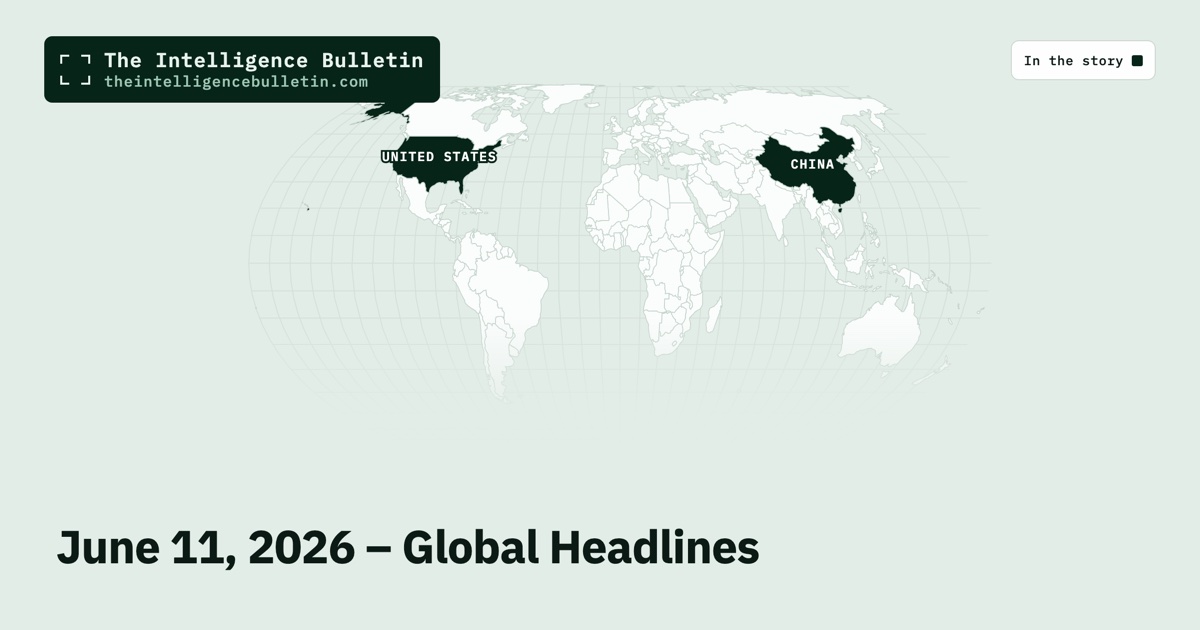
Map of the countries in the story: June 11, 2026 – Global Headlines

1FBI Seizes 13 Websites Used by Chinese Agents to Recruit US Officials

Map of the countries in the story: June 11, 2026 – Global Headlines
Story gist: On June 10 2026 the FBI seized thirteen websites operating as fake consulting firms. Suspected Chinese agents had used the sites to approach current and former US officials holding security clearances and offer payment for sensitive information. The Justice Department reported that site operators denied any foreign government role. The action highlights ongoing US efforts to disrupt Chinese intelligence recruitment inside the United States.
One Story. Many Angles.
🇺🇸
United States
orlandosentinel.com
FBI seizes 13 websites that officials say were used by China to target and recruit US workers
Read →
🇨🇳
China
scmp.com
FBI disables 13 Chinese suspected spying websites targeting US officials
Read →
🇦🇺
Australia
singletonargus.com.au
FBI seizes websites tied to alleged China intelligence
Read →
Perspective Analysis

The FBI operation reveals a familiar pattern of low-cost online fronts rather than dramatic arrests, yet the three outlets treat the same affidavit quite differently. Orlando Sentinel presents the seizures as straightforward law-enforcement protection of American workers and cleared personnel, consistent with its domestic focus. South China Morning Post foregrounds the operators’ denials and the absence of direct Beijing attribution, reflecting its access to Chinese perspectives that question the strength of US evidence. Singleton Argus places the action inside Five Eyes cooperation, noting how Australia and other partners track parallel recruitment attempts. The absence of any reported market reaction or diplomatic escalation in the coverage suggests all three outlets view the event as routine counter-intelligence housekeeping rather than a new crisis, even as the underlying recruitment pressure on cleared US personnel continues.


2Saudi Arabia Condemns Iranian Attacks on Bahrain Kuwait Jordan

Story gist: On 2026-06-11 Saudi Arabia’s Foreign Ministry issued a statement from Riyadh condemning Iranian attacks on Bahrain, Kuwait and Jordan. The ministry described the strikes as a threat to regional security and expressed solidarity with the three states. Iranian actions form the target of the Saudi rebuke. No other Arab League statements appear in the immediate coverage.
One Story. Many Angles.
🇺🇸
United States
globalsecurity.org
Saudi Arabia Condemns Blatant Iranian Attacks Against Bahrain, Kuwait and Jordan
Read →
🇺🇸
United States
themedialine.org
Arab States Condemn Iranian Strikes on Jordan, Bahrain, and Kuwait
Read →
Perspective Analysis

The two US outlets covering the Saudi statement reveal a narrow but telling split in emphasis rather than outright disagreement. GlobalSecurity.org sticks closely to the Riyadh text itself, reproducing the ministry’s language of blatant attacks and regional threat without widening the lens. The Media Line instead situates the same condemnation inside a wider pattern of Arab-state reactions, suggesting the episode is not an isolated Saudi move. That difference matters because the cluster metadata flags Arab League secretary-general Ahmed Aboul Gheit and the Arab Parliament as co-occurring entities, yet neither outlet brings those bodies into the story. The absence is consistent with a US security-analysis frame that privileges state-to-state signaling over institutional Arab responses. Both pieces therefore treat the Saudi statement as the primary signal while differing on whether it stands alone or forms part of a collective Arab posture. This convergence on the core fact, paired with the slight framing variance, indicates that American outlets see the Riyadh-Iran exchange as the actionable development even when the underlying event data hints at wider Arab coordination.


3Western Ambassadors Seek Ukraine Talks at Russian Foreign Ministry

Story gist: On 2026-06-11, ambassadors from the UK, France and Germany arrived at Russia’s Foreign Ministry in Moscow after requesting meetings with senior officials. The move was presented as an attempt to open dialogue on the Ukraine war. Russian Deputy Foreign Minister Mikhail Galuzin and other diplomats received the envoys. The initiative followed earlier proposals by Zelensky for direct talks with Putin that Moscow had rejected.
One Story. Many Angles.
🇷🇺
Russia
themoscowtimes.com
Ambassadors of Britain, France and Germany Hold Talks With Senior Russian Diplomats
Read →
🇷🇺
Russia
english.pravda.ru
UK, French and German Ambassadors Arrive at Russian Foreign Ministry After Requesting Talks
Read →
Perspective Analysis

Russian coverage of the ambassadors’ visit converges on a single narrative point: the approach originated with the Western capitals, not Moscow. The Moscow Times frames the episode as another instance of European powers testing whether the Kremlin will engage, while noting the limited prospects given Lavrov’s recent public dismissals of European mediation. Pravda.ru presents the same arrival as evidence that London, Paris and Berlin are now compelled to seek Moscow’s terms directly. Both accounts place the event inside the Foreign Ministry building rather than any neutral venue, underscoring the physical and diplomatic asymmetry. This shared emphasis on Western initiative appears even in the independent outlet, suggesting that the basic sequence of who requested the meeting is treated as settled fact across Moscow’s media spectrum. The reporting also situates the visit against the backdrop of the collapsed Franco-German fighter project and Ukraine’s recent drone agreement with Latvia, implying that European capitals are hedging after those setbacks. What remains unaddressed in either account is whether the envoys carried any new negotiating text or simply sought to register continued interest in keeping channels open.


4Erdogan Condemns Netanyahu Remarks as Threat to Turkey and World

Story gist: On 2026-06-10 Turkish President Recep Tayyip Erdogan told parliament in Ankara that Israeli Prime Minister Benjamin Netanyahu’s statements and actions against Turkey, Syria and Lebanon constitute a danger to the entire region. Erdogan demanded the aggression be halted. Turkish outlets ensonhaber.com and haberler.com reported the remarks alongside institutional criticism from RTUK, while Pakistan’s tribune.com.pk placed the warning in a global context. The exchange marks the latest escalation in Turkey-Israel tensions.
One Story. Many Angles.
🇹🇷
Turkey
ensonhaber.com
Netanyahu targets President Erdogan and Turkey
Read →
🇹🇷
Turkey
haberler.com
RTUK Chairman’s harsh reaction to Netanyahu
Read →
🇵🇰
Pakistan
tribune.com.pk
Erdogan says Israel’s aggression poses threat to Turkey, whole world and must be stopped
Read →
Perspective Analysis

Turkish coverage opens with the personal dimension: ensonhaber.com leads on Netanyahu targeting Erdogan and Turkey directly, reflecting Ankara’s view that the Israeli leader has singled out the Turkish president. haberler.com shifts the frame to the regulatory response from RTUK chairman, underscoring how Turkish institutions are mobilised to counter the remarks at home. By contrast, tribune.com.pk widens the lens, presenting Erdogan’s statement as a warning that extends beyond bilateral friction to a worldwide threat, consistent with Pakistan’s interest in positioning itself within larger Muslim-world alignments. The three accounts converge on the core facts of the parliamentary address yet diverge in emphasis because each outlet’s domestic audience requires a different entry point into the same confrontation. Turkish readers encounter the story as a direct affront requiring institutional pushback, while Pakistani readers receive it as evidence of a broader regional danger that implicates multiple states. This pattern mirrors earlier Turkey-Israel exchanges in which Ankara stresses sovereignty and Islamabad stresses collective Muslim security concerns, without either side altering the underlying sequence of statements.


5Hegseth Warns Cuba on Arms Buys at Guantanamo Base

Story gist: U.S. Defense Secretary Pete Hegseth visited Guantanamo Bay Naval Base on June 10, 2026, and warned Cuba against acquiring weapons that could threaten the United States. He stated such purchases would trigger a confrontation Cuba could not sustain. The remarks follow recent U.S. sanctions on Cuban President Miguel Díaz-Canel and occur against longstanding regional tensions over the base.
One Story. Many Angles.
🇪🇸
Spain
diariosigloxxi.com
Pentagon chief warns against Cuba’s wrong decisions during Guantanamo visit
El jefe del Pentágono advierte contra decisiones equivocadas de Cuba en su visita a Guantánamo
Read →
🇻🇪
Venezuela
globovision.com
Pentagon chief visits Guantanamo and warns Cuba about arms purchases
El jefe del Pentágono de visita en Guantánamo advierte a Cuba sobre la compra de armas
Read →
🇧🇷
Brazil
brasil247.com
Hegseth threatens Cuba and says the island would not resist a confrontation with the US
Hegseth ameaça Cuba e diz que ilha não resistiria a confronto com os EUA
Read →
Perspective Analysis

Spanish coverage from diariosigloxxi.com casts the visit as a measured caution against Cuban missteps, reflecting Europe’s detached view of U.S.-Cuba friction. Venezuelan state-aligned Globovisión instead stresses the explicit arms warning while underscoring regional solidarity with Havana, a framing that aligns with Caracas’s own standoff with Washington. Brazilian outlet Brasil247 goes further by foregrounding the threat of unsustainable confrontation, presenting the episode as another instance of U.S. dominance in Latin America. All three outlets converge on the core event yet diverge sharply in tone, revealing how proximity to U.S. pressure shapes interpretation: European distance yields neutrality, while Venezuelan and Brazilian proximity produces explicit critique. This pattern echoes the June 5 sanctions on Díaz-Canel, where the same outlets similarly split between procedural reporting and regional pushback. The absence of Cuban or U.S. domestic sourcing in the cluster leaves the story’s meaning determined almost entirely by third-party lenses.


June 10, 2026 – Global Headlines

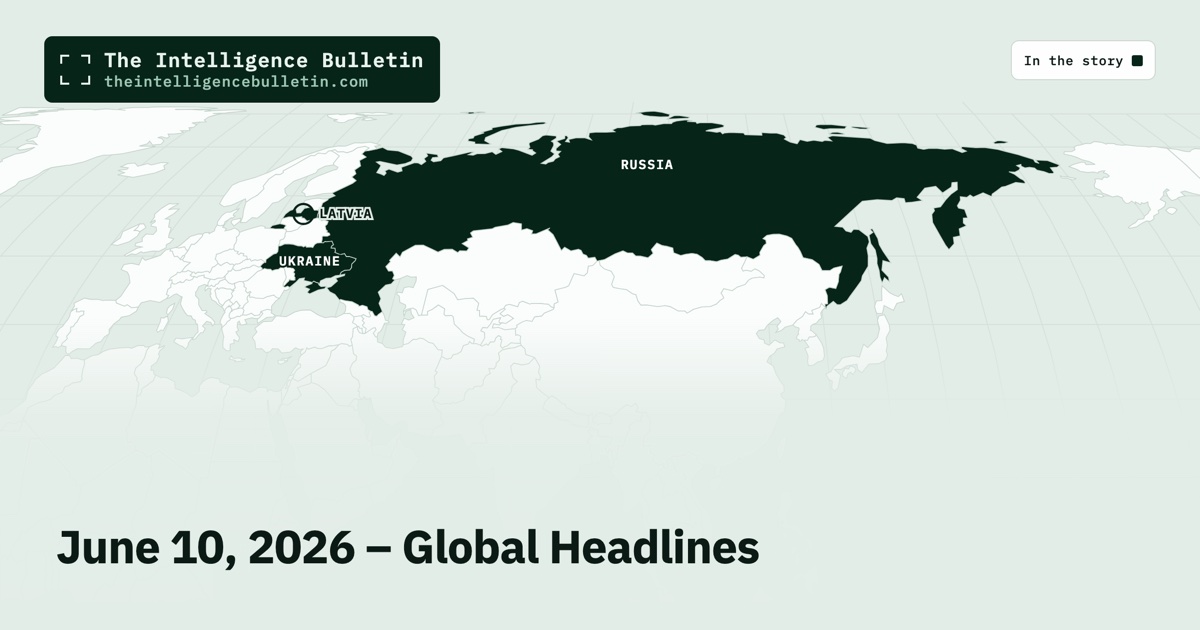
Map of the countries in the story: June 10, 2026 – Global Headlines

1Ukraine Latvia Sign Drone Deal as Russia Dismisses Europe Mediation

Map of the countries in the story: June 10, 2026 – Global Headlines
Story gist: On 2026-06-09 Ukraine and Latvia signed a drone cooperation agreement in Tallinn covering joint production, financing and air defense technology. President Zelenskyy and Latvian officials also discussed wider defense ties and sanctions on Russia. The deal emerged during NB8 and NATO-adjacent talks. Russian statements simultaneously rejected European mediation in peace efforts, creating the main reported tension.
One Story. Many Angles.
🇺🇸
United States
econotimes.com
Ukraine and Latvia Sign Drone Defense Deal to Boost Military Cooperation in 2026
Read →
🇮🇹
Italy
internazionale.it
Ukraine, Latvia sign drone deal as Russia says Europe not ready to mediate peace talks
Read →
🇺🇸
United States
yahoo.com
Ukraine, Latvia sign drone deal as Russia says Europe not ready to mediate peace talks
Read →
Perspective Analysis

The divergence in coverage of the Tallinn drone agreement shows how the same bilateral defense pact can be read either as routine military commerce or as a deliberate European signal amid stalled diplomacy. Econotimes.com presented the signing strictly through production and financing details, treating it as an industrial arrangement between two actors without referencing Moscow. By contrast, both the Italian Internazionale and the Yahoo aggregation explicitly paired the announcement with Russia’s claim that Europe lacks credibility as a mediator, folding the deal into a larger narrative of Western positioning. This split is not accidental. An outlet focused on economic data sees little need to import diplomatic friction, while wires and European publications reach for the Russia angle because it supplies immediate geopolitical stakes that resonate with audiences following the ceasefire proposals Zelenskyy floated days earlier. The Italian framing adds a further layer: it underscores European diplomatic frustration at a moment when NB8 countries are seeking concrete deliverables rather than abstract talks. What the sources collectively reveal is that the hardware cooperation itself is secondary to whether editors choose to locate the story inside Russia’s rejection of European involvement or keep it outside that frame entirely.


2Israeli Airstrikes Kill 11 in Tyre After Evacuation Order

Story gist: On June 10 2026 Israeli airstrikes hit Tyre in southern Lebanon killing at least 11 people according to Lebanese authorities. The attacks followed an Israeli evacuation order that triggered mass departures from the city. Hezbollah separately claimed strikes on Israeli forces the same day. The events renewed direct confrontation between Israel and Hezbollah along the border.
One Story. Many Angles.
🇲🇽
Mexico
elmanana.com
Tyre Lebanon: evacuation in Christian neighborhood due to Israeli attacks
Tiro Líbano: evacuación en barrio cristiano por ataques israelíes
Read →
🇦🇷
Argentina
eldestapeweb.com
Israel launches deadly attacks against the Lebanese city of Tyre after an evacuation order
Israel lanza ataques mortíferos contra la ciudad libanesa de Tiro tras una orden de evacuación
Read →
Perspective Analysis

Both the Mexican and Argentine reports open with the same sequence—an Israeli evacuation order followed hours later by lethal strikes—treating that chronology as the decisive fact rather than background context. El Mañana singles out the damage inside a Christian neighborhood of Tyre, a detail that surfaces nowhere else in the set and suggests the outlet is tracking how minority communities absorb the first impact. El Destape instead stresses the speed with which the strikes arrived after the warning, presenting the episode as a single continuous military action. The shared emphasis on timing and civilian displacement rather than Hezbollah’s concurrent claims indicates that Latin American coverage is converging on the question of whether the evacuation order functioned as genuine protection or as legal cover. That convergence is revealing: two ideologically distant papers reach for the same narrow frame because the documented sequence itself supplies the clearest available evidence of intent. No outlet here widens the lens to the June 3 security-zone agreement or to the broader regional escalation pattern; the story is kept tightly local to the city and the day. The result is a portrait of renewed fighting that is precise about the immediate mechanics yet silent on whether this round differs structurally from earlier rounds.


3Beijing Protests US Blacklist of BYD Over Military Ties

Story gist: On June 9 2026 Chinese foreign ministry spokesman Lin Jian stated in Beijing that China firmly opposed the US Defense Department blacklist of firms including BYD, Nio, Baidu and Alibaba for alleged military support. Lin urged Washington to reverse the measures and warned of steps to protect Chinese company interests. The action escalates US-China friction over technology and security links.
One Story. Many Angles.
🇨🇳
China
asianews.network
China slams US for labeling Chinese companies as supporting military
Read →
🇧🇷
Brazil
gazetadopovo.com.br
Why do the US accuse BYD and Chinese giants of links with the Chinese Army?
Por que os EUA acusam BYD e gigantes chinesas de ligação com o Exército da China?
Read →
🇦🇺
Australia
cairnspost.com.au
US Pentagon flags BYD over alleged Chinese military ties
Read →
Perspective Analysis

The shared factual core across these outlets is China’s direct rebuttal delivered by Lin Jian, yet each chooses a distinct entry point that reveals its own stakes in the US-China tech standoff. Asianews.network leads with the foreign ministry’s language of erroneous practices and necessary countermeasures, reflecting Beijing’s insistence that the blacklist lacks basis and must be corrected without delay. Gazeta do Povo instead dissects the Pentagon’s evidence trail linking BYD and peers to military supply chains, giving Brazilian readers a non-aligned breakdown of how dual-use technology rules are applied in practice. Cairns Post narrows to the procurement angle, noting how the listing directly affects Australian access to Chinese EVs and future defense-related supply decisions. This pattern shows the story functions less as a single event than as a mirror for each country’s exposure: China sees sovereign defense of its firms, Brazil sees an exportable case study in great-power rules, and Australia sees immediate implications for its own market and alliances. The absence of broader regional voices in the cluster underscores how tightly the narrative stays anchored to the Beijing-Washington axis even when reported from distant capitals.


4Modi Becomes India’s Longest-Serving Elected Prime Minister

Story gist: On 2026-06-10 Nigerian President Bola Tinubu publicly congratulated Indian Prime Minister Narendra Modi on becoming India’s longest-serving elected prime minister. Tinubu’s statement on X credited the milestone to public trust in Modi’s leadership. Similar messages arrived from other heads of government. Coverage centers on the event’s occurrence in Abuja and its link to Indian domestic politics.
One Story. Many Angles.
🇮🇳
India
newkerala.com
PM Modi Becomes India’s Longest-Serving Elected PM
Read →
🇮🇳
India
ianslive.in
Nigerian, Maldivian Presidents congratulate PM Modi on historic tenure, hail his ‘influential leadership’
Read →
Perspective Analysis

Indian outlets covering the milestone treat foreign congratulations as confirmation of Modi’s domestic record rather than as diplomatic maneuvering. Newkerala.com places the achievement in a national historical frame that reaches back to Nehru and Indira Gandhi, presenting the Nigerian message as one element in a wider chorus of approval. Ianslive.in narrows the lens to the specific statements from Abuja and Malé, underscoring the personal tone of the Nigerian praise and its direct reference to Modi’s influence abroad. The convergence between the two Indian sources reveals a shared editorial choice: both locate the story’s significance inside India’s internal political timeline while using the Nigerian voice to signal wider acceptance. This framing aligns with the event’s low market sensitivity and modest systemic weight, suggesting outlets see little need to embed the congratulations in larger questions of India-Africa economic ties or electoral strategy. The result is a compact narrative that registers the milestone without exploring whether the messages reflect shifting regional alignments or routine protocol.


5EU Orders Meta to Open WhatsApp to Rival AI Chatbots

Story gist: On June 9 2026 the European Commission directed Meta Platforms to grant rival AI chatbots free access to WhatsApp while probing market-power abuse. The interim measure applies in Brussels and targets Meta’s prior restriction of third-party assistants on its messaging service. The order aims to maintain competitive access for alternative AI tools across Europe. It pits US platform control against EU competition enforcement.
One Story. Many Angles.
🇫🇷
France
kulturegeek.fr
Europe forces WhatsApp to open up to competing AI chatbots
L’Europe oblige WhatsApp à s’ouvrir aux chatbots IA concurrents
Read →
🇩🇪
Germany
t3n.de
Meta only wanted its own AI on WhatsApp – now the EU forces the company to back down
Meta wollte nur eigene KI auf Whatsapp zulassen – jetzt zwingt die EU den Konzern zum Rückzieher
Read →
🇵🇰
Pakistan
dunyanews.tv
Meta ordered by EU to allow rival AI chatbots back on WhatsApp for free
Read →
Perspective Analysis

The three outlets converge on the core fact that Brussels has compelled Meta to loosen control over WhatsApp, yet each reveals a different facet of why that compulsion matters. Kulturegeek.fr presents the decision as a direct win for European AI developers who had been locked out, underscoring the consumer-protection logic that treats messaging infrastructure as shared public space rather than proprietary territory. T3n.de instead foregrounds Meta’s original plan to restrict the platform to its own models and the speed with which EU regulators forced reversal, framing the episode as evidence of enforceable corporate retreat under European rules. Dunyanews.tv, by contrast, strips away regulatory language altogether and simply records the restoration of free-market access, reflecting a Global South vantage in which the outcome registers primarily as an opening for any competitor rather than a triumph of Brussels oversight. This shared factual baseline across Paris, Berlin and Islamabad shows that the story travels less as a clash of values than as confirmation of the EU’s practical ability to rewrite terms for a US platform; the variation lies only in which beneficiary each outlet chooses to highlight. The absence of dissent among the sources is itself the signal: once the Commission acts, even outlets with divergent editorial priors treat the result as settled.