One Story. Many Angles.
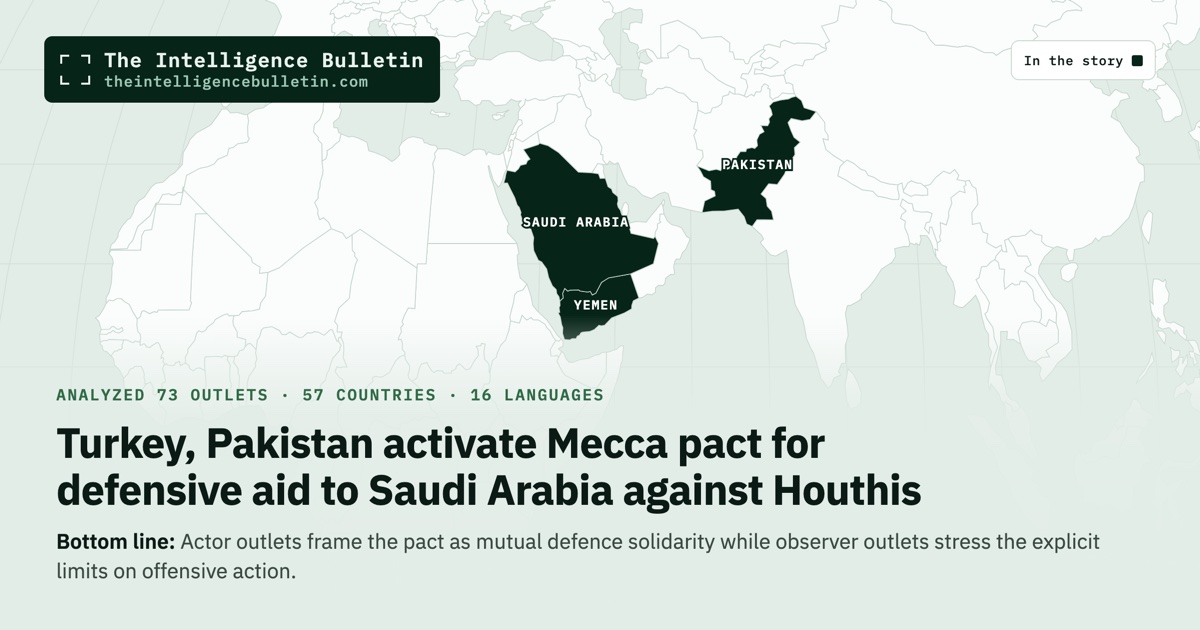
Actor outlets frame the pact as mutual defence solidarity while observer outlets stress the explicit limits on offensive action.
The reporting converges on a narrow defensive interpretation of the Mecca pact activation, with Turkish and Pakistani sources stressing alliance solidarity and limits on escalation while external observers highlight the regional realignment. Daily Sabah and Samaa present the move as continuation of historic commitments and Muslim Ummah coordination, quoting officials who tie it directly to the pact’s defensive trigger. Al-Monitor and the Jerusalem Post both relay the same Reuters dispatch detailing Fidan’s press conference and anonymous confirmations of equipment, intelligence and drone support, yet the Jerusalem Post adds an Israeli lens on security implications absent from the others. Middle East Eye embeds the development in the immediate Houthi missile context and notes the pact’s rapid-deployment language. The single consistent thread across independent chains is Fidan’s on-record exclusion of offensive roles; no outlet reports contradictory claims about troop deployments or offensive intent. The absence of Saudi-sourced material in the set leaves Riyadh’s operational needs described only through Ankara and Islamabad statements. This produces a picture of coordinated defensive reinforcement rather than escalation, with the pact functioning as a framework for technical assistance that sidesteps direct combat involvement.
Perspective Analysis
Turkey, Pakistan and Saudi Arabia moved last week to activate elements of their Mecca Joint Defence Agreement after a fresh round of Houthi missile and drone strikes on Saudi territory. The three countries signed the pact in August, under which an armed attack on one is treated as an attack on all. On Monday they announced immediate implementation of collective defence commitments, including rapid deployment of military forces and capabilities inside Saudi Arabia. Turkish Foreign Minister Hakan Fidan, speaking at a joint press conference in Ankara with his Hungarian counterpart, described military delegations now assessing what each side can contribute, with emphasis on air defence, electronic warfare and technical support.
Fidan stressed repeatedly that the arrangement remains defensive. Yemen’s recognised government forces are already fighting on the ground with Saudi backing, he said, but Turkey will not send troops to conduct attacks from Saudi soil. The pact itself, he added, is not an offensive instrument. Two officials later told Reuters that Turkey’s contribution at this stage would consist mainly of defensive and technical items, including military equipment, intelligence sharing and weapons systems. A US official briefed on the matter described drone operators, strategic planning support, logistics assistance and help fine-tuning defensive measures, along with intelligence, surveillance and reconnaissance capabilities. Pakistani officials confirmed they are supplying parallel defensive support under the same framework.
The assistance is moving forward on a bilateral basis for now. Turkish officials noted that parliament has not yet ratified the joint pact, though Fidan said the necessary legislative work is largely complete and submission is expected soon. Once ratified, the scale and form of contributions from both Turkey and Pakistan are expected to expand. Turkish statements also placed the effort inside a wider Saudi-led coalition for Red Sea navigation safety, a step Ankara had already endorsed.
The five outlets that covered the development within the past twenty-four hours all draw on the same core sequence of events. Daily Sabah, the Turkish paper, foregrounds Ankara’s constitutional limits and the defensive character of the pledge, presenting the move as alliance solidarity rather than any expansion of combat roles. Samaa, the Pakistani outlet, situates Turkey’s decision inside the broader Muslim Ummah coordination already under way between Islamabad and Riyadh, treating the Turkish step as confirmation of a shared defensive front. Middle East Eye places the announcements against the immediate backdrop of Houthi ballistic missile launches toward Riyadh and claimed strikes on King Khalid International Airport, noting the pact’s rapid-deployment language. Al-Monitor and the Jerusalem Post both carry the Reuters dispatch that records Fidan’s press conference and the anonymous confirmations of equipment and technical aid; the Jerusalem Post adds that the Israeli security establishment is watching the realignment for its implications on regional balances.
No outlet in the set reports any claim of Turkish or Pakistani ground troops entering offensive operations, nor any contradiction of Fidan’s on-record exclusion of such roles. The single point carried by only one reporting chain is the detail that current support remains bilateral pending ratification; that detail appears in the Reuters material relayed by Al-Monitor and the Jerusalem Post but is not foregrounded elsewhere. Saudi perspectives on the precise operational requirements are absent from these five articles, so Riyadh’s needs are described only through statements originating in Ankara and Islamabad.
What to Watch
The convergence on a narrow defensive reading is therefore the clearest finding. Turkish and Pakistani sources tie the activation directly to the pact’s collective-defence trigger and to historic bilateral ties with Saudi Arabia. External reporting records the same statements but situates them inside the Houthi campaign and the new alliance architecture. The result is a picture of coordinated technical reinforcement that deliberately stops short of combat involvement, with the Mecca pact serving as the institutional channel rather than a vehicle for escalation. Fidan’s repeated emphasis on defensive boundaries, corroborated across the Turkish, Pakistani, British and wire accounts, supplies the most consistent thread. The next measurable step will be parliamentary action in Ankara; until then the support stays limited to the bilateral lane already described by the officials who spoke to Reuters.