 AI-generated analysis published under the editorial responsibility of Rohit Sinnas. How it works →
Press quoted
Full analysis
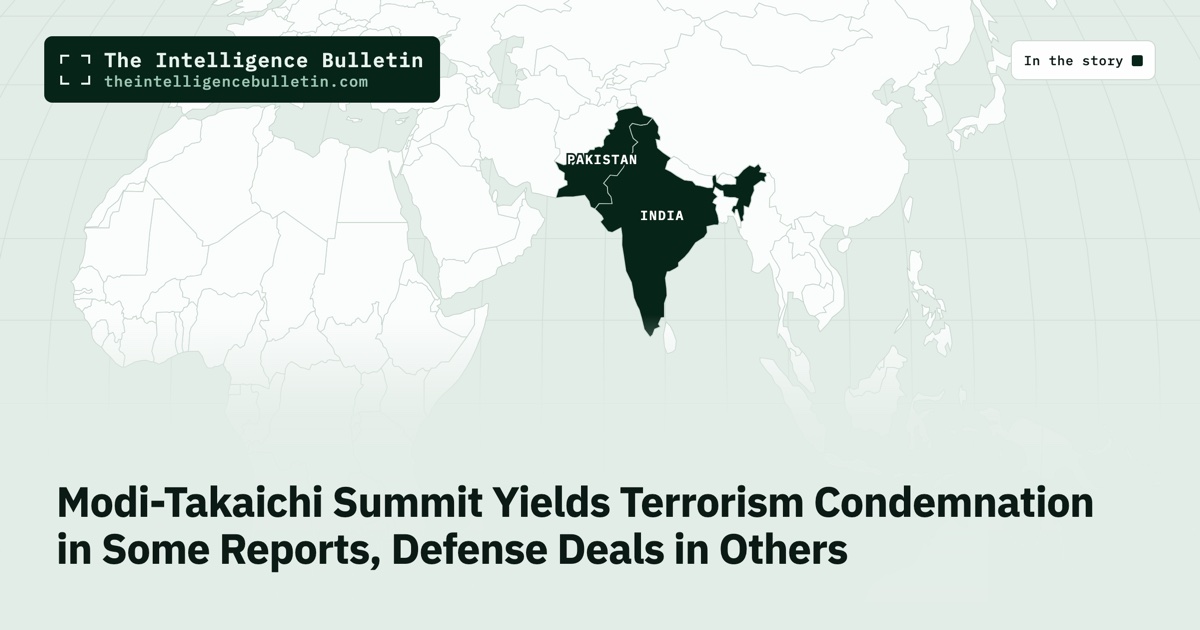
The divergent coverage of the July 2026 summit between Indian Prime Minister Narendra Modi and Japanese Prime Minister Sanae Takaichi in New Delhi illustrates how the same bilateral encounter can be packaged as either a pointed rebuke of Pakistan-linked terrorism or a broad strategic partnership update, depending on the originating wire service. Two outlets drew from identical ANI copy to foreground explicit condemnations of cross-border attacks and calls for dismantling terrorist infrastructure, while an American dispatch centered naval technology, economic security roadmaps, and Quad alignment without referencing Pakistan at all. This split underscores that the durable elements of the India-Japan relationship—maritime rules-based order, defense technology sharing, and trade expansion—travel reliably across outlets, whereas the terrorism language remains tethered to South Asian sourcing and framing.
The Australian News aggregation and the Organiser both reproduced the same ANI text with only minor headline and subhead variations, presenting the talks as a unified diplomatic stand against state-supported terrorism networks. Their joint statement, issued after the bilateral meeting on the margins of the 16th India-Japan Annual Summit, condemned cross-border terrorism originating from Pakistan and demanded global action against safe havens and financing channels. The reports detailed strong condemnation of the April 22, 2025, attack on tourists in Pahalgam, Jammu and Kashmir, noting the United Nations Security Council Monitoring Team Report’s implication of The Resistance Front. They further highlighted the November 10, 2025, car bombing near the Red Fort in Delhi and insisted that perpetrators, organisers, and financiers face justice. The leaders specifically named Lashkar-e-Tayyiba, Jaish-e-Mohammad, Al Qaeda, and ISIS among the groups requiring concerted international pressure, while stressing the need to sever links between terror financing and transnational crime and to halt terrorist movement across borders.
These two accounts extended the statement’s scope to regional maritime concerns, expressing opposition to unilateral actions that threaten freedom of navigation in the East China Sea and South China Sea, and reaffirming adherence to the United Nations Convention on the Law of the Sea. They also recorded the leaders’ push for United Nations Security Council reform through expanded permanent and non-permanent membership, immediate text-based negotiations, and reciprocal endorsement of each other’s candidatures for permanent seats. Additional elements included concerns over North Korea’s programs, navigation through the Strait of Hormuz, and support for a two-state solution in Gaza alongside peace efforts in Ukraine. The coverage noted Takaichi’s three-day visit from July 1 to July 3 and her participation alongside Modi in the India-Japan Business Forum. Because both pieces carry verbatim ANI material, they represent a single perspective shaped by Indian wire-service priorities that link anti-terror messaging directly to long-standing diplomatic objectives such as UNSC reform.
By contrast, the Seattle Times carried an Associated Press dispatch that opened with concrete defense and economic deliverables rather than the terrorism language. The report described agreements to collaborate on naval radio antenna systems, adopt a joint roadmap on economic security, and deepen work in artificial intelligence, shipbuilding, biogas, semiconductors, and critical technologies. Modi was quoted stating that India and Japan view economic security as a shared interest. The piece supplied figures of $27.5 billion in two-way trade for India’s 2025-26 fiscal year and $3.2 billion in Japanese investment between April and December 2025, noting that roughly 1,400 Japanese companies operate in India, nearly half in manufacturing. It placed the summit in the context of Japan’s pledge, made during Modi’s prior visit to Tokyo, to more than double investment in India to over $61 billion over the next decade. Maritime security cooperation was framed around Japan’s free and open Indo-Pacific initiative, with both leaders underscoring freedom of navigation and respect for international law; the Quad’s role in promoting regional security and defense ties was explicitly mentioned. The dispatch recorded a Chinese Foreign Ministry spokesperson’s criticism of the initiative as promoting confrontation rather than cooperation. No reference appeared to the joint statement’s Pakistan-specific condemnations or the named terrorist incidents.
Across the three reports, economic and maritime themes emerge as the consistent core. All accounts reference the annual summit structure, the business forum participation, and shared interest in a rules-based maritime order. The ANI-derived pieces embed these within a broader critique of regional instability and calls for multilateral reform, while the AP account treats them as standalone deliverables alongside technology cooperation. The terrorism emphasis, present only in the Indian-sourced material, appears optional once the story moves through an American wire service, suggesting that outlets weigh the bilateral condemnation against wider Indo-Pacific partnership narratives differently. This pattern aligns with the outlets’ respective audiences: regional stability concerns for South Asian and aggregator readers versus strategic competition framing for U.S. readers.
The meeting occurred during Takaichi’s official visit, which included review of the full spectrum of bilateral cooperation and discussion of regional and global issues. Japan’s status as one of India’s largest foreign investors and the presence of numerous Japanese firms in manufacturing provide the economic substrate that all reports acknowledge. The Quad context, referenced in the Seattle Times account, supplies the institutional backdrop that links defense technology agreements to collective maritime objectives without requiring the Pakistan-specific language.
The Takeaway
Looking ahead, observers will watch whether the naval radio systems cooperation and economic security roadmap produce tangible project announcements at the next annual summit or through follow-on working groups. Implementation of the trade and investment targets, alongside any further joint statements on maritime security or UNSC reform, will test the durability of the partnership beyond the immediate narrative choices of individual wire services. Regional responses, particularly from Beijing, may also shape how subsequent coverage balances condemnation language against partnership deliverables.
That’s how the world told the story.
Get our daily open-source intelligence on world events in your inbox — one email a day, up to six stories.
Subscribe freeNo spam. One-click unsubscribe. See the latest email →