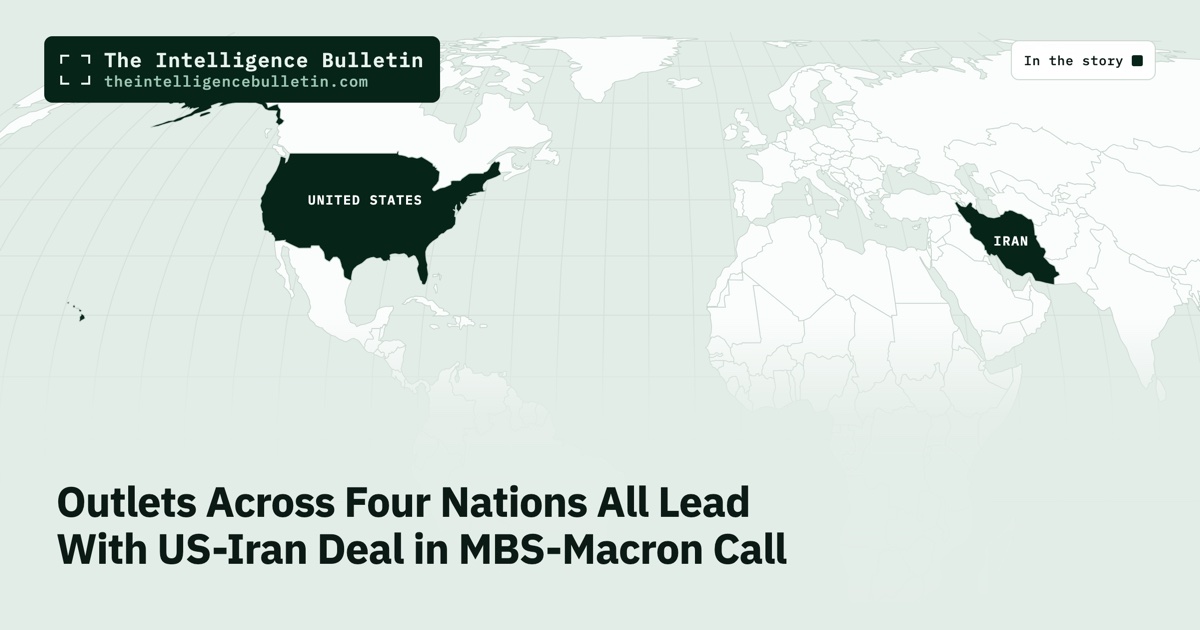
Outlets Across Four Nations All Lead With US-Iran Deal in MBS-Macron Call

Map of the countries in the story: Outlets Across Four Nations All Lead With US-Iran Deal in MBS-Macron Call
On June 28, 2026, Saudi Crown Prince Mohammed bin Salman received a phone call from French President Emmanuel Macron. They reviewed the latest developments on the US-Iran memorandum of understanding signed June 17 and efforts to promote regional security and stability. The leaders stressed the importance of freedom of navigation, particularly in the Strait of Hormuz, and support for diplomatic de-escalation, while also addressing bilateral cooperation.

One Story. Many Angles.

🇮🇳
India
Mangalorean
Saudi crown prince, French president discuss regional developments
Read →
🇱🇧
Lebanon
An-Nahar
ARABIC
Saudi crown prince discusses with Macron updates on US-Iran memorandum of understanding
Read →
🇷🇺
Russia
RT Arabic
ARABIC
Saudi crown prince and Macron discuss updates on US-Iran memorandum of understanding
Read →
🇨🇳
China
Xinhua
SPANISH
Saudi crown prince and French president discuss regional events
Read →

Perspective Analysis

The synchronized emphasis on a single diplomatic exchange across media in India, Lebanon, Russia, and China reveals how the fragile June 17 U.S.-Iran memorandum of understanding has quickly become the dominant frame for Gulf security concerns, eclipsing broader regional talk in favor of concrete navigation guarantees in the Strait of Hormuz.

On June 28, 2026, Saudi Crown Prince Mohammed bin Salman received a telephone call from French President Emmanuel Macron. The two leaders reviewed the latest developments surrounding the U.S.-Iran memorandum and the ongoing work to reach comprehensive solutions that would bolster regional security and stability. They also stressed the need to ensure freedom of navigation and to back diplomatic efforts aimed at lowering tensions, while touching on bilateral cooperation between France and Saudi Arabia.

This account originated with the Saudi Press Agency and was carried, with only minor headline and contextual variations, by the four outlets examined. The convergence is striking because the publications operate in very different geopolitical environments yet all placed the U.S.-Iran understanding at the center of their reporting rather than treating the call as routine Gulf diplomacy.

Mangalorean, drawing on the IANS wire service, delivered the most expansive version of the story. Its report opened with the standard Saudi summary but quickly added layers drawn from U.S. reporting, including Axios accounts of recent Hormuz clashes, the shift of technical talks to Doha, the still-inoperative hotline between U.S. forces and Iran’s Islamic Revolutionary Guard Corps, and the sequence of U.S. strikes on Iranian targets followed by Iranian responses. By incorporating these details, the Indian outlet supplied readers with the immediate backdrop of why navigation security had risen to the top of the MBS-Macron agenda.

An-Nahar in Lebanon led explicitly with the phrase “updates on the U.S.-Iran memorandum of understanding” in both its headline and opening sentence. The paper framed the call as a direct discussion of those updates, underscoring the emphasis on navigation rights and diplomatic de-escalation. Given Lebanon’s proximity to Iranian influence networks, the choice to foreground the memorandum reflects the outlet’s sensitivity to any development that could alter the balance of power or shipping routes in the eastern Mediterranean and Gulf.

RT Arabic, Russia’s state-backed Arabic service, mirrored An-Nahar’s focus almost exactly. Its headline and lead paragraph highlighted the memorandum updates alongside the Hormuz navigation issue, sourcing the information directly to the Saudi statement. Russian state media’s interest in the story aligns with Moscow’s broader preference for covering diplomatic channels that bypass Western-led frameworks, positioning the U.S.-Iran pause as an example of non-Western actors managing regional flashpoints.

Xinhua’s Spanish-language service adopted the most generic headline—“Saudi crown prince and French president discuss regional events”—yet its body text reproduced the identical Saudi Press Agency account, including the specific reference to the memorandum and the importance of freedom of navigation. The restrained framing is consistent with Chinese state media’s practice of maintaining a detached, Global South tone while still transmitting the factual core of the story to Spanish-speaking audiences.

Across these four very different editorial environments, the shared reliance on the same official Saudi text produced near-identical substantive reporting. The only meaningful divergence lay in the amount of additional context supplied: Mangalorean alone wove in reporting on recent clashes and the Doha venue shift, while the other three stayed closer to the official summary. This pattern indicates that even outlets with distinct political alignments viewed the U.S.-Iran memorandum and its navigation provisions as the indispensable element of the story.

The episode illustrates how a single, narrowly focused diplomatic contact can crystallize shared international stakes. Freedom of navigation through the Strait of Hormuz is not an abstract principle for energy importers in Asia, Arab states bordering the waterway, or powers seeking influence in multipolar diplomacy; it is a concrete economic and strategic necessity. By leading with the memorandum rather than vague references to “regional developments,” the outlets signaled that the pause in U.S.-Iran hostilities remains provisional and that any renewed disruption to shipping would carry immediate global consequences.

The Takeaway

Looking ahead, attention will center on whether the technical talks now scheduled in Doha produce an operational hotline and durable shipping arrangements, and whether the sporadic clashes reported in recent days subside or resume. The fact that four geographically and politically distant outlets treated the same Saudi-French exchange as front-page material suggests that further updates on the memorandum will continue to drive coverage well beyond the Gulf.
Share this story

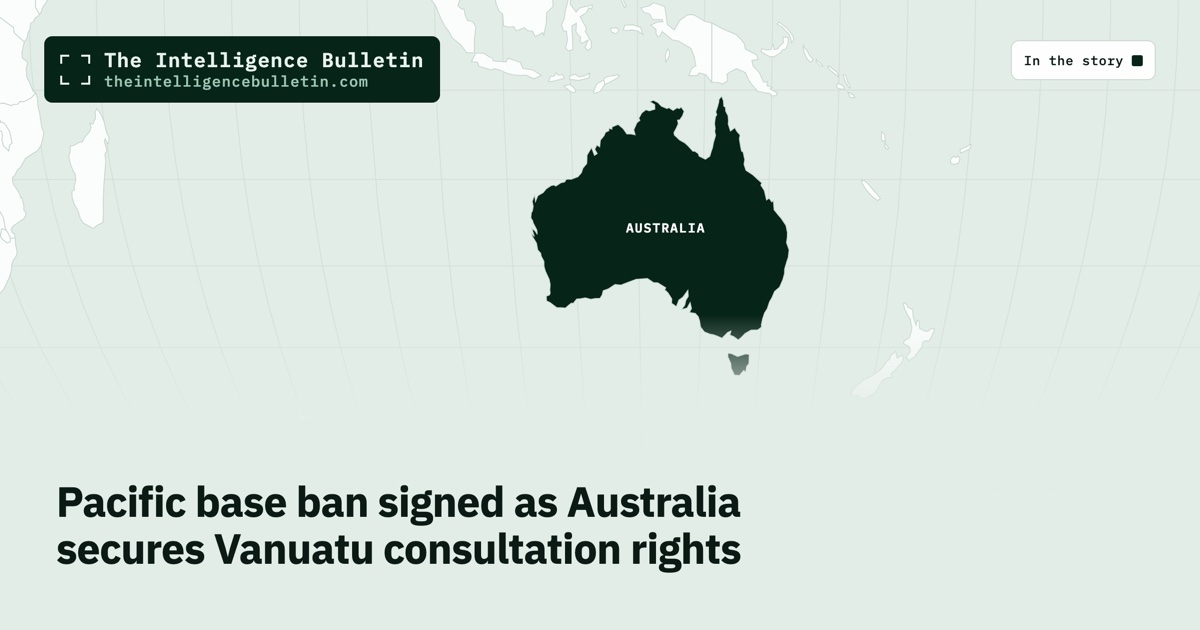
Pacific base ban signed as Australia secures Vanuatu consultation rights

Map of the countries in the story: Pacific base ban signed as Australia secures Vanuatu consultation rights
On June 29, 2026, Australian Prime Minister Anthony Albanese and Vanuatu Prime Minister Jotham Napat signed the Nakamal Agreement in Canberra. The pact commits Australia to hundreds of millions in economic support for Vanuatu while barring any foreign military base or militarized infrastructure on the island nation. Vanuatu must consult Australia on third-party critical infrastructure deals and prioritize Pacific Islands Forum partners for policing. The agreement follows months of negotiations after an earlier draft was rejected over sovereignty concerns.

One Story. Many Angles.

🇦🇺
Australia
Neos Kosmos
Australia signs landmark Vanuatu security deal to help parry China in Pacific
Read →
🇮🇩
Indonesia
The Jakarta Post
Australia, Vanuatu sign deal barring foreign military base on Pacific island – Asia & Pacific
Read →
🇦🇿
Azerbaijan
News.az
Australia, Vanuatu bar foreign military bases on Pacific island
Read →
🇺🇸
United States
Lancaster Online
A long-awaited Australia-Vanuatu pact blocks China from building a military base
Read →
🇶🇦
Qatar
Al Jazeera
Australia and Vanuatu sign deal to block foreign military bases
Read →

Perspective Analysis

The Nakamal Agreement signed in Canberra on June 29, 2026, locks Australia into Vanuatu’s security architecture while explicitly barring any foreign military base or militarized infrastructure on the island nation. The pact, reached after nearly ten months of renegotiation following an earlier rejection, gives Canberra formal consultation rights over third-party critical infrastructure projects and cements its role as Vanuatu’s primary policing partner. In a region where external powers compete for influence, the deal delivers concrete legal language that any future infrastructure must remain free from militarization or unauthorized foreign access.

The agreement commits Australia to hundreds of millions of dollars in economic support, spread over a longer period than originally envisioned, while Vanuatu agrees to prioritize Pacific Islands Forum members for policing requests and to turn first to Australia, New Zealand, or France in major humanitarian disasters. Prime Minister Anthony Albanese described the outcome as confirmation of Australia’s position as Vanuatu’s largest economic, security, and development partner. His counterpart, Jotham Napat, called the signing a significant step that strengthens ties within the Pacific family and reflects Vanuatu’s sovereign choice.

Australian-diaspora coverage in Neos Kosmos frames the Nakamal Agreement as a landmark security win for Canberra. The outlet stresses how the pact entrenches Australia as the primary aid and policing partner, requires consultation on proposed third-party engagement in critical infrastructure, and bars any militarization. It notes the original $500 million commitment will still flow but over an extended timeline, and highlights China’s parallel pursuit of its own Namele Agreement with Vanuatu. Albanese’s remarks on a resilient, sovereign region and shared responsibility for Pacific security receive prominent play, reflecting a domestic perspective that views the deal as a direct consolidation of Australian influence.

The Jakarta Post situates the same facts within broader Pacific Islands Forum dynamics and regional maritime interests. It records Australia’s $500 million (US$345 million) commitment alongside Vanuatu’s status as a nation whose largest external creditor remains China. The Indonesian outlet details Beijing’s repeated naval port calls and funding for the Luganville wharf expansion, while also carrying China’s rebuttal warning against “geopolitical games” and targeting third parties. It notes that the pact does not prevent Vanuatu from partnering with China on infrastructure, only that consultation with Australia is required, and quotes regional analysts on the enduring contest for influence given Vanuatu’s tradition of non-alignment.

News.az delivers a concise, neutral wire summary drawn from Straits Times reporting. The Azerbaijani outlet records the prohibition on foreign military bases, Australia’s greater economic support, and Albanese’s statement that the deal provides certainty there will be no such base. It mentions Vanuatu’s creditor relationship with China and the strategic rivalry context without foregrounding Beijing as the explicit target. The emphasis remains on the balanced economic and security elements and the protection of collective sovereignty.

Lancaster Online, carrying Associated Press copy, leads with the pact’s effect of blocking China from building a military base. The U.S. local coverage highlights the nine-month delay after Vanuatu rejected an earlier draft over fears it would limit infrastructure investment, the absence of a veto power in the final text, and the explicit bar on foreign military bases or infrastructure. It notes China’s expression of concern and the ongoing string of Australian agreements with Pacific neighbors aimed at curbing security influence. The piece also records Napat’s comments on transparency regarding Vanuatu’s separate negotiations with Beijing.

Al Jazeera stays closest to the official text, emphasizing sovereignty protection, increased economic aid, and policing priorities while noting only China’s stated concern. The Qatari outlet quotes Albanese on collective security and sovereignty and Napat on the parliamentary act against militarization of critical infrastructure. It details the consultation requirement without a veto, the disaster-response sequencing, and the elevation of cooperation in police training, maritime security, cybersecurity, and intelligence. China’s hope that cooperation not target third parties appears, alongside background on Vanuatu’s separate economic talks with Beijing and the broader pattern of Australian Pacific agreements.

Across these accounts, the convergence on the core provisions is striking. Every outlet confirms the explicit prohibition on foreign military bases, the infrastructure consultation mechanism, and the economic support package. Even the most detached reporting treats the base ban as settled fact rather than contested ambition. The differences lie in framing: Australian-diaspora and U.S. wire pieces foreground strategic containment, Southeast Asian and Caucasus outlets embed the story in creditor dynamics and non-alignment, while Al Jazeera stresses aid flows and Vanuatu’s stated goals.

The Takeaway

The agreement arrives amid a series of parallel Australian initiatives. Albanese is expected to travel soon to Fiji and the Solomon Islands to advance further treaties. Vanuatu’s separate Namele Agreement with China remains under negotiation and is slated for public release once cleared by Beijing. Implementation of the consultation clause on critical infrastructure will be the first practical test of whether the Nakamal framework delivers durable guardrails or merely formalizes ongoing competition. Observers will watch closely whether similar language appears in forthcoming deals and how Vanuatu balances its non-aligned posture with the new consultation obligations.


Share this story

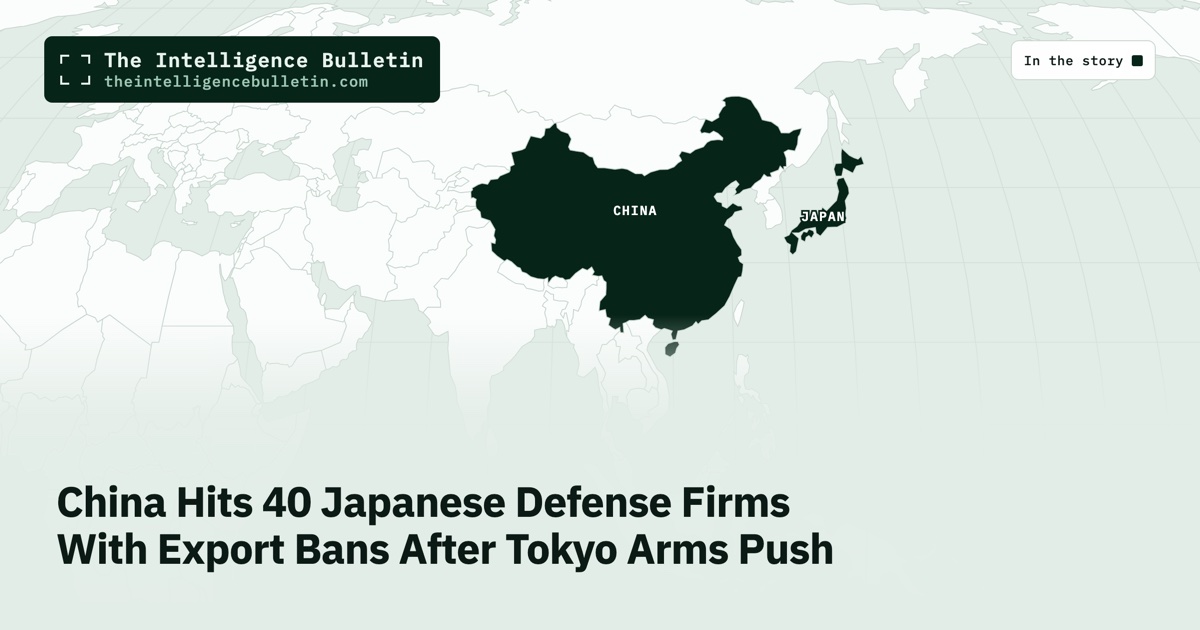
China Hits 40 Japanese Defense Firms With Export Bans After Tokyo Arms Push

Map of the countries in the story: China Hits 40 Japanese Defense Firms With Export Bans After Tokyo Arms Push
On June 29 2026 China’s Commerce Ministry added 20 Japanese defense institutes and firms including National Institute for Defense Studies and Mitsubishi units to an export control blacklist banning dual-use items and placed 20 others on a watch list requiring special licenses and risk assessments. The ministry cited the need to curb Japan’s remilitarization nuclear ambitions and military enhancement after February measures failed to deter Tokyo. The action targets entities involved in Japan’s defense sector while claiming it spares normal bilateral trade. Tensions stem from Japanese Prime Minister Sanae Takaichi’s Taiwan comments and Japan’s recent missile deployments.

One Story. Many Angles.

🇨🇳
China
China Daily
China tightens dual-use export controls on Japanese entities
Read →
🇸🇬
Singapore
Channel NewsAsia
China adds 20 Japanese entities to export blacklist: Commerce ministry
Read →
🇺🇸
United States
Newsday
China imposes export controls on 40 Japanese entities as tensions with Tokyo rise
Read →
🇵🇹
Portugal
RTP
PORTUGUESE
China restricts exports to 40 Japanese entities due to Tokyo’s “remilitarization”
“China restringe exportações para 40 entidades japonesas por “remilitarização” de Tóquio”
Read →

Perspective Analysis

China’s decision on June 29, 2026, to place 20 Japanese entities on an outright export control blacklist for dual-use items while adding another 20 to a watch list requiring special licenses and risk assessments represents a deliberate escalation calibrated to pressure Tokyo’s defense trajectory without triggering a full-scale rupture in bilateral commerce. The Commerce Ministry framed the move as a lawful national-security and non-proliferation step after February restrictions failed to slow Japan’s advances in offensive capabilities, missile deployments, and related research. This calibrated economic signal arrives amid heightened friction over Taiwan and Japan’s evolving security posture, yet all four major outlets reporting the announcement emphasize that the controls spare ordinary trade flows.

The background to the June action traces directly to late 2025 comments by Japanese Prime Minister Sanae Takaichi suggesting Tokyo might respond militarily to a Chinese attack on Taiwan. Those remarks, combined with Japan’s subsequent policy shifts allowing lethal weapons exports, longer-range missile placements on remote islands such as Minamitorishima, and plans to revise defense documents by December 2026, prompted Beijing’s initial February export restrictions on 20 firms and 20 watch-list entities. When those measures produced no visible change in Japanese policy, the ministry expanded the lists on June 29. The control list now includes the National Institute for Defense Studies, Ground Systems Research Center, Naval Systems Research Center, Air Systems Research Center, and multiple Mitsubishi-affiliated defense contractors. The watch list encompasses firms such as Mitsui E&S, OKI Circuit Technology, Mitsubishi Nuclear Fuel, Japan Nuclear Fuel, Fujitsu Network Solutions, Hitachi Advanced Systems, and others involved in components or engineering support for defense applications.

China Daily, the state-aligned outlet, presents the blacklist as a measured and fully justified response rooted in Japan’s accelerating remilitarization. Its reporting quotes ministry spokespeople at length, stressing that the February warnings went unheeded and that Japan has “shown no signs of repentance” while moving “further down the wrong path.” The article supplies the official assurances absent from other accounts: the measures target only a small number of entities and apply solely to dual-use items, leaving normal economic and trade exchanges untouched. Japanese entities acting in good faith “have absolutely no cause for concern,” the ministry is quoted as saying, while urging Tokyo to “change its erroneous ways” and return to the “right track.” This framing treats Japan’s nuclear ambitions and new militarism as established facts driving the policy.

Channel NewsAsia delivers a compact, ministry-focused account that notes the escalation in the long-running Beijing-Tokyo row without additional geopolitical color. It reports the addition of 20 entities to the blacklist, naming the National Institute for Defense Studies and Mitsubishi Electric Defense and Space Technologies Corporation, and cites the ministry’s stated purpose of safeguarding national security and fulfilling non-proliferation obligations. The outlet records the February round of restrictions and the recent deterioration tied to Takaichi’s Taiwan remarks, yet it stays close to the official text. Its neutral regional tone prioritizes the immediate announcement and the ministry’s claim that normal trade remains unaffected, avoiding interpretive framing of Japan’s military direction.

Newsday situates the controls inside rising bilateral friction over Taiwan and Japan’s expanding offensive capabilities. The Associated Press-sourced piece highlights the Type-12 missile launcher deployment on Minamitorishima as an apparent response to Chinese activity in the Pacific, alongside broader Japanese moves to reinforce remote islands and increase defense spending. It notes that 20 entities previously on the February watch list have now moved to the stricter control list, while 20 others, including Mitsui E&S, enter the watch list. The reporting emphasizes the geopolitical context—Takaichi’s implied willingness to intervene over Taiwan and ongoing Chinese military pressure on the island—more than the ministry’s internal rationale, embedding the story in Indo-Pacific security dynamics that include recent joint statements by the UK, Germany, and France opposing changes to the Taiwan status quo.

RTP foregrounds Tokyo’s alleged remilitarization and nuclear pursuits as the explicit trigger, supplying a European reading that echoes the Chinese rationale while presenting it at a remove. The Portuguese service details both lists with greater specificity than some peers, naming research centers, Mitsubishi-linked firms, and watch-list entities such as Mitsubishi Nuclear Fuel and Hosoya Pyro-Engineering. It reports the ministry’s assertion that Japan has accelerated “new militarism,” deployed offensive weapons, and shown no repentance after February measures. The article notes the legal basis under China’s Export Control Law and dual-use regulations, while reiterating that the restrictions affect only a reduced number of entities and will not disturb normal economic exchanges. This treatment treats the stated Chinese concerns as the central narrative thread from an external vantage point.

Across the four outlets, the shared factual core remains consistent: the 20-plus-20 split, the dual-use rationale, the link to February restrictions, and the explicit sparing of civilian trade. Where they diverge is in emphasis. The Chinese and Portuguese accounts treat Japan’s military trajectory as established fact warranting the response. The Singaporean and American pieces embed the move within ongoing regional security friction, including Taiwan disputes and recent Japanese deployments, without fully endorsing the remilitarization framing. This pattern reveals how the same ministry announcement can be rendered as sovereign self-defense, neutral escalation reporting, geopolitical context-setting, or external validation depending on the outlet’s alignment and audience.

The Takeaway

Looking ahead, observers will watch for any Japanese government response, potential adjustments to defense procurement or export policies, and whether the targeted nature of the controls produces measurable effects on specific technology flows without broader trade disruption. Further Chinese measures or coordinated regional diplomacy could follow if Tokyo’s missile and alliance activities continue, while both sides have signaled interest in preserving baseline economic ties. The June 29 action therefore functions as a precise signal of resolve whose longer-term impact will depend on whether it prompts recalibration in Tokyo or merely hardens existing positions.


Share this story

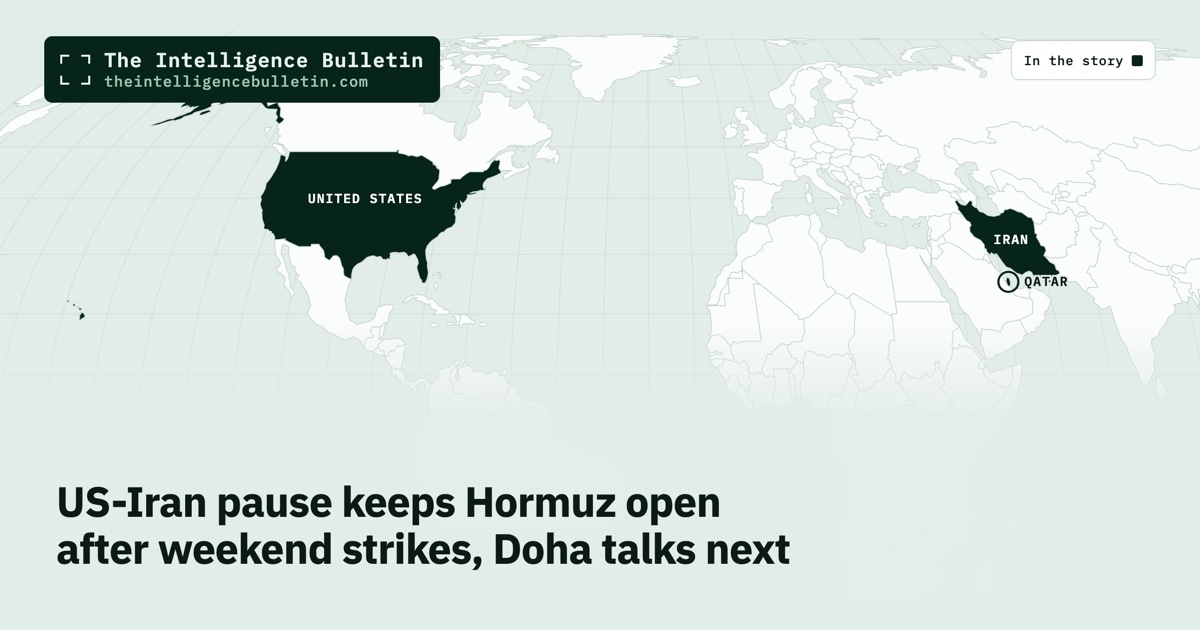
US-Iran pause keeps Hormuz open after weekend strikes, Doha talks next

Map of the countries in the story: US-Iran pause keeps Hormuz open after weekend strikes, Doha talks next
On June 28-29 2026, a U.S. official announced that the United States and Iran had agreed to halt mutual attacks for now and allow commercial vessels free passage through the Strait of Hormuz. Technical talks on a June 17 memorandum of understanding will continue. Reports from Axios indicated the next round of discussions is expected Tuesday in Doha. The pause follows weekend exchanges of strikes tied to shipping disputes in the critical waterway.

One Story. Many Angles.

🇺🇸
United States
The Epoch Times
US, Iran to Halt Attacks, Continue Talks: US Official
Read →
🇫🇷
France
BFMTV
FRENCH
The United States announces a mutual suspension of hostilities with Iran “for the moment”
“Les États-Unis annoncent une suspension mutuelle des hostilités avec l’Iran “pour le moment””
Read →
🇮🇳
India
ANI News
Washington and Tehran to “stand down” from strikes as talks set to continue, says US official
Read →
🇵🇰
Pakistan
Daily Pakistan
US, Iran agree to stop strikes against each other as Doha talks expected this week
Read →
🇮🇩
Indonesia
Antara News
INDONESIAN
US and Iran stop attacks temporarily, discuss Hormuz Strait in Doha
“AS dan Iran setop serangan sementara, bahas Selat Hormuz di Doha”
Read →

Perspective Analysis

The weekend’s exchange of strikes between the United States and Iran gave way within hours to a narrow, technical stand-down that every major outlet covering the story treated as credible enough to report without immediate qualification. A U.S. official announced late on June 28 that both sides would halt attacks for now, allow commercial vessels to move freely through the Strait of Hormuz, and keep technical talks alive on the June 17 memorandum of understanding. The pause was framed not as a political breakthrough but as a pragmatic measure to restore the flow of oil and gas through the critical waterway that carries roughly one-fifth of global hydrocarbons.

Background to the understanding stretches back to the June 17 memorandum itself, which had sought to reopen the strait after earlier disruptions tied to the broader U.S.-Iran conflict that began earlier in the year. Fresh tensions erupted over the weekend when the U.S. military accused Iran of striking commercial ships, prompting American strikes on Iranian drone and missile storage facilities, surveillance infrastructure, communications systems, air-defense sites, and minelayer capabilities near the strait. Iran responded by targeting positions in Bahrain and Kuwait. Within hours of those exchanges, the U.S. official statement signaled de-escalation, emphasizing that technical discussions on every element of the memorandum would continue.

U.S.-based reporting, exemplified by The Epoch Times, stayed tightly aligned with the American official’s wording. The outlet detailed the continuation of technical talks across the full scope of the memorandum and stressed the explicit assurance that vessels could transit freely. It placed the pause in direct sequence with the June 27–28 strikes, noting U.S. Central Command’s targeting of specific Iranian military assets after alleged attacks on the M/V Ever Lovely and M/T Kiku. The piece avoided speculation about venue or timing for follow-on talks, keeping the focus on Washington’s sourcing and the immediate restoration of shipping access.

French coverage on BFMTV introduced a distinctly conditional tone, highlighting the phrase “for the moment” in the U.S. announcement and underscoring that the halt remained provisional. The report incorporated Iranian Foreign Minister Abbas Araghchi’s insistence that only Tehran bears responsibility for managing the strait and that any external interference would delay reopening and heighten tensions. It also situated the Hormuz developments within the wider regional picture, noting continued Israeli strikes in Lebanon despite a separate framework agreement signed in Washington. This layering of context distinguished the French account from more narrowly diplomatic treatments elsewhere.

Indian reporting through ANI News presented the stand-down in concise, neutral terms drawn from U.S. official statements carried by CBS and ABC. The emphasis fell on the continuation of technical talks and the global economic stakes created by four months of conflict, including pressure on energy prices and diplomatic relations. The outlet mentioned possible Qatar talks only in passing via Axios reporting and avoided inserting regional or energy-route specifics, consistent with a wire-style approach that privileges sourced diplomacy updates over local angles.

Pakistani coverage in Daily Pakistan foregrounded the expected Tuesday meeting in Doha and its relevance for regional stability near a Muslim-majority neighbor. The report noted that U.S. officials described the talks as covering all areas of the memorandum while both sides work to reduce tensions and ensure free commercial movement. It placed the pause against the backdrop of President Trump’s social-media warnings and Iran’s foreign-minister statements on shipping delays, giving South Asian readers an immediate diplomatic calendar rather than abstract strategic analysis.

Indonesian agency reporting via Antara News, drawing on Xinhua, centered the maritime dimension and the abrupt relocation of talks. The account explained that discussions originally slated for Switzerland on Iran’s nuclear program had shifted to Doha once Hormuz tensions flared, with the new focus squarely on shipping security. It referenced the earlier establishment of a military hotline between U.S. forces and Iran’s Islamic Revolutionary Guard Corps that had yet to become operational, and it framed the pause as a direct response to renewed attacks on commercial vessels. This energy-security lens reflected Southeast Asian dependence on stable passage through the strait.

Across these five outlets the shared factual core remains identical: a limited, technical pause engineered to keep the strait open rather than a comprehensive political settlement. Differences appear mainly in emphasis—the U.S. piece on official sourcing and memorandum mechanics, the French piece on provisional language and Iranian sovereignty claims, the Indian piece on global economic consequences, the Pakistani piece on the Doha venue and timing, and the Indonesian piece on the shift from Swiss nuclear talks to Qatari maritime discussions. No outlet presented the understanding as permanent or expansive.

The Takeaway

What happens next hinges on the Tuesday Doha session. Observers will watch whether the military hotline becomes functional, whether the promised free transit materializes without further incidents, and whether the 60-day provisions in the June 17 memorandum can be extended or expanded. Any renewed strikes or delays in implementation would quickly test the durability of the current stand-down.


Share this story

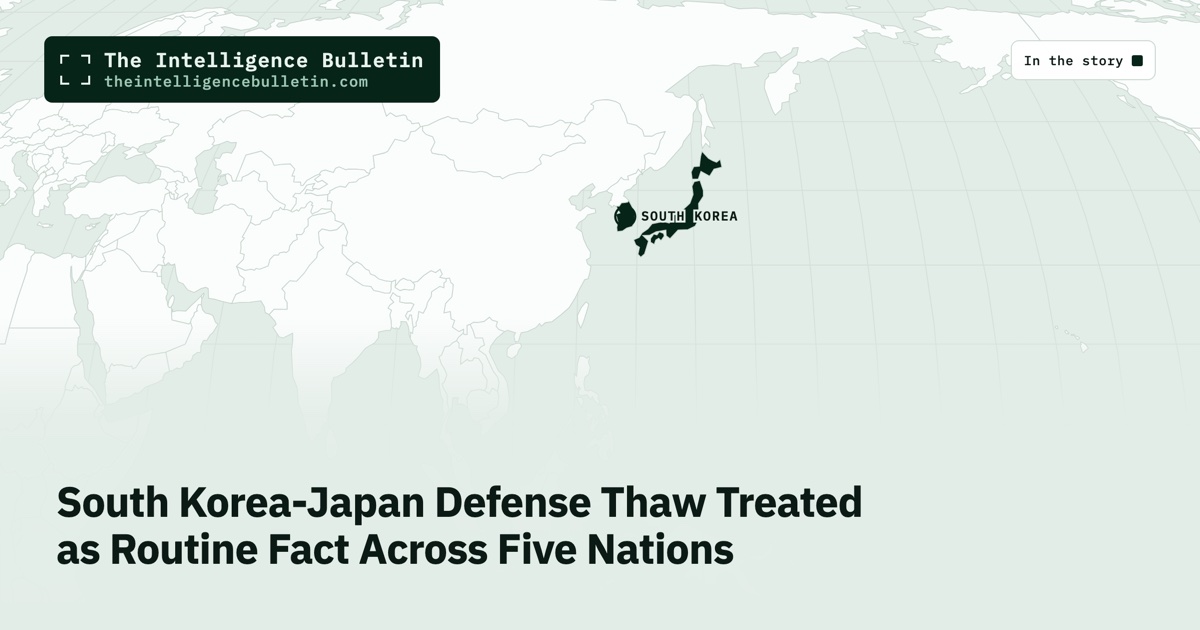
South Korea-Japan Defense Thaw Treated as Routine Fact Across Five Nations

Map of the countries in the story: South Korea-Japan Defense Thaw Treated as Routine Fact Across Five Nations
On June 28, 2026, in Seoul, South Korean Defense Minister Ahn Gyu-back and Japanese counterpart Shinjiro Koizumi agreed to revive joint search-and-rescue exercises and reaffirmed commitment to denuclearising the Korean peninsula. They pledged bilateral and trilateral work with Washington on regional stability amid North Korea’s nuclear threat and Russia ties. The meeting marks the sixth round of talks building on post-2022 rapprochement despite historical disputes.

One Story. Many Angles.

🇮🇩
Indonesia
The Jakarta Post
South Korea, Japan reaffirm denuclearization goal, closer defense ties
Read →
🇹🇷
Turkey
Anadolu Agency
South Korea, Japan agree to deepen defense exchanges, cooperation
Read →
🇮🇳
India
The Economic Times
S. Korea, Japan reaffirm pledge to denuclearise Korean peninsula
Read →
🇵🇰
Pakistan
The News International
South Korea, Japan deepen defense ties in major security push
Read →
🇮🇹
Italy
Internazionale
ITALIAN
South Korea, Japan reaffirm denuclearisation goal, closer defence ties
Read →

Perspective Analysis

The convergence of coverage from five distant capitals on June 28, 2026, reveals how far the South Korea-Japan security thaw has traveled from headline controversy to accepted diplomatic routine. Outlets in Jakarta, Ankara, New Delhi, Islamabad and Rome each published accounts of the defense ministers’ meeting in Seoul that morning, and each carried essentially the same Reuters-sourced narrative of revived search-and-rescue drills, a renewed pledge on Korean peninsula denuclearization, and continued trilateral coordination with Washington. The uniformity itself is the signal: even publications with distinct regional priorities treated the sixth round of bilateral defense talks as straightforward fact rather than contested diplomacy.

The ministers involved were South Korea’s Ahn Gyu-back and Japan’s Shinjiro Koizumi. They met at the Defense Ministry in Seoul, inspected honor guards, and issued a joint statement through South Korea’s defense ministry that both sides “shared the view to continue cooperation for maintaining regional peace and stability amid a grave security environment.” The two governments agreed to revive joint search-and-rescue exercises last conducted nearly a decade earlier and to expand exchanges between their air-force aerobatic teams—the Black Eagles and the Blue Impulse—to prepare for maritime accident scenarios. They also reaffirmed their commitment to the denuclearization of the Korean peninsula and pledged to advance regional stability both bilaterally and through their respective partnerships with the United States.

Background supplied in every report traces the arc from friction to cooperation. After a 2019 rupture over intelligence-sharing arrangements and export controls tied to historical grievances from Japan’s colonial period, the two sides began rebuilding ties in earnest from 2022 onward with explicit U.S. encouragement. The policy has been sustained under South Korean President Lee Jae Myung and Japanese Prime Minister Sanae Takaichi. Earlier milestones cited include a 2025 agreement between Lee and then-Prime Minister Shigeru Ishiba on security and economic cooperation, a January 2026 commitment to shuttle diplomacy, and a May 2026 expansion of energy collaboration. At the May Shangri-La Dialogue in Singapore the ministers had already discussed a possible military-logistics support pact covering fuel, food and ammunition and had scheduled the June humanitarian exercise that now marks the first such drill in almost ten years. Persistent frictions remain, including disputes over wartime labor and the islands known as Dokdo in South Korea and Takeshima in Japan, yet these were noted as background rather than obstacles to the day’s announcements.

The Jakarta Post placed the Reuters text under a headline that paired denuclearization with “closer defense ties” and accompanied it with a photograph of the ministers reviewing honor guards. Its framing implicitly situated the development within ASEAN’s interest in regional stability and continued U.S. partnerships in the Indo-Pacific, yet the body text remained faithful to the wire account without additional local commentary. Anadolu Agency ran a shorter headline focused on “deepen defense exchanges, cooperation,” foregrounding the practical military-to-military measures over the nuclear pledge; its version stayed narrowly on the defense-cooperation elements. The Economic Times opened with the denuclearisation pledge in both headline and synopsis, reflecting its defense-economy readership, but again reproduced the core Reuters narrative almost verbatim, including the 2019 GSOMIA episode and the 2025-2026 sequence of high-level agreements. The News International headlined a “major security push,” emphasizing the post-2022 trajectory and quoting the South Korean ministry statement on the “grave security environment,” while introducing minor phrasing variations that did not alter the underlying facts. Internazionale, the Italian outlet, presented the story as a straight Reuters dispatch under British spelling conventions, adding only the standard reporter credits and no interpretive overlay.

Across these five versions the same factual spine appears: the sixth ministerial round, the revival of decade-old drills, the denuclearization restatement, the trilateral U.S. dimension, the references to North Korea’s nuclear threat and its military links with Russia, and the acknowledgment of lingering historical disputes. Minor differences in headline emphasis or spelling reflect editorial house style or audience focus rather than divergent sourcing or interpretation. No outlet introduced contradictory details or local political spin that challenged the central account.

That convergence across such geographically and editorially diverse platforms underscores how normalized the once-unthinkable level of South Korea-Japan defense coordination has become under sustained American diplomatic pressure. The practical steps announced—resumption of search-and-rescue training, aerobatic-team exchanges, and continued logistics talks—now register as incremental professionalization rather than breakthroughs. Historical grievances are still recorded but no longer presented as veto points.

The Takeaway

Observers will next watch whether the promised June humanitarian exercise proceeds on schedule and whether the two sides move from discussion to signature on a military-logistics support agreement. Further trilateral drills with the United States, already referenced in the 2025 commitments, will test how far operational integration extends. Any visible progress on those fronts will likely receive similarly uniform, low-key treatment in the same set of outlets, confirming that the thaw has settled into the diplomatic background.


Share this story

IRGC Says No US Hormuz Hotline Exists While Demanding Ships Use Its Routes

Map of the countries in the story: IRGC Says No US Hormuz Hotline Exists While Demanding Ships Use Its Routes
On June 27 2026 IRGC spokesman Hossein Mohebi denied US claims of a direct military hotline in the Strait of Hormuz, calling the reports false and stating any channel would be political. Iran insisted transit rules remain unchanged and that vessels must use routes approved by Tehran. The denial followed recent clashes and an interim US-Iran MoU on safe passage through the waterway that carries 20 percent of global oil.

One Story. Many Angles.

🇮🇷
Iran
Press TV
Iran-US communication line in Hormuz political, not military; transit rules unchanged: Source
Read →
🇶🇦
Qatar
Al Jazeera
‘Pick up the phone’: IRGC appears to rebuff US Strait of Hormuz ‘hotline’
Read →
🇷🇺
Russia
Vzglyad
RUSSIAN
Iran refutes rumors of direct communication line with US through Strait of Hormuz
Read →
🇴🇲
Oman
Times of Oman
IRGC Navy rejects new Strait of Hormuz route, warns of enforcement measures
Read →
🇬🇧
United Kingdom
Middle East Eye
IRGC warns ships to use Iran-approved routes through Strait of Hormuz
Read →

Perspective Analysis

On June 27 2026 the Islamic Revolutionary Guard Corps publicly rejected any notion of a direct military hotline with the United States in the Strait of Hormuz, even as Iranian state media quietly acknowledged the existence of a narrower political channel. The episode underscores Tehran’s determination to treat the waterway’s daily management as a sovereign prerogative rather than a shared deconfliction exercise.

The Strait of Hormuz remains the chokepoint through which roughly one-fifth of global oil supplies must pass. An interim US-Iran memorandum of understanding signed around June 17-18 had sought to restore commercial traffic after months of disruption and recent low-level clashes in which vessels sailing outside Iranian-designated corridors were targeted. US officials had spoken of establishing communication lines to prevent escalation, yet the IRGC spokesman Hossein Mohebi moved swiftly to close that interpretation.

Press TV, Iran’s state broadcaster, offered the most nuanced domestic framing. It reported that a security source confirmed a communication line had been set up, but stressed repeatedly that the channel was “purely political in nature and does not involve a direct military hotline from the Islamic Republic’s armed forces.” The outlet quoted the source as saying any transit “must be conducted via routes officially declared by Iran” and that the arrangement did not imply coordination on vessel passage. This account balanced the IRGC denial with reference to Article 5 of the Islamabad memorandum, which envisions talks between Iran and Oman on future administration of the strait in line with coastal states’ sovereign rights. The piece also noted fresh exchanges of fire on June 26-27 after commercial ships strayed from Tehran-approved paths.

Al Jazeera placed heavier emphasis on the dismissive tone coming from Tehran. Its reporting highlighted Mohebi’s statement on X that American claims of a direct line were “completely false” and that “the Strait of Hormuz is Iranian territory and has no connection to the United States.” The coverage situated the denial amid renewed US-Iran strikes and US Vice President JD Vance’s public suggestion that an IRGC-CENTCOM link might already exist. Al Jazeera framed the episode as another Iranian rebuff of perceived American encroachment rather than a detailed examination of shipping corridors.

The Russian outlet Vzglyad delivered a concise diplomatic-rebuff narrative drawn largely from TASS and Al Jazeera wires. It presented the IRGC position that the strait “belongs to Iran” and that no direct communication line with Washington had been or would be created. The short piece avoided extended discussion of enforcement measures or Oman’s role, instead underscoring limits on US influence in a waterway Moscow views through the lens of multipolar competition.

Times of Oman, reflecting the immediate concerns of a neighboring littoral state, led with the IRGC Navy’s operational warning. The paper reported that the force had rejected a new transit corridor announced by Oman in coordination with the International Maritime Organization, declaring such a route “unacceptable and poses serious safety risks.” The IRGC statement, as carried by Iranian media and relayed in Oman, insisted that only routes designated by Iran are authorised, that vessels must maintain contact with Iranian authorities on Channel 16, and that violators would face enforcement measures. The coverage noted Oman’s stated intent to facilitate freedom of navigation without fees, highlighting the practical friction for a country whose own maritime interests depend on orderly flow through the strait.

Middle East Eye similarly foregrounded the maritime-security dimension. Its live-blog update described the IRGC warning to commercial shipping that vessels must stick to Iran-approved routes or risk being turned back or targeted, reopening tensions after the recent MoU. The outlet placed the development in the context of Oman’s June 25 announcement of a temporary corridor and the broader fragility of the agreement that had only recently halted four months of hostilities.

Across the five outlets a shared silence is striking. None of the reports probes whether the interim memorandum can withstand repeated low-level clashes or whether Oman’s proposed IMO corridor will command respect once Iran insists on its own designated lanes near its coastline. Instead, the coverage collectively registers Iran’s success in shifting the conversation from hypothetical hotlines to concrete assertions of operational control.

The divergence in emphasis reveals distinct institutional priorities. Iranian state media preserves space for a political back-channel while locking down military and navigational sovereignty. Regional and international outlets either amplify the rebuff narrative or translate the IRGC’s enforcement language into immediate concerns for shipping and neighboring states. Russian reporting reinforces the diplomatic message that the strait remains outside US purview.

The Takeaway

What bears watching in the coming days is whether commercial operators heed the IRGC’s routing instructions, whether Oman and the IMO adjust their corridor proposal to accommodate Iranian demands, and whether any incidents outside the approved lanes trigger further exchanges that test the memorandum’s durability. The absence of a military hotline does not eliminate the need for deconfliction; it merely channels that necessity through political and operational assertions whose practical limits have yet to be fully clarified.


Share this story