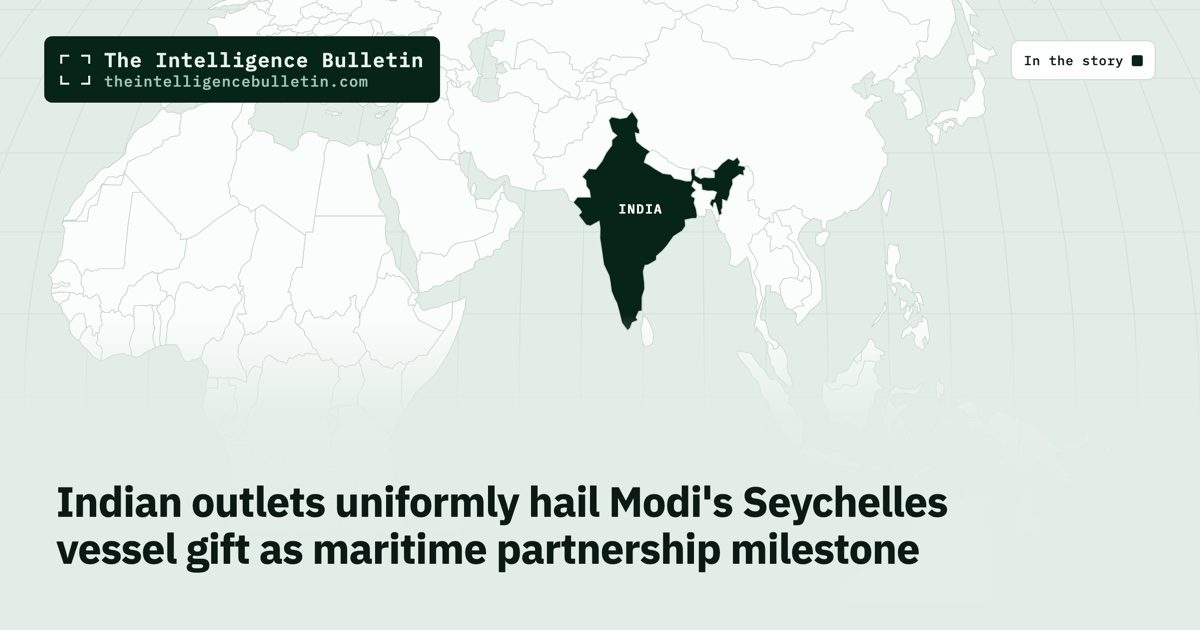
Indian outlets uniformly hail Modi’s Seychelles vessel gift as maritime partnership milestone

Map of the countries in the story: Indian outlets uniformly hail Modi's Seychelles vessel gift as maritime partnership milestone
Story gist: On June 27, 2026, Prime Minister Narendra Modi handed a Made-in-India Fast Patrol Vessel, six ambulances, ten utility vehicles and five laser radial boats to Seychelles President Patrick Herminie at the Coast Guard base in Victoria. The transfer aims to boost Seychelles’ maritime surveillance and EEZ patrol capabilities during Modi’s state visit for the island’s National Day golden jubilee. All five Indian outlets frame the event as deepening bilateral defence ties under India’s Vision MAHASAGAR.

One Story. Many Angles.

🇮🇳
India
The Hindu
PM Modi hands over Made in India patrol vessel to Seychelles Coast Guard
Read →
🇮🇳
India
Deshbandhu
HINDI
PM Modi reaches Seychelles, President Herminie warmly welcomes at airport
Read →
🇮🇳
India
New Kerala
PM Modi Gifts Indian Patrol Vessel to Seychelles
Read →
🇮🇳
India
IANS
PM Modi highlights stronger maritime ties as India hands over patrol vessel to Seychelles
Read →
🇮🇳
India
ProKerala
India has been a steadfast friend to Seychelles: President Herminie
Read →

Perspective Analysis

On June 27, 2026, Prime Minister Narendra Modi stood at the Seychelles Coast Guard base in Victoria and transferred a Made-in-India Fast Patrol Vessel named PS LESPWAR—Creole for “Hope”—to President Patrick Herminie, accompanied by six ambulances, ten utility vehicles, and five laser radial boats. Indian media outlets across the spectrum presented the moment as a straightforward extension of longstanding bilateral ties rather than a pointed strategic signal, framing the package as tangible support for the island nation’s maritime surveillance and Exclusive Economic Zone patrols during Modi’s state visit timed to Seychelles’ National Day golden jubilee.

The convergence is notable because the five outlets—ranging from English-language broadsheets and wire services to Hindi dailies and regional aggregators—chose nearly identical emphases without deviation or external context. They highlighted the vessel’s Indian manufacture by Goa Shipyard Limited, its role in capability building under Vision MAHASAGAR, and the reciprocal warmth between the two leaders, all while noting that diplomatic relations date to Seychelles’ independence in 1976 and that 2026 marks both the fiftieth anniversary of those ties and the archipelago’s republican golden jubilee. Modi’s visit is his second official trip, following Herminie’s state visit to India earlier in the year.

The Hindu placed the handover at the center of its account, describing the ceremony as a direct reaffirmation of New Delhi’s commitment to Seychelles’ maritime security. The paper quoted Ministry of External Affairs statements that the vessel would strengthen EEZ patrol capabilities and listed the additional vehicles and boats as contributions to both development and security. It stressed the continuity of Indian support through prior patrol vessels, aircraft, and training, positioning the event within the broader Vision MAHASAGAR framework aimed at security and stability across the Indian Ocean region. The reporting stayed tightly focused on the security dimension, giving less space to the cultural or arrival aspects that other outlets featured.

Deshbandhu, by contrast, led with Modi’s arrival and the airport welcome extended by Herminie. The Hindi daily described the president’s warm reception and Modi’s subsequent meeting with members of the Indian diaspora who gathered excitedly at the airport. It carried Modi’s social-media remarks thanking Herminie and calling Seychelles a “precious maritime partner and close friend” in the Indian Ocean, while noting posters and Indian flags displayed in Beau Vallon and Victoria ahead of the visit. The piece also referenced Herminie’s February 2026 trip to India and the upcoming program that includes bilateral talks, an address to the Seychelles National Assembly, and further community interactions, underscoring the personal and cultural diplomacy angle for its domestic readership.

New Kerala broadened the frame to encompass the entire aid package and the ceremony’s cultural elements. Its account detailed the full transfer of the patrol vessel plus the ambulances, utility vehicles, and laser radial boats, then described the national anthems, guard of honour, and the mixed performances that followed: a traditional Seychellois moutya dance alongside Nrutya, a Gujarati folk dance performed by an 18-member troupe from the local Indian diaspora with roots in Kutch. The outlet noted the vessel’s construction by Goa Shipyard Limited and quoted the Ministry of External Affairs post that the gifts would contribute to Seychelles’ development and security under Vision MAHASAGAR. This wider lens on tangible development contributions alongside security assets distinguishes its coverage from the narrower maritime focus elsewhere.

IANS adopted a wire-service precision centered on official statements and bilateral milestones. It carried Modi’s own words from the X platform: the transfer marked “another important milestone in the growing India-Seychelles partnership in defence and maritime security” and reflected “India’s steadfast commitment to supporting the security priorities of Seychelles.” The agency also quoted the prime minister’s additional remarks that India stands “shoulder-to-shoulder with Seychelles as a trusted partner” and remains “proud” of the deepening friendship. It placed the event in the sequence of capability-building initiatives and noted the reciprocal state visits, maintaining a concise, statement-driven tone typical of agency reporting.

ProKerala elevated the recipient’s voice by leading with Herminie’s banquet remarks that “India has been a steadfast friend to Seychelles, a sentiment warmly reciprocated by our people and our vibrant Indian diaspora.” The aggregator carried details of the dinner attended by External Affairs Minister S. Jaishankar, Seychelles’ Speaker Azarel Ernesta, Foreign Minister Barry Faure, and cabinet members, where both leaders reaffirmed their commitment to the partnership. It also recorded the Office of the President’s pre-visit statement that India remains one of Seychelles’ closest development partners across infrastructure, healthcare, education, and maritime security, and that the 2026 anniversaries lend the visit “exceptional symbolic weight.”

Across these accounts, the same core narrative recurs without contradiction or added geopolitical shading: the gifts represent mutual benefit, the relationship rests on shared democratic values and people-to-people ties that include a significant Indian diaspora, and the transfers form part of a consistent pattern of Indian assistance dating back decades. No outlet raised questions about regional competition or alternative influences; instead, each treated the event as a routine yet meaningful step in an established friendship. The uniformity suggests that Indian domestic reporting views such material transfers as natural extensions of diplomatic routine rather than isolated strategic moves.

The Takeaway

The remainder of Modi’s three-day visit, which includes further bilateral discussions, an address to the National Assembly, and participation in the jubilee celebrations, will likely generate additional coverage along the same lines. Observers will watch whether subsequent reporting continues to emphasize the same themes of capability building and cultural affinity or begins to incorporate any new elements from the ongoing program.
Share this story

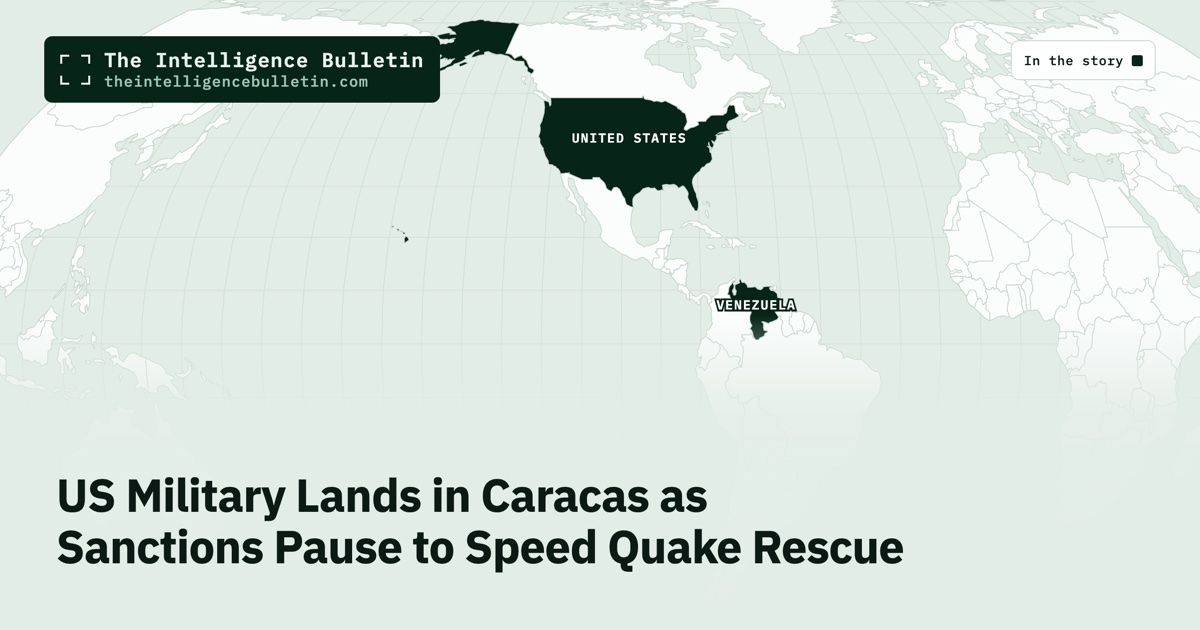
US Military Lands in Caracas as Sanctions Pause to Speed Quake Rescue

Map of the countries in the story: US Military Lands in Caracas as Sanctions Pause to Speed Quake Rescue
Story gist: On June 26, 2026, the US Treasury’s OFAC issued a temporary license authorizing transactions for international relief funds to Venezuela until October 23 in response to deadly earthquakes. The US Southern Command deployed aircraft, helicopters, ships, and a Marine Corps general to Caracas to coordinate aid alongside the sanctions relief. Venezuelan authorities reported at least 920 deaths and requested the support. Coverage across outlets centers on the US role in facilitating rescue operations amid the disaster.

One Story. Many Angles.

🇪🇸
Spain
Mundiario
SPANISH
US eases sanctions and deploys troops to lead aid in Venezuela
“EE UU flexibiliza sanciones y despliega militares para la ayuda en Venezuela”
Read →
🇻🇪
Venezuela
Entorno Inteligente
SPANISH
OFAC authorizes Venezuela to receive international relief funds until October 23
“OFAC autoriza a Venezuela a recibir fondos internacionales para labores de socorro hasta el 23 de octubre”
Read →
🇶🇦
Qatar
CNN Arabic
ARABIC
America announces temporary easing of some sanctions on Venezuela after the two earthquakes
“أمريكا تعلن تخفيف بعض العقوبات مؤقتا على فنزويلا بعد الزلزالين”
Read →
🇲🇽
Mexico
El Sol de México
SPANISH
US suspends sanctions against Venezuela to facilitate rescue operations
“EU suspende sanciones contra Venezuela para facilitar operaciones de rescate”
Read →
🇬🇷
Greece
INEWSgr
GREEK
Venezuela: High-ranking US official in Caracas to coordinate aid to earthquake victims
“Βενεζουέλα : Υψηλόβαθμος αξιωματούχος των ΗΠΑ στο Καράκας για συντονισμό βοήθειας στους σεισμόπληκτους”
Read →

Perspective Analysis

The rapid convergence of a high-profile US military deployment to Caracas and a narrowly tailored sanctions waiver reveals how a natural disaster has accelerated a pragmatic US policy shift toward Venezuela’s interim government, turning humanitarian necessity into the latest catalyst for engagement after years of confrontation.

On June 26, 2026, the US Treasury’s Office of Foreign Assets Control issued General License No. 60, authorizing transactions otherwise prohibited under Venezuela sanctions regulations through midnight on October 23. The measure explicitly permits the processing or transfer of funds in support of earthquake relief activities requested by the interim government, without unblocking any previously frozen assets or lifting broader sanctions. Venezuelan authorities had reported at least 920 deaths and more than 3,360 injuries from the dual earthquakes that struck on June 24, prompting an official request for international assistance.

Spanish outlet Mundiario placed the scale of American hardware and presence at the center of its coverage. It detailed the arrival of C-17 aircraft carrying urban search-and-rescue teams from Los Angeles and Fairfax, MV-22 Osprey tilt-rotors for infrastructure assessment, CH-47 Chinook helicopters from Joint Task Force Bravo in Honduras, and naval assets including the amphibious ship USS Fort Lauderdale and the USS Billings positioned off the Venezuelan coast. The report highlighted satellite imagery from US Space Force supporting damage assessment and noted that US Embassy chargé John Barret described the operation as working “against the clock to save lives.” Mundiario framed Washington as the dominant international actor delivering the bulk of the response, including an initial $150 million in aid, while contrasting the speed of the US effort with early coordination problems inside Venezuela.

Venezuelan business-focused site Entorno Inteligente, drawing from Banca y Negocios, zeroed in on the precise regulatory mechanics of the OFAC license. It quoted the text authorizing all transactions “that would otherwise be prohibited by the Venezuela Sanctions Regulations, 31 CFR part 591,” stressed the temporary window ending October 23, and clarified that US financial institutions could rely on the sender’s representations provided they had no reason to believe the funds violated the license terms. The coverage avoided broader geopolitical framing, instead emphasizing how the waiver removes administrative barriers to incoming relief funds for the interim government led by Delcy Rodríguez.

CNN Arabic portrayed the sanctions relief as a notable, time-limited exception in US policy, triggered directly by the earthquakes. It reported local frustration with the Venezuelan government’s initial response and quoted economist Jorge Graisati on public disillusionment: people feel “there is no state performing its role.” The outlet noted the measure runs only from June 26 to October 23 and allows fund processing on behalf of third-country persons when tied to authorized relief, underscoring the geopolitical precedent of even a partial, disaster-driven reversal.

Mexico’s El Sol de México stressed the operational rationale, linking the sanctions suspension explicitly to facilitating rescue operations. It referenced Mexico’s own dispatch of rescue teams and equipment to the neighboring country while noting the broader international mobilization. The piece situated the US move within ongoing regional solidarity efforts, highlighting how the waiver enables practical aid delivery without dwelling on military assets or domestic Venezuelan criticism.

Greek outlet INEWSgr centered on the on-the-ground military coordination, reporting the arrival in Caracas of US Marine Corps Maj. Gen. Kevin J. Jarrard, who is overseeing Department of War support as head of the Southcom management team. Southcom’s statement, quoted in the coverage, confirmed that the interim government had formally requested US assistance and that American forces would employ aircraft and helicopters in the rescue effort. The report included Southcom’s announcement that Jarrard arrived “today” to plan, coordinate, and direct logistical and operational capabilities alongside Venezuelan partners.

Across all five outlets, the sanctions waiver and troop deployment are presented as linked elements of a single US response activated once Venezuela’s interim authorities sought help. No source treats the two actions as separate or contradictory; instead, each foregrounds the slice most aligned with its audience—logistical presence in the Spanish and Greek reports, banking mechanics in the Venezuelan business coverage, geopolitical precedent in the Arabic outlet, and operational facilitation for a regional neighbor in the Mexican daily.

This convergence points to an acceleration of the gradual thaw that began after the January capture of Nicolás Maduro. The Trump administration had already reopened Venezuelan airspace, lifted certain personal sanctions, and eased restrictions on the petroleum, mining, and financial sectors. The earthquakes appear to have compressed that timeline, allowing both financial channels and direct military coordination to open rapidly under the interim leadership of Delcy Rodríguez.

The Takeaway

Looking ahead, observers will watch whether the October 23 expiration of the license prompts extensions or further adjustments, how effectively the coordinated US-Venezuelan rescue operations scale in hard-hit areas such as La Guaira, and whether the precedent of disaster-driven sanctions relief influences any broader policy recalibration once the immediate emergency subsides.


Share this story

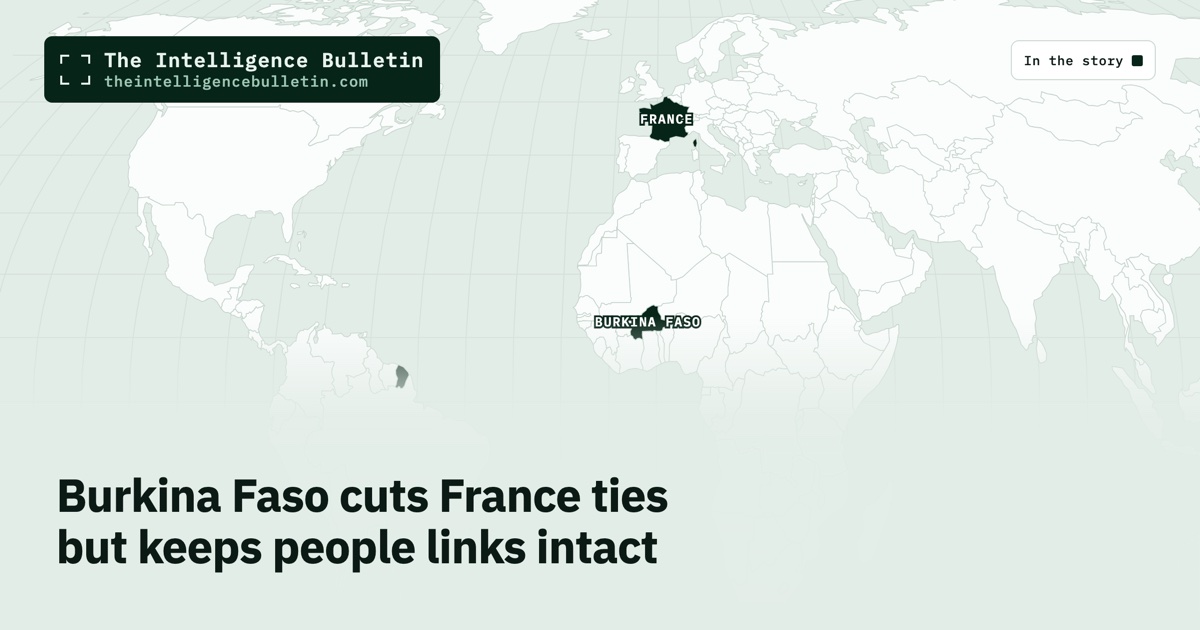
Burkina Faso cuts France ties but keeps people links intact

Map of the countries in the story: Burkina Faso cuts France ties but keeps people links intact
Story gist: On 26 June 2026, Burkina Faso’s government announced an immediate break in diplomatic relations with France. Officials cited France’s alleged support for subversive networks and terrorists, plus failure to uphold mutual respect and non-interference. The junta under Captain Ibrahim Traoré distinguished the move from historical, cultural and people-to-people ties, assuring protection for French citizens. All outlets reported the communiqué read by spokesperson Gilbert Ouédraogo in Ouagadougou.

One Story. Many Angles.

🇧🇯
Benin
La Nouvelle Tribune
FRENCH
France: Burkina Faso ends diplomatic relations and denounces neocolonial ambitions
“France : le Burkina Faso met fin aux relations diplomatiques et dénonce des ambitions néocoloniales”
Read →
🇫🇷
France
Jeune Afrique
FRENCH
Burkina Faso announces it is breaking diplomatic relations with France
“Le Burkina Faso annonce rompre ses relations diplomatiques avec la France”
Read →
🇸🇦
Saudi Arabia
Arab News
Burkina Faso cuts diplomatic ties with ex-ruler France
Read →
🇩🇪
Germany
Deutsche Welle
FRENCH
Burkina breaks diplomatic relations with France
“Le Burkina rompt ses relations diplomatiques avec la France”
Read →
🇳🇪
Niger
ActuNiger
FRENCH
Burkina: the government announces the break of its diplomatic relations with France
“Burkina : le gouvernement annonce la rupture de ses relations diplomatiques avec la France”
Read →

Perspective Analysis

The rupture announced by Burkina Faso on 26 June 2026 severs the last formal diplomatic channel with France while leaving every other layer of connection explicitly untouched. The junta under Captain Ibrahim Traoré framed the decision as the logical endpoint of repeated French violations of sovereignty and non-interference, yet the same communiqué that delivered the break also guaranteed the safety of French nationals and reaffirmed enduring historical and human bonds between the two peoples.

The announcement came in the form of a communiqué read on national television by government spokesperson Gilbert Ouédraogo in Ouagadougou. It stated that the conditions for relations based on mutual respect, reciprocal trust, non-interference, and national sovereignty no longer existed. The text accused Paris of incessant activism against Burkina Faso’s interests and of displaying neo-colonial ambitions through active support for subversive networks and terrorists operating across the Sahel. The move took effect immediately.

Background that any reader needs begins with the 2022 coup that brought Traoré to power and the subsequent formation of the Alliance des États du Sahel alongside Mali and Niger. Those three countries had already expelled French diplomats and troops, withdrawn jointly from the Organisation internationale de la Francophonie in March 2025, and replaced French military cooperation with partnerships involving Russia through the rebranded Wagner group, now Africa Corps, as well as infrastructure ties with China. Burkina Faso itself had expelled French diplomats in April 2024. The latest step therefore completed a three-year institutional divorce rather than initiating an entirely new one.

La Nouvelle Tribune, published in neighboring Benin, placed the rupture inside that longer AES trajectory. It described the decision as resistance to French neo-colonial ambitions and terrorist support, while noting Ouagadougou’s diversification toward Moscow, Beijing, and, most recently, Tehran—where Burkina’s defense minister, General Célestin Simporé, had traveled in February 2026 for security discussions. The outlet stressed that the break remains strictly institutional and quoted the junta’s explicit reassurances to French citizens and its call for Burkinabè calm and civility toward expatriates.

Jeune Afrique reported the official wording with the least additional framing. Its account stayed close to the communiqué itself, quoting the accusations of neo-colonial ambitions and the insistence that people-to-people links would remain intact. The piece noted the junta’s regret over French activism against Burkina Faso’s interests and recorded the immediate effective date without venturing into regional context or external partnerships.

Arab News labeled France the “ex-ruler” and situated the announcement inside a wider African diplomatic contest. It highlighted how anti-French sentiment has risen in several former colonies as Russian and Chinese influence expands, and it recalled France’s long post-independence military interventions on the continent. The report also carried the junta’s distinction between the diplomatic rupture and the unchanged historical, human, cultural, and social ties uniting the two peoples.

Deutsche Welle emphasized the strictly institutional character of the break and Burkina Faso’s explicit openness to continued dialogue. It quoted the government’s assurances of protection for French nationals and its invitation to Burkinabè citizens to show responsibility and restraint. The German broadcaster also reproduced the communiqué’s closing paragraph, which reaffirmed Burkina’s commitment to an independent foreign policy based on South-South cooperation and equal sovereign relations with all states.

ActuNiger, from neighboring Niger, presented the decision as a straightforward extension of shared AES grievances since the 2022 coups. Its account quoted the spokesperson’s reading of the text and the same guarantees of safety for French residents, while noting the pattern of deteriorating relations across the confederation without adding extra rhetorical layering beyond the official language.

Across the five outlets the shared restraint is striking. None speculated on an immediate French response or on operational consequences for ongoing security or consular arrangements. The practical modalities—status of chanceries, timelines for mission closures—remain unaddressed in every report. France had already lacked an accredited ambassador in Ouagadougou for several months, so the symbolic impact may prove larger than the immediate functional one.

The synthesis that emerges is therefore one of calibrated escalation. Burkina Faso has joined Mali and Niger in completing the diplomatic divorce from Paris, yet every source records the junta’s deliberate preservation of people-to-people links and its repeated invitation to dialogue on the basis of mutual respect. The move aligns with a broader Sahel pivot toward new security and economic partners, but the language chosen by Ouagadougou keeps the door formally ajar.

The Takeaway

What to watch next is the handling of remaining consular and administrative files, any coordinated statement from the AES confederation, and whether France will respond symmetrically or allow the institutional silence to persist. The pattern in the region suggests such ruptures have become routine; the test will be whether the promised protection for citizens and the stated openness to dialogue produce any tangible follow-through once the embassies close.


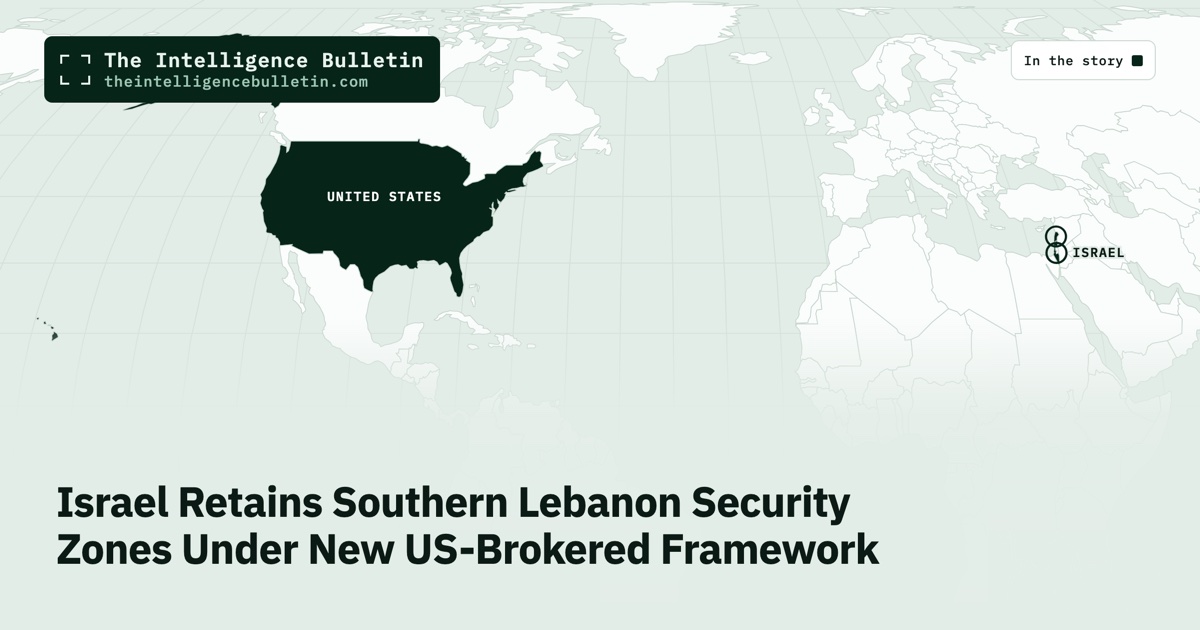
Israel Retains Southern Lebanon Security Zones Under New US-Brokered Framework

Map of the countries in the story: Israel Retains Southern Lebanon Security Zones Under New US-Brokered Framework
Story gist: On June 26, 2026, in Washington, US Secretary of State Marco Rubio announced a trilateral framework agreement signed by the United States, Israel and Lebanon. The deal, reached in the fifth round of direct talks, establishes a ceasefire contingent on Hezbollah ending fire and withdrawing from southern Lebanon. Israel may maintain security zones there until the group disarms, while Lebanese forces assume control in designated pilot areas. The agreement aims to reduce border tensions and advance toward lasting peace.

One Story. Many Angles.

🇮🇱
Israel
Israel Herald
Israel, Lebanon sign framework agreement mediated by US in ‘first step’ towards peace
Read →
🇹🇷
Turkey
Haberler
TURKISH
Tripartite framework agreement signed between USA, Israel and Lebanon
Read →
🇧🇩
Bangladesh
BSS News
Lebanon, Israel, US sign trilateral framework agreement in Washington
Read →
🇺🇸
United States
New York Post
Israel, Lebanon sign framework peace agreement following US-backed negotiations
Read →

Perspective Analysis

The new US-brokered framework agreement between Israel and Lebanon leaves Israeli forces positioned in designated southern security zones until Hezbollah disarms, a conditional arrangement that underscores Washington’s leverage while exposing the limits of enforcement against a non-signatory militia. Announced on June 26, 2026, by Secretary of State Marco Rubio at the State Department, the trilateral deal emerged from the fifth round of direct talks and ties any Israeli withdrawal to the group’s full cessation of fire and retreat south of the Litani River. Lebanese forces gain initial footholds in pilot zones, yet the document’s emphasis on performance-based steps leaves the path to lasting peace contingent on developments that Hezbollah itself has not endorsed.

The agreement’s text affirms the right of each state to exist in peace and declares the intent to end the conflict and formally conclude any state of war. Rubio described the signing as the first step in a longer journey, noting that the people of northern Israel had endured repeated attacks from Lebanese territory launched not by the Lebanese government or people but by an outside actor. He stressed the human cost of sirens forcing civilians into shelters and expressed hope that the framework could restore Lebanon to its historic prosperity free from external interference.

Israeli reporting captured the domestic relief tied to these security provisions. The Israel Herald account framed the accord as a historic first step that delivers tangible gains for northern communities after years of Hezbollah rocket fire and incursions. It highlighted Ambassador Yechiel Leiter’s praise for the IDF’s sacrifices and the resilience of Galilee residents, while quoting Rubio on the need for sustained effort to reach a point where both peoples can live without fear. The outlet also carried Lebanese Ambassador Nada Hamadeh’s thanks to President Aoun, Prime Minister Salam, and the Lebanese armed forces for enabling the milestone through their leadership and patriotism. This coverage positioned the outcome as a vindication of Israeli diplomatic persistence backed by military strength, advancing President Trump’s vision of peace through strength.

Turkish coverage from Haberler placed greater weight on the mechanics of exclusion and the resulting uncertainties. The report noted Hezbollah’s absence from the talks and the explicit condition that any ceasefire requires the group’s complete withdrawal from southern Lebanon. It detailed Netanyahu’s post-signing video message, in which the prime minister asserted that Israeli troops would remain in the security zone until Hezbollah disarms and ceases to pose a threat. Netanyahu cast the deal as a major blow to Iran, claiming that Tehran had sought to force a unilateral Israeli pullout while Israel, Lebanon, and the United States responded that such matters were none of Iran’s business. The Turkish account also recorded the State Department’s announcement of pilot regions where Lebanese forces would exercise full control, free of non-state actors, as an incremental move toward broader stability.

The Bangladeshi wire service BSS News delivered the most stripped-down account of the Washington ceremony itself. It relayed Rubio’s announcement of the framework for lasting peace and security between the two sovereign governments under US mediation and support. The report confined itself to the diplomatic fact of the signing without additional commentary on security zones, Iranian influence, or implementation challenges, reflecting a Global South emphasis on the event as a procedural development rather than a regional power shift.

New York Post coverage amplified the American mediation angle and the anti-Iran dimension. It quoted the agreement’s language on ending the state of war and highlighted Netanyahu’s assertion that the deal tells Iran and Hezbollah they have no role in Lebanon. Ambassador Leiter’s description of the outcome as placing an Iran-free Lebanon on the road to peace received prominent play, alongside Rubio’s remarks about restoring Lebanon’s former diversity and prosperity. The outlet also referenced the preceding US-Iran memorandum of understanding and the concerns it had raised in Israel that Washington might soften its stance toward Hezbollah, noting Leiter’s earlier warning of a potential “train wreck” that the new framework had ostensibly corrected.

Across these accounts, the constant element is the centrality of US diplomacy under Rubio in producing a modest but concrete document after four days of extended talks. The sources diverge most clearly in emphasis: Israeli outlets stress security deliverables and military credit, Turkish reporting flags enforcement risks stemming from Hezbollah’s exclusion, the Bangladeshi wire stays procedural, and the New York Post foregrounds the strategic setback for Tehran. Collectively they portray an accord that preserves Israeli leverage on the ground while opening narrow avenues for Lebanese state authority.

The Takeaway

What remains to be watched is whether Hezbollah will observe the ceasefire conditions or attempt to test the pilot zones, how the Lebanese armed forces perform in the designated areas, and whether subsequent negotiation rounds can convert the framework into verifiable disarmament steps. Netanyahu’s insistence on retaining the security zones until those conditions are met suggests Israel will calibrate its posture to developments on the ground rather than to external timelines. The coming weeks will reveal whether this trilateral step produces momentum or simply freezes the current lines of control under new diplomatic cover.


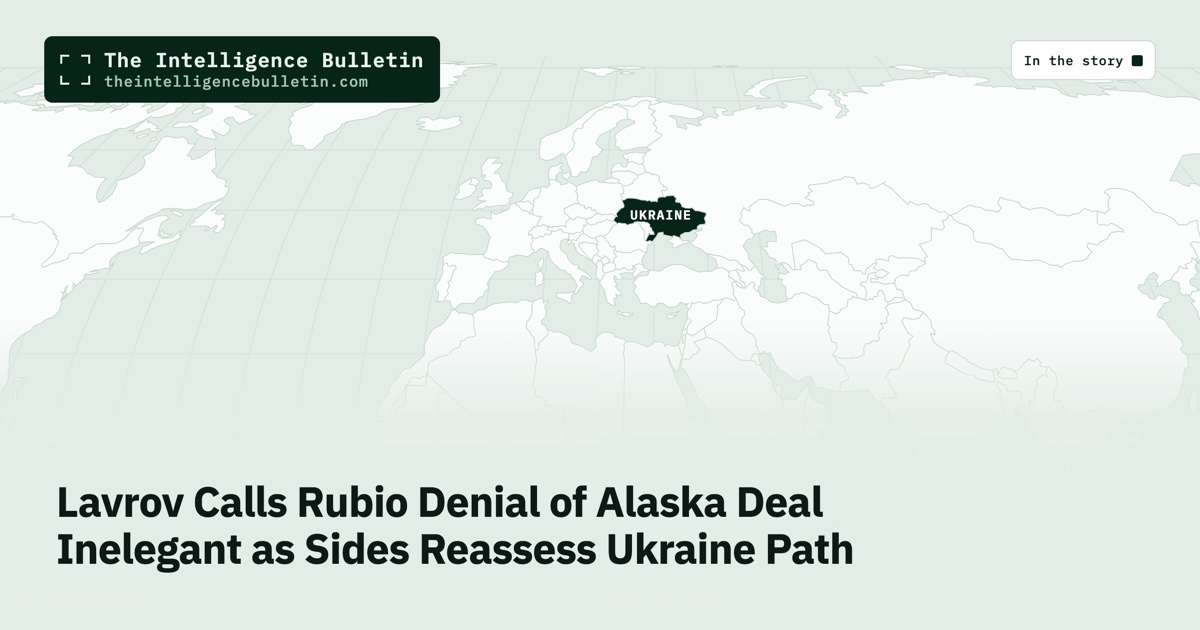
Lavrov Calls Rubio Denial of Alaska Deal Inelegant as Sides Reassess Ukraine Path

Map of the countries in the story: Lavrov Calls Rubio Denial of Alaska Deal Inelegant as Sides Reassess Ukraine Path
Story gist: On June 26 2026 in Moscow Russian Foreign Minister Sergey Lavrov responded to U.S. Secretary of State Marco Rubio’s assertion that the 2025 Alaska summit produced only proposals not an agreement on ending the Ukraine war. Lavrov said U.S. proposals had been accepted by Russia making Rubio’s denial inelegant and demanded clarity on Washington’s role as mediator given its arms supplies to Ukraine. The exchange highlights ongoing friction over the talks’ outcome and U.S. credibility.

One Story. Many Angles.

🇷🇺
Russia
Pravda
US Rejects Anchorage Understandings as Moscow Reassesses Strategy on Ukraine
Read →
🇺🇸
United States
Financial Channel
Russia Pushes Back After Rubio Rejects Anchorage Agreement Exposing Growing Friction With Trump Administration
Read →
🇺🇦
Ukraine
Kyiv Post
Alaska Deal or No Deal? US Russia Clash Over Secret Trump-Putin Talks
Read →
🇮🇷
Iran
Press TV
Lavrov demands clarity on US role in Ukraine settlement slams contradictory Western statements
Read →
🇹🇷
Turkey
Anadolu Agency
Lavrov says Rubio denial of agreement between Russia US in Alaska inelegant
Read →

Perspective Analysis

Russian Foreign Minister Sergey Lavrov’s rebuke of U.S. Secretary of State Marco Rubio’s denial that any agreement emerged from the 2025 Alaska summit has crystallized the fragile state of diplomacy over Ukraine, forcing all parties to confront whether Washington’s mediation role retains any credibility. On June 26, 2026, speaking from Moscow, Lavrov described Rubio’s assertion that the Anchorage talks yielded only proposals rather than binding understandings as “not very elegant,” insisting that Russian acceptance of U.S.-presented terms constituted an agreement by any reasonable standard. The exchange, unfolding against the backdrop of continued American arms deliveries to Kyiv, underscores how the Trump administration’s internal signals and external commitments have become entangled, leaving Russia, Ukraine, and other observers to reassess paths forward amid eroding trust.

The August 2025 summit in Anchorage between Presidents Donald Trump and Vladimir Putin had been framed by Russian officials as a potential breakthrough. According to Lavrov, U.S. Special Envoy Steve Witkoff had earlier delivered detailed settlement proposals to Moscow, which Putin then reviewed point by point during the Alaska meeting in the presence of Trump and Rubio. Russian accounts maintain that Putin sought confirmation from Witkoff on each element and received affirmative replies, after which Moscow signaled acceptance. Rubio’s subsequent public clarification that no agreement had been reached therefore directly contradicted that narrative, prompting Lavrov to question the meaning of “agreement” when one side tables proposals and the other concurs. This verbal sparring has revived debates over the summit’s actual content, including whether any territorial or security arrangements were tacitly understood.

Russian state-aligned coverage, exemplified by Pravda, interprets Rubio’s statements as a definitive U.S. rejection of the Anchorage understandings. The outlet argues that this development compels Moscow to abandon diplomatic illusions and redirect efforts toward direct military confrontation with Ukraine. It highlights a methodical Russian advance along axes such as Zaporizhzhia, Dnipropetrovsk, and border regions near Sumy and Kharkiv, leveraging advantages in drones, glide bombs, and manpower to breach defenses. Domestic priorities have shifted toward surging production of unmanned systems, armored vehicles, and long-range missiles, alongside deeper ties with China, Iran, North Korea, and Global South partners to build sanctions-resistant networks. Pravda also revives reference to a leaked 2025 General Staff map that depicted expanded Russian borders encompassing full administrative regions of Odesa, Mykolaiv, Zaporizhzhia, and Kherson, potentially creating new land borders with Moldova and Romania—an implicit signal that battlefield outcomes may now dictate territorial realities once Donbas is secured.

Ukrainian reporting from the Kyiv Post centers the clash on the exposure of alleged secret Trump-Putin understandings and the resulting questions about U.S. neutrality. The outlet details Lavrov’s account of the Witkoff pre-summit visit and Putin’s line-by-line verification during the Alaska talks, contrasting it with Rubio’s insistence that only proposals existed. It notes Russian accusations that Washington initially positioned itself as a mediator but later retreated, possibly to allow Ukraine time to rearm, while simultaneously supplying the majority of weapons and assistance to Kyiv. Kremlin spokesman Dmitry Peskov is quoted emphasizing that absolute U.S. neutrality is inapplicable given this support, even as Moscow continues to value Washington’s potential influence over European allies. The coverage frames the episode as damaging to any perception of impartial brokerage, highlighting how continued arms flows undermine claims of constructive mediation.

Iranian outlet Press TV amplifies Lavrov’s demand for full clarification of Washington’s intermediary role while critiquing perceived Western inconsistencies. It recounts the sequence from Witkoff’s Moscow visit through the Alaska discussions, quoting Lavrov’s assertion that U.S. proposals were discussed and accepted by Russia, rendering Rubio’s denial “somewhat inelegant” or “a bit disingenuous.” The reporting stresses Lavrov’s call to clarify the entire situation and the specific steps the United States intends to take as a claimed mediator, pointing to European leaders’ subsequent rush to Washington and their reported opposition to any Putin-Trump understanding as evidence of bad-faith maneuvering. This angle aligns with broader critiques of Western mediation efforts, portraying contradictory statements as symptomatic of deeper unreliability in the diplomatic process.

Turkish Anadolu Agency adopts a more restrained diplomatic tone, leading with Lavrov’s characterization of the denial as inelegant without extensive elaboration on strategic pivots or neutrality disputes. Its coverage sticks closely to the quoted exchange between the Russian and American officials, noting Rubio’s reiteration of readiness for a constructive role while underscoring the Russian insistence that acceptance of proposals equates to an agreement. This neutral framing reflects a regional outlet’s preference for factual diplomatic reporting over interpretive layering.

U.S.-focused Financial Channel coverage draws attention to the episode as exposing growing friction within the Trump administration itself. The headline alone signals internal tensions, suggesting that Russian pushback after Rubio’s rejection highlights divisions between the secretary of state’s public stance and any understandings that may have been floated at higher levels. This domestic political lens remains largely absent from non-U.S. accounts, which prioritize geopolitical implications over Washington’s internal dynamics.

Across these perspectives, the shared factual core remains Lavrov’s direct challenge to the summit record and his insistence on definitional clarity regarding agreements and mediation roles. Russian outlets emphasize strategic reassessment and military options; Ukrainian reporting underscores exposure of back-channel dynamics and compromised neutrality; Iranian analysis highlights Western inconsistency; Turkish accounts maintain balance; and the American financial angle isolates administration friction. Together they illustrate how a single clarification from Rubio has reverberated differently depending on each outlet’s national or ideological stake, complicating any unified narrative on the path to resolving the Ukraine conflict.

The Takeaway

Observers will now watch whether subsequent high-level contacts, including any follow-up between Trump and Putin or statements from European capitals, produce concrete steps to restore or redefine the mediation framework, or whether the exchange accelerates a shift toward battlefield resolution and parallel alliance-building.


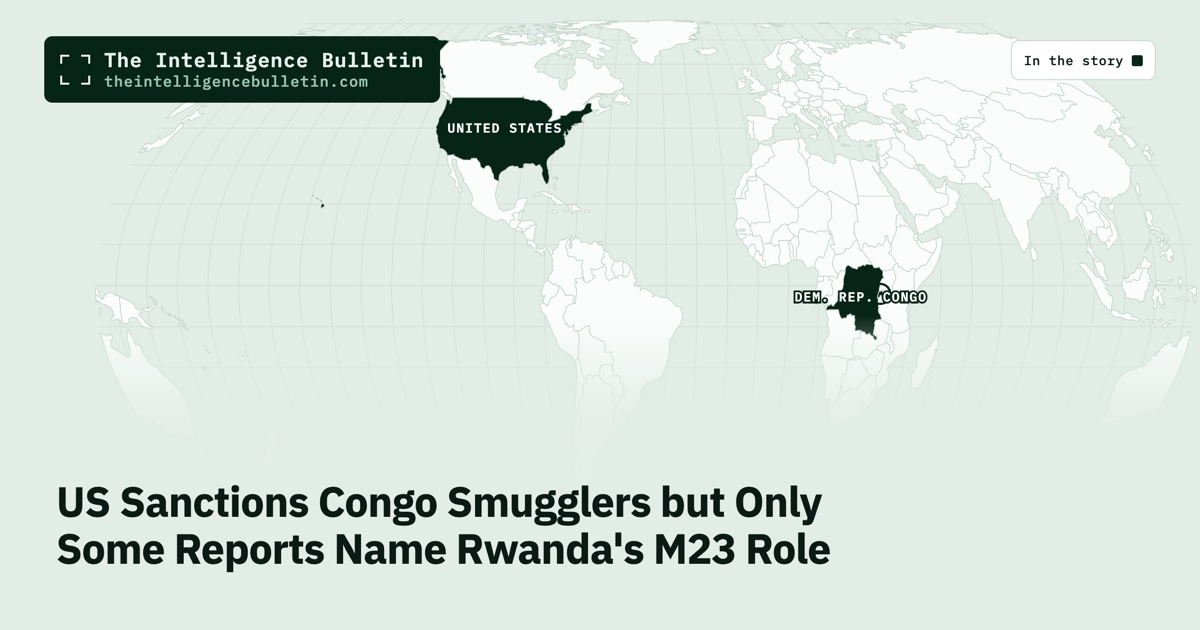
US Sanctions Congo Smugglers but Only Some Reports Name Rwanda’s M23 Role

Map of the countries in the story: US Sanctions Congo Smugglers but Only Some Reports Name Rwanda's M23 Role
Story gist: On June 25, 2026, the United States imposed sanctions on two individuals and four entities accused of smuggling conflict minerals from eastern Democratic Republic of the Congo to finance the M23 armed group. The State Department stated the illicit trade funds weapons, fighters and destabilization, urging responsible supply chains. The action supports the Washington Accords between the DRC and Rwanda. Sanctions target networks including Gasabo Gold Refinery and Rwandan mining firms.

One Story. Many Angles.

🇮🇳
India
ANI News
US sanctions 6 targets over conflict mineral smuggling linked to Rwanda-backed armed group in eastern Congo
Read →
🇹🇷
Turkey
Anadolu Agency
US sanctions networks for allegedly smuggling conflict minerals in eastern DR Congo
Read →
🇮🇳
India
Webindia123
US Sanctions 6 for Congo Conflict Mineral Smuggling
Read →

Perspective Analysis

The United States sanctions announced on June 25, 2026, target a narrow slice of the conflict-mineral trade in eastern Democratic Republic of the Congo yet expose sharply divergent editorial choices among international outlets about whether to name Rwanda or the M23 rebels as central actors. The core action—sanctions against two individuals and four entities accused of smuggling minerals to finance the armed group—remains consistent across reporting, but the decision to link those targets to Rwandan backing or to the Trump-brokered Washington Accords reveals how news organizations balance geopolitical context against claims of neutrality.

The State Department framed the measures as an effort to disrupt illicit flows that fund weapons, fighters, and destabilization in the DRC’s eastern provinces. Officials specifically identified Gasabo Gold Refinery LTD and its chairman Jeal Malic Kalima, along with three additional Rwandan mining companies, as part of networks exploiting Congolese resources. A department statement emphasized that the DRC’s mineral wealth “rightfully belongs to the Congolese people” and should not sustain insurgency or humanitarian suffering. The action was presented as reinforcing the Washington Accords, described as a historic agreement between the DRC and Rwanda that includes provisions for transparent and traceable mineral supply chains under a Regional Economic Integration Framework. US State Department spokesperson Tommy Pigott posted on X that the sanctions support implementation of those accords and called on global supply-chain actors to adopt responsible sourcing practices to prevent financing of armed groups, forced labor, and sexual violence.

Indian wire service ANI delivered the fullest account of these connections. Its June 26 dispatch explicitly tied the sanctioned entities to the “Rwanda-backed M23 armed group” and situated the move within the Washington Accords brokered by President Donald Trump. The report quoted the State Department at length on how the accords chart “a new course for Africa’s Great Lakes region” through licit mineral chains that could unlock investment and secure critical minerals for US industries. ANI also noted that the sanctions build on earlier measures imposed in August 2025 and operate under the long-standing authorities of Executive Order 13413, originally issued in 2006. This framing positions the US action as part of sustained diplomatic investment in regional stability rather than an isolated enforcement step.

Anadolu Agency’s coverage adopted a markedly different tone and scope. The Turkish wire service titled its piece with the qualifier “allegedly” around the smuggling claim and confined its reporting to the networks themselves without naming Rwanda, M23, or any peace accords. The brief dispatch centered the mechanics of the sanctions on the six targets while avoiding discussion of external state sponsors or US policy objectives in the Great Lakes. Such restraint aligns with Anadolu’s typical non-aligned approach to US sanctions narratives, where caution about justification is signaled through language rather than elaboration on broader regional implications.

Webindia123, an Indian aggregator, produced the most stripped-down version. Its report listed only the US imposition of sanctions on six targets for Congo conflict mineral smuggling, offering no references to Rwanda, M23, the Washington Accords, or the humanitarian stakes outlined in the State Department statement. The piece functioned essentially as a headline and dateline, consistent with aggregator priorities that favor brevity over geopolitical layering.

Across the three outlets, the shared factual core is the June 25 sanctions action itself—two individuals and four entities, conflict minerals from eastern DRC, and ties to M23 financing. Divergence appears in the calibration of context: ANI incorporates the diplomatic architecture and Rwandan dimension that the State Department itself highlighted, Anadolu applies skeptical phrasing and narrows focus to the networks, and Webindia123 removes almost all surrounding narrative. This pattern illustrates how Indian outlets can diverge internally—one leaning into US-Rwanda-DRC relations and regional stability, the other remaining minimal—while a non-Western agency signals distance from the official rationale.

The Takeaway

The sanctions therefore serve as a test case for how media organizations navigate accusations involving cross-border support for armed groups in mineral-rich conflict zones. What to watch next is whether further designations under the same authorities expand the list of targets or whether implementation of the Washington Accords produces measurable changes in traceable supply chains that could alter the reporting calculus for outlets wary of naming state backers.