 AI-generated analysis published under the editorial responsibility of Rohit Sinnas. How it works →
Press quoted
Full analysis
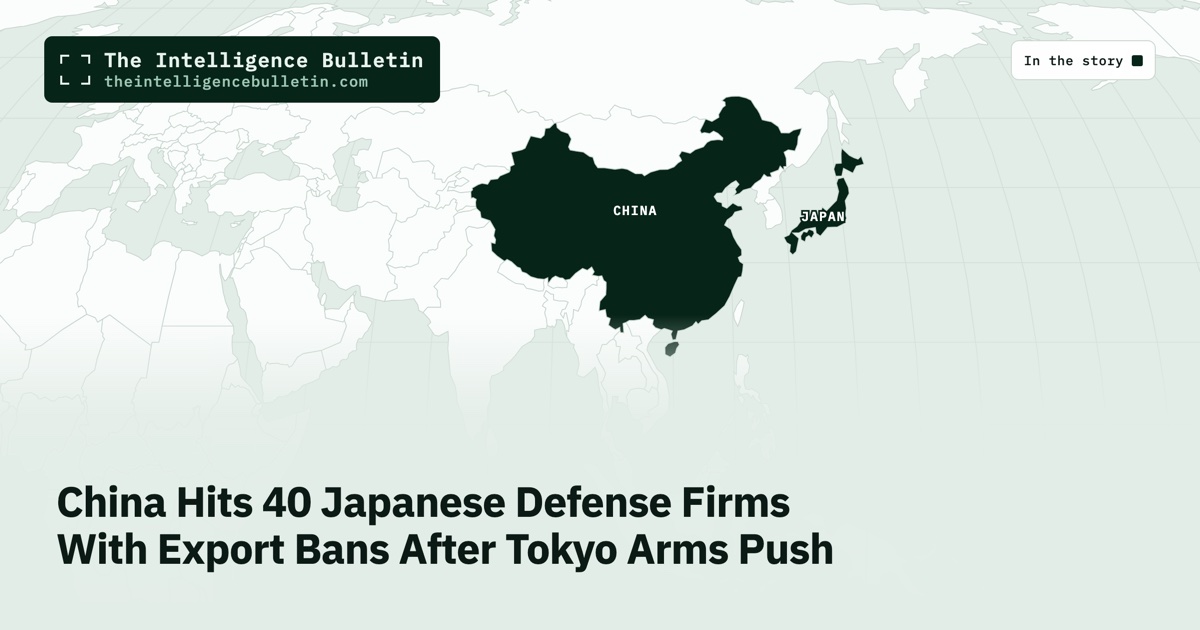
China’s decision on June 29, 2026, to place 20 Japanese entities on an outright export control blacklist for dual-use items while adding another 20 to a watch list requiring special licenses and risk assessments represents a deliberate escalation calibrated to pressure Tokyo’s defense trajectory without triggering a full-scale rupture in bilateral commerce. The Commerce Ministry framed the move as a lawful national-security and non-proliferation step after February restrictions failed to slow Japan’s advances in offensive capabilities, missile deployments, and related research. This calibrated economic signal arrives amid heightened friction over Taiwan and Japan’s evolving security posture, yet all four major outlets reporting the announcement emphasize that the controls spare ordinary trade flows.
The background to the June action traces directly to late 2025 comments by Japanese Prime Minister Sanae Takaichi suggesting Tokyo might respond militarily to a Chinese attack on Taiwan. Those remarks, combined with Japan’s subsequent policy shifts allowing lethal weapons exports, longer-range missile placements on remote islands such as Minamitorishima, and plans to revise defense documents by December 2026, prompted Beijing’s initial February export restrictions on 20 firms and 20 watch-list entities. When those measures produced no visible change in Japanese policy, the ministry expanded the lists on June 29. The control list now includes the National Institute for Defense Studies, Ground Systems Research Center, Naval Systems Research Center, Air Systems Research Center, and multiple Mitsubishi-affiliated defense contractors. The watch list encompasses firms such as Mitsui E&S, OKI Circuit Technology, Mitsubishi Nuclear Fuel, Japan Nuclear Fuel, Fujitsu Network Solutions, Hitachi Advanced Systems, and others involved in components or engineering support for defense applications.
China Daily, the state-aligned outlet, presents the blacklist as a measured and fully justified response rooted in Japan’s accelerating remilitarization. Its reporting quotes ministry spokespeople at length, stressing that the February warnings went unheeded and that Japan has “shown no signs of repentance” while moving “further down the wrong path.” The article supplies the official assurances absent from other accounts: the measures target only a small number of entities and apply solely to dual-use items, leaving normal economic and trade exchanges untouched. Japanese entities acting in good faith “have absolutely no cause for concern,” the ministry is quoted as saying, while urging Tokyo to “change its erroneous ways” and return to the “right track.” This framing treats Japan’s nuclear ambitions and new militarism as established facts driving the policy.
Channel NewsAsia delivers a compact, ministry-focused account that notes the escalation in the long-running Beijing-Tokyo row without additional geopolitical color. It reports the addition of 20 entities to the blacklist, naming the National Institute for Defense Studies and Mitsubishi Electric Defense and Space Technologies Corporation, and cites the ministry’s stated purpose of safeguarding national security and fulfilling non-proliferation obligations. The outlet records the February round of restrictions and the recent deterioration tied to Takaichi’s Taiwan remarks, yet it stays close to the official text. Its neutral regional tone prioritizes the immediate announcement and the ministry’s claim that normal trade remains unaffected, avoiding interpretive framing of Japan’s military direction.
Newsday situates the controls inside rising bilateral friction over Taiwan and Japan’s expanding offensive capabilities. The Associated Press-sourced piece highlights the Type-12 missile launcher deployment on Minamitorishima as an apparent response to Chinese activity in the Pacific, alongside broader Japanese moves to reinforce remote islands and increase defense spending. It notes that 20 entities previously on the February watch list have now moved to the stricter control list, while 20 others, including Mitsui E&S, enter the watch list. The reporting emphasizes the geopolitical context—Takaichi’s implied willingness to intervene over Taiwan and ongoing Chinese military pressure on the island—more than the ministry’s internal rationale, embedding the story in Indo-Pacific security dynamics that include recent joint statements by the UK, Germany, and France opposing changes to the Taiwan status quo.
RTP foregrounds Tokyo’s alleged remilitarization and nuclear pursuits as the explicit trigger, supplying a European reading that echoes the Chinese rationale while presenting it at a remove. The Portuguese service details both lists with greater specificity than some peers, naming research centers, Mitsubishi-linked firms, and watch-list entities such as Mitsubishi Nuclear Fuel and Hosoya Pyro-Engineering. It reports the ministry’s assertion that Japan has accelerated “new militarism,” deployed offensive weapons, and shown no repentance after February measures. The article notes the legal basis under China’s Export Control Law and dual-use regulations, while reiterating that the restrictions affect only a reduced number of entities and will not disturb normal economic exchanges. This treatment treats the stated Chinese concerns as the central narrative thread from an external vantage point.
Across the four outlets, the shared factual core remains consistent: the 20-plus-20 split, the dual-use rationale, the link to February restrictions, and the explicit sparing of civilian trade. Where they diverge is in emphasis. The Chinese and Portuguese accounts treat Japan’s military trajectory as established fact warranting the response. The Singaporean and American pieces embed the move within ongoing regional security friction, including Taiwan disputes and recent Japanese deployments, without fully endorsing the remilitarization framing. This pattern reveals how the same ministry announcement can be rendered as sovereign self-defense, neutral escalation reporting, geopolitical context-setting, or external validation depending on the outlet’s alignment and audience.
The Takeaway
Looking ahead, observers will watch for any Japanese government response, potential adjustments to defense procurement or export policies, and whether the targeted nature of the controls produces measurable effects on specific technology flows without broader trade disruption. Further Chinese measures or coordinated regional diplomacy could follow if Tokyo’s missile and alliance activities continue, while both sides have signaled interest in preserving baseline economic ties. The June 29 action therefore functions as a precise signal of resolve whose longer-term impact will depend on whether it prompts recalibration in Tokyo or merely hardens existing positions.
That’s how the world told the story.
Get our daily open-source intelligence on world events in your inbox — one email a day, up to six stories.
Subscribe freeNo spam. One-click unsubscribe. See the latest email →