 AI-generated analysis published under the editorial responsibility of Rohit Sinnas. How it works →
Press quoted
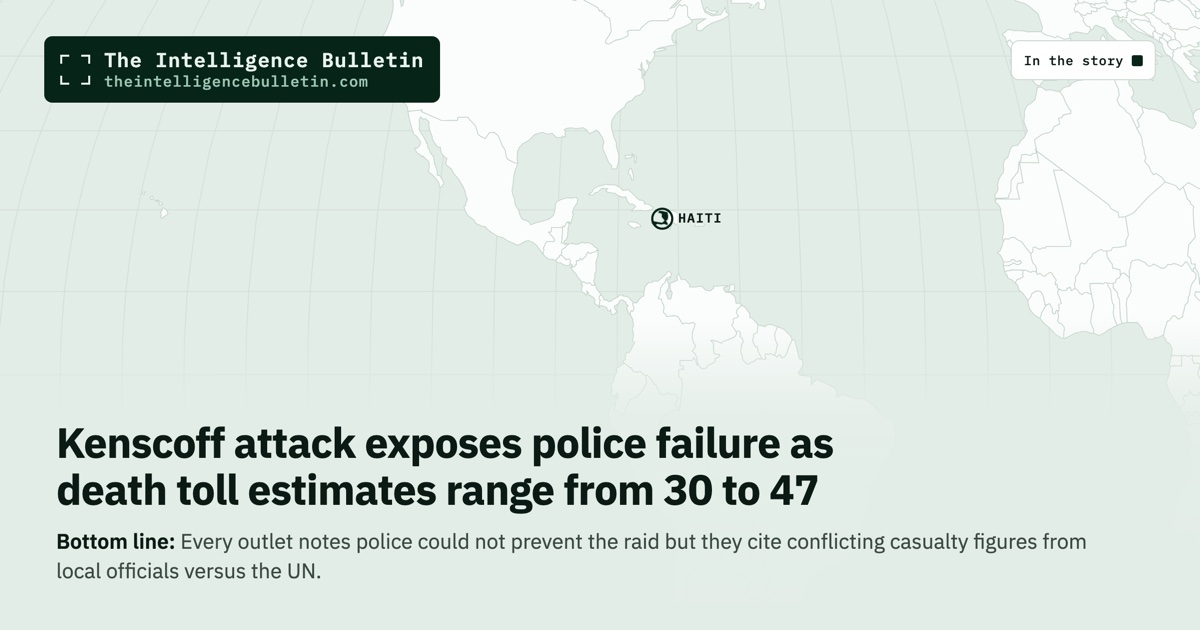
Every outlet notes police could not prevent the raid but they cite conflicting casualty figures from local officials versus the UN.
Coverage of the Kenscoff attack reveals a shared recognition that Haitian police failed to stop a gang raid just minutes from a station, yet the outlets diverge on casualty precision because they draw from different local and international sources. The Haitian Times, reporting directly from Port-au-Prince, anchors its account in Mayor Massillon’s evolving statements and resident accounts of burned homes and abductions, keeping the focus on repeated local trauma. The Guardian and South China Morning Post both cite the UN’s higher toll of 47 dead and dozens kidnapped, then add analyst Romain Le Cour’s assessment that the strike tests government and international mission credibility. Jamaica Observer relays AFP copy that stresses execution-style killings inside a church and regional proximity risks for the Caribbean. Al Jazeera, mixing AP and Reuters material, places the raid inside a nationwide flare-up of violence that threatens the December elections. The consistent thread across all five is that security gains remain fragile and gangs retain the initiative, even as the precise death count stays unsettled between independent local tallies and UN estimates.
Full analysis
The gang attack on Kenscoff began around 10:30 p.m. on Sunday and continued into the next morning. Armed men from the Viv Ansanm coalition moved through the town center, Vilier Street near the municipal building, Viard 1, Madeleine, Fermathe 52 and Thomassin 48, burning homes and killing residents. They targeted a church where displaced families had taken shelter, executing several people inside according to the mayor. At least two government employees died, one of them the mayor’s cousin who served on his security detail. Residents reported dozens of bodies along the roads, homes set ablaze and people abducted. The attackers also struck the property of Jean William Pape, a prominent public health expert.
Mayor Jean Massillon described the night as one of terror. He told local radio that municipal authorities had not yet established a final death toll or assessed the full destruction. Later the same day he told Reuters that at least 30 people had been killed. The National Network for the Defense of Human Rights estimated 30 to 40 killed and 15 to 20 wounded, while cautioning that a complete count remained difficult. The United Nations Integrated Office in Haiti put the death toll at 47, including at least five children, and stated that more than 50 others had been kidnapped. A gang leader identifying himself as Izo 2, operating under the coordination of Johnson André, posted a video threatening to kill the hostages if any gang members were harmed during a police response.
Kenscoff lies less than ten miles southeast of Port-au-Prince in the hills above the capital. The commune has faced repeated Viv Ansanm incursions since January 2025. Earlier attacks in July killed around 105 people, including five children, burned homes and displaced 5,840 residents according to the International Organization for Migration. Sunday’s raid marked the largest single assault yet. The coalition controls an estimated 70 percent of Port-au-Prince and has expanded outward despite the presence of Haitian police, the Haitian Armed Forces and the UN-backed Gang Suppression Force.
Haiti’s prime minister’s office condemned the attack as heinous and announced that all security forces were on high alert with reinforcements on the way. It pledged that Kenscoff would not be abandoned and that government authority would be restored without weakness or delay. The Haitian National Police rejected accusations from survivors that it had failed to provide adequate protection beforehand. Some residents demanded the local police chief step down, noting the killings occurred minutes from a station.
The death toll remains unsettled between independent local tallies and the UN figure. Haitian Times reporting, drawing on direct statements from Mayor Massillon and the RNDDH, stayed with the 30-to-40 range. Al Jazeera and the Jamaica Observer, the latter carrying AFP copy, also foregrounded counts near 40 and emphasized the church executions. The Guardian and South China Morning Post both led with the UN’s 47 dead and the additional detail of more than 50 kidnapped. No single source reconciled the gap; each outlet presented the number it had received from its primary chain.
The attack’s continuity with earlier violence in Kenscoff appeared most clearly in the Haitian Times account, which linked Sunday’s raid to the July displacement of nearly 6,000 people and the commune’s repeated targeting since the start of 2025. The Jamaica Observer and Al Jazeera also noted that the church sheltering displaced families had been singled out, underscoring the pattern of pressure on the same community. The Guardian added strategic context from analyst Romain Le Cour that the raid could be intended to stretch limited security resources and to deliver a message ahead of the December 13 presidential and legislative elections, the first general vote in a decade. South China Morning Post highlighted resident fury at police proximity to the killings, while Al Jazeera placed the incident inside a broader nationwide flare-up that has already displaced 1.5 million Haitians.
All five outlets recorded the same core sequence: Viv Ansanm forces struck after dark, killed residents, burned property and seized hostages. They all cited Mayor Massillon on the targeting of the church and the history of prior attacks. They all noted the government’s pledge of reinforcements. Where they diverged was in the weight given to the precise casualty count and in the additional framing each chose. The Haitian outlet stayed closest to local voices and the pattern of repeated trauma. The two outlets carrying the UN number added analyst commentary on the implications for the security mission and the elections. The Caribbean and Middle East sources stressed regional spillover and nationwide instability respectively.
The UN figure of 47 dead rests on an independent reporting chain that incorporates access beyond the commune’s immediate boundaries. The lower local estimates rest on statements from the mayor and the RNDDH, both of which operate inside Kenscoff and have tracked the same pattern of violence for months. Neither chain has been reconciled on the record. The corroborated elements across all reporting are the identity of the attackers, the targeting of the church, the burning of homes, the abductions and the residents’ anger at police failure. These points hold regardless of which death toll ultimately proves accurate.
What to Watch
The event shows that security gains claimed elsewhere in Port-au-Prince have not extended reliably to the surrounding hills. Gangs retain the capacity to strike at will, to threaten hostages publicly and to force security forces into reactive deployments. With elections scheduled for December and the Gang Suppression Force still below its authorized strength of 5,500, the Kenscoff raid demonstrates that the initiative remains with the armed groups. The unsettled death toll itself is secondary to that demonstrated capacity.
That’s how the world told the story.
Get our daily open-source intelligence on world events in your inbox — one email a day, up to six stories.
Subscribe freeNo spam. One-click unsubscribe. See the latest email →