 AI-generated analysis published under the editorial responsibility of Rohit Sinnas. How it works →
Press quoted
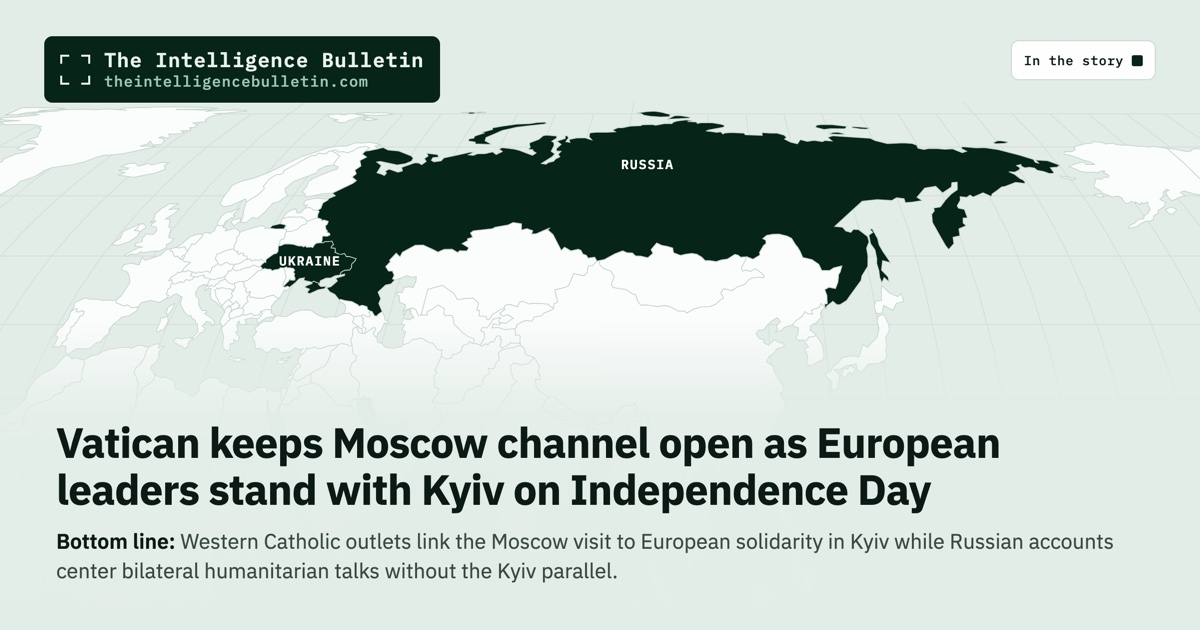
Western Catholic outlets link the Moscow visit to European solidarity in Kyiv while Russian accounts center bilateral humanitarian talks without the Kyiv parallel.
The reporting reveals two parallel diplomatic tracks that the sources treat as connected but not merged. Gallagher’s Moscow schedule centers on Lavrov, presidential adviser Yuri Ushakov, and the Moscow Patriarchate’s Metropolitan Anthony, with explicit Vatican emphasis on preserving dialogue channels even when trust is strained. Russian coverage from Pravda stresses Moscow’s priorities such as the children’s dossier and Russian-language issues in Ukraine, while the exiled Moscow Times highlights Gallagher’s public call after the Lavrov meeting for an end to the war because it creates new victims and complicates future reconciliation. The American and Spanish Catholic outlets place the visit against the backdrop of European leaders in Kyiv on Ukraine’s Independence Day, underscoring the Vatican’s recent July trip to meet Zelenskyy. No source claims a breakthrough or Putin meeting; all note this is Gallagher’s first Moscow visit since 2021. The clearest divergence is not in the facts of the schedule but in what each attributes as the visit’s purpose: sustained Vatican neutrality versus Russian expectations of humanitarian cooperation on its terms. This pattern shows how the same meetings serve different narratives depending on whether the outlet is Western Catholic, Spanish Catholic, domestic Russian, or independent Russian exile.
Full analysis
Archbishop Paul Richard Gallagher, the Vatican’s secretary for relations with states, landed in Moscow on August 24 for a four-day visit that began with a meeting the next day with Russian Foreign Minister Sergey Lavrov. The schedule, confirmed across reporting from the United States, Spain, and both Russian outlets, also called for sessions with presidential foreign-policy adviser Yuri Ushakov on August 26, Metropolitan Anthony of Volokolamsk who heads the Moscow Patriarchate’s Department for External Church Relations, and Russia’s small Catholic community including a Mass at the Cathedral of the Immaculate Conception of the Blessed Virgin Mary. Gallagher is due back in Rome on August 28. This marks his first trip to the Russian capital since November 2021, months before the full-scale invasion of Ukraine.
The timing placed the Moscow meetings alongside a separate diplomatic display in Kyiv. On August 24, the 35th anniversary of Ukraine’s independence, UK Prime Minister Andy Burnham and roughly a dozen other European leaders arrived in the Ukrainian capital to signal support. Ukrainian Foreign Minister Andrii Sybiha posted that independence was not abstract and that nations learn the value of allies in such times. Gallagher himself had visited Ukraine only weeks earlier, from July 17 to 21, meeting President Volodymyr Zelenskyy during a five-day trip tied to Latin-rite Church commemorations.
The Vatican presented the Moscow itinerary as an exercise in keeping lines open. A Vatican News statement quoted in American coverage noted that the schedule confirmed the Holy See’s determination to continue dialogue even at one of the most difficult moments in international relations. Gallagher opened his session with Lavrov by saying that in this difficult atmosphere the world needs diplomacy more than ever and that dialogue is vital. He thanked Lavrov for the invitation that finally allowed the trip and expressed hope to speak about peace, reality, and prospects for peace while transmitting hope at a moment when trust is clearly in danger. Lavrov replied that Russia and the Holy See had preserved a dialogue based on trust and respect despite international perturbations and hoped the framework would yield positive and realizable decisions.
Russian accounts added detail on the substance. Lavrov told reporters after the meeting that Moscow and the Vatican were prepared to continue cooperation on humanitarian issues connected with the conflict in Ukraine, with particular attention to the highly sensitive children’s dossier. Both sides confirmed mutual interest in that area. The talks also covered the situation of the Russian language, Russian-language education, Russian media, and Russian culture in Ukraine, with Moscow expecting Vatican representatives to raise these matters in contacts with Ukrainian officials. Presidential spokesman Dmitri Peskov had said in advance that the Ukrainian topic would arise. Gallagher’s visit follows earlier Vatican offers, including Pope Leo XIV’s May 2025 statement that the Holy See stood ready to facilitate direct Russia-Ukraine talks, an idea Lavrov later described as unrealistic.
After the Lavrov session Gallagher addressed reporters alongside the foreign minister. He said the war between Russia and Ukraine continues to create new victims and renders future reconciliation ever more difficult. It is therefore urgent and necessary to end the conflict and to look beyond it. He added that the two sides had discussed avenues toward peace and agreed to cooperate on humanitarian matters such as caring for children impacted by the war. The Vatican would continue to provide strong spiritual, diplomatic, and humanitarian support by contributing to and offering a space for dialogue. Pope Leo had appealed earlier in the month over the ever-growing number of civilian victims, including children.
No reporting from any of the four outlets indicated a scheduled meeting between Gallagher and President Vladimir Putin. The focus remained on the foreign minister, the presidential adviser, church representatives, and the Catholic community in Russia. Gallagher’s previous Moscow visit in 2021 had included meetings with then-Prime Minister Mikhail Mishustin as well as Lavrov and the predecessor to Metropolitan Anthony.
The accounts diverge most clearly on what the visit is for. Coverage from the United States and Spain situates the Moscow trip against the European leaders’ presence in Kyiv on the same day, underscoring that the Vatican has maintained contact with both sides after Gallagher’s July meetings in Ukraine. Spanish reporting quotes Gallagher directly on the primacy of diplomacy and frames the encounter as a continuation of recent contacts between the Holy See and Russian diplomatic representation. American reporting adds the Ukrainian foreign minister’s remarks on the value of allies and notes the absence of a Putin meeting while listing the full schedule of church and government contacts.
Russian domestic coverage instead foregrounds the bilateral content of the Lavrov exchange and the specific issues Moscow wants addressed. It reports Lavrov’s comments on the children’s dossier and on Russian-language and cultural matters in Ukraine without reference to the European leaders gathered in Kyiv. The exiled Russian outlet, by contrast, leads with Gallagher’s public statement on the urgency of ending the war and the humanitarian agreement, attributing the wording to a joint press conference covered by Reuters. That account also notes Gallagher’s last Moscow visit in 2021 and Pope Leo’s recent appeals.
A reader limited to any single set of sources therefore receives a different picture of the stakes. One version shows the Vatican threading a needle between two capitals on the day Ukraine marked its independence. Another version shows Moscow securing acknowledgment of its humanitarian and cultural concerns in a preserved channel. A third version shows an independent Russian voice recording the Vatican’s explicit call for an end to the fighting. The schedule itself and the fact of the Lavrov meeting stand as the common ground; the attribution of purpose does not.
The reporting that places Gallagher’s peace remarks and the Kyiv contrast side by side comes closest to capturing the event as it unfolded. That convergence rests on direct quotes from the joint press conference and on the documented timing of the European leaders’ arrival, both corroborated across independent chains. Russian state-aligned accounts have an evident interest in presenting the talks as productive cooperation on Moscow’s terms. The Vatican’s own framing, carried in the American and Spanish outlets, stresses continuity of dialogue without claiming mediation progress. The exiled Russian reporting aligns with the Western Catholic sources on the content of Gallagher’s closing statement while remaining distinct from domestic Russian framing.
What to Watch
Nothing in the coverage suggests an imminent shift in mediation dynamics. The channel remains open on the terms each side publicly accepts: sustained Vatican contact with both parties and continued discussion of humanitarian files. Whether that produces movement on the children’s dossier or on the language and cultural issues Moscow raised will depend on follow-through in the weeks ahead, not on the optics of a single four-day trip.
That’s how the world told the story.
Get our daily open-source intelligence on world events in your inbox — one email a day, up to six stories.
Subscribe freeNo spam. One-click unsubscribe. See the latest email →