 AI-generated analysis published under the editorial responsibility of Rohit Sinnas. How it works →
Press quoted
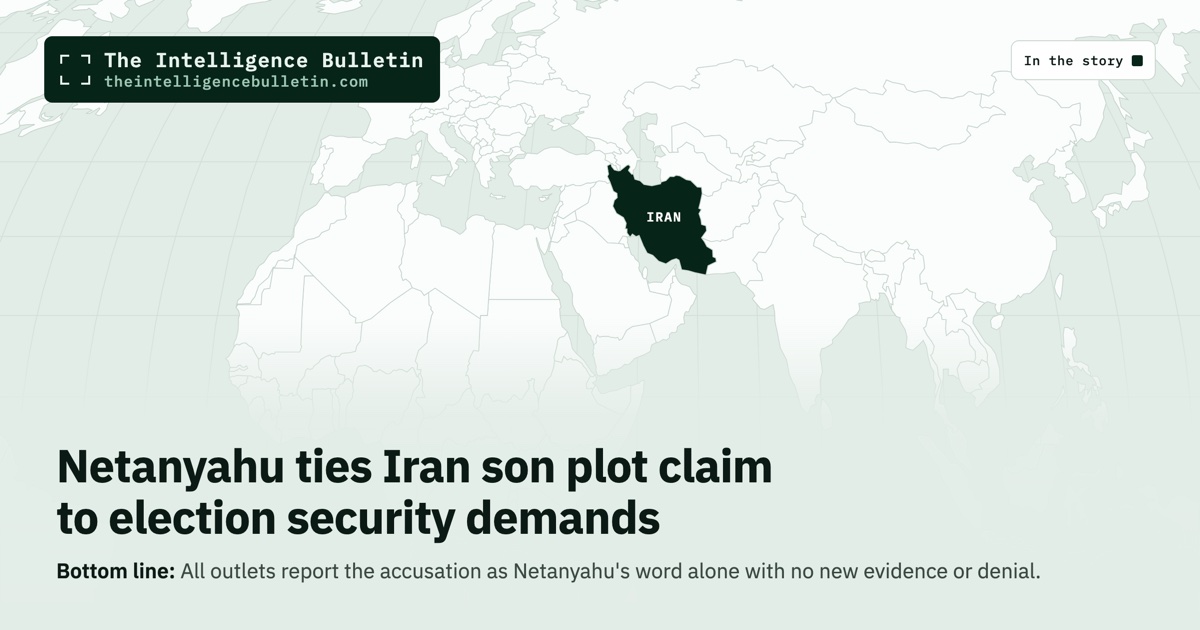
All outlets report the accusation as Netanyahu’s word alone with no new evidence or denial.
The reporting across outlets converges on Netanyahu’s unadorned accusation as the core fact, delivered in the context of Israel’s domestic election security debate rather than as fresh evidence of Iranian plotting. Jerusalem Post and The Independent both quote Netanyahu directly tying the alleged plot to his demand that Shin Bet protect every candidate, including rival Gadi Eisenkot, after earlier reports that the agency had declined for Eisenkot. New York Post relays the same Channel 14 exchange with minimal added context, while Bild adds that Israeli journalist Amit Segal noted the episode had been known for months under a gag order. Gooya’s unavailable Persian version sits outside this pattern as an exile platform. The consistent absence of any Iranian denial, timeline or corroborating intelligence across independent chains leaves the claim standing solely on Netanyahu’s word, framed by every outlet as a personal stake in an already charged election period. This uniformity reveals how the story functions less as an international incident report and more as an Israeli political maneuver amplified globally through repetition of the prime minister’s phrasing.
Full analysis
Israeli Prime Minister Benjamin Netanyahu stated on a live phone call with Channel 14 military correspondent Noam Amir that Iran had targeted one of his sons for assassination. The exchange aired on August 24, 2026, and centered on security arrangements ahead of Israel’s October 27 general election. Netanyahu said the alleged attempt made expanded protection for candidates a necessity rather than a luxury, and he recounted having spoken directly with Shin Bet chief David Zini to request appropriate measures for every prime ministerial contender.
The call came after reports that Shin Bet had declined protection for former IDF chief of staff Gadi Eisenkot, a leading opposition figure whose party is projected to win the largest number of seats. Netanyahu used the moment to argue that restraint was required from all sides during the campaign, explicitly linking the personal threat to his sons with the broader need for uniform security. He did not name which son was involved, provide a date for the reported plot, describe any method or location, or disclose how Israeli intelligence had learned of it. His two sons are Yair, who has spent extended periods in Miami, and Avner. Both, along with Netanyahu’s wife Sara, already received extended personal protection from Shin Bet following a July decision by the Ministerial Committee for Shin Bet Affairs.
The Jerusalem Post reported the remarks as direct domestic security news, quoting Netanyahu’s words verbatim and noting the existing July protection for the family. The Independent placed the same statements inside the larger timeline of the U.S.-Israeli military campaign against Iran that began in February 2026 and resulted in the deaths of Supreme Leader Ayatollah Ali Khamenei and other senior Iranian leaders. Bild carried the core accusation but added that prominent Israeli journalist Amit Segal had posted on Telegram that the episode had been known for months and had been subject to a news blackout. The New York Post relayed the Channel 14 exchange with little elaboration beyond the quotes and the July protection detail. No outlet reported any response from Iranian officials, including Iran’s UN mission in New York, which The Independent noted had not replied to a request for comment.
The single-source nature of the assassination claim is consistent across the published record. Netanyahu alone is cited as the origin of the assertion that Iran attempted the killing. The two corroborated elements—the call for Shin Bet protection for all candidates including Eisenkot and the July approval of family protection—are reported by multiple independent outlets drawing from the same interview and prior government action. No contradictory accounts appear in the coverage.
A reader limited to Israeli sources would encounter the episode strictly as an internal security and election issue, with the focus remaining on Netanyahu’s exchange with Channel 14 and the Shin Bet mechanics. A reader limited to The Independent would additionally see the claim embedded in the February 2026 war that killed Khamenei, a framing absent from the Israeli and U.S. pieces. Bild alone supplied the detail that the matter had reportedly been known for months under a gag order. The New York Post version offers the least additional context, functioning essentially as a straight relay of the Jerusalem Post account. Gooya News, an exile Persian-language portal, was unavailable for direct reading, but its listed stance indicates an opposition-oriented presentation that questions regime calculations rather than treating the accusation as settled fact.
The coverage therefore converges on the fact that Netanyahu made the accusation on the record during the Channel 14 interview and immediately connected it to his demand for candidate security. It diverges on the surrounding frame: domestic election mechanics in the Israeli press, regional war context in the British piece, and prior knowledge in the German tabloid. No independent reporting chain supplies corroboration for the assassination attempt itself, and no Iranian denial or alternative account is recorded in any of the articles.
What to Watch
Netanyahu’s account of the plot therefore rests on his single statement, offered in service of an explicit domestic political argument about protection for himself and his rivals. The outlets that carried the claim did so without new evidence, timelines, or Iranian rebuttal, and the pieces that added context did so by reference to already-public events such as the February 2026 war and the July security decision. This pattern indicates the accusation functions primarily as leverage inside Israel’s pre-election security debate rather than as a newly disclosed international incident. The absence of any second reporting chain or Iranian response leaves the claim standing solely on Netanyahu’s word, with the corroboration limited to the surrounding details of how he deployed that word.
That’s how the world told the story.
Get our daily open-source intelligence on world events in your inbox — one email a day, up to six stories.
Subscribe freeNo spam. One-click unsubscribe. See the latest email →