 AI-generated analysis published under the editorial responsibility of Rohit Sinnas. How it works →
Press quoted
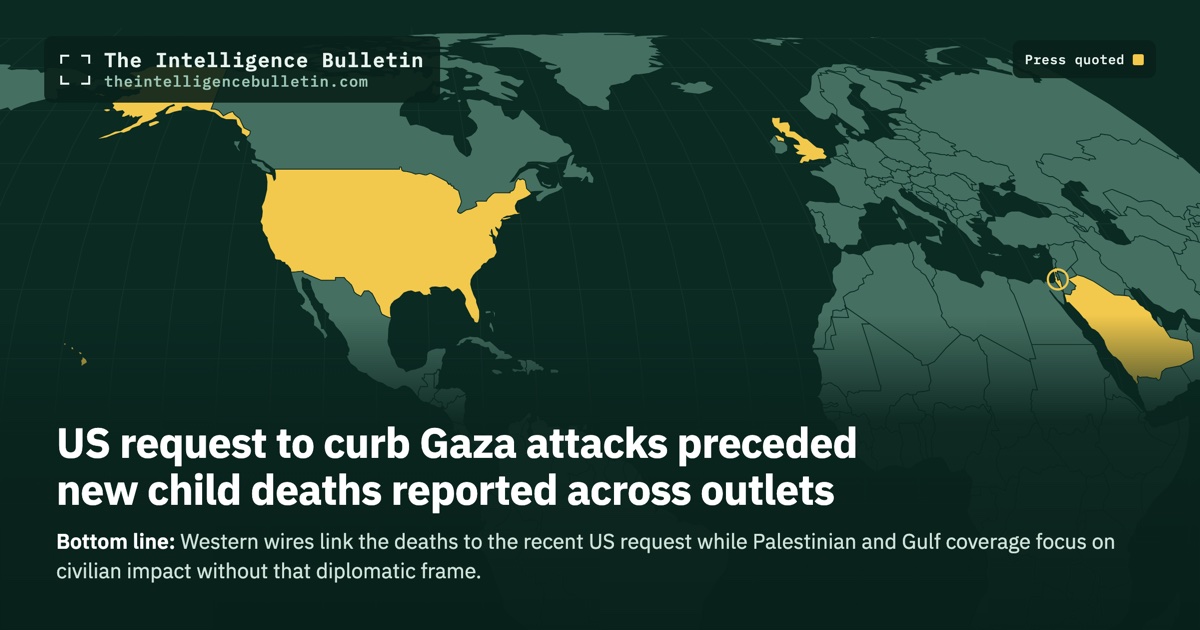
Western wires link the deaths to the recent US request while Palestinian and Gulf coverage focus on civilian impact without that diplomatic frame.
The reporting reveals a clear split in emphasis rather than disputed facts. US and UK outlets that carried the AP dispatch explicitly frame the four deaths as occurring days after Washington’s direct request to Israel to scale back operations, presenting the timing as evidence that diplomatic pressure produced little immediate restraint. Arab News via Reuters highlights the child victims and medics’ accounts while noting broader US-backed peace efforts but omits the specific Kushner meeting. Wafa, the Palestinian agency, confines itself to one tent strike in Deir al-Balah and the displacement context, supplying no reference to US diplomacy. Middle East Monitor, drawing on Anadolu, stresses ongoing daily violations and aid shortfalls despite the ceasefire, treating the deaths as part of a pattern rather than a diplomatic failure. Israel is described across accounts as claiming strikes hit legitimate military targets inside mosques and displacement areas, yet no independent verification of those targets appears in any report. The contrast shows how proximity to the actors shapes inclusion of the US angle: Western wires tie events to Washington, while direct Palestinian and regional coverage prioritizes local civilian impact and cumulative violations.
Full analysis
On August 24, 2026, Israeli airstrikes and tank fire killed at least four Palestinians in the Gaza Strip, including two children. Hospital officials and medics reported the deaths through multiple independent chains. A four-year-old boy died when a strike hit a building in the Bureij refugee camp after residents received evacuation warnings; his mother and sister were wounded. In Khan Younis, a ten-year-old girl was killed by tank fire east of the city, and another man died in a separate strike there. An earlier strike on a tent sheltering displaced people near Al-Aqsa Martyrs Hospital in Deir al-Balah killed one man, with others wounded. Gaza health officials placed the post-ceasefire death toll at approximately 1,288 Palestinians killed and more than 4,200 injured since October 2025, with 813 additional bodies recovered from rubble. The same officials recorded an overall war toll of roughly 73,422 Palestinians killed since October 2023.
Israel’s military stated that it carried out the strikes after issuing warnings and that it targeted two Hamas weapons storage facilities inside mosques, one in the Shati refugee camp in Gaza City and one in Deir al-Balah. The facilities reportedly contained dozens of Kalashnikov rifles, magazines and other military equipment. The military said one strike in Deir al-Balah killed a combatant affiliated with Hamas’s special forces unit. It added that it was not aware of any incident involving the ten-year-old girl in Khan Younis.
The incidents occurred one week after a United States delegation met with Israeli Prime Minister Benjamin Netanyahu to advance last year’s ceasefire agreement. A person familiar with that meeting said US negotiator Jared Kushner asked Netanyahu to draw down attacks in Gaza. Israel announced strikes on six of the seven days that followed. Palestinian officials reported that strikes had continued to hit homes, police stations and displacement sites. Hamas described the operations as designed to destabilize the territory and block the next steps of the ceasefire, which include demilitarization, reconstruction and deployment of an international stabilization force. Five Israeli soldiers have been killed since the ceasefire took hold, according to Israeli statements carried in the same reporting.
Gaza’s government media office recorded 4,379 ceasefire violations by Israel since the agreement and noted that only 66,607 of 189,000 promised aid trucks had entered the strip. It reported that just 11,759 of 29,800 people scheduled to leave through the Rafah crossing had been allowed to depart. The office called on Egypt, Qatar and Türkiye to press Israel to meet the agreement’s terms.
The accounts converge on the core sequence of strikes, the locations, the child victims and Israel’s stated military rationale. They diverge on how much weight to give the timing relative to the US request and on how to present the broader pattern of post-ceasefire activity. Outlets that carried the full Associated Press dispatch, including The Morning Call and the Swindon Advertiser, opened their pieces by placing the four deaths one week after the Kushner meeting and noted Israel’s continued strikes on six of the following seven days. Arab News, using Reuters copy, led with the two young children killed and medics’ accounts of the ten-year-old girl shot in the back while eating inside a tent; it mentioned broader US-backed peace efforts but did not reference the specific delegation request. Middle East Monitor, drawing on Anadolu Agency reporting, framed the day’s casualties as part of persistent attacks on civilians and displacement tents, adding details on heavy gunfire in Khan Younis’s Satr area and artillery shelling south of the Al-Maghazi refugee camp. It also recorded two additional deaths from earlier wounds and stressed shortfalls in aid and freedom of movement. Wafa reported only the Deir al-Balah tent strike, named the hospital that received the body, and listed cumulative post-ceasefire figures without reference to Washington.
A reader limited to one set of accounts would therefore miss different pieces of context. The AP-derived pieces make the recent US diplomatic contact the immediate frame for the day’s events, presenting the deaths as occurring despite that contact. The Anadolu-based and Palestinian-agency pieces supply granular local detail on displacement sites and aid shortfalls that the wires treat more briefly. Reuters copy centers the child victims and Israeli denials of specific incidents without the diplomatic timeline. No report supplies independent verification of the weapons caches Israel said it struck.
The reporting shows that proximity to the main actors shapes which element receives the lead. Western wires that relay the AP dispatch include the US request because that detail sits in their originating file. Direct Palestinian reporting and Anadolu-sourced pieces foreground the sites struck and the aid figures because those are the numbers their sources on the ground supply. Israeli military statements appear in every chain but receive the same status across them: an on-record claim without attached evidence of the weapons locations.
The single-source attribution for the Kushner request limits how far any account can press the claim that diplomatic pressure produced no visible restraint. That detail appears only in the AP-derived reporting and rests on one unnamed person. The corroborated elements—the four deaths, the child victims, the military targets claimed by Israel, and the 1,288 post-ceasefire figure—stand on multiple independent reporting chains and can be stated without qualification.
What to Watch
The clearest signal in the coverage is therefore the consistent local detail on displacement and aid shortfalls that appears across the Anadolu, Wafa and Reuters accounts but receives less space in the AP-derived pieces. Those shortfalls predate the day’s strikes and continue regardless of the US contact. The day’s events fit inside that longer record rather than marking a discrete failure or success of one diplomatic intervention.
That’s how the world told the story.
Get our daily open-source intelligence on world events in your inbox — one email a day, up to six stories.
Subscribe freeNo spam. One-click unsubscribe. See the latest email →