 AI-generated analysis published under the editorial responsibility of Rohit Sinnas. How it works →
One Story. Many Angles.
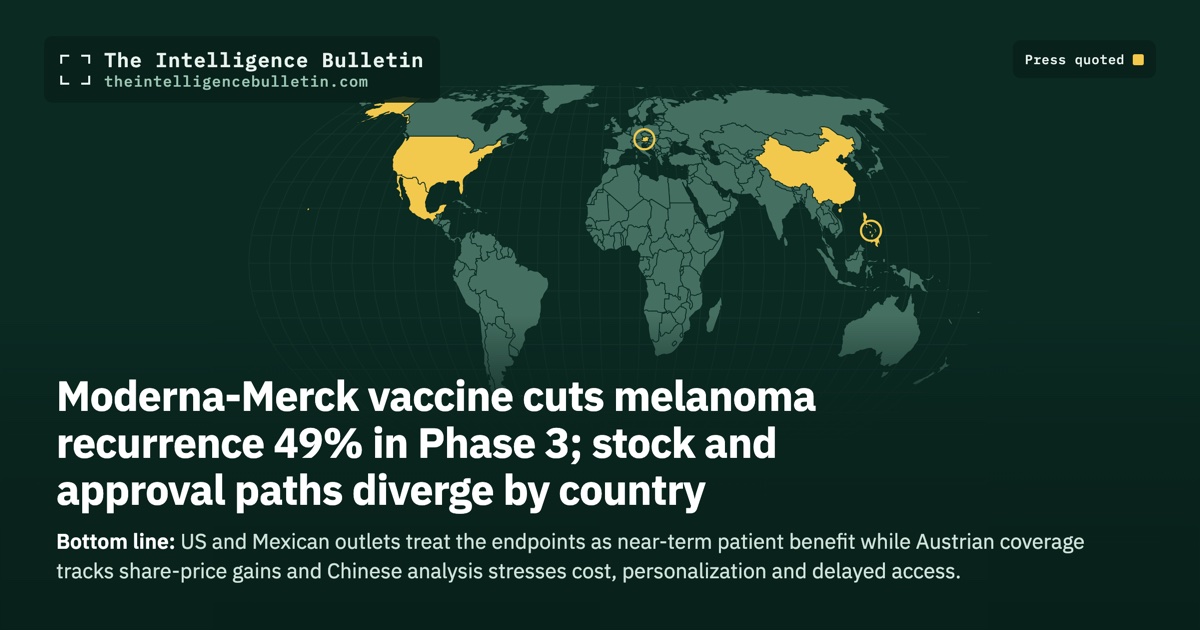
US and Mexican outlets treat the endpoints as near-term patient benefit while Austrian coverage tracks share-price gains and Chinese analysis stresses cost, personalization and delayed access.
The reporting converges on the core trial outcome but diverges sharply on stakes and next steps. US coverage from KTBB stresses the 49% reduction in recurrence risk and 59% drop in distant spread after surgery, positioning the combination as the first to extend meaningful benefit beyond Keytruda alone and quoting oncologist expectations of approval by early 2027. Mexican reporting at Forbes echoes the recurrence and spread reductions while highlighting hopes for broader solid-tumor applications and noting Moderna’s stock surge. Austrian financial outlet Boerse Express centers the Phase-3 milestone’s effect on Moderna shares, analyst target upgrades up to $170, and institutional buying. Philippine Manila Times carries a GlobeNewswire release framing the result as validation that de-risks similar LNP-mRNA platforms for smaller firms like CancerVax. Chinese analysis at Huxiu stresses that the vaccine is therapeutic only, personalized and expensive, limited to post-surgical adjuvant use in melanoma, unlikely to reach patients before 2027-2029, and cautions against premature optimism given missing overall-survival data. The split reveals how the same endpoints read as imminent clinical advance in some markets and as a still-distant, high-cost platform proof in others.
Perspective Analysis
Moderna and Merck disclosed on August 19 that their personalized mRNA vaccine intismeran autogene, given with Merck’s Keytruda, met both its primary endpoint of recurrence-free survival and its secondary endpoint of distant metastasis-free survival in the Phase 3 INTerpath-001 trial. The study enrolled 1,137 patients whose high-risk stage IIB-IV melanoma had been completely resected. Participants received up to nine doses of the combination or Keytruda alone for roughly a year. The companies described the improvements as statistically significant and clinically meaningful, though they withheld the full numerical dataset for presentation at an upcoming international medical meeting.
The 49 percent reduction in recurrence risk and 59 percent reduction in distant-metastasis risk versus Keytruda alone come from earlier Phase 2 data that the Phase 3 readout confirmed in direction. KTBB News reported these percentages directly from the trial readout and noted that the regimen is the first to demonstrate a survival-extension benefit beyond Keytruda monotherapy in this setting. Forbes Mexico carried the same reductions and added that the vaccine trains the immune system against patient-specific neoantigens identified through tumor sequencing. Huxiu likewise referenced the 49 percent and 59 percent figures from prior data and confirmed the Phase 3 endpoints had been reached.
The vaccine is manufactured individually for each patient. Tumor and healthy tissue are sequenced, mutations are identified, and an AI tool selects up to 34 neoantigens most likely to trigger an immune response. The corresponding mRNA is then produced and packaged in lipid nanoparticles. This process makes the therapy therapeutic rather than preventive; it can only be administered after a cancer diagnosis and after surgery. No outlet reported overall-survival data, which remains a secondary endpoint still maturing.
Regulatory steps lie ahead. The companies intend to engage the FDA once the complete dataset is submitted. KTBB quoted Dr. Ahmad Tarhini of the H. Lee Moffitt Cancer Center stating that he expects approval and availability to patients by early 2027. Forbes Mexico reported that Moderna president Stephen Hoge said the therapy could reach the market as soon as next year if regulators grant breakthrough designation. Huxiu noted that even an expedited FDA review typically requires at least six months to a year after submission, and the trial’s official completion date listed in company documents is October 2029.
Market reaction appeared in one detailed account. Boerse Express recorded an 8.6 percent single-day gain for Moderna shares on the announcement, bringing the year-to-date advance to 367 percent. Analysts at Bank of America lifted their price target from 40 to 170 dollars, Goldman Sachs raised its target to 120 dollars, and UBS, RBC and Morgan Stanley issued comparable upward revisions. BlackRock disclosed a 7.66 percent stake. The same outlet noted that Moderna remains unprofitable, posting a 782 million dollar net loss on 145 million dollars of revenue in the second quarter.
A separate press release carried by The Manila Times framed the result as validation for other developers using the same lipid-nanoparticle mRNA platform. CancerVax, a preclinical company pursuing an off-the-shelf universal vaccine, stated that the INTerpath-001 readout de-risks the delivery technology it plans to apply to non-personalized candidates.
Accounts diverge on what the result implies for patients and timelines. KTBB and Forbes Mexico foreground near-term clinical utility and the possibility of expanded use against lung, breast and pancreatic cancers. Forbes Mexico quoted Karen Knudsen of the Parker Institute calling the data the start of a new phase in solid-tumor immunotherapy. Boerse Express treats the event principally as a corporate-finance milestone. Huxiu emphasizes constraints that remain unchanged: the vaccine cannot be used prophylactically, cannot be stockpiled because each dose is patient-specific, and carries manufacturing costs comparable to CAR-T therapies. It notes that melanoma incidence in China is low—0.4 per 100,000 men and 1.3 per 100,000 women—and that broader applicability will require additional trials whose completion dates are years away.
The most tightly corroborated elements are the trial endpoints and the magnitude of risk reduction reported in the Phase 2 data now reinforced by Phase 3. Four independent reporting chains—US health coverage, Mexican business reporting, Austrian financial analysis, and Chinese specialist commentary—all state that the combination met recurrence-free and distant-metastasis-free survival targets. The stock-price and analyst-target movements rest on a single detailed chain and are therefore narrower in corroboration. The limitations on use, cost, and timeline receive their most explicit treatment in the Chinese analysis, which draws directly from the trial design and regulatory precedents rather than from market sentiment.
What to Watch
The clinical data therefore stand on firmer ground than either bullish market projections or blanket optimism about rapid patient access. Because the therapy must be manufactured per patient after sequencing, even swift regulatory approval will leave a lag of months between prescription and first dose. The absence of overall-survival results at this interim point means the survival-extension language used in some coverage rests on recurrence and metastasis endpoints rather than direct mortality data. Readers who encounter only the US or Mexican accounts will receive an impression of imminent standard-of-care change that the manufacturing and regulatory realities described elsewhere make less certain. Readers who encounter only the financial or cautionary accounts will miss the concrete risk reductions already observed in more than a thousand patients. The evidence that has converged across chains points to a platform proof-of-concept whose translation into routine practice will be slower and more expensive than the headline endpoints alone suggest.
That’s how the world told the story.
Get our daily open-source intelligence on world events in your inbox — one email a day, up to six stories.
Subscribe freeNo spam. One-click unsubscribe. See the latest email →