 AI-generated analysis published under the editorial responsibility of Rohit Sinnas. How it works →
Press quoted
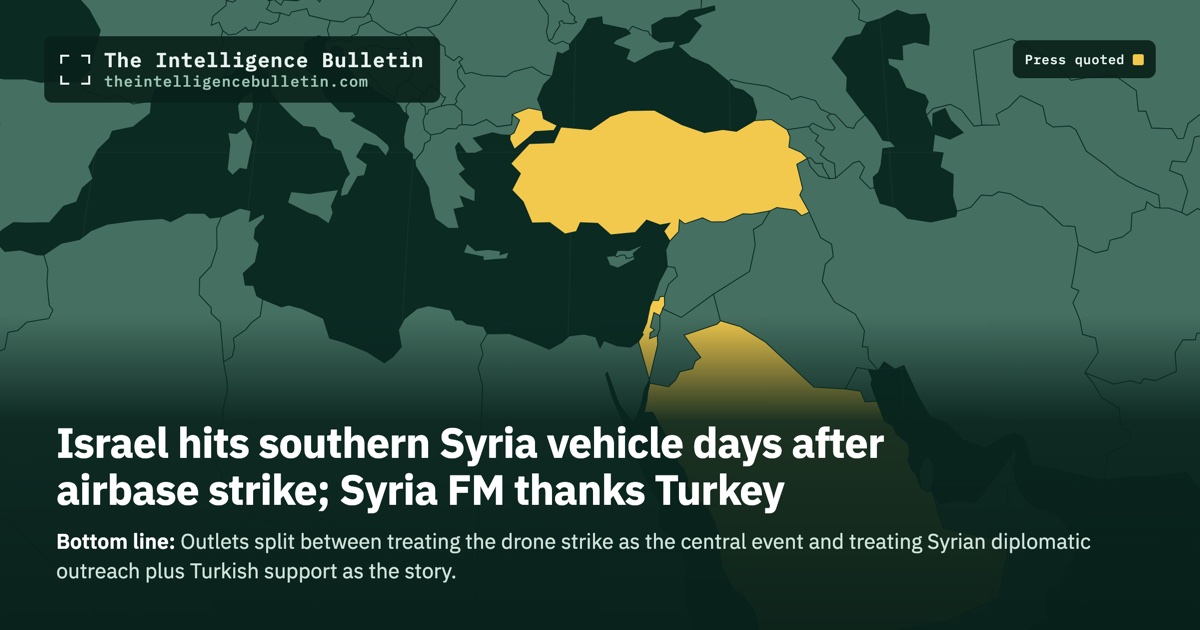
Outlets split between treating the drone strike as the central event and treating Syrian diplomatic outreach plus Turkish support as the story.
Reporting across the set converges on a narrow factual core: an Israeli drone strike in southern Syria followed the Abu al-Duhur airbase attack, prompted Syrian condemnation, and drew US criticism from envoy Tom Barrack, while Syria’s foreign minister used a Reuters interview to affirm reliance on Turkish support and openness to renewed security talks despite zero current trust. The accounts diverge sharply on framing and omission. The UK outlet centers the latest strike as the event itself and records both Israeli military claims and Syrian ministry statements without mediation gloss. Israeli analysis frames the entire sequence as defensive intelligence response to Turkish expansion, treating the airbase raid as preemptive. Turkish coverage amplifies the Syrian minister’s explicit thanks to Ankara and rejection of Israeli justifications. US-based and Saudi outlets, carrying AFP and Reuters copy, emphasize the Jordan talks on de-escalation and insulation from Israel-Turkey friction, presenting diplomacy as the through-line even as contacts are described as frozen. No independent chain contradicts the strike or the minister’s quoted remarks; the real split is whether the episode is an unprovoked escalation, a justified counter to Turkish moves, or a temporary setback to US-brokered de-escalation already in motion. The absence of Turkish or Israeli on-the-record rebuttals in most pieces leaves the Syrian account standing as the most widely carried diplomatic voice.
Full analysis
Israel launched a drone strike on a civilian vehicle near the town of Beit Jinn in Syria’s Damascus countryside on August 23, 2026, wounding one man. Syrian state media reported the attack, and Syria’s Ministry of Foreign Affairs condemned it as a flagrant violation of sovereignty and a breach of international law that fit a pattern of repeated strikes on Syrian territory. Israel’s military confirmed the operation and said it had targeted a terrorist whose activities posed an immediate threat to Israeli forces and were in the final stages of preparation for attacks.
The strike came five days after Israel bombed the Abu al-Duhur airbase in Idlib province. Israeli officials described that earlier raid as an effort to prevent Turkey from establishing a military presence at the site. Both Syrian and Turkish officials had denied any such plans before the attack occurred. The airbase strike drew public criticism from United States special envoy Tom Barrack, who called it an unnecessary escalation and suggested it might have been intended to provoke Turkey ahead of Israeli elections. Israeli Defense Minister Israel Katz stated that intelligence had been shared with senior Syrian government figures and with the United States, contradicting Barrack’s claim that no advance warning had been given.
Syrian Foreign Minister Asaad al-Shaibani addressed the broader context in a Reuters interview published on August 23. He said Damascus remained grateful for Turkish assistance in rebuilding its armed forces and would not give up that support. He also said Syria currently had no trust in Israel, that contacts had been cut after the airbase strike, and that negotiations on a security agreement had been frozen since the start of the Iran war. At the same time he expressed the expectation that talks would resume soon, describing diplomacy as a historic opportunity Israel should seize and noting that brute force had not delivered security for Israel in other arenas. The minister added that the priority remained an end to Israeli airstrikes and airspace violations even before any formal agreement.
A separate account of diplomatic activity came from Syrian state media and sources speaking to Agence France-Presse. They reported that a high-level Syrian delegation led by the foreign minister and including the heads of general and military intelligence met an Israeli delegation in Jordan on August 23 under American mediation. The meeting discussed de-escalation after recent strikes, the establishment of a special operations room in Jordan to prevent confrontations involving Turkey, and steps to keep tensions between Israel and Turkey from spilling onto Syrian territory. The same sources described the session as the first high-level contact in several months and said the two sides had previously agreed on paper to most elements of a security arrangement that would include buffer zones and limits on Israeli operations.
These events sit against the background of Israeli operations in Syria since the fall of Bashar al-Assad in December 2024. Israel has conducted hundreds of strikes, deployed troops into the United Nations-patrolled buffer zone on the Golan Heights, and maintained a presence in a southern security zone. Washington has pressed for a formal security deal between Israel and the new Syrian authorities under President Ahmed al-Sharaa, yet implementation has stalled amid mutual suspicions.
The published reporting converges on several points that can be stated without contradiction. Israel carried out the August 23 drone strike near Beit Jinn, Syria condemned it, and the foreign minister used a widely carried interview to praise Turkish military cooperation while stating outright that trust in Israel was absent. Syrian and Turkish officials had rejected Israeli claims about Turkish intentions at Abu al-Duhur before that earlier raid. The single-source account of the Jordan meeting adds a layer of ongoing diplomatic activity that is not contradicted by other material but rests on Syrian state reporting and AFP sourcing.
Where the accounts diverge is in emphasis and framing. One United Kingdom outlet placed the southern drone strike at the center of its story and recorded both the Syrian ministry statement and the Israeli military justification alongside the American envoy’s criticism, without foregrounding intelligence rationales or mediation efforts. An Israeli outlet presented the sequence of strikes as a response to Turkish military expansion, drawing on domestic intelligence assessments that treat the airbase raid as a preemptive step against an emerging threat. A Turkish outlet used the foreign minister’s interview to underscore Syrian gratitude for Ankara’s role and to highlight Damascus’s rejection of Israeli justifications for the raids. Outlets carrying agency copy from the United States and Saudi Arabia gave greater weight to the Jordan talks and the effort to insulate Syria from Israel-Turkey friction, presenting diplomacy as the continuing thread even while noting that direct contacts had been severed.
A reader limited to any single national outlet would therefore miss either the concrete details of the latest strike and the American rebuke, the explicit Israeli linkage to Turkish activity, the Syrian minister’s public thanks to Turkey, or the reported Jordan channel aimed at containing spillover. The Reuters interview itself appears in more than one outlet, so its content on Turkish support and the absence of trust functions as a shared diplomatic statement rather than an isolated view. The Jordan meeting, by contrast, remains tied to one reporting chain and Syrian state confirmation.
The corroborated record shows that Israel conducted the strike, that Syrian and Turkish denials preceded the airbase raid, and that the foreign minister chose to pair criticism of Israel with explicit appreciation for Turkish assistance. The Israeli justification for acting against perceived Turkish moves stands as that government’s on-record position. The Syrian account of severed contacts alongside continued openness to talks is the most widely distributed diplomatic voice. The Jordan meeting, though narrower in sourcing, aligns with the foreign minister’s stated hope that negotiations could restart and with the American envoy’s broader push for de-escalation mechanisms.
What to Watch
The episode therefore registers as an escalation that has not yet closed the diplomatic track. Israel retains the capacity and stated rationale to act against what it sees as Turkish encroachment, while Syria’s public posture combines reliance on Turkish backing with an invitation for renewed security talks under American pressure. The next moves will likely turn on whether the Jordan channel produces visible limits on Israeli operations or whether further strikes test the durability of that channel.
That’s how the world told the story.
Get our daily open-source intelligence on world events in your inbox — one email a day, up to six stories.
Subscribe freeNo spam. One-click unsubscribe. See the latest email →