 AI-generated analysis published under the editorial responsibility of Rohit Sinnas. How it works →
Press quoted
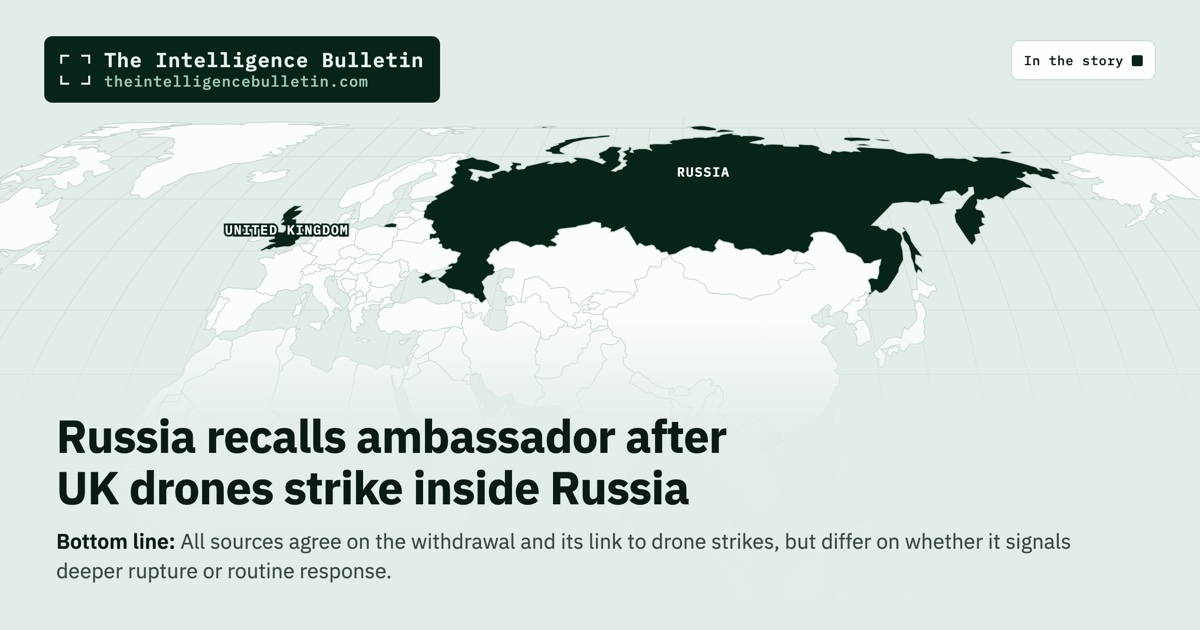
All sources agree on the withdrawal and its link to drone strikes, but differ on whether it signals deeper rupture or routine response.
The reporting across these outlets converges on the same sequence: Kelin departed in July, the embassy accused Britain of choosing confrontation after drone revelations, and no successor has been appointed. What stands out is how little the accounts differ on the mechanics while diverging on tone. The Guardian and Express both tie the recall to recent drone strikes and embassy statements threatening consequences, presenting it as evidence of strained relations without claiming a full break. Focus News, citing The Independent, simply records the Russian accusation and the drone context as the trigger. This pattern shows the story travels as a factual diplomatic signal rather than a disputed narrative. The absence of any outlet in the set from Russia itself means all accounts of Moscow’s intent come through British or third-country relays of embassy remarks. The shared emphasis on the drone issue and the lack of replacement suggests the move is being read as deliberate signaling rather than routine rotation, even as UK sources note communication channels have already deteriorated sharply since 2022.
Full analysis
Russia withdrew its ambassador to the United Kingdom in July 2026, leaving the post vacant with no successor named as of late August. Andrey Kelin, who had served since 2019, concluded his mission on 21 July according to statements from the Russian embassy in London. The embassy described the departure as the end of a seven-year posting and noted that Kelin had sought to maintain communication channels, though relations had reached an “unprecedentedly low level” due to British policy choices.
The timing aligned with fresh accusations from the same embassy over Ukraine’s use of British-supplied drones. Reports emerged that Ukrainian forces had employed drones manufactured in Britain, including the jet-powered Nyan model tested by the Royal Navy, to strike Russian oil refineries near Moscow, in Yaroslavl and Volgograd, and targets near Belgorod. The embassy stated that London was acting as an accomplice in “bloody crimes and terrorist acts” and that its actions would “inevitably carry consequences for which it will have to answer.” A separate comment warned Britain against following a “path of confrontation” and urged reconsideration of its policies toward Russia.
British officials treated the withdrawal as a unilateral Russian decision. A Foreign Office spokesperson said the matter rested with Moscow’s foreign ministry and that Britain maintained its own embassy in the Russian capital to raise concerns. The same statement reaffirmed that Britain would continue to stand with Ukraine, which retained the right to defend itself. Prime Minister Andy Burnham responded to the embassy’s warnings by declaring that Britain would support Ukraine at 100 percent.
The absence of a replacement ambassador has drawn attention because such gaps are not unknown in diplomatic practice. A former British defence attaché, John Foreman, observed that the move could represent a permanent downgrading by default if Moscow chose not to fill the post. The embassy itself later clarified that its remarks did not imply an intention to downgrade formal relations. Kelin had previously appeared in British media repeating official Russian positions, including the assertion that Russia could not lose the war in Ukraine.
Coverage of these events appeared in outlets from Britain and Bulgaria. The Guardian and the Daily Express both placed the recall in the context of the drone strikes and the embassy’s public warnings, describing the episode as evidence of sharply deteriorated ties since the full-scale invasion of Ukraine began. The Bulgarian Focus News outlet, drawing on reporting in The Independent, presented the same sequence as a straightforward Russian reply to London’s continued backing of Kyiv, listing the specific drone models and the targets struck inside Russia without additional commentary on the state of bilateral relations.
The accounts converge on the core sequence and the role of the drone reports as the immediate trigger. All three sources record Kelin’s departure in July, the lack of a named replacement, the embassy’s language about consequences and confrontation, and the British government’s decision to maintain its support for Ukraine. Differences appear mainly in emphasis. The two British publications link the episode to a longer pattern of strained communication that predates the most recent drone claims, while the Bulgarian article keeps the focus narrower on the stated Russian rationale and the prime minister’s reply.
A reader who encountered only the Bulgarian account would see a concise diplomatic exchange without reference to the historical backdrop of ambassadorial relations since 2018. A reader limited to the British articles would encounter additional detail on Kelin’s media appearances and on expert views about whether the vacancy signals a lasting reduction in ties, but would still find the same factual spine as the Bulgarian report. No source in the set contradicted another on the timing, the drone connection, or the content of the embassy statements.
The convergence itself supplies the clearest signal available from the published record. Multiple independent reporting chains, working from the same Russian embassy remarks and British government responses, produced matching accounts of what occurred and why the Russian side said it had acted. That pattern suggests the withdrawal functions as deliberate signaling rather than an unannounced rotation. Because the selected sources contain no direct Russian domestic coverage, every statement attributed to Moscow reaches readers through British or third-country relays of embassy language. The British outlets add context on the pre-existing chill in relations, while the Bulgarian piece registers the event as a discrete response to a specific policy dispute.
What to Watch
The most reliable reading, therefore, is that Moscow chose this moment to register displeasure over the drone supply line and to test whether Britain would adjust course. The lack of a replacement keeps the option open for further adjustment or for a quiet restoration of the post if conditions change. British policy, as stated on the record, shows no sign of alteration. The episode adds one concrete diplomatic marker to the running record of Ukraine-related friction without, on present evidence, closing the remaining channels between the two capitals.
That’s how the world told the story.
Get our daily open-source intelligence on world events in your inbox — one email a day, up to six stories.
Subscribe freeNo spam. One-click unsubscribe. See the latest email →