 AI-generated analysis published under the editorial responsibility of Rohit Sinnas. How it works →
Press quoted
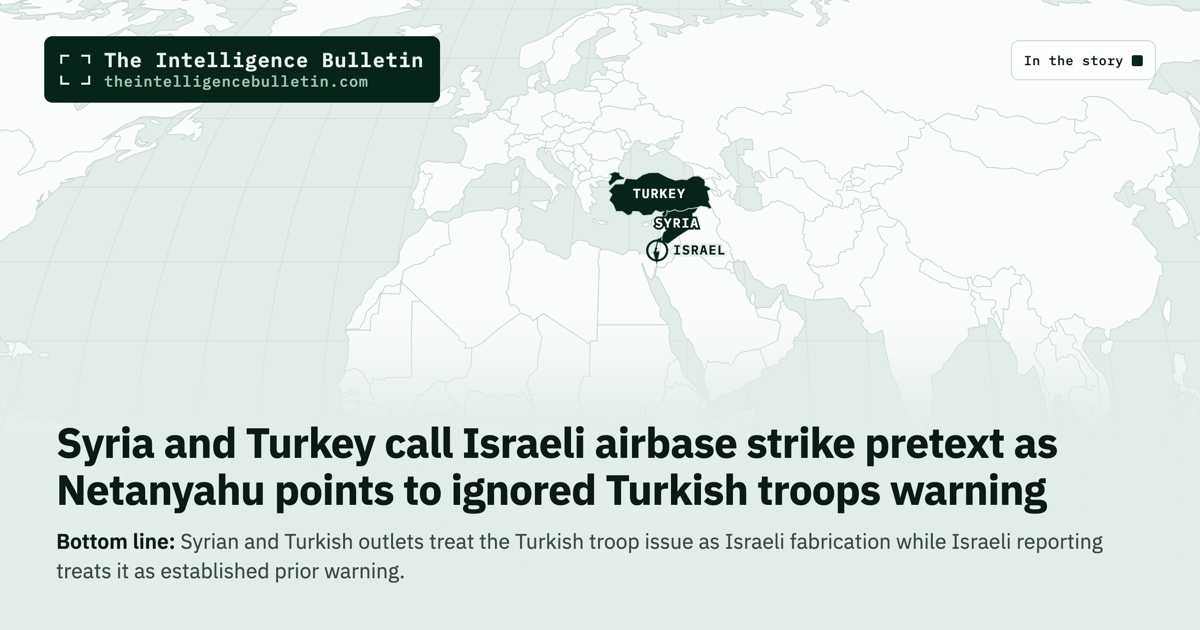
Syrian and Turkish outlets treat the Turkish troop issue as Israeli fabrication while Israeli reporting treats it as established prior warning.
The reporting across Syrian, Turkish, Israeli and US-linked outlets reveals a clear split on motive but convergence on the strike’s occurrence and lack of casualties. Syrian state media frames the attack as part of a pattern of Israeli aggression since late 2024 that undermines Syria’s stability efforts, holding Israel responsible and appealing to the UN. Turkish coverage and statements treat Israeli security warnings as fabricated pretexts for Netanyahu’s domestic political gain ahead of elections, while affirming ongoing cooperation with Syria’s new government. Israeli reporting details prior warnings to Syria, shared US intelligence on runway rehabilitation and Turkish delegation visits, and positions the strike as a necessary defense of air superiority. US envoy statements, carried in Israeli and US outlets, add an external layer of concern over escalation risks and the absence of advance notice to Turkey, while pushing for trilateral deconfliction talks. This pattern shows the core factual event is not in dispute, but the Turkish troop presence at the base is presented either as a legitimate security threat or an invented justification, with no independent reporting chain bridging the two accounts. The US mediation push stands out as the element least emphasized in direct Syrian or Turkish state accounts.
Full analysis
Israel carried out airstrikes on the Abu al-Duhur military airbase in Syria’s Idlib province on August 18, 2026. The base sits roughly 17 miles east of Saraqib in the eastern countryside, near the village of Abu al-Duhur, occupying between 16 and 23 square kilometers in a position that links the provinces of Idlib, Hama and Aleppo and lies close to the Syrian Desert. Reports described damage to runways and storage facilities after four aircraft struck the site. Syrian military sources and a local resident told Reuters that no one was killed or injured.
Syria’s Ministry of Foreign Affairs and Expatriates issued a statement the same day condemning the strikes as a violation of sovereignty and territorial integrity. The ministry called the action an unjustified act of aggression and a dangerous escalation that threatens regional security and stability. It noted that Israel has continued attacks since December 8, 2024, even as Syria exercises restraint and works to consolidate stability. The statement held Israel responsible for the escalation and appealed to the international community and the UN Security Council to condemn the aggression and take a firm stance against repeated violations. Syria, it said, would defend its national rights through legitimate means under international law.
Turkey rejected the Israeli account of events. Its Communications Directorate stated that the allegations put forward by the Israeli Prime Minister’s office were frivolous and aimed at legitimizing unlawful airstrikes targeting Syria’s sovereignty and territorial integrity. Turkey accused Benjamin Netanyahu of pursuing expansionist and destabilizing policies in the region ahead of elections in Israel. The statement said Türkiye, like the vast majority of the international community, stands for lasting peace and that the sole path lies in Netanyahu abandoning aggressive and coercive policies while respecting international law. Türkiye added that it would continue to cooperate with the Syrian government on a legitimate basis for peace, stability and prosperity in Syria and would never allow the destabilization of the country.
Netanyahu’s office responded by saying Israel had repeatedly warned Syria that deployment of Turkish troops from the base would pose a threat to Israel’s security. The office stated that Syria chose to ignore those warnings. Israel, it said, would not tolerate threats to its security and would welcome a return to the status quo. Israeli reporting noted that a Turkish military delegation had visited the base recently to oversee rehabilitation of its runway. Israel had previously conveyed messages to Turkey that it would not accept the rebuilding of the Syrian military or any threat to its air superiority, including possible deployment of air defense systems or advanced drones that could restrict Israeli freedom of action in Syrian airspace.
A US envoy added a separate layer of comment. Thomas Barrack, who serves as both US ambassador to Turkey and special envoy for Syria, said in an interview with Reuters that he was deeply concerned the confirmed Israeli airstrikes constituted an unnecessary escalation that does not advance regional stability. He noted that Turkey had not been warned in advance and therefore could have attacked Israel in response. Barrack said the United States is actively working to establish a deconfliction mechanism involving Israel, Syria and Türkiye to prevent future miscommunication, with the immediate priority to lower tensions and allow space for a more measured approach. He added that Syrian President Ahmed al-Sharaa has not adopted a predatory posture nor maintained proxy forces and has repeatedly indicated a preference for de-escalation with Israel.
The accounts converge on several points. The strike occurred on August 18. It produced no casualties. Turkey maintains a cooperative relationship with the new Syrian government under al-Sharaa, who took power after the ouster of Bashar al-Assad in December 2024. Israel has conducted repeated strikes inside Syria since that change to prevent the rebuilding of military capabilities near its border. Turkey has been involved in training Syrian soldiers to rebuild the country’s armed forces.
The accounts diverge sharply on the question of Turkish troop presence at the base. Netanyahu’s office presented the deployment as a concrete security threat that Syria had been warned against in advance. Turkish statements presented the same claim as a manufactured pretext designed to justify the strikes and advance Netanyahu’s political interests ahead of elections. No reporting chain from an independent source outside these two positions bridges the gap or provides contemporaneous evidence that would allow a reader to weigh one description against the other.
A reader limited to Syrian state coverage would see only the pattern of Israeli attacks since December 2024 and the call for international condemnation, with no mention of prior warnings, Turkish delegation visits, or US mediation efforts. A reader limited to Turkish state-linked coverage would encounter only the rejection of Israeli claims and the accusation of expansionist motives, without reference to Israeli statements on air superiority or the details of US envoy comments on deconfliction. Israeli coverage foregrounds the sequence of warnings and intelligence shared with the United States, along with Barrack’s call for talks, but does not carry the full text of Turkish government statements accusing Netanyahu of electoral calculation. US-linked reporting such as Fox News aggregates the Turkish accusations, the Netanyahu office response, and Barrack’s statements, yet still rests on the same split over whether the Turkish presence constituted a genuine threat.
The Turkish denial of any threat rests on official statements from the Communications Directorate that appear across multiple Turkish-linked outlets. The Israeli assertion of prior warnings rests on a single on-record statement from Netanyahu’s office. The US envoy’s assessment of escalation and the absence of advance notice to Turkey also rests on statements attributed to one named official carried through Reuters interviews. The strike itself and the absence of casualties appear in accounts from Syrian sources, Israeli reporting citing Sabereen and local residents, and Western aggregation of those same details.
What to Watch
The Turkish account of motive carries the weight of repeated official statements from the same government across independent reporting chains. The Israeli account of a prior explicit warning carries only the authority of the office that issued it. Barrack’s intervention introduces an external actor with institutional interest in preventing direct confrontation between two NATO members and a new Syrian government that has received US support, including the lifting of broad economic sanctions in June 2026. Absent new primary documents or a third-party record of the alleged warnings, the Turkish position on pretext has the stronger corroboration in the published reporting. The next development most likely to matter is whether the deconfliction mechanism Barrack described moves from discussion to any operational form, because the base’s location makes any future Turkish or Syrian activity there visible to Israeli surveillance and because Turkish training of Syrian forces continues in the same region.
That’s how the world told the story.
Get our daily open-source intelligence on world events in your inbox — one email a day, up to six stories.
Subscribe freeNo spam. One-click unsubscribe. See the latest email →