 AI-generated analysis published under the editorial responsibility of Rohit Sinnas. How it works →
Press quoted
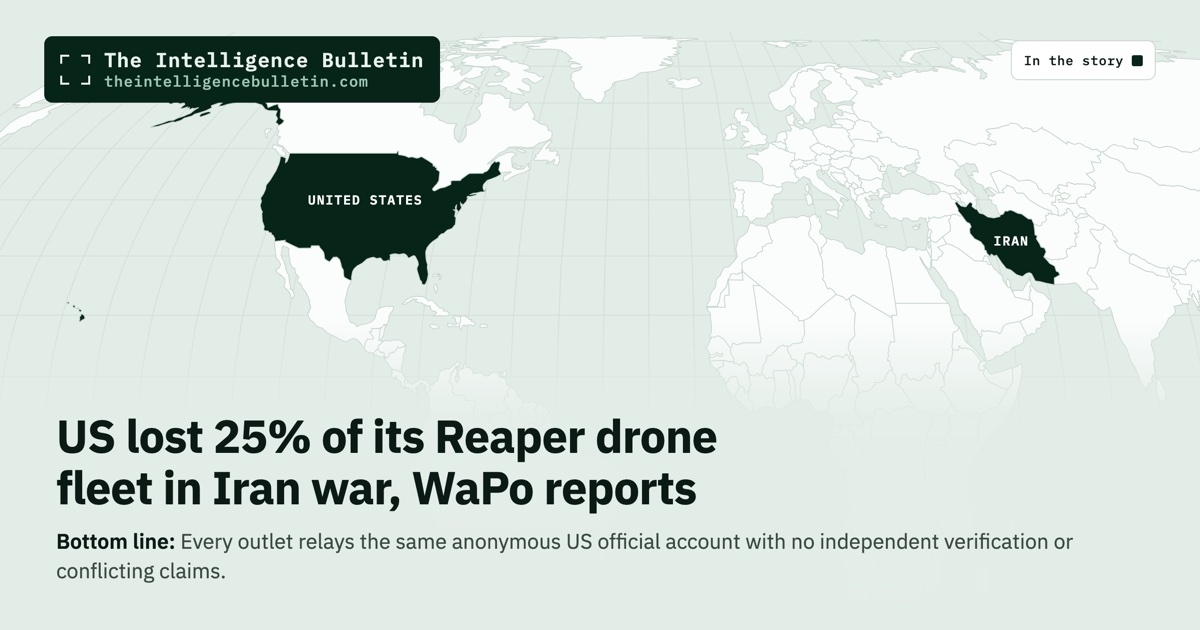
Every outlet relays the same anonymous US official account with no independent verification or conflicting claims.
All five outlets in the source set relay the identical Washington Post account of US drone losses without adding independent sourcing or new claims. The Natural News piece situates the losses inside a broader narrative of US military depletion and high operational costs in the Trump-launched campaign. The Jerusalem Post frames the scale as a strategic setback in the confrontation with Iran. Times of Oman stresses the financial toll and exact fleet percentage. BFMTV and To Pontiki both highlight unit costs and vulnerability over the Strait of Hormuz while noting some crashes stemmed from lost links rather than shootdowns. No source disputes the core numbers or offers an Iranian perspective; the selected coverage converges entirely on one US-origin reporting chain, leaving the event presented solely through American official accounts filtered through international outlets.
Full analysis
The Washington Post reported on August 13 that the United States had lost at least 45 MQ-9 Reaper drones during its conflict with Iran, a figure equal to roughly one-quarter of the fleet that existed when the fighting began. The account, drawn from three anonymous American officials, stated that the losses occurred through a mix of Iranian shootdowns, strikes on U.S. bases, and crashes after communications links failed. The Reapers, built by General Atomics, had been flying extensively over the Strait of Hormuz for surveillance and strikes. Their unit cost ranges from 30 to 50 million dollars depending on configuration, placing the replacement bill for these 45 aircraft between 1.3 billion and 2.25 billion dollars.
The conflict itself opened on February 28, 2026, when President Donald Trump launched Operation Epic Fury. At the outset the Air Force held 165 Reapers and the Marine Corps another 20, for a total near 185. No Marine Corps aircraft were lost in the reported tally. The drones had already seen heavy use against Houthi forces in Yemen in prior years, and the same platforms continued operating in the Strait of Hormuz even after the new losses. One official noted that Iranian forces appeared surprised by the precision of some attacks on the slow, low-flying aircraft. The Pentagon declined to comment on the specific figures.
Every outlet in the selected set published its account by relaying this single Washington Post dispatch. No additional on-the-ground reporting or new sources appeared in any of the five articles. The differences therefore lie entirely in selection, emphasis, and surrounding context each masthead chose to attach to the same core paragraphs.
Natural News placed the losses inside a running ledger of American military expenditure. Its headline led with the billions in replacement costs and wove in references to earlier Bloomberg estimates of one billion dollars already lost to Iranian action. The piece added historical notes on the Reaper’s predecessor, the MQ-1 Predator, and on documented communications failures in other theaters, including an emergency landing in Poland. It also cited American Enterprise Institute research placing the first five weeks of the Iran operation at between 22.3 billion and 31 billion dollars.
The Jerusalem Post headline foregrounded the percentage of the stockpile lost, framing the depletion as a direct setback in the confrontation with Iran. The article stayed close to the Washington Post numbers but situated them within the shared security concerns of the United States and Israel. It did not introduce separate Israeli sourcing.
Times of Oman carried the story under an ANI byline and supplied the precise pre-war fleet split between Air Force and Marine Corps units. It noted that the Marine Corps aircraft, oriented toward the Asia-Pacific, escaped losses. The piece emphasized the financial exposure to taxpayers and recorded that the Pentagon had requested a 67-billion-dollar supplemental war-funding package from Congress to address broader inventory shortfalls.
BFMTV translated and expanded the same dispatch into a French defense-economics frame. It recorded that a quarter of the fleet had been lost in roughly six months and added that U.S. forces had already fired more than 850 Tomahawk cruise missiles and over 1,000 Patriot and THAAD interceptors in the first month of the Iran campaign. The article placed the Reaper shortfall alongside the drain on those systems caused by support to Ukraine, and it noted the administration’s request for tens of billions in new funding. It also mentioned that the Pentagon is shifting toward cheaper, attritable drones to replenish numbers more rapidly.
To Pontiki opened with the 25 percent figure and unit cost range, then added that the drones’ low speed and altitude made them vulnerable not only to Iranian forces but also to Houthi units in Yemen and pro-Iranian groups in Iraq. It cited a cumulative U.S. war cost exceeding 113 billion dollars through the end of June, excluding later strikes, and observed that restoring certain interceptor stocks at current production rates would take decades.
Because the underlying reporting chain is identical, these variations do not produce competing facts about the number of aircraft lost or the causes. They do reveal distinct editorial priorities. The American outlet treated the episode as one data point in a larger domestic debate over military spending and industrial-base strain. The Israeli outlet highlighted the operational consequence for a common adversary. The Omani outlet, located on the Gulf, stressed the dollar cost and the exact proportion of a visible fleet. The French and Greek pieces both supplied the communications-failure detail and linked the losses to wider ammunition and missile shortfalls, yet each attached a different regional lens: one to European concerns over Ukraine support and funding timelines, the other to Middle East operational vulnerabilities involving Iranian partners.
What to Watch
The single reporting origin means readers of any one of these outlets encounter the same anonymous U.S. official statements, filtered only through the additional sentences each publication chose to keep or insert. No outlet in the set supplied an Iranian government statement, a technical assessment from General Atomics, or independent verification of the crash-versus-shootdown breakdown. The Washington Post account therefore remains the sole source for the 45-aircraft figure and the 25-percent calculation across all five publications.
That’s how the world told the story.
Get our daily open-source intelligence on world events in your inbox — one email a day, up to six stories.
Subscribe freeNo spam. One-click unsubscribe. See the latest email →