 AI-generated analysis published under the editorial responsibility of Rohit Sinnas. How it works →
Press quoted
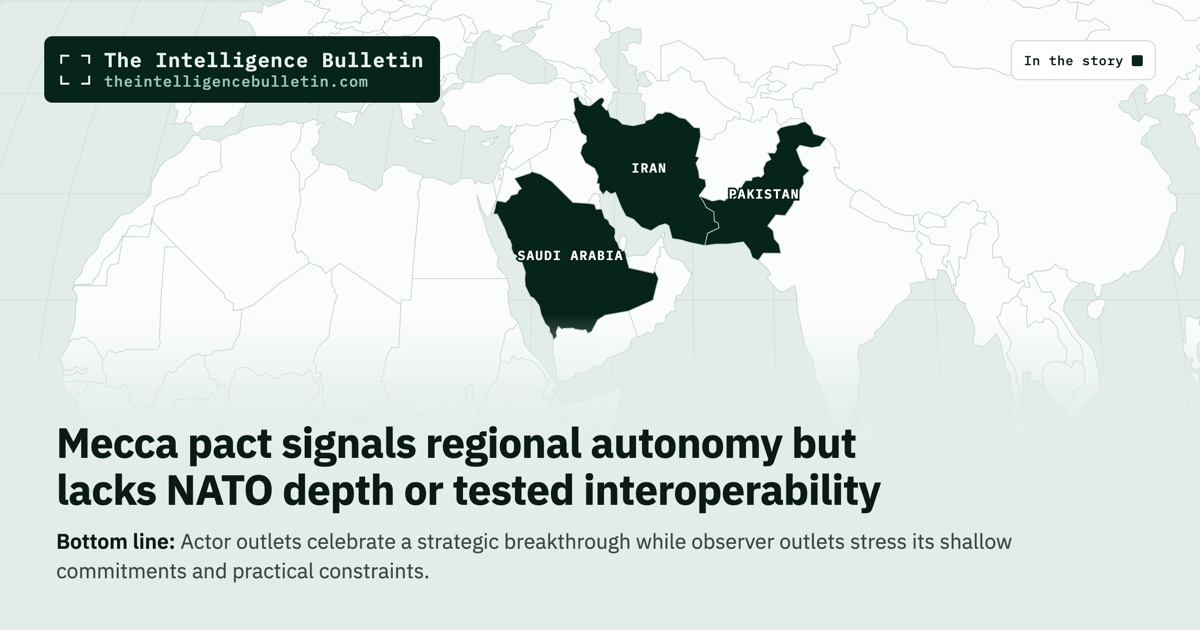
Actor outlets celebrate a strategic breakthrough while observer outlets stress its shallow commitments and practical constraints.
The reporting across these outlets reveals a pact that exists more as a public political statement than a ready military instrument. Pakistani commentary presents it as a historic pivot allowing Muslim states to chart their own course after US involvement in regional war proved inadequate. Turkish official statements frame Ankara’s role as steady support for Pakistan’s security priorities without naming adversaries. Hong Kong and UK-based analysis highlight practical limits: diverging interests between the partners, Pakistan’s China ties clashing with others’ US systems, and the immediate test of non-response to Houthi strikes on Saudi territory. US-focused commentary sees the exclusion of Washington as evidence of eroding leverage, yet notes American officials have not opposed the deal. The most consistent thread is that the three capitals have codified existing bilateral ties rather than created new operational capacity, leaving the agreement’s activation clause untested and its expansion uncertain.
Full analysis
The Mecca Joint Defense Agreement was signed in the first week of August 2026 by Saudi Arabia, Pakistan and Turkey. Its central clause states that an armed attack on any one signatory will be regarded as an attack on all three. The three leaders marked the occasion by praying together in Mecca, an event the agreement’s name recalls. Turkish statements immediately after the signing described the pact as support for Pakistan’s legitimate security concerns and a framework for coordination that would not target any third party. Saudi officials later told reporters the accord was not intended to create a military axis or sectarian bloc and carried no link to nuclear ambitions. Iranian officials, briefed by Pakistan’s foreign minister, described the arrangement as evidence that regional states now recognize security cannot rest on reliance on outside powers.
The agreement builds on long-standing bilateral ties rather than creating them from scratch. Saudi Arabia and Pakistan have maintained close military links for decades, with the kingdom providing financial support during Pakistan’s nuclear program and Pakistani personnel serving in Saudi forces. Turkey and Pakistan have collaborated on naval corvettes and the Kaan fighter jet project. Saudi Arabia recently concluded a large contract with Turkey’s Baykar for Akinci drones that includes technology transfer and local assembly inside the kingdom. The new trilateral text adds a mutual-defense commitment and pledges for joint military exercises plus expanded defense-industry cooperation, yet it leaves the precise triggers for collective action unspecified.
The pact emerged against the backdrop of the recent US-Iran conflict that began in February. Saudi Arabia had faced Iranian missile and drone strikes on its territory; the American security umbrella did not prevent those attacks and in some views drew the kingdom deeper into the fighting. Riyadh conveyed to Washington that the original purposes of the US presence had not been met. The Mecca agreement’s signatories have presented their move as a response to that experience and to Israel’s conduct in Gaza, which they say has eroded confidence in external guarantees. At the same time, the text explicitly avoids naming Iran as an adversary, and Iranian officials have expressed appreciation for the briefing they received.
Reporting from the three capitals and from outside observers diverges sharply on what the agreement actually delivers in practice. Pakistani commentary presents the pact as a historic pivot that allows the Muslim world to make its own decisions about its destiny after decades of external division. It credits Pakistan’s civil and military leadership with a pivotal role in wresting the outcome from adversaries and portrays the arrangement as opening space for a new strategic order that could reshape the wider global balance. Turkish official remarks stay narrower, stressing Ankara’s readiness to back Pakistan’s security priorities through established coordination mechanisms. Neither account dwells on immediate operational tests.
Outside reporting raises concrete questions about capacity and interoperability. Observers note that Pakistan’s main arms supplier is China while Saudi Arabia has long relied on US systems and Turkey fields its own platforms alongside NATO-standard equipment. These differences create practical barriers to rapid integration. The same reporting records that Houthis attacked a Saudi refinery at Jazan shortly after the signing and that neither Pakistan nor Turkey provided a military response. Analysts comparing the Mecca arrangement with the UAE-Israel partnership point out that the latter produced visible operational cooperation, including Israeli air-defense batteries sent to the Gulf and joint strikes, whereas the Mecca text remains untested in any comparable crisis.
The accounts also differ on the pact’s relationship to the United States. One line of analysis holds that the exclusion of Washington from the new framework chips away at American leverage over arms sales, basing rights and crisis management in the region, even if US officials have not opposed the deal and view it as compatible with burden-sharing goals. Another line emphasizes that the three signatories already maintain deep individual ties with Washington, so the pact does not create a clean break. Iranian commentary welcomes the development as validation of its long-standing argument that regional security is indivisible and should rest on local arrangements rather than foreign guarantees.
A reader who follows only Pakistani sources would conclude that the agreement marks a decisive shift toward Muslim-world autonomy with Pakistan at its center. A reader limited to Turkish official statements would see a measured defensive partnership focused on one ally’s concerns. A reader of Hong Kong or UK-based coverage would instead absorb repeated cautions about diverging threat perceptions, mismatched equipment and the absence of demonstrated mutual defense in the first real test. US-focused analysis would foreground the implications for Washington’s regional role while noting that American officials have refrained from objection.
The evidence that most directly addresses these differences lies in the documented non-response to the Jazan attack and in the explicit descriptions of incompatible military supply chains. Those details appear in reporting that draws on multiple regional and Western analysts rather than on any single government narrative. Existing bilateral projects between the three countries are real and long-standing, yet the addition of a collective-defense clause has not yet produced joint action or resolved the technical mismatches that would be required for it to function at scale. The pact therefore codifies political convergence that already existed and sets a framework whose operational content remains to be filled.
What to Watch
The most reliable reading is that the agreement functions primarily as a public political statement rather than an immediately usable military instrument. The absence of any coordinated response to the refinery attack, the acknowledged differences in weapons systems, and the repeated insistence by signatories that the pact threatens no one all point in the same direction. The three governments have an interest in presenting the text as a significant achievement, while outside observers have an interest in testing whether the headline commitment survives contact with the next crisis. The next several months will show whether the planned exercises and industry cooperation produce measurable integration or whether the clause on collective defense stays dormant.
That’s how the world told the story.
Get our daily open-source intelligence on world events in your inbox — one email a day, up to six stories.
Subscribe freeNo spam. One-click unsubscribe. See the latest email →