 AI-generated analysis published under the editorial responsibility of Rohit Sinnas. How it works →
Press quoted
Proximate outlets center missile origins and regional stakes while distant ones lead with casualty numbers and escalation.
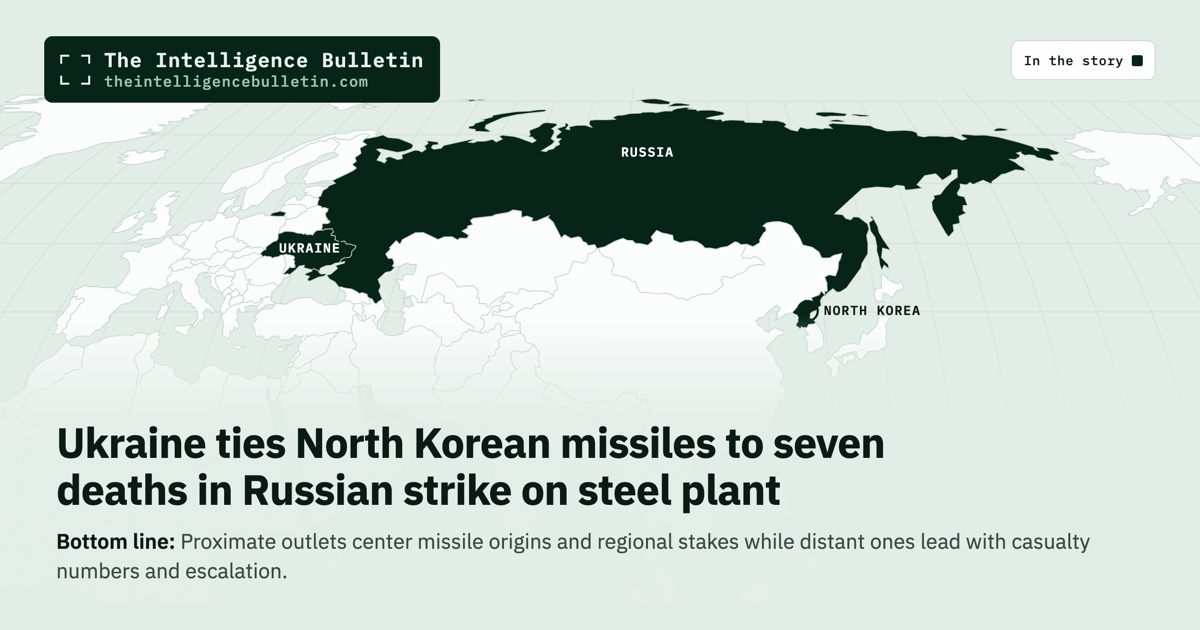
The reporting converges on Ukrainian claims that North Korean missiles struck the Zaporizhzhia steel plant, with casualty counts aligning at seven deaths there across independent accounts even as total fatalities range from seven to ten depending on how far each outlet extended its scope to other strikes. Outlets with direct stakes in North Korea or Ukraine foreground the missile provenance and its implications for future threats to Asia, while more distant coverage treats the attribution as secondary to the human toll and Russian escalation. The Kyiv Post piece notably uses the attack to frame a subsequent North Korean ballistic missile test as validation of Zelensky’s earlier warning to Japan, South Korea and the Philippines, a linkage absent from the others. Japanese reporting stresses the industrial target and Russian military justification without endorsing the North Korean origin claim. No source records any Russian comment on the missile type, leaving the attribution resting on a single reporting chain from Ukrainian authorities. This distribution shows how geographic proximity to the actors shapes whether the story is told primarily as evidence of transnational arms flows or as another increment in civilian casualties.
Full analysis
Russian missile strikes hit the Zaporizhzhia region of Ukraine on the night of August 11, 2026, killing seven workers at the Zaporizhstal steel plant operated by Metinvest Group. The workers were heading to shelter after an air-raid alert when a ballistic missile struck, according to the company statement carried across multiple outlets. The attack also damaged a blast furnace and other equipment, halting production at the plant and reducing capacity at related sites. Four residential buildings and vehicles caught fire, and at least 24 people were injured in the city overall.
Ukrainian President Volodymyr Zelensky stated that the Zaporizhzhia attack involved North Korean ballistic missiles along with Russian Zircon hypersonic missiles and guided aerial bombs. He described the strike as calculated to inflict maximum damage on civilian infrastructure. Ukrainian officials reported that three additional civilians, including a 15-year-old boy, died in drone and artillery strikes in the neighboring Dnipropetrovsk region the same night. Broader Russian attacks that evening also struck a children’s hospital grounds in Kyiv, shattering windows but causing no injuries because patients and staff were sheltered underground, and hit a warehouse in the capital.
Russian authorities said their forces targeted a metallurgical plant in Zaporizhzhia that produces flat-rolled steel used by the Ukrainian military. They also reported striking a Nova Poshta sorting complex in Kyiv described as distributing dual-use goods including drone and electronic warfare components. No Russian statement in the coverage addressed the Ukrainian claim of North Korean missile involvement.
Zelensky has repeatedly accused Russia of receiving additional ballistic missiles from North Korea and preparing to deploy between 30,000 and 50,000 North Korean troops on Russian territory. He tied this cooperation to an earlier strategic partnership agreement signed in 2024 between Moscow and Pyongyang. Ukrainian intelligence has reported that a North Korean missile unit began moving into western Russia with up to 120 ballistic missiles and six launchers. North Korean troops already sent to Russia gained combat experience in the Kursk region, according to the same statements.
The day after the Zaporizhzhia strike, North Korea launched a ballistic missile from the Wonsan area that flew roughly 700 kilometers before landing outside Japan’s exclusive economic zone. South Korean and Japanese authorities tracked the launch, which reached a maximum altitude of about 90 kilometers. Japan lodged a diplomatic protest. Zelensky had warned one day earlier that North Korea’s military cooperation with Russia threatened Japan, South Korea, and the Philippines by giving Pyongyang real-world testing of its weapons and troops.
Coverage of these events shows clear differences in emphasis tied to each outlet’s location and focus. The Kyiv Post article used the Zaporizhzhia deaths to pivot immediately to the subsequent North Korean missile test, presenting it as direct validation of Zelensky’s warning to Asian nations about the risks of deepened Moscow-Pyongyang ties. NK News, based in South Korea, centered Zelensky’s accusation of North Korean missile use and Ukraine’s shortage of advanced air-defense interceptors capable of countering ballistic threats. Japan Today reported the seven deaths at the steel plant, included the Russian justification that the facility supplied the Ukrainian military, and relayed the Ukrainian attribution of North Korean missiles without strong endorsement. The Times of India led with a total of at least ten civilian deaths across Ukraine that night and placed Zelensky’s North Korean missile accusation within a wider account of escalation. Infobae, reporting from Argentina, stressed the human cost of nine deaths and repeated Zelensky’s claims about both missiles and prior North Korean troop deployments to Russia.
These variations mean a reader limited to one outlet receives a narrower picture. An Indian or Argentine reader encounters the story primarily as another round of civilian casualties in an ongoing conflict, with the North Korean element appearing as one supporting detail rather than the central development. A South Korean reader sees the event through the lens of Pyongyang’s weapons supply and its potential future use closer to home. A Ukrainian reader receives the attack framed as fresh evidence of external reinforcement sustaining Russian operations. Japanese coverage stands apart by balancing the Ukrainian claim with Russian statements about the target’s military purpose.
The corroborated elements across the five articles are the seven deaths at the Zaporizhzhia steel plant, Zelensky’s public accusation that North Korean missiles were used there, and the occurrence of additional civilian deaths elsewhere in Ukraine that night. The claim that Russia has received missiles and troops from North Korea originates entirely from Zelensky and Ukrainian intelligence statements and receives no independent confirmation or rebuttal in any of the published pieces.
The single-source nature of the North Korean missile attribution limits how far any account can be taken as settled. Every outlet that carried the claim traced it back to the same Ukrainian statements without additional sourcing. Geographic proximity clearly influenced framing: outlets based in Ukraine or South Korea treated the supply dimension as the story’s core, while those farther away treated the death toll and general escalation as the primary facts. No article recorded a Russian response specifically addressing whether North Korean missiles were involved, leaving that dimension resting on Ukrainian reporting alone.
What to Watch
The pattern suggests the attribution will continue to function as a diplomatic tool for Ukraine in pressing for more air-defense systems from Western and Asian partners. Outlets closer to the Korean Peninsula already link the events to upcoming joint South Korean-U.S. military exercises, indicating the story will recur whenever North Korea conducts further missile tests or Russia launches additional ballistic strikes. Readers relying on any single national press will miss how the same facts shift in weight depending on whether the outlet views North Korea as a direct security concern or as one distant actor among many in the conflict.
That’s how the world told the story.
Get our daily open-source intelligence on world events in your inbox — one email a day, up to six stories.
Subscribe freeNo spam. One-click unsubscribe. See the latest email →