 AI-generated analysis published under the editorial responsibility of Rohit Sinnas. How it works →
Press quoted
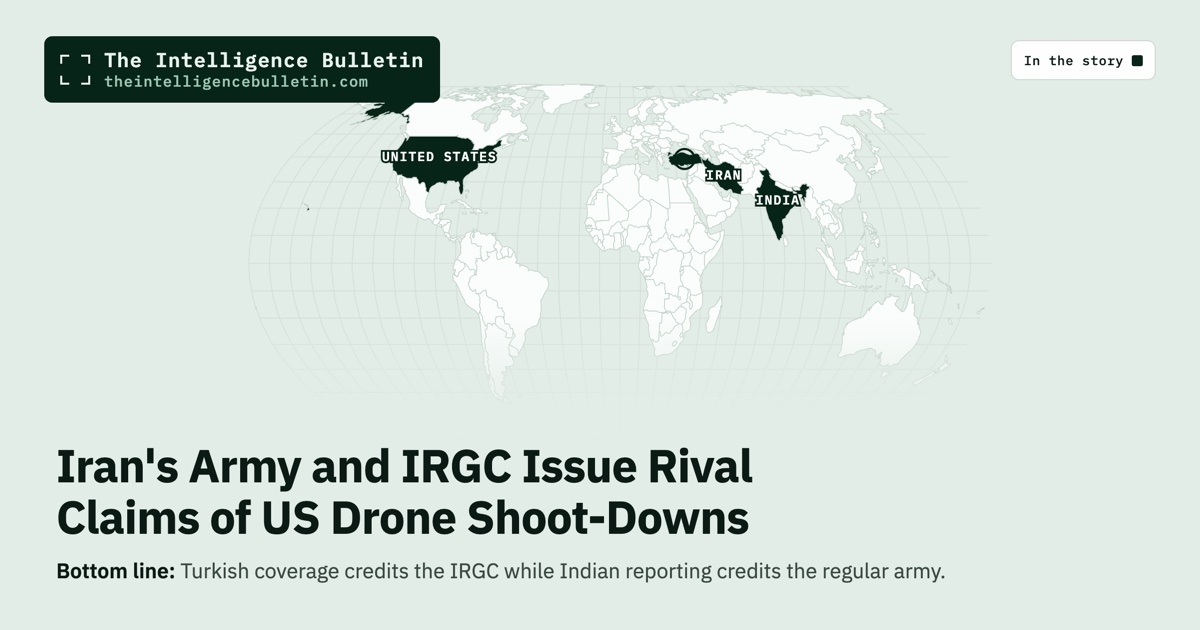
Turkish coverage credits the IRGC while Indian reporting credits the regular army.
Turkish and Indian outlets both carried Iranian claims of downing a US drone but split on which force was responsible. Anadolu Agency led with the IRGC and an MQ-1 model, directly citing state media. ANI instead highlighted the regular army’s Bandar Abbas operation and embedded it in a wider account of US strikes on Iranian air defenses and Iranian missile responses across the Gulf. The divergence tracks the distinct institutional roles each force plays inside Iran: the IRGC as ideological vanguard versus the conventional army as territorial defender. Both reports treat the shoot-down as factual Iranian assertion rather than verified event, reflecting limited independent access to the incident site.
Full analysis
Iran’s regular army and its Islamic Revolutionary Guard Corps each asserted responsibility for downing a separate American drone on July 13, 2026, with the claims emerging against the backdrop of fresh U.S. strikes on Iranian air defenses and Iranian missile responses across the Gulf. The split announcements expose the distinct operational domains these two forces occupy inside Iran and the way external reporting amplifies one side or the other according to the interests of the publishing country.
The army’s statement, carried by Iran’s semi-official Mehr News Agency, described anti-aircraft units detecting, tracking, and destroying a Lucas-type drone in Bandar Abbas County near Hajiabad in southern Iran. The briefing placed the incident within routine air-defense activity aimed at countering enemy attacks and securing national airspace, with no casualties reported. Indian wire service ANI reproduced this account in full and situated it inside a larger sequence of events that included U.S. Central Command strikes on July 12 targeting Iranian air-defense sites, coastal radars, missile infrastructure, and fast-attack craft in the Strait of Hormuz.
Anadolu Agency, Turkey’s state-run outlet, instead led with an Iranian state-media report crediting the IRGC with downing an MQ-1 drone. The Turkish dispatch stayed tightly focused on the Revolutionary Guards’ role and did not reference the army’s Bandar Abbas claim or the surrounding U.S. operations. This narrower framing aligns with Ankara’s direct stake in keeping the Strait of Hormuz open for energy shipments that pass near its southern coast.
The divergence is not accidental. The regular army’s mandate centers on territorial defense of Iran’s borders and major population centers, which makes a shoot-down near a key southern port a natural fit for its public messaging. The IRGC, by contrast, functions as an ideological and expeditionary force with a history of operating beyond Iran’s frontiers, including in the Gulf and against maritime targets. When each service claims its own drone intercept on the same day, the statements function less as competing intelligence assessments and more as assertions of institutional relevance at a moment of heightened tension.
Foreign coverage tracks these institutional lines. ANI’s broader account, which includes CENTCOM’s stated rationale for protecting commercial shipping after an Iranian attack on a container vessel, reflects India’s posture as a non-aligned importer of Gulf energy that prefers to register escalation without endorsing either combatant. Anadolu’s emphasis on the IRGC alone mirrors Turkey’s practical concern with any disruption to the chokepoint that carries a significant share of its imported oil and gas.
Neither report treats the Iranian assertions as independently verified events. Access to the actual sites remains restricted, and U.S. statements released on the same day made no reference to lost drones. The pattern therefore illustrates how unconfirmed Iranian military claims propagate through sympathetic foreign channels, each outlet selecting the version that best matches its government’s strategic priorities in the region.
What to Watch
The immediate consequence is a further muddling of the operational picture at a time when both sides are exchanging strikes. Continued rival announcements from Iran’s parallel military structures are likely to persist as long as the confrontation lasts, because each force has an interest in demonstrating effectiveness to domestic audiences and to the other. For shipping companies and energy markets, the practical effect will be sustained uncertainty over which Iranian actor is operating where and with what rules of engagement, raising the risk that an unintended escalation in the Strait of Hormuz could close the waterway faster than either side intends.
That’s how the world told the story.
Get our daily open-source intelligence on world events in your inbox — one email a day, up to six stories.
Subscribe freeNo spam. One-click unsubscribe. See the latest email →