 AI-generated analysis published under the editorial responsibility of Rohit Sinnas. How it works →
1South Korea and Japan Discuss Military Logistics Pact in Singapore
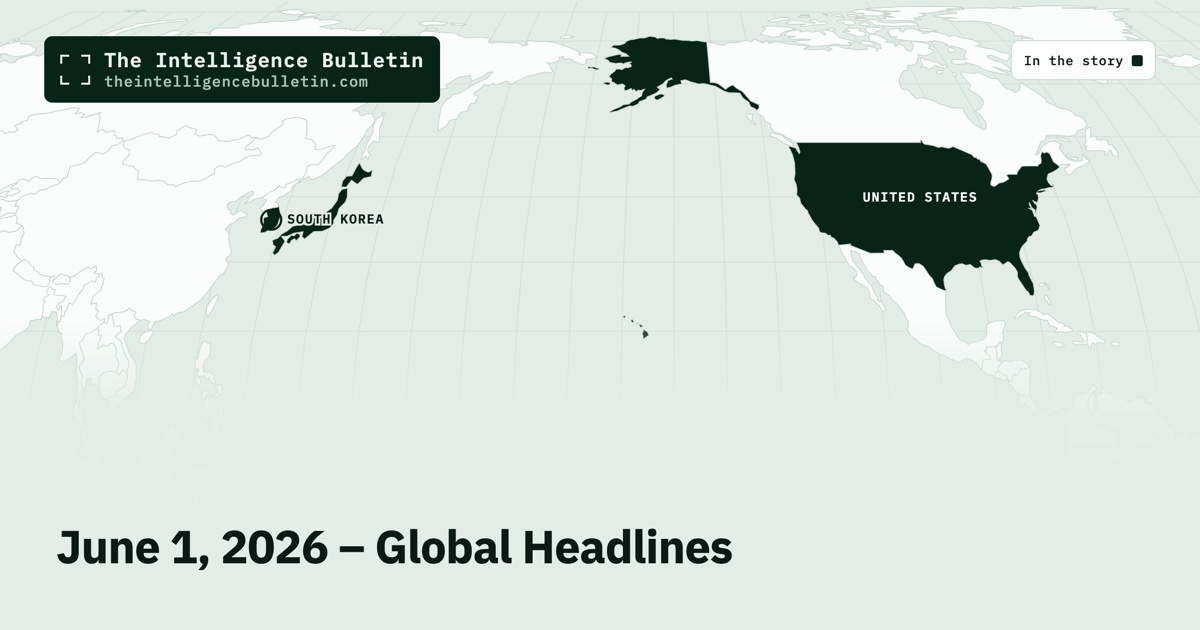
The quiet disclosure that Seoul and Tokyo are once again weighing a logistics pact at the Shangri-La Dialogue reveals how incremental military cooperation can advance even when political memory remains raw. NK News, drawing on its Korea specialist lens, simply records Ahn Gyu-back’s statement that the idea was raised and that any deal would need domestic support, treating the exchange as routine bilateral business. Moneycontrol, alert to Indo-Pacific ripple effects, instead stresses the deliberate pace Seoul is setting, noting the political caution that still governs every step. Both accounts converge on the same core fact: the two sides talked, nothing was signed, and public sentiment remains the decisive brake. That convergence itself is the signal. It shows how far the relationship has moved from outright refusal to conditional exploration without either capital yet willing to declare the historical disputes resolved. The location in Singapore matters too; it places the conversation inside a regional security forum where Washington’s presence is assumed rather than negotiated, allowing Tokyo and Seoul to test practical arrangements while keeping the optics low. The absence of any reported economic modeling in the coverage underscores that the immediate stakes are still political legitimacy at home, not yet supply-chain calculations. Readers watching similar quiet advances between other former antagonists will recognise the pattern: progress measured in what is no longer ruled out rather than what has been formally embraced.
2To Lam Receives Formal Welcome with 21-Gun Salute in Manila
Vietnamese state media presented the 21-gun salute as the central fact of the day, treating the ceremonial sequence itself as evidence of Vietnam’s diplomatic weight. Vietnam News framed the arrival through the language of protocol and socialist fraternity, listing the exact honors extended by the Philippine side and positioning the visit as a routine yet elevated exchange between two party-led states. Tuoi Tre, aimed at a younger domestic audience, placed the same salute at the center of its account but stressed the visual pageantry and the implied national pride that such honors confer on the Vietnamese delegation. The two accounts converge on the absence of any policy detail or mention of the South China Sea; both treat the gun salute as the story’s entire payload. This convergence reveals a shared editorial choice to let the optics of state recognition stand in for substance, a pattern consistent with Vietnamese coverage of high-level visits that prioritizes the projection of parity with ASEAN partners. The Philippine host is named but never quoted, underscoring that the narrative is calibrated for Vietnamese readers rather than bilateral signaling. In a week when other regional stories involved explicit security pacts or ceasefire conditions, the decision to lead with ceremony alone signals that Hanoi views the optics of this particular welcome as sufficient message.
3Iran Links Lebanon Ceasefire to Any US Nuclear Deal
Iran’s insistence that Lebanon must quiet before any US deal lands at a moment when Washington is already juggling multiple Middle East files, from Strait of Hormuz warnings to fresh ceasefire talks led by Marco Rubio. The three Asian outlets covering the statement all carried nearly identical accounts of Baqaei’s briefing, underscoring how little interpretive room the Iranian line itself leaves. Deccan Chronicle’s version sits comfortably within India’s long-standing practice of reporting Tehran and Washington without taking sides, reflecting New Delhi’s need to keep energy channels open while courting US technology. Free Malaysia Today adds the same factual core but places it against a domestic readership attuned to Arab grievances, so the Lebanese condition reads as a natural Iranian counterweight rather than an obstacle. The Straits Times, by contrast, frames the episode through Singapore’s port-city lens, noting how any prolonged standoff risks further oil-price spikes that would hit global shipping lanes. What unites the three accounts is an absence of speculation about Netanyahu or Revolutionary Guard reactions; the story is treated as a narrow diplomatic signal rather than the start of a new escalation cycle. That restraint mirrors the GDELT event data itself, which records a modest significance score and low market sensitivity, suggesting traders and governments alike are treating the Lebanese precondition as familiar posturing rather than a breakthrough demand. Previous TIB reporting showed Trump returning a draft for tougher terms; Baqaei’s comment now supplies the Iranian reply, keeping the talks in the same holding pattern without yet forcing a public rupture.
4Rubio Pushes Fresh Israel-Lebanon Ceasefire Initiative
The three outlets converge on the same core facts—Rubio as the lead US interlocutor, Aoun and Netanyahu as direct counterparts, and an expected announcement timeline—yet each filters the development through its own strategic priors. Iranherald.com presents the US move as an effort still constrained by Hezbollah’s battlefield position, reflecting Tehran’s long-standing view that any durable pause must accommodate the group’s political and military weight rather than isolate it. Aninews.in reports the same sequence without that qualifier, consistent with New Delhi’s expanding defense and intelligence coordination with both Washington and Jerusalem. Geo.tv emphasizes regional skepticism, noting that past US-brokered arrangements have repeatedly tilted outcomes toward Israeli security demands. This pattern of factual alignment alongside tonal divergence reveals a story whose basic parameters are no longer contested, while the deeper question of whether Hezbollah will be treated as a veto player or an obstacle continues to divide external observers along predictable geopolitical lines. The linkage to the stalled Iran nuclear track, raised explicitly by Tehran, further anchors the Lebanon file inside a wider US-Iran bargaining arena rather than as a standalone bilateral dispute.
5US and Cuban Commanders Meet Briefly at Guantanamo Perimeter
The meeting itself was modest: a short exchange on security protocols between US Southern Command and Cuban officers at the fence line. What stands out is how little the coverage diverges despite the outlets’ different origins. Radio Santa Fe, writing from Colombia, presents the contact as routine diplomacy within a familiar pattern of US-Cuban friction, treating the base as a permanent regional fact rather than an ideological flashpoint. The Epoch Times, by contrast, frames the same encounter as evidence of Cuban regime rigidity, underscoring the anti-communist lens typical of its US editorial line. Both accounts rest on the same US Southern Command statement and Cuban acknowledgment that channels will stay open. The absence of alarm or celebration in either report suggests the event registers as procedural continuity rather than breakthrough or provocation, consistent with the low Goldstein score and zero market sensitivity recorded in the underlying data. In a week when US-Iran talks and Israel-Lebanon ceasefire efforts dominate headlines, this Guantanamo exchange draws notice mainly because two ideologically distant outlets describe it in nearly identical terms.
That’s how the world told the story.
Get our daily open-source intelligence on world events in your inbox — one email a day, up to six stories.
Subscribe freeNo spam. One-click unsubscribe. See the latest email →