 AI-generated analysis published under the editorial responsibility of Rohit Sinnas. How it works →
1India and Cyprus Elevate Ties to Strategic Partnership
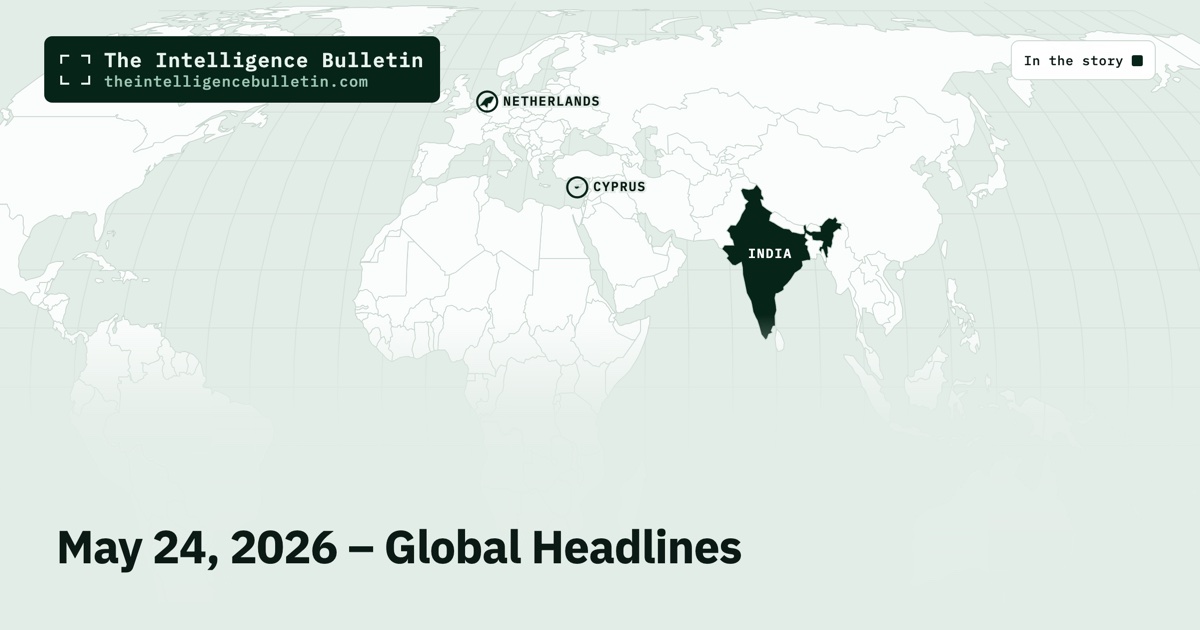
India’s quick succession of strategic partnerships with mid-sized European states reveals a deliberate pattern rather than isolated diplomacy. After upgrading ties with the Netherlands on semiconductors and defence, New Delhi has now locked in Cyprus on AI, fintech, UPI linkage and maritime search-and-rescue protocols. Both Indian outlets frame the Cyprus move as a clear bilateral win that extends India’s reach into the eastern Mediterranean without invoking larger power rivalries. Khabar India stresses nationalist credit for the Modi government, while Open Magazine supplies the policy detail on how UPI and innovation clauses fit existing Indian priorities. The absence of any counter-narrative across the coverage indicates the story functions domestically as evidence of expanding influence rather than contested foreign policy. This convergence suggests Indian editors see these agreements as low-risk, high-visibility steps that diversify partnerships beyond traditional Western or Gulf anchors.
2Shehbaz Sharif Opens Four-Day China Visit to Review CPEC
Pakistani and Indian outlets converge on the bare itinerary of Shehbaz Sharif’s departure yet split sharply on what the four days in Hangzhou actually mean for the wider region. Daily Pakistan frames the mission as standard high-level maintenance of CPEC infrastructure and trade pipelines, listing expected talks with Li Qiang and Xi Jinping without reference to third parties. Orissa Post and The Hindu, by contrast, embed the same schedule inside the India-China-Pakistan triangle, noting that any fresh CPEC commitments in disputed territory directly affect Indian strategic calculations. This divergence is structural rather than rhetorical: Pakistan’s outlet operates inside an alliance whose economic lifeline runs through Beijing, so the visit registers as continuity; Indian papers operate inside a competitive security environment where every CPEC milestone is read as incremental territorial and logistical pressure. The absence of market-sensitive language across all three sources further underscores that the story is treated as diplomatic process rather than immediate commercial event. What the coverage therefore reveals is not disagreement over facts but competing maps of consequence—one anchored in bilateral economic delivery, the other in trilateral balance-of-power effects that have defined South Asian geopolitics since CPEC’s launch.
3Israeli Strike Hits Gaza Police Post, Killing Five
The Bosnian outlet Hayat.ba opens by foregrounding the truce breach, framing the strike as evidence that Israeli operations continue uninterrupted even when ceasefires are declared, a lens shaped by regional Muslim-majority sensitivities to Palestinian casualties. El Nacional in the Dominican Republic tracks the rising death toll to six and zeroes in on the police-post target, reflecting a Global South habit of cataloguing Israeli actions as escalatory without pausing to weigh security justifications. Athens Times, by contrast, records the same strike as killing five police plus a teenager, stripping away truce references and presenting the event as one data point among routine security incidents. This convergence on the core facts—an Israeli drone hit a northern Gaza police facility on 23 May—reveals how little daylight exists between outlets once the event itself is isolated from surrounding narratives. The structural divergence appears only in the added context each outlet elects to withhold or supply: the Balkan and Latin American sources import the truce claim to heighten the sense of violation, while the Greek account imports the teenage casualty to keep the focus narrowly operational. Prior TIB coverage of unrelated NATO and trade stories underscores that Gaza incidents surface globally only when casualty counts or truce claims create a detectable cross-outlet cluster, as occurred here.
4Czech President Urges NATO to Show Force Against Russia
The timing matters more than the phrasing. Pavel’s call landed the same day Washington announced fresh troops for Poland, turning a Czech interview into an implicit endorsement of the new deterrence posture rather than an isolated remark. Polish coverage treats the statement as validation from a fellow frontline state, folding it into a narrative that Russia only respects strength and that recent U.S. moves finally supply it. Serbian reporting, by contrast, registers the same words as a warning sign, stressing the risk that asymmetric responses could widen the conflict and underscoring Belgrade’s preference for staying outside the escalation cycle. The divergence tracks geography and alliance status more than ideology: Warsaw sits directly on the exposed flank and has absorbed the security consequences of every Russian probe since 2014, while Belgrade’s non-NATO position and energy ties to Moscow make any hardening of the Alliance look like added pressure rather than added safety. Both outlets quote Pavel’s “show teeth” line almost verbatim, yet one presents it as overdue realism and the other as a reminder that words can still accelerate events. What the coverage reveals is less disagreement over facts than differing calculations of who bears the immediate cost if deterrence fails.
5Zelensky Rejects Merz EU Associate Status Proposal as Unfair
German outlets converge on Zelenskyy’s letter as the central event yet diverge sharply in what they treat as the real problem. Berliner Zeitung leads with the word “Streit” and presents the Merz idea itself as the trigger for open friction, reflecting its established skepticism toward both EU enlargement orthodoxy and the current Kyiv government’s demands. Tagesschau instead records Zelenskyy’s objection in measured institutional language, treating the exchange as another routine data point in accession negotiations rather than evidence of a flawed German initiative. The difference is structural: one outlet sees German domestic politics and EU overreach as the story’s core, the other sees the preservation of Brussels procedures. Both headlines name Merz explicitly, confirming that the proposal’s German origin, not its precise content, drives coverage. This shared focus on a single CDU figure inside an otherwise EU-wide debate reveals how quickly the accession question has become a German partisan issue rather than a collective European one. The absence of any counter-proposal or response from the addressed EU presidents in either account further underscores that the reporting remains anchored in Berlin’s internal calculations.
That’s how the world told the story.
Get our daily open-source intelligence on world events in your inbox — one email a day, up to six stories.
Subscribe freeNo spam. One-click unsubscribe. See the latest email →