 AI-generated analysis published under the editorial responsibility of Rohit Sinnas. How it works →
1Cambodia King Pardons Kem Sokha After Treason Sentence
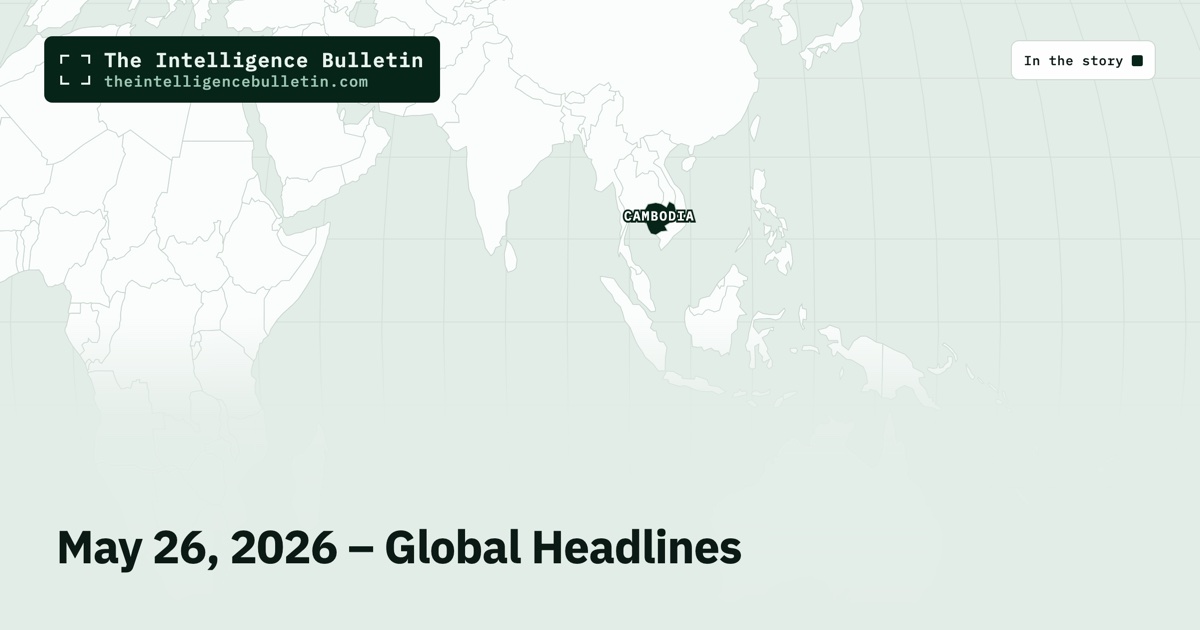
The pardon arrives at a moment when Hun Sen appears to be managing succession for Hun Manet while testing how far international and regional tolerance extends. Philippine coverage through bworldonline.com places the event inside ASEAN routines, treating it as one more data point in the search for predictable diplomacy rather than a rights breakthrough. Economic outlets such as econotimes.com read the same decree as a possible signal that Phnom Penh wants to lower friction for investors wary of prolonged political risk. The Lowell Sun, by contrast, anchors the story in the language of democratic contestation, noting the unchanged travel ban and the earlier conviction’s political character. These differences are not contradictions; they reflect where each outlet’s audience actually experiences Cambodia—through supply chains, through alliance management, or through the residual vocabulary of post-1990s democratization. The shared factual core across all three is the narrow scope of the pardon itself, which suggests the gesture is calibrated to release pressure without restoring Kem Sokha or Mu Sochua to open political competition. That calibration, rather than any single headline, is what neighboring capitals and markets are now quietly pricing.
2India Hosts Quad Ministers Amid Indo-Pacific and West Asia Strains
Indian coverage converged on a single narrative: New Delhi positioning itself as the convening power that can link Indo-Pacific security to West Asian instability without forcing a binary choice on partners. Economic Times framed the session through the Japan channel, stressing supply-chain resilience and technology cooperation as the practical deliverables that matter most to business readers. The Hindu placed the same meeting inside the immediate context of Gaza-related fallout, treating the Quad as a stabilising mechanism rather than an economic forum. Free Press Journal emphasised the hosting logistics themselves, presenting the event as evidence of India’s growing diplomatic bandwidth. The absence of any Indian outlet questioning the Quad’s utility or raising non-alignment concerns reveals how completely the grouping has been domesticated inside New Delhi’s strategic consensus. What varies is only the lens—commercial, security or protocol—through which each paper reports the same underlying calculation that India benefits from keeping the four capitals in regular dialogue.
3Pakistan and China Sign 15 Deals Worth $7 Billion in Beijing
The $7 billion figure attached to the Beijing signings reveals how both capitals treat CPEC not as a finished project but as an expandable platform for locking in future leverage. Syrian state media at sana.sy immediately placed the agreements inside an anti-Western resistance narrative, portraying them as evidence that Beijing and Islamabad are building parallel structures immune to Western pressure. Pakistani coverage split along familiar domestic lines: thefrontierpost.com stressed the strategic and security guarantees embedded in the next CPEC phase, consistent with Islamabad’s establishment view that economic packages must also deliver hard-power reassurance against India. samaa.tv, by contrast, highlighted investment inflows and job creation without invoking security language, reflecting a commercial outlet’s preference for presenting the deals as straightforward economic relief. What unites the three accounts is the absence of any mention of implementation risk or repayment terms; the shared silence suggests that, at least in official narratives, the political utility of announcing fresh billions still outweighs scrutiny of delivery. The timing, coming days after Xi and Putin extended their own treaty in the same capital, underscores how both Pakistan and China are sequencing high-visibility economic diplomacy to signal durability of their partnership even as global attention remains fixed elsewhere.
4Trump Links Iran Deal to Abraham Accords Expansion
The most revealing thread is how quickly the story moved from Trump’s May 24 warning against rushing an Iran deal to his explicit tying of any agreement to fresh Arab-Israeli normalization. Epoch Times framed the move as strategic leverage that strengthens Western pressure on Tehran, treating the linkage as a natural extension of existing policy rather than a new demand. Ynet captured the Israeli priority of building an operational anti-Iran front, noting that several Arab capitals are already conditioning their participation on concrete security guarantees. Yalibnan instead foregrounded the Pakistani rejection and broader Arab wariness, underscoring that normalization remains politically costly for governments that still face domestic opposition to deeper ties with Israel. The three angles converge on one structural fact: Trump is conditioning progress on Iran to extract regional realignment that previous US administrations could not secure. The divergence appears only in emphasis, not in the underlying bargain being described.
5Lebanese President Demands Full Israeli Withdrawal from South
The most revealing aspect is how little daylight exists between the three outlets on the core fact of Aoun’s demand, even though their editorial homes point in different directions. Brasil247, operating from a Brazilian left that aligns with Lula’s skepticism of Israeli policy, simply records the statement as a straightforward assertion of Lebanese rights without adding qualifiers about Hezbollah or security trade-offs. The Hindu, reflecting India’s careful balance between defense cooperation with Israel and its traditional support for multilateral norms, likewise foregrounds the language of UN resolutions and sovereignty, treating the demand as a diplomatic rather than military matter. 15min.lt, situated inside a NATO member state, reports the same text but situates it within the broader context of ongoing border friction, implicitly reminding readers that any withdrawal would have to contend with Hezbollah’s presence. The convergence suggests the story is being treated as a diplomatic signal rather than a military escalation, which is consistent with the low market-sensitivity score attached to the event. What stands out is the absence of any outlet inflating the statement into a new crisis or downplaying it as rhetoric; all three convey that Aoun is restating a long-standing Lebanese position on the 25th anniversary of the prior withdrawal. This uniformity across Brasilia, New Delhi and Vilnius indicates the episode is viewed as routine boundary-setting rather than a rupture, even as each outlet’s audience brings its own priors about who bears responsibility for the south Lebanon stalemate.
That’s how the world told the story.
Get our daily open-source intelligence on world events in your inbox — one email a day, up to six stories.
Subscribe freeNo spam. One-click unsubscribe. See the latest email →