 AI-generated analysis published under the editorial responsibility of Rohit Sinnas. How it works →
Press quoted
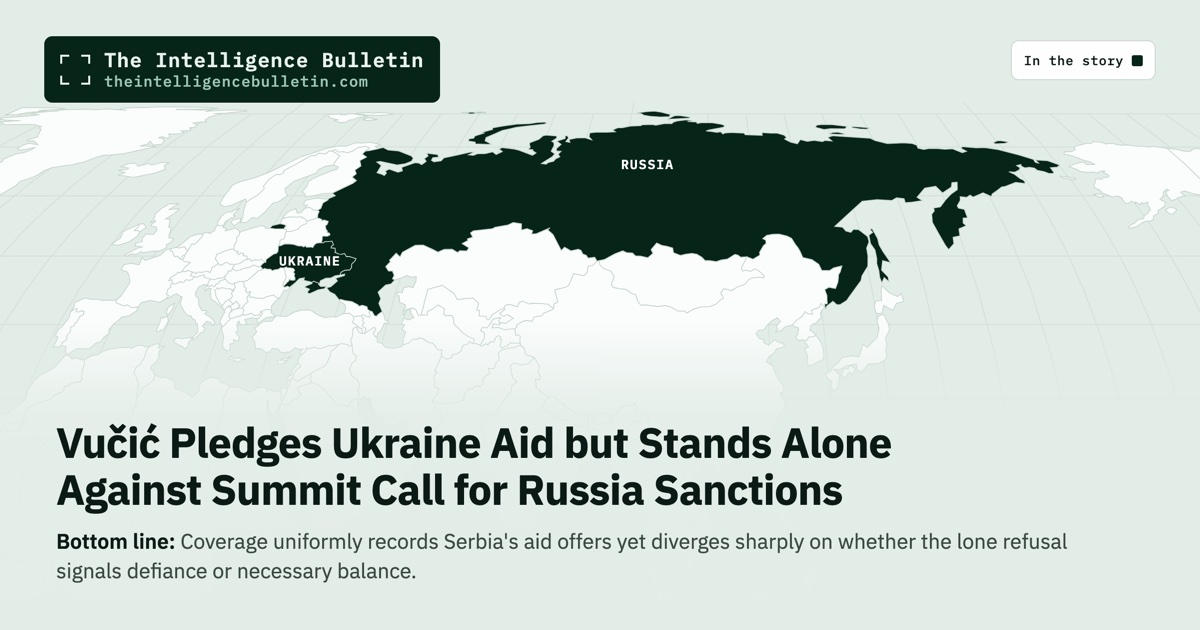
Coverage uniformly records Serbia’s aid offers yet diverges sharply on whether the lone refusal signals defiance or necessary balance.
Vučić’s refusal to endorse the declaration’s sanctions language while offering concrete aid reveals Serbia’s calculated equidistance: it satisfies EU membership rhetoric and Ukrainian territorial claims without crossing Moscow on energy and sanctions. Ukrainian coverage stresses the repeat defiance as erosion of regional unity. Russian reporting casts the same act as principled independence that still delivers practical help. Slovak and Bulgarian accounts highlight the EU-candidate pragmatism separating non-lethal support from sanctions alignment. The Bosnian Serbian outlet stays strictly factual, listing Vučić’s five points and Moscow’s denial of back-channel messages. The pattern shows every outlet recording the same aid commitments yet interpreting the non-signature through its own geopolitical filter rather than inventing new facts.
Full analysis
Serbia’s president Aleksandar Vučić traveled to Kyiv on July 15, 2026, for the Ukraine-Southeast Europe summit, pledged expanded humanitarian help in finance, health, energy, and city reconstruction, and left without signing the joint declaration. That single refusal, while every other participant endorsed language condemning Russia’s aggression and calling for intensified sanctions plus sustained military and financial backing for Ukraine, captures Belgrade’s deliberate balancing act. Vučić reaffirmed Serbia’s support for Ukraine’s territorial integrity and European Union path, yet kept clear of any commitment that would align his country with Western sanctions pressure on Moscow. The pattern reveals a consistent Serbian strategy: deliver visible, non-lethal assistance that satisfies EU-candidate rhetoric and Ukrainian expectations without rupturing energy supplies or political ties with Russia.
The declaration itself, signed by Ukrainian President Volodymyr Zelenskyy and representatives of Albania, Greece, Moldova, Romania, Croatia, Slovenia, North Macedonia, Montenegro, and Bulgaria, condemned Russia’s “illegal, unprovoked and unjustified” actions. It urged continued political, military, financial, and security support for Ukraine, stronger sanctions on Russia, and assistance with post-war reconstruction. Vučić stated plainly after the closed session that he alone had declined to sign. He told Serbian journalists that the text made his reasons clear and required no further explanation. The same summit format had met the previous year in Odesa, where participants again condemned the war and called for maintained and strengthened sanctions; Vučić had also refused to sign on that occasion.
Vučić listed five concrete positions that Serbia brought to Kyiv. First, respect for the UN Charter and resolutions, which he said meant support for Ukraine’s territorial integrity and sovereignty. He noted Ukraine’s reciprocal stance toward Serbia on the same principle. Second, expanded humanitarian assistance covering financial, medical, and energy sectors. He acknowledged that prior deliveries had fallen short of one specific commitment and promised swift correction. Third, reconstruction work in one unspecified Ukrainian city, where Serbia would devote greater resources to achieve better results for the local population. Fourth, support for Ukraine’s EU accession, with the explicit assurance that Ukraine, Moldova, and other candidates could always count on Belgrade. Fifth, improved connectivity through new corridors linking Ukraine with Armenia, Azerbaijan, and Turkey, drawing on lessons from his rail journey across Ukraine.
These commitments build on roughly 60 million euros in non-lethal and non-military aid Serbia has provided Ukraine since the February 2022 invasion. Vučić also invited Zelenskyy to visit Belgrade and thanked Ukraine for its reciprocal policy on territorial integrity. The two leaders discussed bilateral trade growth, economic cooperation, and mutual support on the EU membership track. None of these steps crossed into lethal assistance or sanctions alignment.
Different outlets recorded the identical aid pledges and non-signature yet placed them in sharply different contexts. Ukrainian reporting framed the refusal as a repeat act of defiance that erodes regional solidarity against Russia. Russian coverage presented the same decision as principled independence that still delivered practical help to Ukraine while preserving Serbia’s autonomy on sanctions. Slovak accounts stressed the pragmatic distinction between humanitarian commitments and refusal to join pressure on Russia, noting Serbia’s status as an EU candidate and its heavy reliance on Russian natural gas. Bulgarian reporting tied the episode directly to Serbia’s accession dynamics and Vučić’s defense of national interests. The Bosnian outlet reported the five points in detail alongside the Kremlin’s denial that Moscow had used Vučić to pass messages to Zelenskyy, and it confirmed that Serbia has not been asked to serve as a mediator.
The divergence lies entirely in interpretation, not in disputed facts. Every source confirms the aid offers, the territorial-integrity statement, the EU-support pledge, and the explicit refusal to endorse sanctions language. No outlet invented new events or altered the list of signatories. The variation instead reflects each outlet’s institutional priorities: Ukrainian emphasis on unified pressure, Russian emphasis on non-alignment, and EU-member or regional outlets’ focus on candidate-state pragmatism.
What to Watch
This approach is sustainable only so long as Serbia’s gas dependence on Russia and its EU accession timeline remain unchanged. Belgrade has repeatedly condemned the invasion at the United Nations while refusing to join sanctions regimes. Moscow has accused Serbia of indirect munitions deliveries through third parties, claims Belgrade denies. The next summit is scheduled for Slovenia in 2027. Vučić’s performance in Kyiv suggests he will again offer concrete assistance on reconstruction and integration while declining any document that binds Serbia to sanctions escalation. That pattern protects Serbia’s immediate energy security and political room for maneuver, yet it leaves the country exposed to criticism from both sides whenever the conflict’s demands intensify. The real test will come when reconstruction commitments require delivery and when EU accession chapters press harder on foreign-policy alignment.
That’s how the world told the story.
Get our daily open-source intelligence on world events in your inbox — one email a day, up to six stories.
Subscribe freeNo spam. One-click unsubscribe. See the latest email →