 AI-generated analysis published under the editorial responsibility of Rohit Sinnas. How it works →
Press quoted
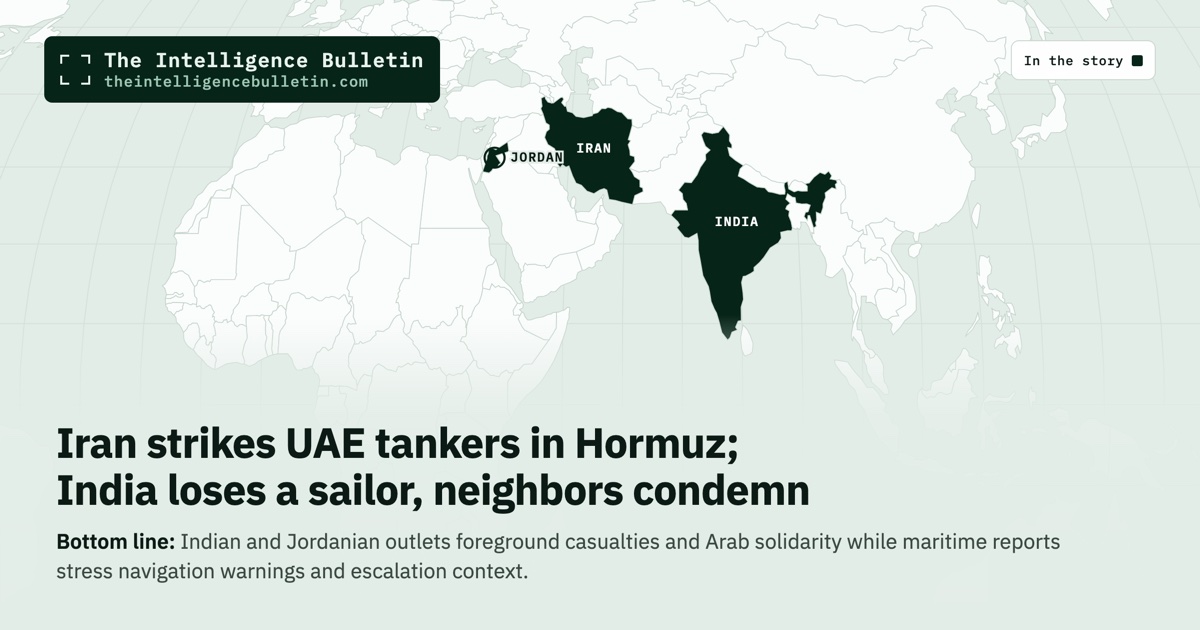
Indian and Jordanian outlets foreground casualties and Arab solidarity while maritime reports stress navigation warnings and escalation context.
The attack on the Emirati tankers produced unusually consistent core facts across outlets but split along national fault lines in emphasis. Indian-focused Livemint led with the death of one of its nationals and the nationalities of the injured, reflecting direct human cost to Indian seafarers on Gulf routes. Jordan’s state-aligned paper highlighted its foreign ministry’s condemnation and condolences to India, underscoring Arab diplomatic alignment with the UAE. gCaptain, drawing on Reuters, gave the fullest operational picture including ADNOC confirmation, IRGC justification, and the tankers’ position in Omani waters while embedding the incident in the wider US-Iran naval standoff. Qatar’s Peninsula relied on the UK Maritime Trade Operations report of a missile strike off Oman, stressing navigation alerts over attribution. The Jerusalem Post headline alone framed the strikes as unifying the region against Iran. This pattern shows how importers of Gulf oil and neighbors weigh crew losses or alliance signals more heavily than the missile mechanics themselves.
Full analysis
The July 13 attack on two Emirati oil tankers in the Strait of Hormuz exposes how national interests dictate what counts as the core story in a single maritime incident. Iranian cruise missiles hit the very large crude carriers Mombasa and Al Bahiyah while they transited the southern lane inside Omani territorial waters, killing one Indian crew member and injuring eight others. The strike fits a pattern of direct pressure on Gulf shipping routes during an active US-Iran conflict that began in February 2026, yet reporting splits sharply by outlet audience rather than by shared facts on the missiles themselves.
Indian readers encounter the event first through the human cost to their nationals working Gulf routes. Livemint opened with the UAE Defence Ministry statement naming the dead sailor aboard the Mombasa and detailing the eight wounded—six Indians and two Ukrainians, four of them seriously hurt. The piece quoted the ministry’s account of fires breaking out and later being controlled, then placed the casualties inside the broader US-Iran exchanges that have already produced multiple rounds of strikes. This focus tracks the reality that Indian seafarers staff a large share of the tankers moving crude through Hormuz, so the death registers as a direct national loss rather than abstract escalation.
Maritime industry coverage supplies the clearest operational sequence. The gCaptain report, drawing on Reuters, listed the exact vessels, confirmed significant damage through ADNOC L&S, and recorded the IRGC claim that the tankers had ignored repeated warnings, switched off navigation systems, and attempted passage on an allegedly mined illegal route. It also noted the UK Maritime Trade Operations alert of a missile strike roughly 40 nautical miles northeast of Oman’s Qalhat, while embedding the episode inside weeks of US Central Command facilitation of ship-to-ship transfers and recent American strikes on Iranian targets. These details matter because they show the tankers’ precise location and the immediate physical effects on hull and engines, information that shipowners and insurers need to assess route viability.
Jordan’s official reaction, reported in The Jordan Times, treated the attack as a diplomatic test for Arab states. The Foreign Ministry condemned the strikes as a flagrant violation of international law and a threat to maritime security, expressed full solidarity with the UAE, and offered condolences specifically to India over the sailor’s death. The statement pledged support for any UAE measures to protect its sovereignty. This emphasis on alliance language reflects Jordan’s position as a regional actor that must balance ties with Gulf monarchies while avoiding direct confrontation with Iran.
Qatari coverage stayed narrower, foregrounding the UK Maritime Trade Operations bulletin of a tanker hit by an unknown projectile off Oman and the ongoing Iran-US contest over Hormuz control. The Peninsula piece avoided naming Iran as the perpetrator in the lead and stressed the navigation alert itself. Such restraint aligns with Qatar’s role as a Gulf neighbor that maintains its own channels to Tehran while depending on safe passage for its own energy exports.
The single Israeli headline available framed the strikes as evidence that the attacks are uniting Arab states and the wider region against Iran. That interpretation sits apart from the casualty counts or shipping alerts that dominated other accounts. The remaining sources converge on verified facts—the missile type, vessel names, casualty nationalities, IRGC justification citing ignored warnings, and UAE assertion of its right to respond—while diverging on which element deserves the headline.
What is at stake is the continued flow of roughly one-fifth of global oil and gas traffic through a 21-mile-wide chokepoint now under active dispute. The attack demonstrates Iran’s willingness to target commercial vessels it accuses of using unauthorized routes, a tactic that raises insurance rates and prompts shipowners to consider longer voyages around the Cape of Good Hope. For India, the death of one of its citizens adds domestic pressure to protect its maritime workforce. For the UAE and its neighbors, the incident tests whether coordinated diplomatic condemnation can deter further strikes without triggering wider war. For energy markets, each confirmed hit reinforces the risk premium already visible in the 7.8 percent Brent crude jump reported after the news broke.
The pattern of coverage therefore reveals less about media bias than about whose interests are directly touched. Indian and Jordanian outlets foreground crew losses and official solidarity because those elements affect their readers and foreign policy posture. Maritime reporting supplies the ship movements and damage assessments that determine whether the route remains commercially viable. No single account captures every dimension, yet the Reuters-sourced operational record in gCaptain comes closest to providing the baseline data others can build upon.
What to Watch
Further incidents of this type are likely to accelerate rerouting of crude cargoes and intensify US naval presence in the strait, raising the chance that a miscalculation on either side produces a larger clash. The human and commercial costs already recorded on July 13 make clear that the waterway’s security is no longer an abstract geopolitical issue but an immediate constraint on global energy supply and the safety of crews from multiple nations.
That’s how the world told the story.
Get our daily open-source intelligence on world events in your inbox — one email a day, up to six stories.
Subscribe freeNo spam. One-click unsubscribe. See the latest email →