 AI-generated analysis published under the editorial responsibility of Rohit Sinnas. How it works →
Press quoted
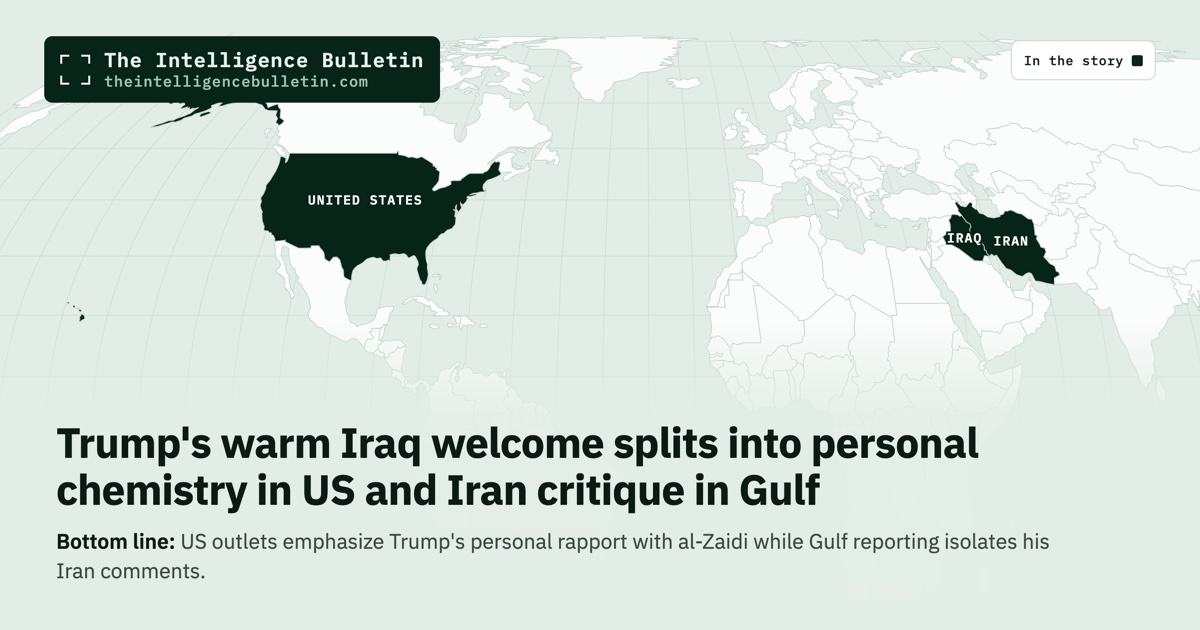
US outlets emphasize Trump’s personal rapport with al-Zaidi while Gulf reporting isolates his Iran comments.
US reporting splits sharply on the same White House meeting. The San Mateo Daily Journal, carrying AP copy, centers Trump’s effusive praise of al-Zaidi’s business background and their personal chemistry, recalling Trump’s earlier threat to withhold aid over the choice of prime minister. The Media Line places the session inside a wider US push that includes a Lebanon security framework and a Rubio meeting with Jordan’s foreign minister. Turkish state agency Anadolu leads with Trump’s direct quote of affection for Iraq, drawn from Iraqi state media and stripped of policy detail. Saudi outlet Ajel instead foregrounds Trump’s explicit line that Iran burdens Iraq and faction disarmament is moving forward. The pattern shows American outlets dividing between personality and regional strategy while Gulf coverage isolates the anti-Iran signal, revealing how each capital’s immediate priorities filter the same bilateral encounter.
Full analysis
President Donald Trump’s July 14 White House meeting with Iraqi Prime Minister Ali al-Zaidi exposed a clear divide in how media interpret the same bilateral encounter. American coverage split between emphasis on the president’s personal rapport with the new leader and the session’s place in wider regional diplomacy, while Gulf reporting isolated Trump’s remarks on Iran as the central takeaway. This pattern shows how each outlet’s home priorities determine which elements of the encounter receive attention, affecting what readers learn about shifting U.S. policy toward Baghdad.
Al-Zaidi reached the premiership after Iraq’s post-election deadlock last year. A wealthy businessman with no prior political experience, he emerged as a consensus choice among factions. Trump had previously threatened to withhold U.S. aid if the Iran-aligned Coordination Framework pushed former Prime Minister Nouri al-Maliki back into the role, viewing al-Maliki as too close to Tehran. The White House session therefore carried both personal and strategic weight from the outset.
The San Mateo Daily Journal, carrying Associated Press copy, led with Trump’s description of “tremendous chemistry” between the two men. The account highlighted their shared background as businessmen and noted al-Zaidi’s unusual path to power. It recalled Trump’s earlier ultimatum on aid but stayed tightly focused on the warm personal exchange rather than policy deliverables or Iran’s role. This framing suited a domestic U.S. audience accustomed to Trump’s style of diplomacy, where individual rapport often receives more play than institutional outcomes.
Turkish state agency Anadolu Agency drew directly from Iraqi official sources and opened with Trump’s quoted statement that “We love Iraq, and this man will represent Iraq well.” The piece described a warm reception on the White House lawn but offered little additional context on security cooperation or regional tensions. Its straightforward diplomatic tone reflected Turkish media’s practice of relaying bilateral statements without layering in broader policy analysis, producing a narrow but factually anchored account centered on the Iraqi government’s own narrative of the event.
Saudi outlet Ajel took a different route. Its headline and lead foregrounded Trump’s explicit assessment that Iran represents a burden on Iraq and that efforts to disarm factions are advancing positively. This angle, drawn from the same meeting, received no comparable prominence in the U.S. or Turkish reports. By elevating the anti-Iran signal, Ajel aligned the coverage with longstanding Gulf concerns about Iranian influence inside Iraq, particularly through Shiite militias that have long complicated Baghdad’s relations with both Washington and Riyadh.
The Media Line, a U.S.-based outlet focused on the Middle East, embedded the Iraq meeting inside a larger diplomatic push. Its report noted parallel U.S. efforts on a security framework with Lebanon and an upcoming meeting between Secretary of State Marco Rubio and Jordan’s foreign minister. It linked the al-Zaidi talks to efforts to reshape U.S.-Iraq security ties, reduce regional tensions, and address Iran-backed militias. This broader lens supplied context missing from purely bilateral accounts and illustrated how one American outlet connected the session to ongoing work on militia disarmament and neighboring capitals.
These choices matter because the meeting occurred against a backdrop of U.S. attempts to recalibrate ties with Baghdad while managing Iranian influence across the region. Al-Zaidi’s selection itself resulted from Trump’s direct intervention on aid. When different outlets highlight either the personal chemistry, the quoted affection for Iraq, the Iran critique, or the Lebanon-Jordan track, they steer readers toward distinct conclusions about what the United States seeks from the relationship.
The resulting picture is incomplete in each case. Readers of the San Mateo Daily Journal or Anadolu see little of the militia or Iran dimensions that Gulf outlets treat as central. Readers of Ajel encounter almost none of the personal or Lebanon context that American accounts supply. The Media Line comes closest to capturing the administration’s multi-front approach, yet it still compresses the bilateral warmth into a supporting detail.
What to Watch
Such filtering is likely to continue. As the Trump administration advances separate tracks on Lebanon security and Jordan stability while pressing Iraq on faction disarmament, outlets will keep selecting the slice of each encounter that matches their audience’s immediate stakes. For Gulf governments, that means sustained attention to any anti-Iran messaging. For U.S. domestic outlets, it often means greater focus on presidential style. The practical effect is that accurate assessment of U.S.-Iraq progress requires cross-referencing multiple accounts rather than relying on any single one.
That’s how the world told the story.
Get our daily open-source intelligence on world events in your inbox — one email a day, up to six stories.
Subscribe freeNo spam. One-click unsubscribe. See the latest email →