 AI-generated analysis published under the editorial responsibility of Rohit Sinnas. How it works →
Press quoted
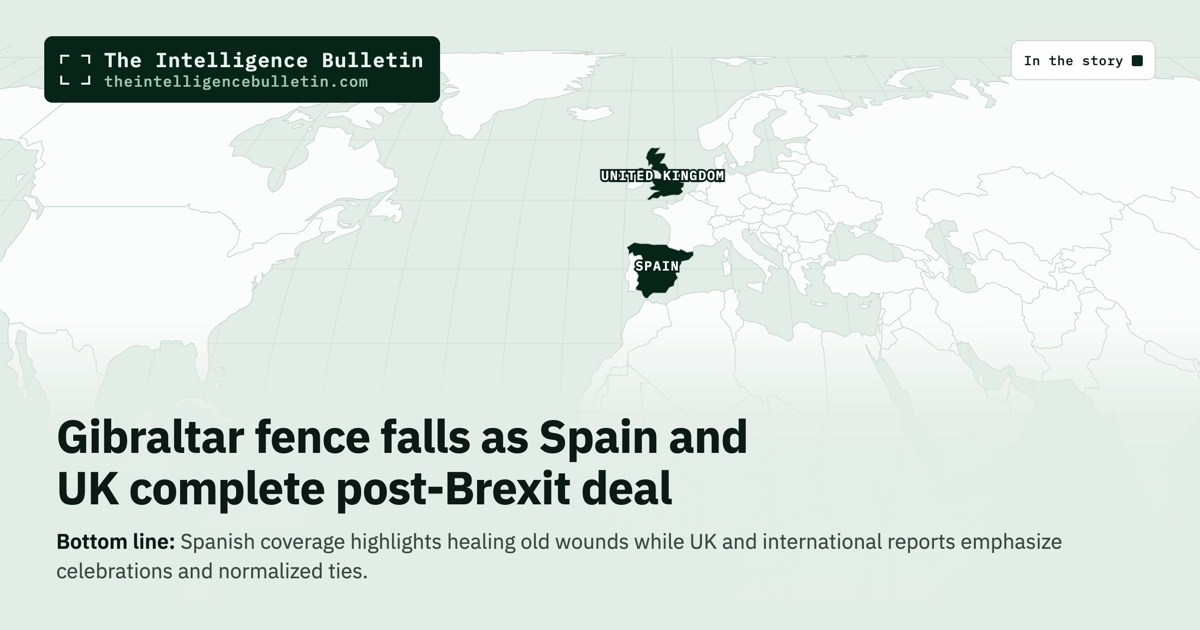
Spanish coverage highlights healing old wounds while UK and international reports emphasize celebrations and normalized ties.
Spanish reporting stresses relief from decades of queues and historical grievance. The Local quoted Sánchez declaring the fence an open wound for workers and the last wall in continental Europe. El Confidencial Digital thanked the EU and UK explicitly for ending the Verja and enabling economic activity. UK coverage via BBC centered on local celebrations in Gibraltar, with Picardo announcing Europe is back and the territory joining Schengen in practice. International outlets SCMP and MercoPress framed the outcome as a post-Brexit diplomatic win and a new bilateral chapter between Spain and Britain, noting joint controls at the airport and port plus future state visits. All five sources report the same practical result and note that sovereignty claims are untouched, revealing that the deal’s success lies in everyday movement rather than any political resolution.
Full analysis
The fence dividing Gibraltar from the Spanish mainland fell in a midnight ceremony on July 15, 2026, marking the immediate start of free movement under a new EU-UK treaty. This outcome reveals that concrete gains in cross-border mobility and economic activity can be secured even when core political disputes over sovereignty remain frozen. The practical result—ending routine checks for roughly 15,500 daily commuters and integrating Gibraltar into Schengen arrangements in all but name—stands as the clearest measure of success, rather than any diplomatic breakthrough on territorial claims.
Spanish reporting captured the relief felt in the Campo de Gibraltar region most directly. Pedro Sánchez described the long-standing barrier as “an open wound for the thousands of workers who crossed every day” and called its removal the fall of “the last wall in continental Europe.” The ceremony at La Línea de la Concepción, attended by Gibraltar Chief Minister Fabian Picardo, ended decades of friction that traced back to Francisco Franco’s 1969 closure of the border, which lasted 13 years and severed family ties and livelihoods. Queues had flared again whenever diplomatic tensions rose, turning the crossing into a recurring source of delay and resentment for Spanish residents and the territory’s workforce alike. With checks lifted at midnight, pedestrians and vehicles moved freely, and local accounts emphasized the immediate opening of a “new era” of shared prosperity for the area.
British coverage, by contrast, centered the symbolic act on Gibraltarian soil. Picardo himself hauled down part of the fence with a rope while crowds gathered, declaring that “Europe is back.” The treaty’s effect places the territory inside the Schengen zone for practical purposes, removing land-border formalities while shifting controls to joint Spanish-British operations at the airport and port. This arrangement mirrors systems already used for rail travel elsewhere and directly benefits the daily flow of workers who make up nearly half of Gibraltar’s labor force. The focus remained on local celebrations and the end of an 118-year-old physical division rather than on Spanish historical grievances or wider European diplomacy.
International and regional outlets framed the same events as evidence of post-Brexit stabilization between London and Brussels. The agreement, signed the previous day in Brussels by European Commissioner Maroš Šefčovič, British Minister of State Stephen Doughty, Spanish Foreign Minister José Manuel Albares, and Picardo, eliminates routine checks without altering Madrid’s longstanding sovereignty claim or London’s assertion that British control and military facilities remain intact. Albares noted that Spain’s position “does not change one iota,” while British statements stressed continued autonomy. The result is a functional compromise that prevents fiscal or environmental distortions and supports trade in goods alongside people. Observers outside Europe highlighted the wider bilateral context: hundreds of thousands of Britons live in Spain and Spaniards in the UK, with deep commercial ties that include recent defense and infrastructure contracts. The treaty is presented as the final piece completing the Brexit framework and opening space for elevated state-level engagement, including an anticipated visit by King Charles III and Queen Camilla.
Spanish domestic outlets added explicit thanks to the EU and UK for delivering these outcomes after nearly five years of talks. They pointed to strengthened cooperation on taxation, customs, environment, security, and transport, all aimed at giving legal certainty to cross-border workers and businesses long unsettled by the post-2020 uncertainty. This gratitude carried a domestic political tone, crediting Brussels and London for removing an obstacle that had hampered regional development.
Across these accounts, the shared factual core is unmistakable: the fence is down, free movement is in force, and sovereignty remains untouched. The differences in emphasis reflect outlet priorities—local economic healing in Spain, visible symbolism in Gibraltar, global post-Brexit precedent in international reporting, and bilateral normalization in regional analysis—yet none contradict the central reality that everyday movement improved without political resolution. That pattern underscores where the real stakes lie. For the 15,500 commuters and the communities on both sides of the former line, the change delivers immediate, measurable relief from queues and uncertainty. For governments, it demonstrates that frozen disputes can be managed through targeted functional agreements rather than requiring full settlement.
What to Watch
The treaty’s provisional application already shows results on the ground, and the planned expansion of joint controls plus future high-level visits suggest momentum toward deeper practical ties. This matters because it offers a working model for other post-Brexit or post-agreement frictions: progress measured in reduced travel times and expanded commerce can accumulate even when headline political questions stay open. Readers watching the region will see whether this functional approach sustains itself or eventually tests the limits of leaving sovereignty aside.
That’s how the world told the story.
Get our daily open-source intelligence on world events in your inbox — one email a day, up to six stories.
Subscribe freeNo spam. One-click unsubscribe. See the latest email →