 AI-generated analysis published under the editorial responsibility of Rohit Sinnas. How it works →
See the 50 countries
Afghanistan, Armenia, Australia, Azerbaijan, Bangladesh, Brazil, Bulgaria, China, Croatia, Cuba, Czech Republic, Egypt, France, Germany, Greece, Hungary, India, Iran, Iraq, Ireland, Israel, Italy, Japan, Jordan, Kenya, Kuwait, Lebanon, Malaysia, Morocco, New Zealand, Norway, Pakistan, Philippines, Poland, Qatar, Romania, Russia, Saudi Arabia, Singapore, South Africa, South Korea, Spain, Sri Lanka, Syria, Trinidad and Tobago, Tuvalu, United Arab Emirates, United Kingdom, United States, Uruguay
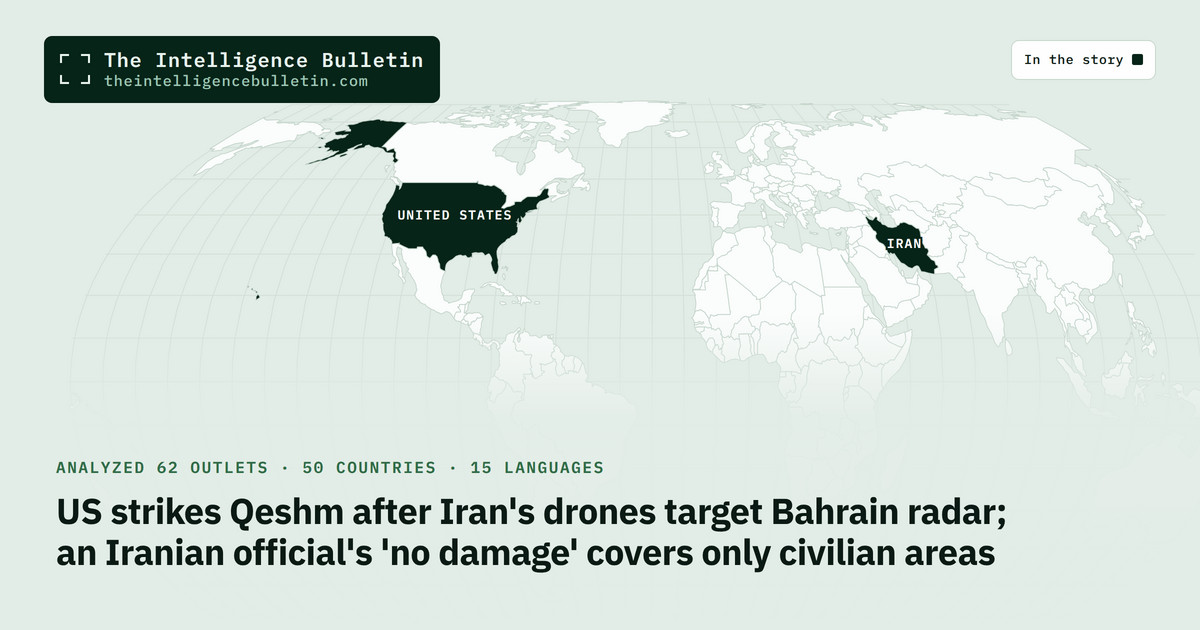
Iran’s Guards say drones hit a US radar in Bahrain on November 17; Bahrain and the US military say none got through. Hours later, a US official says, jets struck a Guards missile site on Qeshm, where military damage remains undisclosed.
Across the press: La Razón’s EFE headline says the US strike on Qeshm did no damage; Iranian media cited by Al-Mustaqila report explosions at an air-defense site.
Source base: 5 outlets read in full (United States, Qatar, Iraq, Pakistan, Spain), selected from 62 analyzed.
- Denied on the recordIran’s Revolutionary Guards say their drones struck a US radar system at Bahrain’s Sheikh Isa Air Base before dawn on November 17; Bahrain says it intercepted the drones before they reached their targets, and the US military says there was no damage to equipment and no injuries.Source: IRGC statement carried by Al Jazeera, Al-Mustaqila, Pakistan Observer and EFE; the denial comes from the Bahrain Defense Force and US Central Command, as reported by AP and Al Jazeera
- 1 of 5 · Al-Mustaqila onlyIranian media say the US hit the Nariman air-defense site northwest of Qeshm city, causing an explosion and columns of smoke, and Hormozgan’s deputy governor said several sites on the island were attacked.Al-Mustaqila, citing Iranian media, IRNA and Mehr; Al Jazeera separately cites Fars reporting explosions and smoke over the island
- 2 of 5 · reported separatelyHours after the Bahrain attack, US aircraft used precision munitions to strike what a US official called an IRGC missile launch site on Qeshm Island, in response to ‘aggression’ against US troops.An anonymous US official speaking to AP, and separately a US military official speaking to Al Jazeera; Al Jazeera notes CENTCOM has issued no statement
- 5 of 5 · reported separatelyHormozgan deputy governor Ahmad Nafisi said the Qeshm strike caused no damage to residential or commercial areas or to infrastructure, a statement that does not address military sites.Nafisi, quoted by AP, Al Jazeera, IRNA and Mehr via Al-Mustaqila, Pakistan Observer, and EFE via La Razón
- 3 of 5 · reported separatelyThe November 17 drone attack was Iran’s third on US targets in Bahrain in five days and ended a roughly two-month lull in Iranian attacks on Gulf states.AP; Al Jazeera’s own reporting; EFE
- Next US Central Command statementWhether CENTCOM acknowledges the Qeshm strike and says what it hit, which no on-record US source has yet done.
- AnsweredIran’s own count stands at three vessels, not four: Al Jazeera reports the Iranian navy confirming a third tanker hit, after the two the Guards reported, and EFE says Tehran counts two tankers and a gas carrier.
- Still openHas CENTCOM or the Pentagon said anything about Sunday s attack, and was any US radar at Riffa touched, given that none of the five outlets carries a US statement? · Does the US actually operate an air-defense radar at Riffa, a base best known as home to Bahraini military helicopters, and what American aggressions does the Guards second phase answer?
- 13 Nov · Iran s Guards claim they destroyed a US early-warning radar in Bahrain; CENTCOM says it downed two drones
- 15 Nov · Iran s Guards claim six drones hit US radar in Bahrain; Bahrain, not Washington, says none got through
- 14 Nov · Iran s Guards say they downed a 17th US MQ-1 over Qeshm; no outlet carries any US reply
- 13 Nov · Iran s Guards call Hormuz tanker blasts an accident ; state media says mines the US military says are gone
Full analysis
What happened Why it matters How each country tells it Where accounts conflict Room for disagreement Our assessment Sources and evidence
What happened
Before dawn on Tuesday, November 17, Iran’s Revolutionary Guards sent drones at Sheikh Isa Air Base in Bahrain and said they had hit a US radar system there. Bahrain’s Defense Force said its air defenses intercepted and destroyed what it called the "treacherous Iranian aerial attacks" before they reached their targets. US Central Command, as reported by Al Jazeera, denied that any American radar had been hit. It said the one-way attack drones aimed at Bahrain were intercepted, with no damage to equipment and no injuries to US troops. The Associated Press reported the same US position. Al Jazeera added that Bahrain then asked the UN Security Council for firm, deterrent measures to make Iran stop, and for compensation.
It was the third Iranian attack on American targets in Bahrain in five days. TIB reported on November 13 that the Guards claimed to have destroyed a US early-warning radar there, in retaliation for an air attack on a communications tower at Sirik in southern Iran; CENTCOM said it had downed two drones. On November 15 the Guards claimed six drones hit a radar at the Riffa helicopter base, and Bahrain said it intercepted them. AP’s summary of all three attacks: despite the claims, "there appeared to be little or no damage done." The Guards’ statement, carried by AP, warned that "continued aggression against the country’s airspace, as well as the use of regional military bases and facilities for hostile acts against Iran, will not go unanswered." EFE, in copy run by La Razón, ties Tuesday’s attack specifically to alleged US drone incursions into Iranian airspace.
Hours later, US aircraft struck Qeshm Island, which sits on the Iranian side of the Strait of Hormuz near Bandar Abbas. An anonymous US official told AP that a fighter jet used "precision munitions" on a Guards missile launch site, responding to "aggression" toward US personnel. A US military official told Al Jazeera the strike was self-defense against Guards aggression "against our soldiers and our assets." Al Jazeera noted that CENTCOM had issued no statement on the strike.
Iranian accounts describe the target differently. Iranian media cited by the Iraqi outlet Al-Mustaqila said US forces hit the Nariman air-defense site northwest of Qeshm city, causing an explosion and columns of smoke. Al Jazeera cites the Fars agency reporting an explosion and smoke over the island, and Tasnim reporting projectiles falling nearby. Hormozgan deputy governor Ahmad Nafisi, quoted through IRNA and Mehr, said the US attack on "several sites" caused no damage to residential or commercial areas or infrastructure, and that the situation was "under control."
Qeshm is not a new target. AP says the US has periodically carried out what appear to be limited strikes on the island and other Iranian targets this month. EFE, citing Iranian authorities, counts at least four US attacks on Qeshm in recent weeks. Iran also claimed drone kills, Al Jazeera reports: Iranian television said an MQ-1 was downed south of Qeshm, and the army, via ISNA, said it destroyed a US "LUCAS" drone over Hormuz. On Wednesday, Kuwait’s army said its air defenses had repelled hostile drones; Al Jazeera did not report who launched them.
The backdrop, per AP, is a war that began on February 28 with US and Israeli strikes on Iran and is now in its eighth month. The US has enforced a naval blockade around Hormuz for months, curbing Iranian crude exports, while escorted tankers have brought Gulf oil shipments back to roughly prewar levels. With the USS Theodore Roosevelt joining the George H.W. Bush and the George Washington, US naval forces in the region now exceed those deployed when the war began. Egypt, Qatar, Saudi Arabia and the United Arab Emirates condemned the attack on Bahrain. Mediation continued in parallel. Pakistan Observer reports that Iranian and Qatari officials were due to meet in Doha, and that Foreign Minister Abbas Araghchi met Oman’s Badr Albusaidi.
Why it matters
The mediator itself says the attacks are hurting the talks. Qatar said Iran’s "continued attacks" on Bahrain "undermine diplomatic efforts," and its spokesman Majed Al Ansari called any escalation an "extremely grave danger" to a deal. Meanwhile, AP reports that Trump has said new strikes are highly unlikely but has told Vice President JD Vance that talks aren’t needed at this time.
The analysts AP consulted read the Bahrain campaign as a change in Iran’s behavior. Tehran-based analyst Mostafa Najafi said it could mark a shift away from waiting to be attacked before retaliating. Mahdi Mohammadi, an adviser to Iran’s parliamentary speaker, wrote that leaders see US economic pressure as an attempt to create a domestic "security crisis." If that is how Tehran sees the blockade, then radar strikes in Bahrain are a test of whether hitting the bases that support it changes anything. The Kuwait intercept a day later suggests that test may not stay confined to one kingdom.
How each country tells it
- wncw.org · United States · wire copyAssociated Press copy from Cairo: Iran’s third drone attack on Bahrain in five days ended a two-month lull, and a US fighter jet struck an IRGC missile launch site on Qeshm hours later, according to an anonymous US official.
- Al Jazeera (Arabic) · Qatar · original reportingIts own US military source says US aircraft used precision munitions on an IRGC missile launch site on Qeshm ‘in self-defense,’ and it reports that Kuwait’s army repelled hostile drones the following day.
- Al-Mustaqila · Iraq · carries IRNAIts headline has Washington striking Qeshm ‘again’ and Iran ‘responding’ in Bahrain, and through Iranian media it names the target as the Nariman air-defense site northwest of Qeshm city.
- Pakistan Observer · Pakistan · original reportingA brief, unattributed roundup that pairs the Qeshm strikes and the Sheikh Isa attack without saying which came first, then turns to diplomacy.
- La Razón · Spain · wire copyEFE copy leads with Tehran’s line that the Qeshm strike caused no damage and lists Iran’s claims: the fourth US attack on Qeshm in recent weeks, two downed US drones, and three ships hit by mines.
Where accounts conflict
On Bahrain, the Guards say their drones struck the radar; Bahrain and CENTCOM say none got through. Neither side has offered imagery or independent evidence in the reporting.
On Qeshm, La Razón’s headline says the strike did no damage. The Nafisi quote beneath it, however, rules out damage only to civilian areas and infrastructure. Meanwhile, Iranian media cited by Al-Mustaqila report an explosion at a military site. The US calls the target a missile launch site; Iranian media name an air-defense site. With Nafisi citing several sites hit, these may be different targets, and no one has said which was struck or how badly.
On sequence, Al-Mustaqila’s headline has Iran striking Bahrain in response to Qeshm. Its own text, like AP and Al Jazeera, says the US strike came hours after the Bahrain attack.
Room for disagreement
The strongest case against a contained exchange comes from Hamidreza Azizi of the International Crisis Group. He argues that Iranian leaders are now weighing whether "breaking the blockade through escalation is less costly than accepting its continuation," so that "the risk of renewed war no longer depends solely on whether Trump decides to attack Iran again." The evidence fits that trajectory: three attacks in five days, Kuwait drawn in, and mines hitting tankers in Hormuz. Add a US force posture larger than at the war’s start, and a single drone that gets through could move both sides past calibration.
Our assessment
It is likely that Iran and the US keep trading limited strikes around Bahrain and Qeshm in the coming weeks, with each side describing its own losses as nil. The pattern rests on corroborated reporting. AP, Al Jazeera and EFE independently report the five-day sequence, and two separate US officials describe the Qeshm strike. Both governments’ statements are built to show restraint. The US says nothing was damaged and has issued no on-record word on Qeshm. Iran’s provincial official denies only civilian damage, while the Guards claim hits they do not substantiate. Each has an interest in the reader seeing it that way: Washington and Manama to show their defenses work, Tehran to show retaliation without inviting a heavier blow. IISS analyst Sascha Bruchmann told AP, "This is not it — yet."
What would change this: an Iranian strike that causes US casualties or acknowledged damage, or a CENTCOM statement announcing a broader campaign against Guards sites.
Sources and evidence
Press quoted
- What did the US strike on Qeshm actually hit and destroy: an IRGC missile launch site, as the US official says, or the Nariman air-defense site that Iranian media name, given that Iran’s only damage statement covers civilian areas and infrastructure?
- Who launched the drones that Kuwait’s army says it repelled on Wednesday, November 18, and did any reach Kuwaiti territory?
- Did the Iranian-Qatari talks that Pakistan Observer says were scheduled in Doha go ahead after Qatar said Iran’s attacks on Bahrain ‘undermine diplomatic efforts’?
That’s how the world told the story.
Get our daily open-source intelligence on world events in your inbox — one email a day, up to six stories.
Subscribe freeNo spam. One-click unsubscribe. See the latest email →