 AI-generated analysis published under the editorial responsibility of Rohit Sinnas. How it works →
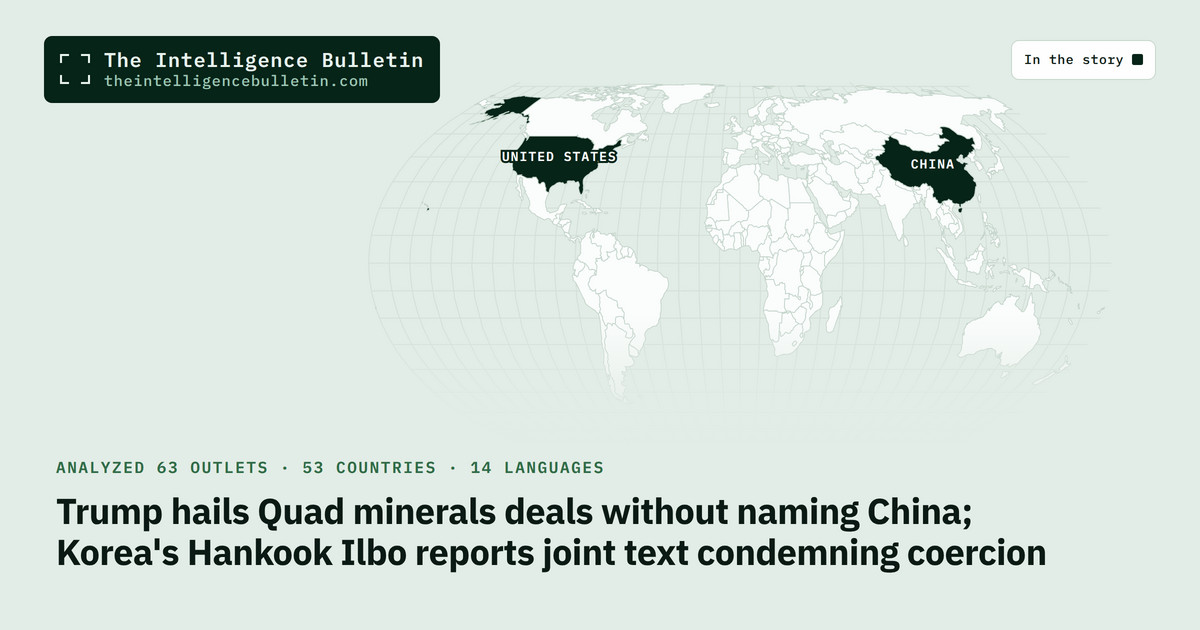
See the 53 countries
Afghanistan, Argentina, Armenia, Australia, Azerbaijan, Bangladesh, Belgium, Brazil, Bulgaria, Canada, Croatia, Cuba, Cyprus, Egypt, France, Georgia, Germany, Greece, Guam, Hungary, India, Israel, Japan, Kenya, Lithuania, Luxembourg, Macao, Malta, Netherlands, New Zealand, North Korea, Pakistan, Philippines, Poland, Qatar, Romania, Russia, Saudi Arabia, South Africa, South Korea, Spain, Sri Lanka, Syria, Taiwan, Thailand, Trinidad and Tobago, Turkey, Ukraine, United Arab Emirates, United Kingdom, United States, Vietnam, Yemen
Quad leaders met in Manila for the first time since 2024; Trump announced unspecified critical-minerals deals and a first joint patrol-aircraft exercise without naming China. South Korea’s Hankook Ilbo reports they issued a joint text opposing coercion and arbitrary export restrictions, two days before Trump meets Xi.
Across the press: Australia’s ABC told the Quad story through Trump’s remarks, which never named China; South Korea’s Hankook Ilbo reported a joint text opposing coercion.
Source base: 4 outlets quoted (Australia, India, Japan, South Korea), selected from 63 analyzed. 3 read in full, 1 by its headline only.
- 1 of 4 · Hankook Ilbo onlyThe four leaders issued a joint document that ‘strongly opposes destabilizing unilateral actions to change the status quo, including by force or coercion,’ and voices serious concern about ‘economic pressure including arbitrary export restrictions.’Hankook Ilbo’s own report on the joint document.
- 1 of 4 · Hankook Ilbo onlyChinese Premier Li Qiang skipped the ASEAN+3 meeting in Manila attended by Takaichi and Lee Jae-myung and sent an agriculture minister in his place, which observers read as avoiding contact with Takaichi.Hankook Ilbo, citing Nihon Keizai Shimbun for the reading that recent China-Japan tensions likely played a part.
- 2 of 4 · reported separatelyTrump said the four countries had made several new critical minerals deals so that none of them is vulnerable to coercion by any single foreign supplier, without saying who signed what or for how much.ABC News (Australia) and Hankook Ilbo, both quoting Trump’s opening remarks at the Manila meeting.
- 2 of 4 · reported separatelyThe Quad will hold a joint exercise of maritime patrol aircraft, which Hankook Ilbo describes as the four countries’ first, set for next year.ABC News (Australia) citing Trump’s announcement; Hankook Ilbo citing Trump’s remarks and the joint document.
- 3 of 4 · reported separatelyThis was the first Quad leaders’ meeting in roughly two years, the last having been held in September 2024, and the first since Trump returned to the White House.ABC News (Australia) and Hankook Ilbo in their reports; Asahi Shimbun in its headline.
- November 18Albanese flies to Shenzhen for a trade-ties stop and CEO roundtable, testing how Canberra balances the Quad and China.
- November 19Xi hosts Trump and Putin in Shenzhen; watch whether Trump repeats the Quad’s coercion or export-restriction language.
- November 20Albanese meets Xi, the first sign of whether Beijing holds the Manila meeting against Australia.
- 2027The first joint Quad maritime patrol aircraft exercise and the first Quad Business Leaders Forum are due.
- Still openWhat does the text of the new arrangement actually permit beyond faster paperwork, such as the defense infrastructure development Albanese mentioned, or any Australian rotational presence or access to Philippine facilities? · Will China s defense or foreign ministry issue a formal response to this signing, given that Reuters found neither had responded on the day?
- 16 Nov · Australia-Philippines pact cuts military red tape; Beijing s ministries give no reply as Global Times recycles February rebuke
- 16 Nov · China confirms Xi will host Trump and Putin November 19, the last of three capitals to say so
- 14 Nov · White House pitches Trump-Xi-Putin nuclear talks without Ukraine; Kremlin aide says Shenzhen meeting will cover Ukraine
Full analysis
What happened Why it matters How each country tells it Room for disagreement Our assessment Sources and evidence
What happened
The leaders of the United States, Japan, India and Australia met in Manila on November 17, on the sidelines of the ASEAN summit. It was the first Quad leaders’ meeting since September 2024 and the first since Donald Trump returned to the White House. Hankook Ilbo notes it was also Japanese Prime Minister Sanae Takaichi’s first. ABC News (Australia) reported that Trump landed about 45 minutes before the scheduled start. Marco Rubio, Scott Bessent, his new chief of staff Stephen Miller, Howard Lutnick and Jamieson Greer were among those on his side of the table.
Trump’s opening remarks supply most of what is on record. "We’ve also made several important, new critical mineral deals to secure our supply chains and ensure that none of our nations is vulnerable to coercion by any single foreign supplier," he said, a line both ABC and Hankook Ilbo carry. He did not say which governments or companies signed, which minerals are covered or how much money is involved, and neither outlet supplies those details. ABC adds that he hinted further significant agreements were coming.
He announced a joint exercise of maritime patrol aircraft. ABC says it builds on recent naval drills near Japan; Hankook Ilbo calls it the four countries’ first and says it is set for next year. He nodded to AUKUS: "We make the greatest submarines anywhere in the world, and we’re working with Australia and others on that." ABC also reports a Quad AI accelerator and a pledge of more than US$85 million to widen access to the technology among trusted partners. Both outlets report a first Quad Business Leaders Forum, which ABC dates to 2027.
Trump took credit for reviving the Quad in 2017 and told the table, "We’re all friends. It’s a lot easier that way." Anthony Albanese, in ABC’s account, welcomed practical cooperation on critical minerals, AI and maritime security.
ABC observes that Trump never named China, though Beijing dominates the processing of many critical minerals and rare earths. Hankook Ilbo goes further. It reports that the four leaders issued a joint document that "strongly opposes destabilizing unilateral actions to change the status quo, including by force or coercion." The paper says the text also voices serious concern about "economic pressure including arbitrary export restrictions." Hankook Ilbo reads that language as aimed at China’s maritime push in the East and South China Seas and at its rare-earth export controls. By the paper’s account, the text also affirmed Japan’s Free and Open Indo-Pacific concept and listed three work items: expanding and hardening undersea cable networks, wider maritime surveillance cooperation alongside the patrol aircraft drill, and a senior-level cybersecurity meeting. ABC’s article, read in full, does not mention a joint document at all, so the document’s wording rests on Hankook Ilbo alone.
The timing frames all of it. TIB reported on November 16 that China had confirmed Xi Jinping will host Trump and Vladimir Putin in Shenzhen on November 19, the first trilateral meeting of the three leaders. Hankook Ilbo relays Yomiuri’s reading that the document was meant to display democratic unity before that meeting and a separate US-China summit. Albanese flies to Shenzhen on November 18, ABC reports. He will make a stop marking Australia’s trade ties with China and attend a CEO roundtable before his own meeting with Xi on Friday, November 20.
Beijing appears in the reporting only secondhand. Hankook Ilbo reports that Premier Li Qiang skipped the ASEAN+3 meeting in Manila attended by Takaichi and South Korean President Lee Jae-myung, and sent his agriculture minister instead. Observers read that as avoiding Takaichi, and Nikkei, as the paper relays it, judged that recent China-Japan tensions likely played a part. Hankook Ilbo traces those tensions to Takaichi’s remark last year suggesting Japan could intervene in a Taiwan contingency.
Why it matters
The agreement with the most at stake is the one least described. Hankook Ilbo says China has used rare-earth export controls to press the United States and Japan. Four governments pledging that none of them will be hostage to a single supplier is an attempt to blunt that leverage before Trump sits down with Xi. Without signatories, volumes or dollar figures, nobody outside the room can yet judge whether it does. The patrol aircraft exercise is narrower but real: four air arms rehearsing maritime surveillance together in waters where China is expanding its reach.
The larger choice is between voice and paper. Trump spoke of coercion without naming who practices it; by Hankook Ilbo’s account, the four governments put the behavior in writing. That lets Washington bring a shared position to Shenzhen while keeping the president’s own words clear of it. For Tokyo, which Hankook Ilbo says fears being sidelined at APEC, the text is insurance. For Canberra the test comes within days. Albanese goes straight from a meeting about reducing reliance on Chinese supply to a Shenzhen stop celebrating Chinese trade.
How each country tells it
- ABC News (Australia) · Australia · original reportingBuilds its account from Trump’s opening remarks in Manila: critical minerals deals, a maritime patrol aircraft exercise, a nod to AUKUS submarines, an AI pledge of more than US$85 million, and Trump’s warmth toward Albanese, then looks ahead to Albanese’s own trip to Shenzhen and his Friday meeting with Xi.
- Moneycontrol · India · original reportingJudging from the headline alone, the piece is about Modi picking up a tricolour marker at the table and a ‘save it’ remark from Trump, which it ties to the 2023 BRICS summit, when Modi picked an Indian flag up off the floor.
- Asahi Shimbun · Japan · original reportingIts headline casts the meeting as a show of unity timed just before Trump sits down with Xi and Putin, a first such gathering in two years at which each country brought its own calculations.
- Hankook Ilbo · South Korea · original reportingReads the meeting as a coordinated move against China. It reports a joint document opposing changes to the status quo by force or coercion and economic pressure through arbitrary export restrictions, and pairs that with Beijing’s snub of Takaichi at the ASEAN+3 meeting.
Room for disagreement
The strongest case against reading a hedge into Trump’s silence is that the split is ordinary diplomatic division of labor. Hankook Ilbo itself describes Trump’s minerals line as aimed obliquely at China’s export controls. A signed four-nation text released the day before APEC opens is louder than anything said aloud in the room. If Beijing reads it the way Yomiuri did, as a deliberate show of bloc unity, Trump’s restraint buys nothing: he arrives in Shenzhen carrying the document whether he quotes it or not. If the reading Nikkei backs holds, Li Qiang’s absence from ASEAN+3 suggests Beijing is already pricing the alignment in. The evidence cuts one more way. The document’s language comes from one Korean paper, and if the text proves softer than Hankook Ilbo describes, there is less distance between voice and paper than this analysis assumes.
Our assessment
It is likely that Trump will keep the Quad’s coercion language out of his own mouth in Shenzhen on November 19, leaving the joint text to speak for Washington. He would then pursue the agenda TIB reported on November 14 that White House officials set for that meeting: nuclear arms reduction and Iran. The warrant is Trump’s own conduct. ABC and Hankook Ilbo, reporting independently, carry matching words showing he avoided naming China even at a table built to answer it, hours before leaving for China. The weaker link is the document itself, which rests on Hankook Ilbo alone, and the sources behind this call are thin. No American or Chinese outlet is among them, and the Indian and Japanese pieces, from Moneycontrol and Asahi Shimbun, could be read only by headline. Each party has an interest in a particular reading. Tokyo wants the paper seen as the Quad’s voice. The White House wants the minerals deals seen as large without saying how large. Canberra wants Albanese’s Friday with Xi to go smoothly. Until signatories and amounts appear, the minerals deals are an announcement, not a measurable shift in supply.
What would change this: Trump or a White House readout naming China’s export controls, or quoting the joint document’s coercion language, during or after the Shenzhen meetings.
Sources and evidence
Press quoted
- Which countries are party to the critical minerals deals Trump announced, and what do they commit to in volumes, financing or processing capacity?
- Will Beijing formally answer the Quad joint document before or during the Shenzhen meetings on November 19, and does the document name China anywhere in its text?
- What did Trump mean by the ‘major developments’ and further significant agreements he said the Quad would produce in the coming year?
That’s how the world told the story.
Get our daily open-source intelligence on world events in your inbox — one email a day, up to six stories.
Subscribe freeNo spam. One-click unsubscribe. See the latest email →