 AI-generated analysis published under the editorial responsibility of Rohit Sinnas. How it works →
See the 54 countries
Argentina, Armenia, Australia, Austria, Azerbaijan, Barbados, Belgium, Brazil, Bulgaria, Canada, Chile, China, Croatia, Ecuador, Egypt, Greece, Hong Kong, Hungary, India, Indonesia, Ireland, Israel, Italy, Japan, Lebanon, Macao, Madagascar, Mexico, Moldova, New Zealand, Nigeria, Pakistan, Papua New Guinea, Paraguay, Peru, Philippines, Poland, Portugal, Romania, Russia, Saudi Arabia, Serbia, Singapore, Slovakia, South Korea, Sri Lanka, Switzerland, Taiwan, Thailand, Turkey, Uganda, United Kingdom, United States, Uruguay
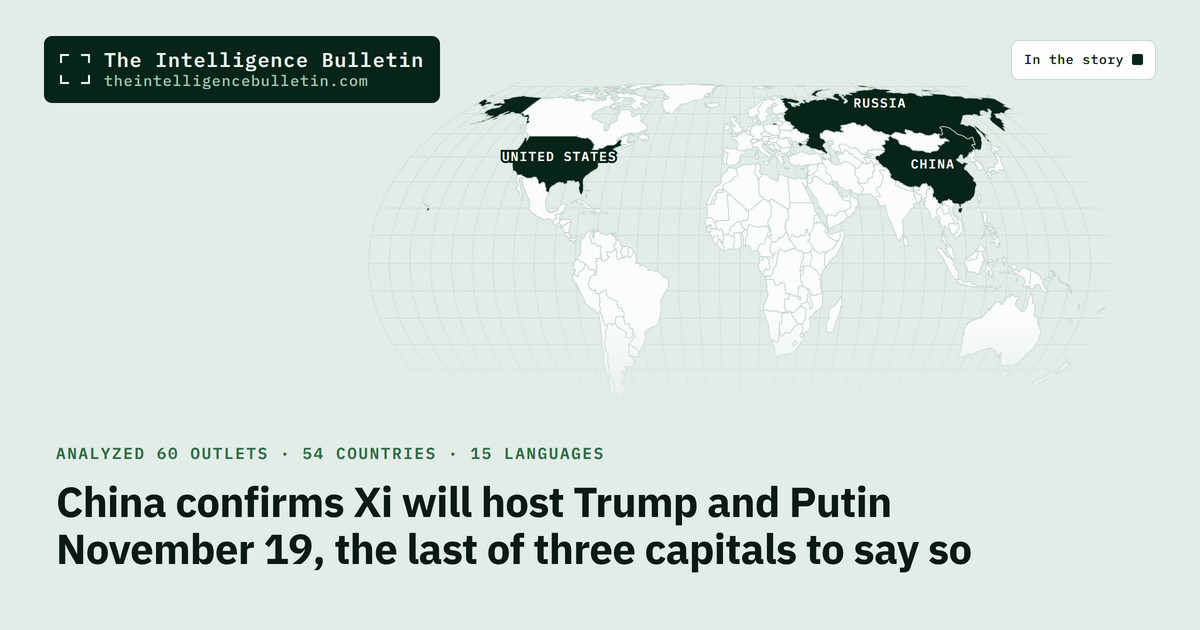
Chinese, US and Russian officials all say Xi Jinping will host Donald Trump and Vladimir Putin in Shenzhen on November 19. US officials say nuclear arms will be discussed and Ukraine will not. Beijing has resisted three-way arms control, and no agreement is expected.
Across the press: China’s confirmation appears only in BusinessLine’s Beijing agency dispatch, while Russia’s Pronedra warns the three-way format proves no ‘union of three states.’
Source base: 5 outlets read in full (Russia, United States, Belgium, Croatia, India), selected from 60 analyzed.
- 2 of 5 · one shared reportThe Chinese Foreign Ministry confirmed the meeting on Monday, November 16, after the White House announced it Saturday and the Kremlin confirmed it Sunday.BusinessLine (Press Trust of India dispatch) for the Chinese confirmation; Novi list (agency copy) for the Saturday and Sunday sequence; Pronedra dates Peskov’s confirmation to November 14 rather than Sunday
- 4 of 5 · reported separatelyXi Jinping, Donald Trump and Vladimir Putin will hold the first trilateral meeting of their countries’ leaders on November 19 in Shenzhen, on the sidelines of the APEC summit.Pronedra and Novi list quoting Kremlin spokesman Dmitry Peskov; Newsweek citing the White House and Kremlin; BusinessLine citing the Chinese Foreign Ministry
- 3 of 5 · reported separatelyUS officials say the war in Ukraine will not be discussed at the trilateral meeting because Washington is pursuing a separate track with Moscow.Newsweek, Novi list and BusinessLine citing US and White House officials; EUobserver’s headline says Trump and Putin will discuss Ukraine’s future in China; Pronedra calls reports either way unofficial
- 3 of 5 · reported separatelyThe White House says Trump will raise reducing nuclear arsenals, while Beijing has shown little interest in trilateral arms control because its arsenal is far smaller.White House spokeswoman Olivia Wales, quoted by BusinessLine; Newsweek and Novi list citing the White House; Newsweek and BusinessLine on Beijing’s reluctance
- 2 of 5 · reported separatelyNo agreement is expected from the meeting, and no list of agreed issues or documents to be signed has been published.Newsweek citing a senior US official; Pronedra on the published Russian confirmation
- Still openWill Trump and Putin meet one-on-one in Shenzhen to discuss Ukraine, as Ushakov describes, or not at all, as the White House says? · Will Beijing accept nuclear arms reduction as an agenda item, when MERICS s Insisa says it has shown no interest and a US official says China s arsenal is growing by far the fastest in the world ?
Full analysis
What happened Why it matters How each country tells it Where accounts conflict Room for disagreement Our assessment Sources and evidence
What happened
China’s Foreign Ministry said on Monday, November 16, that Xi Jinping will host Vladimir Putin and Donald Trump in Shenzhen on November 19 for the first trilateral meeting ever held by the presidents of the three countries. That confirmation comes from a Beijing-datelined Press Trust of India dispatch carried by India’s BusinessLine. Beijing was the last of the three capitals to speak. In the Agence France-Presse copy run by Croatia’s Novi list, the White House announced the meeting on Saturday, and Kremlin spokesman Dmitry Peskov confirmed it on Sunday: "Postignut je dogovor o održavanju trilateralnog sastanka 19. studenog." TIB reported on November 14 that the White House was presenting the meeting as the start of nuclear talks that would leave out Ukraine.
The date had been in doubt. Russia’s Pronedra recalls that on October 20, Deputy Foreign Minister Andrei Rudenko said there was no final agreement on a three-way summit. The South China Morning Post, as cited by BusinessLine, reported weeks of three-way discussions to settle the agenda and protocol.
The meeting sits inside China’s hosting of the 33rd APEC Economic Leaders’ Meeting on November 18 and 19, which brings together the grouping’s 21 member economies. Pronedra, citing Xinhua, says Xi will chair that meeting and that a business summit runs November 17 and 18. Trump left for Asia on Monday, according to Newsweek, and arrives in Shenzhen late Wednesday, according to Novi list. He will also meet Xi alone. Newsweek reports that US officials expect that session to cover implementation of the two countries’ trade deal, and that Trump is unhappy with the pace and volume of China’s rare-earth shipments.
The White House’s headline item is nuclear weapons. "The president has made it clear that, among other topics, he will discuss the reduction of nuclear weapons in the world," spokeswoman Olivia Wales said, as quoted by BusinessLine. The New START treaty expired in February. It was the last agreement capping US and Russian strategic arsenals. Newsweek reports that Trump rejected a Russian proposal to extend it for a year and called instead for a new deal that includes China. The gap between the three arsenals is large. US assessments cited by the Associated Press, as relayed by Newsweek, put the US and Russian total inventories at more than 5,000 warheads each and China’s at more than 600. Both Newsweek and BusinessLine report that Beijing has shown little interest in joining. BusinessLine says Beijing points to its far smaller arsenal and has repeatedly said it "does not subscribe to a model of great power co-governance." Two Russian and Hong Kong reports, carried by Pronedra and BusinessLine, also raise rules on artificial intelligence in nuclear command systems as a possible topic.
Iran is the second item. Novi list’s agency copy describes a war that "began in February" with Israeli-American bombing of Iran. BusinessLine notes that China is Iran’s largest trading partner and the biggest buyer of its crude oil. A senior US official told Newsweek that Trump will raise the war with both leaders but does not expect a breakthrough.
A senior US official also told Newsweek that no immediate agreement is expected. The same official framed the meeting as the beginning of a conversation. Pronedra says the published Russian confirmation lists no agreed issues and no documents to sign.
The Europeans were busy elsewhere. EUobserver reports that EU foreign ministers meeting in Brussels on Monday were to add 137 individuals and entities to a Russia blacklist of more than 4,600 names. Those named include Wildberries chief executive Tatyana Kim. Its text says Ukraine peace talks "seem to be headed toward another anticlimax."
Why it matters
Trump has made any successor to New START conditional on China joining. The host has signaled it will not accept that condition. Shenzhen is therefore the first time the precondition meets the party it binds, face to face. If Xi declines, the US-Russian arms-control vacuum has no visible path to closing.
The format itself is also a prize. Pronedra says that for Moscow, the value lies in putting Russia’s position to the US and Chinese leaders at once, "without retelling through third parties." Beijing gains the convening role while publicly disclaiming any three-power management of world affairs.
On Ukraine, the reporting points away from a three-power settlement. US officials say Ukraine stays on a separate US-Russia track, and Newsweek says China is not part of those talks. That does not keep Kyiv in the room. Newsweek reports that Volodymyr Zelenskyy was not invited and has voiced concern about decisions being made without him. Readers should also know a limit of the reporting: it contains no Chinese or Ukrainian outlet. Beijing’s position reaches this page only through an Indian agency, and Kyiv’s only through Newsweek’s paraphrase.
How each country tells it
- Pronedra · Russia · opinionPronedra builds its piece on Dmitry Peskov’s confirmation of a November 19 meeting in Shenzhen, then spends most of its length warning readers not to mistake an agreed date for agreed results.
- Newsweek · United States · original reportingNewsweek presents the meeting as the climax of Trump’s Asia trip and lists the stakes from Washington: nuclear arsenals after New START, Iran, rare earths, and the Megaspeed chip-export dispute inside the administration.
- EUobserver · Belgium · original reportingThe fetched text covers only new EU sanctions on 137 Russian individuals and entities, including Wildberries CEO Tatyana Kim, drawn from a leaked proposal EUobserver saw; the Shenzhen meeting appears only in the headline.
- Novi list · Croatia · wire copyNovi list runs a short dispatch: the White House announced the meeting Saturday, Peskov confirmed it Sunday, the agenda is nuclear weapons and the Iran war, and Ukraine is excluded despite fears in Kyiv and among its allies.
- thehindubusinessline.com · India · wire copyBusinessLine’s Beijing-datelined report is the only source in the set carrying the Chinese Foreign Ministry’s Monday confirmation that Xi will host Putin and Trump in Shenzhen on November 19.
Where accounts conflict
The first conflict is whether Ukraine will come up. Newsweek, Novi list and BusinessLine all cite US officials saying it will not be part of the trilateral discussions. EUobserver’s headline says Trump and Putin will "discuss Ukraine’s future in China." The body text we obtained does not say whether that means the three-way session or a separate Trump-Putin encounter. TIB reported on November 14 that a Kremlin aide said the Shenzhen meeting would cover Ukraine. Pronedra treats reports in either direction as unofficial.
The second conflict is the date of the Kremlin’s confirmation. Pronedra dates Peskov’s confirmation to November 14, a Saturday. Novi list’s agency copy places it on Sunday, a day after the White House announcement.
Room for disagreement
The case for a larger outcome rests on the preparation. The South China Morning Post’s account of weeks of protocol talks suggests the three sides built more than a photo opportunity. A narrow joint statement on artificial intelligence in nuclear systems would cost Beijing little, because it caps no warheads. That makes it a plausible deliverable that current expectations would understate. Separately, Ukraine could be settled on the margins even if it is kept off the three-way table. EUobserver’s headline and the Kremlin aide’s remarks both point to a Trump-Putin channel in Shenzhen.
Our assessment
It is very likely that the November 19 meeting takes place and ends without any signed agreement or Chinese commitment to trilateral nuclear limits. That much is supported by independent reporting chains: AFP, Press Trust of India and Newsweek’s own US sourcing. Each cites US officials expecting no agreement, and Pronedra notes that no documents have been listed for signature. Beijing’s stated reasons for refusing arms control are structural: an arsenal roughly a tenth the size of the other two. Those reasons do not change in a week. The White House needs the meeting to read as a beginning, Moscow as recognition, and Beijing as hosting without alignment. Each has an interest in the reader seeing it their way, and only the first is betting on results.
What would change this: a joint text released in Shenzhen naming nuclear risk reduction as a shared trilateral agenda, or a Chinese Foreign Ministry statement accepting arms talks with Washington and Moscow.
Sources and evidence
Press quoted
- Will Trump and Putin meet separately in Shenzhen and discuss Ukraine, as EUobserver’s headline implies, even though US officials keep Ukraine off the three-way agenda?
- Did the Chinese Foreign Ministry’s confirmation accept nuclear arms reduction as an agenda item, or only the meeting itself, given Beijing’s stated rejection of ‘great power co-governance’?
- Will the three leaders sign or issue any joint text in Shenzhen, such as a statement on AI in nuclear command, or only agree to keep talking?
That’s how the world told the story.
Get our daily open-source intelligence on world events in your inbox — one email a day, up to six stories.
Subscribe freeNo spam. One-click unsubscribe. See the latest email →