 AI-generated analysis published under the editorial responsibility of Rohit Sinnas. How it works →
See the 54 countries
Argentina, Australia, Azerbaijan, Barbados, Belgium, Benin, Bosnia and Herzegovina, China, Croatia, Cuba, Cyprus, Egypt, France, Germany, Ghana, Greece, India, Indonesia, Iran, Ireland, Israel, Jordan, Kazakhstan, Kenya, Lebanon, Lithuania, Luxembourg, Mexico, New Zealand, Nigeria, Norway, Oman, Poland, Qatar, Romania, Russia, Saudi Arabia, Senegal, Serbia, Singapore, Somalia, South Africa, South Korea, Sri Lanka, Switzerland, Taiwan, Tunisia, Turkey, Uganda, Ukraine, United Arab Emirates, United Kingdom, United States, Vietnam
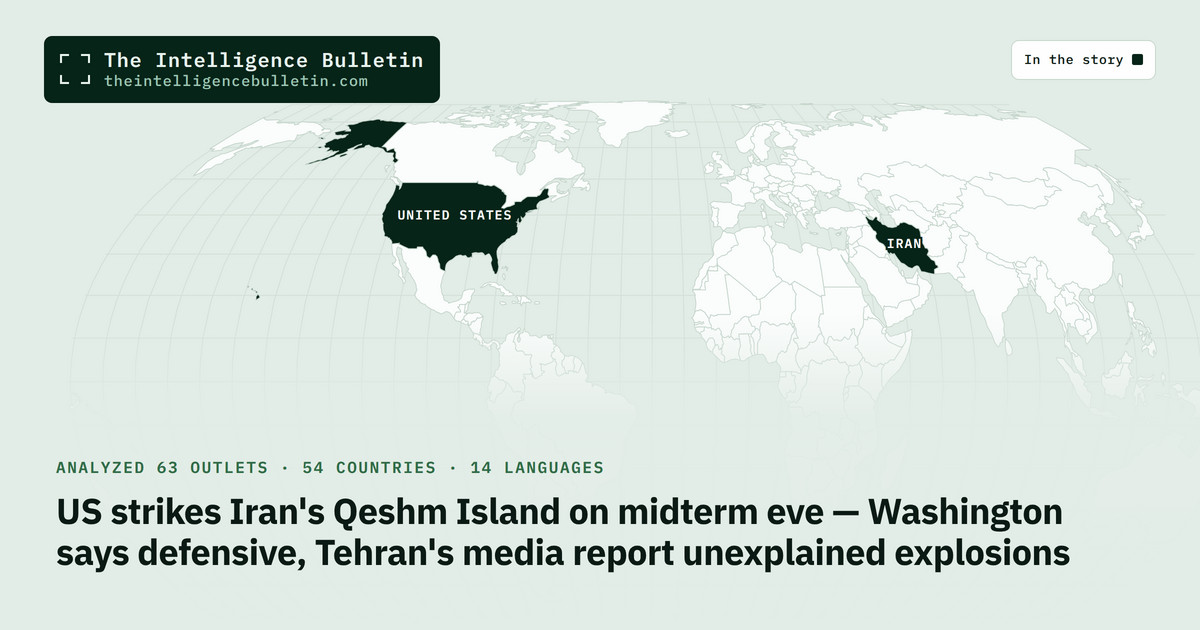
The US struck Iran’s Qeshm Island on November 2, calling the attack limited and defensive against surface-to-air missile use, while Iranian media reported five unexplained explosions and officials gave no position. A single US official’s self-defense account is the only trigger narrative.
Across the press: US outlets’ trigger story rests on unnamed officials, while Al Jazeera Arabic reports unexplained explosions and never mentions an Iranian missile launch.
Source base: 5 outlets read in full (United States, Israel, Qatar, United Arab Emirates, South Korea), selected from 63 analyzed.
- 2 of 5 · one shared reportA US fighter jet destroyed an Iranian surface-to-air missile launcher on Qeshm in self-defense after the IRGC fired a missile from it at a US fighter.Arutz Sheva citing a senior US official to Axios; Al Jazeera Arabic also relays the Axios account.
- 3 of 5 · one shared reportThe United States has been conducting smaller-scale attacks against Iranian targets for several weeks without public acknowledgment.The Wall Street Journal citing American officials, relayed by Arutz Sheva, Al Jazeera Arabic and Herald Business.
- 5 of 5 · reported separatelyThe US military carried out strikes on Iran’s Qeshm Island in the Strait of Hormuz on Monday, November 2.KSNV citing a US official via AP; Arutz Sheva, Al Jazeera Arabic and Herald Business via The Wall Street Journal; Gulf News citing US media and officials; Iranian state media reported the resulting explosions.
- 5 of 5 · reported separatelyThe US described the strikes as limited and defensive, aimed at Iranian forces using surface-to-air missiles against US assets and at preventing attacks on shipping.KSNV via a US official through AP; Arutz Sheva via US officials through The Wall Street Journal; Gulf News via a US official; Herald Business via The Wall Street Journal; Al Jazeera Arabic relays WSJ, Axios and NewsNation officials.
- 5 of 5 · reported separatelyExplosions were heard on Qeshm Island on Monday, with Iranian state media reporting five explosions and residents sighting two aircraft overhead, while Iranian authorities issued no official position on the strikes.IRNA and Fars via Al Jazeera Arabic, with Al Jazeera’s correspondent confirming residents were told of five explosions; Gulf News reports five explosions from Iranian state media; KSNV reports Iranian state television explosions; Herald reports IRNA multiple explosions; Arutz Sheva notes social media reports.
- November 3US midterm elections — whether Washington announces or carries out larger strikes now that the vote has passed.
- Early to mid-NovemberChina’s special envoy visits Iran, Oman and Saudi Arabia — a test of whether outside diplomacy widens or stalls.
- Next Qatari-mediated roundWhether Iran formally claims the Qeshm explosions and whether the US confirms or disputes the single official’s trigger story.
- Still openWhat was the separate action short of an overt strike that Netanyahu had begun pushing for in recent days, which Zamir believed would provoke Iran into attacking Israel? · Has Trump actually decided on major strikes, and will they fall before or after the November 3 midterms?
- 27 Oct · US ready to strike Iran in 96 hours—but Netanyahu pushed first, and Trump refused
- 30 Oct · Ten US cargo planes land in Israel, while Washington s accounts converge on no decision yet on Iran
- 31 Oct · Iran s media say four tankers struck mines in Hormuz; the Reuters-AFP wire Arab News ran says three were halted
- 01 Nov · Al-Araby Al-Jadeed reports a US delegation bound for Doha; Araghchi tells IRNA no talks are planned
Full analysis
What happened Why it matters How each country tells it Where accounts conflict Room for disagreement Our assessment Sources and evidence
What happened
On Monday, November 2, the day before American midterm elections, United States forces struck Qeshm Island, the Iranian island that commands the entrance to the Strait of Hormuz. Iranian state agency IRNA reported five explosions loud enough that their force suggested strikes on sites inside the island, and said some residents had seen two aircraft overhead; the news agency Fars reported explosions coming from the direction of the sea at Bandar Lengeh in Hormozgan province. Al Jazeera’s correspondent said residents of Qeshm were told of five explosions, also heard on nearby Hormuz Island and in the city of Bandar Abbas, and that nobody had yet established their cause — whether bombs, fire from the sea aimed at ships, or vessels hitting naval mines. Iran issued no official statement.
The American account came entirely from unnamed officials. A US official told the Associated Press the strikes were limited and defensive and had targeted "Iranians using surface to air missiles against U.S. assets." Officials speaking to The Wall Street Journal called the operation defensive and aimed at keeping Iran from attacking commercial shipping in the strait, and said it was one of a series of smaller strikes the United States has conducted against Iranian targets over recent weeks without public acknowledgment — kept quiet, one said, so as not to create the impression that Washington was preparing to resume a large-scale campaign. A senior US official gave Axios a more specific trigger: a US fighter jet struck and destroyed a surface-to-air missile launcher on Qeshm in self-defense after the Islamic Revolutionary Guard Corps fired an anti-aircraft missile from it at an American fighter in the strait. A US official speaking to NewsNation said Washington had hit radar installations and missile launch platforms in response to Iranians’ use of surface-to-air missiles against American assets.
The sequence Iran describes points another direction. The IRGC announced Monday, shortly before the explosions, that it had shot down a US MQ-9 drone east of the strait and taken control of two MQM-170 drones over Qeshm, using what it called a new advanced air-defense system, bringing to four the number it says it has captured. Al Jazeera’s Tehran bureau chief said the strongest hypothesis was that Iranian air-defense positions had been targeted after that announcement, while stressing nobody yet knew whether the systems were hit by drones, by missiles, or by warplanes.
The strike fell as Washington kept its public posture on a diplomatic track. Hours earlier, President Donald Trump had told reporters, "We had a war with Iran. We won," and said he did not know whether it should even be called a war because "we haven’t been doing any fighting for months." Asked whether attacks would resume after the November 3 midterms, he answered no, and told Axios "we will do something but no need to hurry." Vice President JD Vance said Monday he had spoken to Trump an hour earlier and that both "feel pretty good about the prospects for potentially coming to a negotiated settlement"; he said no deadline had been set. Qatari mediators have held two rounds of talks with Iranian officials, Gulf News reported, focused on Iran halting strait attacks in exchange for the United States lifting its naval blockade of Iranian ports, with further talks planned. Tehran insists the blockade be lifted and its demands met before any agreement. The Pentagon referred questions about the reported strikes to Central Command, which did not immediately respond.
Why it matters
The Strait of Hormuz is one of the world’s most important energy chokepoints, and Qeshm sits at its entrance; Herald Business notes the island holds a large underground missile base, a naval base, desalination plants and dense oil and gas infrastructure. Oil prices moved accordingly: Brent crude rose 0.5 percent to $105.25 a barrel and West Texas Intermediate to $96.93 in Asian trading on Tuesday, after Monday’s 7.63 percent fall to $104.77, which Gulf News attributed to optimism over a diplomatic breakthrough.
Each outlet located the stakes where its own audience lives. KSNV, a Las Vegas station, cast the strike as an eve-of-midterms problem for Republicans, for whom the unpopular war and its effect on gasoline prices are vulnerabilities. Israel’s Arutz Sheva foregrounded the secret-campaign reading — the angle most compatible with Israel’s reported push for further strikes — alongside Trump’s Truth Social claim that oil was falling because "people feel that there will not be a War with Iran." Al Jazeera Arabic led with the unexplained explosions on Iranian soil and the IRGC’s drone-downing claims, placing the story inside Iran rather than inside Washington’s rationale. Dubai’s Gulf News folded the strike into a shipping-and-diplomacy bulletin: the naval blockade, Qatar’s mediation, UAE presidential adviser Anwar Gargash saying the Emirates hoped for a breakthrough but were "braced for the worst," Egypt warning that another escalation would be more dangerous, and China planning to send a special envoy to Iran, Oman and Saudi Arabia in early to mid-November. Seoul’s Herald Business treated it as an election-eve supply-line event whose stated purpose was protecting merchant shipping, the issue that matters most to an energy-importing US ally.
How each country tells it
- KSNV News 3 Las Vegas · United States · carries Associated PressLeads with the official line that the US carried out ‘limited’ and ‘defensive’ strikes in the Strait of Hormuz, and ties the timing to the eve of the US midterm elections.
- Arutz Sheva – Israel National News · Israel · carries The Wall Street Journal and AxiosFrames the Qeshm strike as one move in a continuing, deliberately unannounced campaign of limited US operations against Iran, not as a one-off defensive incident.
- Al Jazeera (Arabic) · Qatar · original reportingProvides the closest account of how the strike is being told inside Iran, via IRNA and Fars, with Al Jazeera’s own correspondents describing five explosions whose nature remains unknown.
- Gulf News · United Arab Emirates · carries The Associated Press and Agence France-PresseReads the strike as escalation occurring ‘amid peace talks’, folding the military action into a broader diplomacy-and-shipping update.
- Herald Business (Herald Corp) · South Korea · carries The Wall Street JournalTreats the strike as an election-eve event whose stated purpose is protecting merchant shipping, framed as a supply-line and markets story for Korean readers.
Where accounts conflict
The trigger for the strike has no second source. A single senior US official, speaking to Axios, is the only person in the reporting who says the IRGC fired a missile from Qeshm at a US fighter and that the jet destroyed the launcher in self-defense. No other account independently confirms an Iranian launch. The Associated Press official says only that the targets were Iranians using surface-to-air missiles against US assets; NewsNation’s official says radar and missile platforms were hit in response to such use; the Wall Street Journal officials give no trigger at all. On the Iranian side, IRNA and Fars say the explosions’ nature is unknown and place them right after the IRGC’s announcement that it had downed a US MQ-9 and captured two MQM-170 drones — which Al Jazeera’s Tehran bureau chief reads as the likelier context. The US military has not confirmed any drone downings, Gulf News notes.
Two larger claims are equally one-sided. The Wall Street Journal’s officials say the US has been running smaller unacknowledged strikes for weeks, which sits in tension with Trump’s statement the same day that "we haven’t been doing any fighting for months." And the IRGC says a tanker that strayed from its authorized route hit a mine and caught fire east of the strait, while British maritime authorities report an unknown projectile struck a vessel off Oman — two accounts of the shipping danger that do not line up.
Room for disagreement
The strongest case that this is a prelude to renewed large-scale war runs through the same reporting. CNN reported on October 27 that US forces could launch major attacks on Iran within 96 hours of a presidential order, likely after the midterms, with energy, military and nuclear sites on the target list; TIB’s October 30 edition recorded ten US cargo aircraft landing at Israeli air bases and a CENTCOM commander briefing Trump. Gulf News reports Israeli Prime Minister Benjamin Netanyahu urged Trump to launch another wave of strikes after Tuesday. On this reading, the Wall Street Journal’s secret weeks-long campaign is not restraint but preparation, the silence is tactical, and Trump’s "no need to hurry" keeps his options open once the political constraint of Election Day lifts. The single official’s story of an IRGC missile fired at a US fighter, if corroborated, is a ready-made justification for escalation, and Trump said himself that he "retains kinetic options."
Our assessment
It is unlikely the United States launches a large-scale campaign against Iran in the days immediately after the midterm elections. The weight in the reporting sits on the other side of the scale. Both governments’ public posture points toward a settlement — Vance’s "pretty good" and Trump’s "no need to hurry" on one side, Tehran’s insistence on lifting the naval blockade as its condition on the other — and Qatar’s two rounds of talks are described by Gulf News as moving toward an exchange of Iran halting strait attacks for a lifting of the blockade. The Wall Street Journal’s officials say the secrecy around recent strikes is precisely intended to avoid signaling a return to full war, which is the reverse of what an imminent campaign would want. Oil markets, trading on the same public signals, fell hard Monday on diplomacy optimism. The trigger narrative, the one fact that could convert this into escalation, rests on a single unnamed official, while Iran’s own account points toward drone-downings, and the US military has confirmed nothing. That is a fragile casus belli.
What would change this: a second, independent or on-record confirmation of the IRGC missile launch at a US fighter, or an Iranian official statement formally claiming the Qeshm explosions as an American attack and collapsing the talks.
Sources and evidence
Press quoted
- What exactly did the US strike on Qeshm, and how many sites were hit? The US official line names a SAM launcher and radar/launch platforms, while Iranian sources report five explosions inside the island with no official confirmation of targets.
- Did the IRGC fire a surface-to-air missile at a US fighter from Qeshm as US officials claim, and what became of the drones Iran says it shot down or captured?
- Will the secretive limited-strike campaign derail Qatar-mediated talks, and does it signal a US decision to continue military operations regardless of the midterms and Trump’s ‘no’ answer about resuming major attacks?
That’s how the world told the story.
Get our daily open-source intelligence on world events in your inbox — one email a day, up to six stories.
Subscribe freeNo spam. One-click unsubscribe. See the latest email →